SUBSCRIBE TO OUR FREE NEWSLETTER
Daily news & progressive opinion—funded by the people, not the corporations—delivered straight to your inbox.
5
#000000
#FFFFFF
To donate by check, phone, or other method, see our More Ways to Give page.
Daily news & progressive opinion—funded by the people, not the corporations—delivered straight to your inbox.
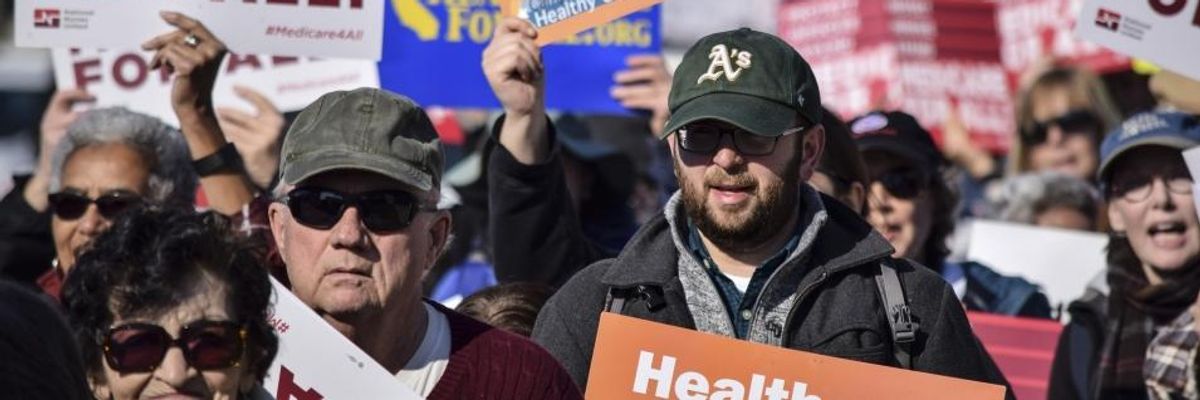
"Democratic politicians I never thought would utter the words have mentioned single-payer to me in a non-joking way of late," Len Nichols, director of the Center for Health Policy Research and Ethics at George Mason University. (Photo: ufcw770/Flickr/cc)
As Senate Republicans are reportedly set to introduce yet another version of their overwhelmingly despised and "deadly" healthcare plan on Thursday, Medicare for All is experiencing an unprecedented surge in support from both the grassroots and elected officials.
"People say Medicare for All is 'politically unfeasible. But the past ten years have taught us that it's politically unfeasible to aim for anything less."
--Richard Eskow, Campaign for America's FutureRecent polls have indicated that most Americans favor something like the healthcare plan Sen. Bernie Sanders (I-Vt.) proposed during his 2016 presidential campaign, despite the fact that his ideas were repeatedly denounced as "unrealistic" and "pie-in-the-sky" by politicians and major news outlets like the Washington Post.
Some notable polls include:
These numbers have been seized upon by progressive groups across the country as they mobilize to ensure the death of Trumpcare, the latest Senate version of which would strip health insurance from an estimated 22 million Americans. Organizations like Our Revolution have argued that while resisting efforts to repeal Obamacare, it is crucial to articulate an inspiring and ambitious alternative.
"Healthcare is a right, not a privilege," the group stated ahead of a recent nationwide day of action. "Our country needs single-payer, Medicare for All that leaves no one out."
At the behest of the grassroots, Democratic politicians are increasingly warming to the idea as well.
As Common Dreams has reported, Rep. John Conyers' (D-Mich.) Medicare for All legislation "has now received support from more than half of the Democratic caucus, a record for the party."
"I have been introducing the Medicare for All bill every session of Congress since 2003, and I'm the longest serving member of Congress," Conyers has said. "I have never seen more enthusiasm and energy behind this issue than what I'm seeing today."
Sen. Elizabeth Warren (D-Mass.) has been the most prominent progressive to join the growing chorus in recent weeks. In an interview with the Wall Street Journal, Warren argued that single-payer is "the next step" urged Democrats to run on the issue in 2018 and 2020.
In an interview with CNN on Tuesday, Sen. Jeff Merkley (D-Ore.) noted that he is seeing support for Medicare for All even in the most conservative parts of his state.
"I've been asking each audience, I've been saying, 'How many people here 10 years ago would have supported a single-payer Medicare for All?' And it's a small number," Merkley said. "And then I ask, 'How many now?' And the hands just go up throughout the room."
"I have never seen more enthusiasm and energy behind [Medicare for All] than what I'm seeing today."
--Rep. John Conyers (D-Mich.)
Commentators have argued that all of these signs--surging poll numbers, grassroots enthusiasm, and support from elected officials--indicate that Medicare for All has rapidly transitioned from "pie-in-the-sky" to "inevitable."
A recent New York Times analysis showed why a single-payer system makes sound economic sense.
And countering those who have in recent years insisted that Medicare for All is "unrealistic" from a political standpoint, Richard Eskow, a senior fellow at Campaign for America's Future, argued that in fact "it's an easy sell: I can save you thousands of dollars a year by replacing a terrible system with a much better one."
"People say Medicare for All is 'politically unfeasible,'" Eskow added. "But the past ten years have taught us that it's politically unfeasible to aim for anything less."
Dear Common Dreams reader, It’s been nearly 30 years since I co-founded Common Dreams with my late wife, Lina Newhouser. We had the radical notion that journalism should serve the public good, not corporate profits. It was clear to us from the outset what it would take to build such a project. No paid advertisements. No corporate sponsors. No millionaire publisher telling us what to think or do. Many people said we wouldn't last a year, but we proved those doubters wrong. Together with a tremendous team of journalists and dedicated staff, we built an independent media outlet free from the constraints of profits and corporate control. Our mission has always been simple: To inform. To inspire. To ignite change for the common good. Building Common Dreams was not easy. Our survival was never guaranteed. When you take on the most powerful forces—Wall Street greed, fossil fuel industry destruction, Big Tech lobbyists, and uber-rich oligarchs who have spent billions upon billions rigging the economy and democracy in their favor—the only bulwark you have is supporters who believe in your work. But here’s the urgent message from me today. It's never been this bad out there. And it's never been this hard to keep us going. At the very moment Common Dreams is most needed, the threats we face are intensifying. We need your support now more than ever. We don't accept corporate advertising and never will. We don't have a paywall because we don't think people should be blocked from critical news based on their ability to pay. Everything we do is funded by the donations of readers like you. When everyone does the little they can afford, we are strong. But if that support retreats or dries up, so do we. Will you donate now to make sure Common Dreams not only survives but thrives? —Craig Brown, Co-founder |
As Senate Republicans are reportedly set to introduce yet another version of their overwhelmingly despised and "deadly" healthcare plan on Thursday, Medicare for All is experiencing an unprecedented surge in support from both the grassroots and elected officials.
"People say Medicare for All is 'politically unfeasible. But the past ten years have taught us that it's politically unfeasible to aim for anything less."
--Richard Eskow, Campaign for America's FutureRecent polls have indicated that most Americans favor something like the healthcare plan Sen. Bernie Sanders (I-Vt.) proposed during his 2016 presidential campaign, despite the fact that his ideas were repeatedly denounced as "unrealistic" and "pie-in-the-sky" by politicians and major news outlets like the Washington Post.
Some notable polls include:
These numbers have been seized upon by progressive groups across the country as they mobilize to ensure the death of Trumpcare, the latest Senate version of which would strip health insurance from an estimated 22 million Americans. Organizations like Our Revolution have argued that while resisting efforts to repeal Obamacare, it is crucial to articulate an inspiring and ambitious alternative.
"Healthcare is a right, not a privilege," the group stated ahead of a recent nationwide day of action. "Our country needs single-payer, Medicare for All that leaves no one out."
At the behest of the grassroots, Democratic politicians are increasingly warming to the idea as well.
As Common Dreams has reported, Rep. John Conyers' (D-Mich.) Medicare for All legislation "has now received support from more than half of the Democratic caucus, a record for the party."
"I have been introducing the Medicare for All bill every session of Congress since 2003, and I'm the longest serving member of Congress," Conyers has said. "I have never seen more enthusiasm and energy behind this issue than what I'm seeing today."
Sen. Elizabeth Warren (D-Mass.) has been the most prominent progressive to join the growing chorus in recent weeks. In an interview with the Wall Street Journal, Warren argued that single-payer is "the next step" urged Democrats to run on the issue in 2018 and 2020.
In an interview with CNN on Tuesday, Sen. Jeff Merkley (D-Ore.) noted that he is seeing support for Medicare for All even in the most conservative parts of his state.
"I've been asking each audience, I've been saying, 'How many people here 10 years ago would have supported a single-payer Medicare for All?' And it's a small number," Merkley said. "And then I ask, 'How many now?' And the hands just go up throughout the room."
"I have never seen more enthusiasm and energy behind [Medicare for All] than what I'm seeing today."
--Rep. John Conyers (D-Mich.)
Commentators have argued that all of these signs--surging poll numbers, grassroots enthusiasm, and support from elected officials--indicate that Medicare for All has rapidly transitioned from "pie-in-the-sky" to "inevitable."
A recent New York Times analysis showed why a single-payer system makes sound economic sense.
And countering those who have in recent years insisted that Medicare for All is "unrealistic" from a political standpoint, Richard Eskow, a senior fellow at Campaign for America's Future, argued that in fact "it's an easy sell: I can save you thousands of dollars a year by replacing a terrible system with a much better one."
"People say Medicare for All is 'politically unfeasible,'" Eskow added. "But the past ten years have taught us that it's politically unfeasible to aim for anything less."
As Senate Republicans are reportedly set to introduce yet another version of their overwhelmingly despised and "deadly" healthcare plan on Thursday, Medicare for All is experiencing an unprecedented surge in support from both the grassroots and elected officials.
"People say Medicare for All is 'politically unfeasible. But the past ten years have taught us that it's politically unfeasible to aim for anything less."
--Richard Eskow, Campaign for America's FutureRecent polls have indicated that most Americans favor something like the healthcare plan Sen. Bernie Sanders (I-Vt.) proposed during his 2016 presidential campaign, despite the fact that his ideas were repeatedly denounced as "unrealistic" and "pie-in-the-sky" by politicians and major news outlets like the Washington Post.
Some notable polls include:
These numbers have been seized upon by progressive groups across the country as they mobilize to ensure the death of Trumpcare, the latest Senate version of which would strip health insurance from an estimated 22 million Americans. Organizations like Our Revolution have argued that while resisting efforts to repeal Obamacare, it is crucial to articulate an inspiring and ambitious alternative.
"Healthcare is a right, not a privilege," the group stated ahead of a recent nationwide day of action. "Our country needs single-payer, Medicare for All that leaves no one out."
At the behest of the grassroots, Democratic politicians are increasingly warming to the idea as well.
As Common Dreams has reported, Rep. John Conyers' (D-Mich.) Medicare for All legislation "has now received support from more than half of the Democratic caucus, a record for the party."
"I have been introducing the Medicare for All bill every session of Congress since 2003, and I'm the longest serving member of Congress," Conyers has said. "I have never seen more enthusiasm and energy behind this issue than what I'm seeing today."
Sen. Elizabeth Warren (D-Mass.) has been the most prominent progressive to join the growing chorus in recent weeks. In an interview with the Wall Street Journal, Warren argued that single-payer is "the next step" urged Democrats to run on the issue in 2018 and 2020.
In an interview with CNN on Tuesday, Sen. Jeff Merkley (D-Ore.) noted that he is seeing support for Medicare for All even in the most conservative parts of his state.
"I've been asking each audience, I've been saying, 'How many people here 10 years ago would have supported a single-payer Medicare for All?' And it's a small number," Merkley said. "And then I ask, 'How many now?' And the hands just go up throughout the room."
"I have never seen more enthusiasm and energy behind [Medicare for All] than what I'm seeing today."
--Rep. John Conyers (D-Mich.)
Commentators have argued that all of these signs--surging poll numbers, grassroots enthusiasm, and support from elected officials--indicate that Medicare for All has rapidly transitioned from "pie-in-the-sky" to "inevitable."
A recent New York Times analysis showed why a single-payer system makes sound economic sense.
And countering those who have in recent years insisted that Medicare for All is "unrealistic" from a political standpoint, Richard Eskow, a senior fellow at Campaign for America's Future, argued that in fact "it's an easy sell: I can save you thousands of dollars a year by replacing a terrible system with a much better one."
"People say Medicare for All is 'politically unfeasible,'" Eskow added. "But the past ten years have taught us that it's politically unfeasible to aim for anything less."