SUBSCRIBE TO OUR FREE NEWSLETTER
Daily news & progressive opinion—funded by the people, not the corporations—delivered straight to your inbox.
5
#000000
#FFFFFF
To donate by check, phone, or other method, see our More Ways to Give page.
Daily news & progressive opinion—funded by the people, not the corporations—delivered straight to your inbox.
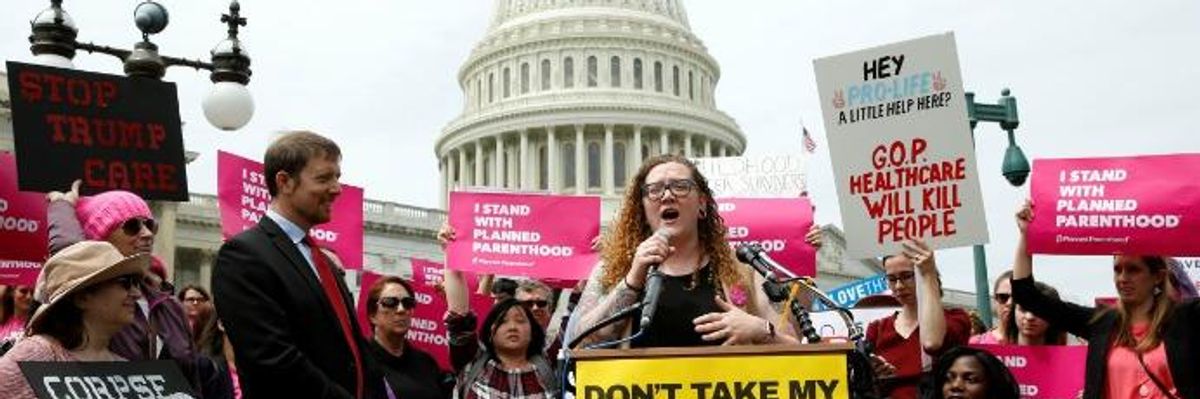
"By a 3-to-1 margin, the American public holds a negative view of the American Health Care Act," NBC's Mark Murray observed. (Photo: Yuri Gripas/Reuters)
Just following the release of the Senate's "morally bankrupt" healthcare bill--which would impose deep cuts to Medicaid, eliminate funding for Planned Parenthood, and give enormous tax breaks to the wealthy--an NBC News/Wall Street Journal poll published on Thursday found Americans "overwhelmingly" dislike the House version of the legislation.
"The bottom line is that Americans don't support this bill. It is irredeemable and unfixable."
--Angel Padilla, policy director for Indivisible
"By a 3-to-1 margin, the American public holds a negative view of the American Health Care Act, legislation that House Republicans passed last month and that President Donald Trump supports," NBC's Mark Murray observed. "Just 16 percent of adults believe that House health care bill is a good idea, versus 48 percent who say it's a bad idea."
In addition, the poll found that a mere 34 percent of Republicans view the House plan favorably.
Given the similarities between the two bills, the numbers appear to bode poorly for Senate Majority Leader Mitch McConnell (R-Ky.), who hopes to bring his measure--the Better Care Reconciliation Act--to the floor for a vote next week.
The fierce and persistent backlash against GOP attempts to repeal and replace Obamacare has given many Republicans pause, as they consider the electoral risks of backing legislation that could kick tens of millions off their insurance.
Resistance groups have moved in recent weeks to take advantage of this hesitance. UltraViolet has organized sit-ins at the offices of vulnerable senators; Indivisible launched the Trumpcare Ten initiative, which highlights lawmakers who could potentially defect from the Republican Party given enough grassroots pressure.
Sen. Rob Portman (R-Ohio) experienced that pressure firsthand on Wednesday, as his "usually quiet" constituent coffee meeting was turned into a mini town hall, with angry Ohioans peppering him with questions about his healthcare stance. Portman has been one of several Republican senators to worry publicly about the draconian cuts the bill would impose on crucial programs, including ones designed to help those addicted to opioids.
Now that the Senate bill is public, groups are looking to ramp up their efforts to force the handful of defections needed to prevent the measure's passage. As the Senate's Trumpcare bill was making the rounds, protesters, including many in wheelchairs, were being arrested after staging a protest outside of Sen. McConnell's office.
"The bottom line is that Americans don't support this bill. It is irredeemable and unfixable," said Indivisible policy director Angel Padilla in a statement. "If the well-being of their constituents is every senator's priority, no senator should vote for this bill, period."
Indivisible co-executive directors Ezra Levin and Leah Greenberg layed out an action plan on Thursday for those looking to get involved.
"We've got three ways to fight back," they wrote:
Dear Common Dreams reader, It’s been nearly 30 years since I co-founded Common Dreams with my late wife, Lina Newhouser. We had the radical notion that journalism should serve the public good, not corporate profits. It was clear to us from the outset what it would take to build such a project. No paid advertisements. No corporate sponsors. No millionaire publisher telling us what to think or do. Many people said we wouldn't last a year, but we proved those doubters wrong. Together with a tremendous team of journalists and dedicated staff, we built an independent media outlet free from the constraints of profits and corporate control. Our mission has always been simple: To inform. To inspire. To ignite change for the common good. Building Common Dreams was not easy. Our survival was never guaranteed. When you take on the most powerful forces—Wall Street greed, fossil fuel industry destruction, Big Tech lobbyists, and uber-rich oligarchs who have spent billions upon billions rigging the economy and democracy in their favor—the only bulwark you have is supporters who believe in your work. But here’s the urgent message from me today. It's never been this bad out there. And it's never been this hard to keep us going. At the very moment Common Dreams is most needed, the threats we face are intensifying. We need your support now more than ever. We don't accept corporate advertising and never will. We don't have a paywall because we don't think people should be blocked from critical news based on their ability to pay. Everything we do is funded by the donations of readers like you. When everyone does the little they can afford, we are strong. But if that support retreats or dries up, so do we. Will you donate now to make sure Common Dreams not only survives but thrives? —Craig Brown, Co-founder |
Just following the release of the Senate's "morally bankrupt" healthcare bill--which would impose deep cuts to Medicaid, eliminate funding for Planned Parenthood, and give enormous tax breaks to the wealthy--an NBC News/Wall Street Journal poll published on Thursday found Americans "overwhelmingly" dislike the House version of the legislation.
"The bottom line is that Americans don't support this bill. It is irredeemable and unfixable."
--Angel Padilla, policy director for Indivisible
"By a 3-to-1 margin, the American public holds a negative view of the American Health Care Act, legislation that House Republicans passed last month and that President Donald Trump supports," NBC's Mark Murray observed. "Just 16 percent of adults believe that House health care bill is a good idea, versus 48 percent who say it's a bad idea."
In addition, the poll found that a mere 34 percent of Republicans view the House plan favorably.
Given the similarities between the two bills, the numbers appear to bode poorly for Senate Majority Leader Mitch McConnell (R-Ky.), who hopes to bring his measure--the Better Care Reconciliation Act--to the floor for a vote next week.
The fierce and persistent backlash against GOP attempts to repeal and replace Obamacare has given many Republicans pause, as they consider the electoral risks of backing legislation that could kick tens of millions off their insurance.
Resistance groups have moved in recent weeks to take advantage of this hesitance. UltraViolet has organized sit-ins at the offices of vulnerable senators; Indivisible launched the Trumpcare Ten initiative, which highlights lawmakers who could potentially defect from the Republican Party given enough grassroots pressure.
Sen. Rob Portman (R-Ohio) experienced that pressure firsthand on Wednesday, as his "usually quiet" constituent coffee meeting was turned into a mini town hall, with angry Ohioans peppering him with questions about his healthcare stance. Portman has been one of several Republican senators to worry publicly about the draconian cuts the bill would impose on crucial programs, including ones designed to help those addicted to opioids.
Now that the Senate bill is public, groups are looking to ramp up their efforts to force the handful of defections needed to prevent the measure's passage. As the Senate's Trumpcare bill was making the rounds, protesters, including many in wheelchairs, were being arrested after staging a protest outside of Sen. McConnell's office.
"The bottom line is that Americans don't support this bill. It is irredeemable and unfixable," said Indivisible policy director Angel Padilla in a statement. "If the well-being of their constituents is every senator's priority, no senator should vote for this bill, period."
Indivisible co-executive directors Ezra Levin and Leah Greenberg layed out an action plan on Thursday for those looking to get involved.
"We've got three ways to fight back," they wrote:
Just following the release of the Senate's "morally bankrupt" healthcare bill--which would impose deep cuts to Medicaid, eliminate funding for Planned Parenthood, and give enormous tax breaks to the wealthy--an NBC News/Wall Street Journal poll published on Thursday found Americans "overwhelmingly" dislike the House version of the legislation.
"The bottom line is that Americans don't support this bill. It is irredeemable and unfixable."
--Angel Padilla, policy director for Indivisible
"By a 3-to-1 margin, the American public holds a negative view of the American Health Care Act, legislation that House Republicans passed last month and that President Donald Trump supports," NBC's Mark Murray observed. "Just 16 percent of adults believe that House health care bill is a good idea, versus 48 percent who say it's a bad idea."
In addition, the poll found that a mere 34 percent of Republicans view the House plan favorably.
Given the similarities between the two bills, the numbers appear to bode poorly for Senate Majority Leader Mitch McConnell (R-Ky.), who hopes to bring his measure--the Better Care Reconciliation Act--to the floor for a vote next week.
The fierce and persistent backlash against GOP attempts to repeal and replace Obamacare has given many Republicans pause, as they consider the electoral risks of backing legislation that could kick tens of millions off their insurance.
Resistance groups have moved in recent weeks to take advantage of this hesitance. UltraViolet has organized sit-ins at the offices of vulnerable senators; Indivisible launched the Trumpcare Ten initiative, which highlights lawmakers who could potentially defect from the Republican Party given enough grassroots pressure.
Sen. Rob Portman (R-Ohio) experienced that pressure firsthand on Wednesday, as his "usually quiet" constituent coffee meeting was turned into a mini town hall, with angry Ohioans peppering him with questions about his healthcare stance. Portman has been one of several Republican senators to worry publicly about the draconian cuts the bill would impose on crucial programs, including ones designed to help those addicted to opioids.
Now that the Senate bill is public, groups are looking to ramp up their efforts to force the handful of defections needed to prevent the measure's passage. As the Senate's Trumpcare bill was making the rounds, protesters, including many in wheelchairs, were being arrested after staging a protest outside of Sen. McConnell's office.
"The bottom line is that Americans don't support this bill. It is irredeemable and unfixable," said Indivisible policy director Angel Padilla in a statement. "If the well-being of their constituents is every senator's priority, no senator should vote for this bill, period."
Indivisible co-executive directors Ezra Levin and Leah Greenberg layed out an action plan on Thursday for those looking to get involved.
"We've got three ways to fight back," they wrote: