SUBSCRIBE TO OUR FREE NEWSLETTER
Daily news & progressive opinion—funded by the people, not the corporations—delivered straight to your inbox.
5
#000000
#FFFFFF
To donate by check, phone, or other method, see our More Ways to Give page.
Most Americans can't stand the frontrunner of either major political party, a new NBC News/Survey Monkey poll released Tuesday has found.
Almost 60 percent of respondents said they "dislike" or "hate" Democratic presidential frontrunner Hillary Clinton, and 63 percent said the same about Republican nominee Donald Trump.
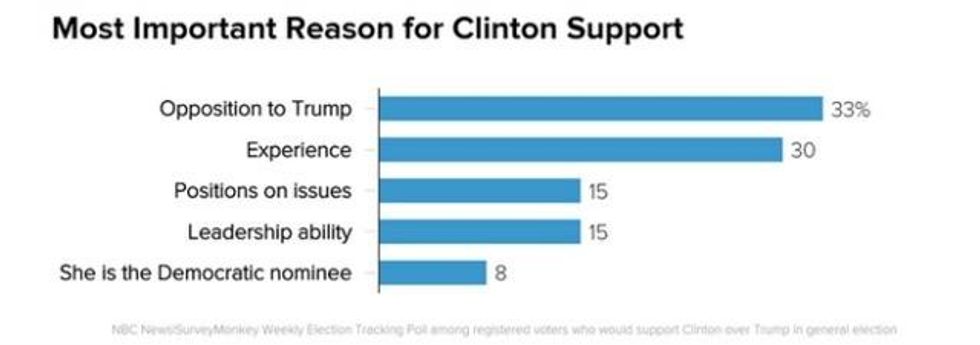
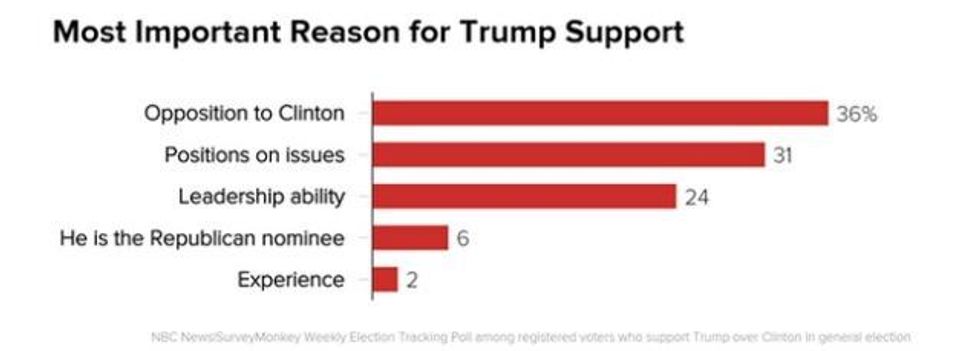
In fact, the poll found that the roughly one-third of respondents on either side of the political aisle were voting for their candidate solely to defeat the other nominee.
Such findings bolster Sanders' recent arguments that if the Democratic Party truly wishes to defeat Trump in November, the party's superdelegates should choose Sanders to be the nominee. According to all recent polling, Sanders is a far stronger candidate than Clinton against Trump--a phenomenon political observers are finding harder and harder to ignore.
Indeed, even as a national polling average shows Trump besting Clinton for the first time this week, Sanders has maintained a significant lead against the real estate mogul.
The NBC News/Survey Monkey poll follows the trend, showing Clinton beating Trump by a slim four-point margin, while Sanders wins against Trump by a full 12 points:


As Sanders said in a CNN interview on Sunday, "Virtually every poll taken in the last two months has me doing better against Trump than Hillary Clinton."
Sanders' dominance in the polls is "getting harder to overlook," notes Politico, outlining the trouble facing Clinton if she goes up against Trump in the general election:
The data remain unequivocal[...] The latest averages from HuffPost Pollster give Clinton a just less-than-2-point advantage over Trump, while Sanders--who is virtually certain to finish well behind Clinton in pledged delegates--leads Trump by 10 points. Trump has narrowed Clinton's lead by 5 points since the end of April, while he's only chipped 2 points off Sanders' edge.
Moreover, there's evidence that Clinton will face challenges uniting Democrats the way Trump has brought Republicans together since eliminating his opponents. Sanders' backers appear increasingly hostile to Clinton, polls show--especially those voters who currently favor Sanders over Trump but say they would defect to the Republican if Clinton is the Democratic nominee.
The debate isn't just academic. Part of Sanders' last-ditch argument to the unpledged superdelegates he'd need to win over to have any hope of winning the Democratic nomination is that they should consider which candidate would run best against Trump before making their choice.
"The ballot test isn't the only survey data point pointing to Sanders' strong position," notes Politico, "and the shortcomings of both Trump and Clinton. According to HuffPost Pollster, Sanders' average image rating stands at 50 percent favorable and 41 percent unfavorable. That's far better than the historically poor ratings for Trump (39 percent favorable/57 percent unfavorable) and Clinton (41 percent favorable/55 percent unfavorable)."
While Clinton and other prominent Dems argue that Clinton will be able to bring Sanders supporters into the Democratic Party fold once she clinches the nomination, "the data suggest it will be difficult for Clinton to win them over," Politico writes.
Most Americans can't stand the frontrunner of either major political party, a new NBC News/Survey Monkey poll released Tuesday has found.
Almost 60 percent of respondents said they "dislike" or "hate" Democratic presidential frontrunner Hillary Clinton, and 63 percent said the same about Republican nominee Donald Trump.
In fact, the poll found that the roughly one-third of respondents on either side of the political aisle were voting for their candidate solely to defeat the other nominee.
Such findings bolster Sanders' recent arguments that if the Democratic Party truly wishes to defeat Trump in November, the party's superdelegates should choose Sanders to be the nominee. According to all recent polling, Sanders is a far stronger candidate than Clinton against Trump--a phenomenon political observers are finding harder and harder to ignore.
Indeed, even as a national polling average shows Trump besting Clinton for the first time this week, Sanders has maintained a significant lead against the real estate mogul.
The NBC News/Survey Monkey poll follows the trend, showing Clinton beating Trump by a slim four-point margin, while Sanders wins against Trump by a full 12 points:
As Sanders said in a CNN interview on Sunday, "Virtually every poll taken in the last two months has me doing better against Trump than Hillary Clinton."
Sanders' dominance in the polls is "getting harder to overlook," notes Politico, outlining the trouble facing Clinton if she goes up against Trump in the general election:
The data remain unequivocal[...] The latest averages from HuffPost Pollster give Clinton a just less-than-2-point advantage over Trump, while Sanders--who is virtually certain to finish well behind Clinton in pledged delegates--leads Trump by 10 points. Trump has narrowed Clinton's lead by 5 points since the end of April, while he's only chipped 2 points off Sanders' edge.
Moreover, there's evidence that Clinton will face challenges uniting Democrats the way Trump has brought Republicans together since eliminating his opponents. Sanders' backers appear increasingly hostile to Clinton, polls show--especially those voters who currently favor Sanders over Trump but say they would defect to the Republican if Clinton is the Democratic nominee.
The debate isn't just academic. Part of Sanders' last-ditch argument to the unpledged superdelegates he'd need to win over to have any hope of winning the Democratic nomination is that they should consider which candidate would run best against Trump before making their choice.
"The ballot test isn't the only survey data point pointing to Sanders' strong position," notes Politico, "and the shortcomings of both Trump and Clinton. According to HuffPost Pollster, Sanders' average image rating stands at 50 percent favorable and 41 percent unfavorable. That's far better than the historically poor ratings for Trump (39 percent favorable/57 percent unfavorable) and Clinton (41 percent favorable/55 percent unfavorable)."
While Clinton and other prominent Dems argue that Clinton will be able to bring Sanders supporters into the Democratic Party fold once she clinches the nomination, "the data suggest it will be difficult for Clinton to win them over," Politico writes.
Most Americans can't stand the frontrunner of either major political party, a new NBC News/Survey Monkey poll released Tuesday has found.
Almost 60 percent of respondents said they "dislike" or "hate" Democratic presidential frontrunner Hillary Clinton, and 63 percent said the same about Republican nominee Donald Trump.
In fact, the poll found that the roughly one-third of respondents on either side of the political aisle were voting for their candidate solely to defeat the other nominee.
Such findings bolster Sanders' recent arguments that if the Democratic Party truly wishes to defeat Trump in November, the party's superdelegates should choose Sanders to be the nominee. According to all recent polling, Sanders is a far stronger candidate than Clinton against Trump--a phenomenon political observers are finding harder and harder to ignore.
Indeed, even as a national polling average shows Trump besting Clinton for the first time this week, Sanders has maintained a significant lead against the real estate mogul.
The NBC News/Survey Monkey poll follows the trend, showing Clinton beating Trump by a slim four-point margin, while Sanders wins against Trump by a full 12 points:
As Sanders said in a CNN interview on Sunday, "Virtually every poll taken in the last two months has me doing better against Trump than Hillary Clinton."
Sanders' dominance in the polls is "getting harder to overlook," notes Politico, outlining the trouble facing Clinton if she goes up against Trump in the general election:
The data remain unequivocal[...] The latest averages from HuffPost Pollster give Clinton a just less-than-2-point advantage over Trump, while Sanders--who is virtually certain to finish well behind Clinton in pledged delegates--leads Trump by 10 points. Trump has narrowed Clinton's lead by 5 points since the end of April, while he's only chipped 2 points off Sanders' edge.
Moreover, there's evidence that Clinton will face challenges uniting Democrats the way Trump has brought Republicans together since eliminating his opponents. Sanders' backers appear increasingly hostile to Clinton, polls show--especially those voters who currently favor Sanders over Trump but say they would defect to the Republican if Clinton is the Democratic nominee.
The debate isn't just academic. Part of Sanders' last-ditch argument to the unpledged superdelegates he'd need to win over to have any hope of winning the Democratic nomination is that they should consider which candidate would run best against Trump before making their choice.
"The ballot test isn't the only survey data point pointing to Sanders' strong position," notes Politico, "and the shortcomings of both Trump and Clinton. According to HuffPost Pollster, Sanders' average image rating stands at 50 percent favorable and 41 percent unfavorable. That's far better than the historically poor ratings for Trump (39 percent favorable/57 percent unfavorable) and Clinton (41 percent favorable/55 percent unfavorable)."
While Clinton and other prominent Dems argue that Clinton will be able to bring Sanders supporters into the Democratic Party fold once she clinches the nomination, "the data suggest it will be difficult for Clinton to win them over," Politico writes.