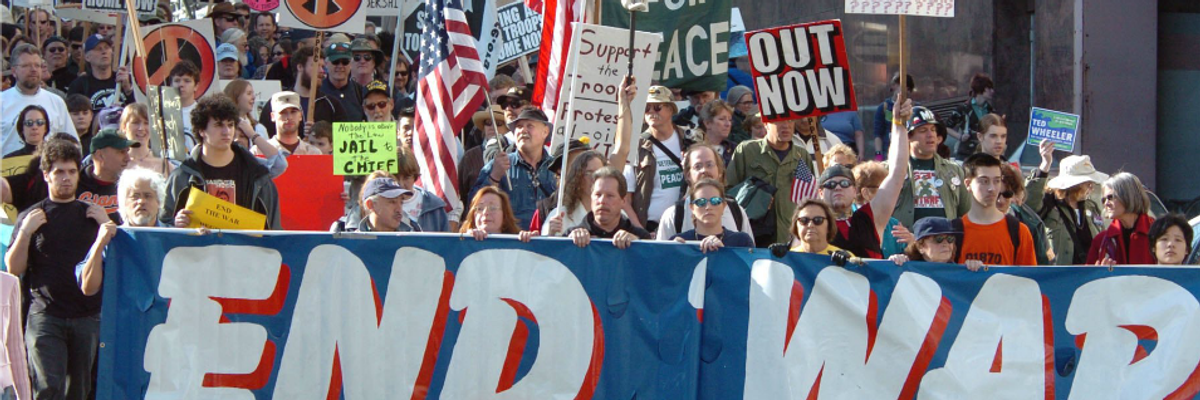
Protesters display signs as they march to mark the third anniversary of the war in Iraq March 19, 2006 in Portland, Oregon. Thousands participated in the event in Portland as demonstrators in cities across the U.S. called for an end to the conflict and withdrawal of U.S. troops. (Photo: Greg Wahl-Stephens/Getty Images)
What Happened to the Global Anti-War Movement?
The world had never seen anything like it, but where did it go?
Call it strange, but call it something. After all, never in history had there been such active opposition to a war before it began. I'm thinking, of course, about the antiwar surge that, in the winter and early spring of 2003, preceded the U.S. invasion of Iraq. Starting in the autumn of 2002, in fact, the top officials of President George W. Bush's administration couldn't have signaled more clearly that such an attack was coming. They had been ready to do so even earlier but, as White House Chief of Staff Andrew Card so classically put it, "From a marketing point of view, you don't introduce new products in August."
In the months that followed, one of those "new products" would turn out to be an antiwar movement. Outraged citizens took to the streets globally by the millions and, in this country, in small towns and large cities in staggering numbers carrying handmade signs saying things like "Contain Saddam--and Bush," "Remember when presidents were smart and bombs were dumb?," and "How did USA's oil get under Iraq's sand?" It was an unprecedented planetary movement of protest. More than a decade after the Soviet Union imploded, Patrick Tyler of the New York Times even suggested that those demonstrators might represent a second superpower. ("There may still be two superpowers on the planet: the United States and world public opinion.") And then, despite such opposition, the Bush administration launched its mission-accomplished invasion and, though in the years that followed disaster ensued, the marches died away and that antiwar movement seemed to evaporate.
Ever since, as the U.S. military intervened again and again--from Iraq to Yemen, Libya to Syria--throwing away literally trillions of dollars in the process, bombing, killing, uprooting, destroying, but never actually winning, next to no one would take to the streets in protest, no handmade signs would be made, no attention would seemingly be paid. Washington would continue to fight its endless sinkhole wars across the Greater Middle East and parts of Africa, unsettling whole swathes of the planet, with nary a peep at home.
Consider it one of the mysteries of our moment. Congress (until recently) remained supine when it came to those conflicts, while Americans basically looked the other way and went about their business as their tax dollars were squandered on a set of wars from hell. It's in this context--and that of a president who claimed he would get us out of our forever wars but only seems to keep getting us in further--that former Boston Globe columnist James Carroll, an antiwar activist (as I was) in the Vietnam era, looks back on that distant moment with a strange sense of regret (one that I deeply understand).
We are at a crossroads
This country and this world are at a monumental crossroads. In a few short weeks, US voters will have an opportunity to beat back the forces of fascism and confront the billionaires who are rigging the economy, our media system, and our democracy, making it increasingly impossible for ordinary people to get by. We’re not just talking about the election. We’re talking about what must be done once these fascist elements are vanquished from power. We need a bolder set of solutions than what either major party has so far been willing to offer and a working-class movement ready to fight like hell for it. Trump didn't emerge from nowhere. The conditions that fueled MAGA authoritarianism were created by decades of radical neoliberal economic policies and a corrupt political system dominated by corporate interests. They slashed taxes on the super-rich, promising that the benefits would trickle down. They said giveaways to the corporate titans would make life more affordable for the rest of us. It was all bullshit. And when a bitter, betrayed populace searches for someone to blame, right-wing demagogues have little trouble finding scapegoats. People know when they're being lied to, but you won't hear any of this from the corporate media. Only independent journalism—powered and funded by people who believe in building a better world—can deliver truly trustworthy daily news. Our Fall Campaign is underway, and we need your help. To power our newsroom through the rest of the year, we need to raise $125,000 by midnight on October 31. So if you share our vision, please contribute whatever you can to sustain our work. |
The above piece, published here with permission, first appeared at Tom Engelhardt's substack page, where you can find more of his writing.
Engelhardt, was editor-in-chief of TomDispatch.com for over 24 years, is the author of numerous books, including: "A Nation Unmade by War" (2018, Dispatch Books), "Shadow Government: Surveillance, Secret Wars, and a Global Security State in a Single-Superpower World" (2014, with an introduction by Glenn Greenwald), "Terminator Planet: The First History of Drone Warfare, 2001-2050"(co-authored with Nick Turse), "The United States of Fear" (2011), "The American Way of War: How Bush's Wars Became Obama's" (2010), and "The End of Victory Culture: a History of the Cold War and Beyond" (2007).
Call it strange, but call it something. After all, never in history had there been such active opposition to a war before it began. I'm thinking, of course, about the antiwar surge that, in the winter and early spring of 2003, preceded the U.S. invasion of Iraq. Starting in the autumn of 2002, in fact, the top officials of President George W. Bush's administration couldn't have signaled more clearly that such an attack was coming. They had been ready to do so even earlier but, as White House Chief of Staff Andrew Card so classically put it, "From a marketing point of view, you don't introduce new products in August."
In the months that followed, one of those "new products" would turn out to be an antiwar movement. Outraged citizens took to the streets globally by the millions and, in this country, in small towns and large cities in staggering numbers carrying handmade signs saying things like "Contain Saddam--and Bush," "Remember when presidents were smart and bombs were dumb?," and "How did USA's oil get under Iraq's sand?" It was an unprecedented planetary movement of protest. More than a decade after the Soviet Union imploded, Patrick Tyler of the New York Times even suggested that those demonstrators might represent a second superpower. ("There may still be two superpowers on the planet: the United States and world public opinion.") And then, despite such opposition, the Bush administration launched its mission-accomplished invasion and, though in the years that followed disaster ensued, the marches died away and that antiwar movement seemed to evaporate.
Ever since, as the U.S. military intervened again and again--from Iraq to Yemen, Libya to Syria--throwing away literally trillions of dollars in the process, bombing, killing, uprooting, destroying, but never actually winning, next to no one would take to the streets in protest, no handmade signs would be made, no attention would seemingly be paid. Washington would continue to fight its endless sinkhole wars across the Greater Middle East and parts of Africa, unsettling whole swathes of the planet, with nary a peep at home.
Consider it one of the mysteries of our moment. Congress (until recently) remained supine when it came to those conflicts, while Americans basically looked the other way and went about their business as their tax dollars were squandered on a set of wars from hell. It's in this context--and that of a president who claimed he would get us out of our forever wars but only seems to keep getting us in further--that former Boston Globe columnist James Carroll, an antiwar activist (as I was) in the Vietnam era, looks back on that distant moment with a strange sense of regret (one that I deeply understand).
The above piece, published here with permission, first appeared at Tom Engelhardt's substack page, where you can find more of his writing.
Engelhardt, was editor-in-chief of TomDispatch.com for over 24 years, is the author of numerous books, including: "A Nation Unmade by War" (2018, Dispatch Books), "Shadow Government: Surveillance, Secret Wars, and a Global Security State in a Single-Superpower World" (2014, with an introduction by Glenn Greenwald), "Terminator Planet: The First History of Drone Warfare, 2001-2050"(co-authored with Nick Turse), "The United States of Fear" (2011), "The American Way of War: How Bush's Wars Became Obama's" (2010), and "The End of Victory Culture: a History of the Cold War and Beyond" (2007).
Call it strange, but call it something. After all, never in history had there been such active opposition to a war before it began. I'm thinking, of course, about the antiwar surge that, in the winter and early spring of 2003, preceded the U.S. invasion of Iraq. Starting in the autumn of 2002, in fact, the top officials of President George W. Bush's administration couldn't have signaled more clearly that such an attack was coming. They had been ready to do so even earlier but, as White House Chief of Staff Andrew Card so classically put it, "From a marketing point of view, you don't introduce new products in August."
In the months that followed, one of those "new products" would turn out to be an antiwar movement. Outraged citizens took to the streets globally by the millions and, in this country, in small towns and large cities in staggering numbers carrying handmade signs saying things like "Contain Saddam--and Bush," "Remember when presidents were smart and bombs were dumb?," and "How did USA's oil get under Iraq's sand?" It was an unprecedented planetary movement of protest. More than a decade after the Soviet Union imploded, Patrick Tyler of the New York Times even suggested that those demonstrators might represent a second superpower. ("There may still be two superpowers on the planet: the United States and world public opinion.") And then, despite such opposition, the Bush administration launched its mission-accomplished invasion and, though in the years that followed disaster ensued, the marches died away and that antiwar movement seemed to evaporate.
Ever since, as the U.S. military intervened again and again--from Iraq to Yemen, Libya to Syria--throwing away literally trillions of dollars in the process, bombing, killing, uprooting, destroying, but never actually winning, next to no one would take to the streets in protest, no handmade signs would be made, no attention would seemingly be paid. Washington would continue to fight its endless sinkhole wars across the Greater Middle East and parts of Africa, unsettling whole swathes of the planet, with nary a peep at home.
Consider it one of the mysteries of our moment. Congress (until recently) remained supine when it came to those conflicts, while Americans basically looked the other way and went about their business as their tax dollars were squandered on a set of wars from hell. It's in this context--and that of a president who claimed he would get us out of our forever wars but only seems to keep getting us in further--that former Boston Globe columnist James Carroll, an antiwar activist (as I was) in the Vietnam era, looks back on that distant moment with a strange sense of regret (one that I deeply understand).