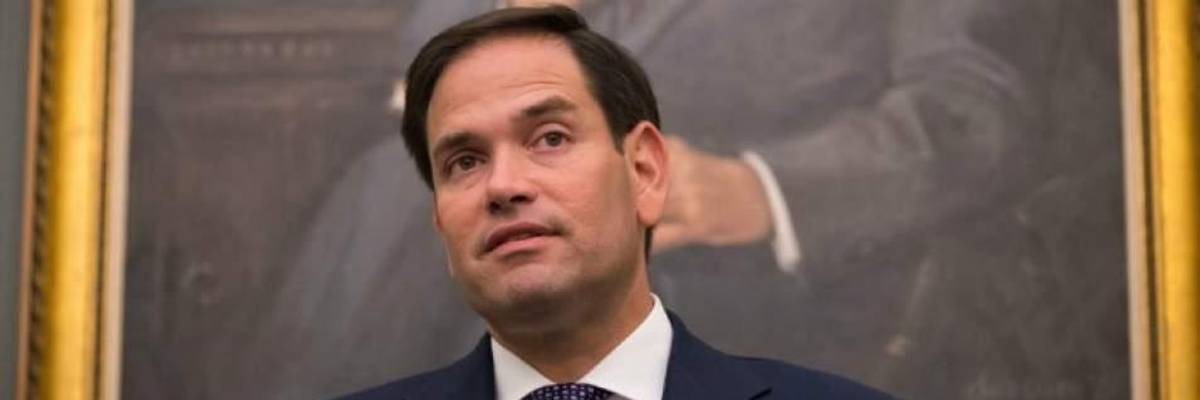
Sen. Marco Rubio (R-Fla.) takes questions from reporters about the relief effort in Puerto Rico following Hurricane Maria, September 26, 2017 at the U.S. Capitol in Washington, D.C. (Photo: Drew Angerer/Getty Images)
Marco Rubio and His Colleagues Need a Refresher on the First Amendment
Marco Rubio and his colleagues may not agree with the BDS movement, and they have a First Amendment right to express that. But public officials cannot use the power of public office to punish views they don't agree with.
This week, amid a partial government shutdown, senators tried to sneak through a bill that would encourage states to suppress constitutionally protected political boycotts of Israel.
Ultimately, the Combating BDS Act failed to make it to the Senate floor, largely because enough people exercised their First Amendment right to protest the bill and educate senators that they should get their priorities straight. But it seems that's not the only education that is in order.
The recent spate of bills that seek to penalize Israel boycotts is a bipartisan problem. Many Senate Democrats blocked the Combating BDS Act this week, rightly arguing that Congress should end the government shutdown rather than making this the first order of business of the new session. But four Senate Democrats voted to pass the bill, and many others, including Sens. Chuck Schumer (D-N.Y.) and Ben Cardin (D-Md.), have expressed support for other anti-boycott efforts, even when they have come at the expense of our constitutional rights.
This week, however, Sen. Marco Rubio (R-Fla.) led the charge, and even took to Twitter to spread a number of perplexing and often downright false statements about the First Amendment and the Combating BDS Act.
Here's what Sen. Rubio got wrong:
Fiction: Local and state governments should be free to end contracts with companies that boycott Israel.
Senator Rubio suggested that not only should states be free to boycott the boycotters, they have the right to boycott them. That's a troubling proposition, and one specifically prohibited under the Constitution.
First Amendment rights belong to the people, not the government. The government cannot impose its views on people or punish them for expressing views that the government disagrees with. This principle applies to both individuals and companies doing business with the state, and with full force to politically motivated boycotts. Two federal courts recently affirmed this, blocking laws in Arizona and Kansas that penalized individuals and companies for boycotting Israel. And this principle was famously tested in the McCarthy era, when many state laws required government employees to declare they were not members of the Communist Party or other "subversive groups" in order to keep their jobs.
The ACLU successfully challenged many of those laws on constitutional grounds -- just as it's now fighting unconstitutional state laws suppressing lawful boycotts of Israel -- and anti-Communist loyalty tests have been mostly relegated to the dustbin of history. The same should happen to the laws requiring people to pledge not to boycott Israel as a condition of doing business with the government.
Fiction: The Combating BDS Act 'doesn't punish any political activity.'
That's what Sen. Rubio tweeted to his followers on January 7. Less than a day later, he tweeted that his bill "allows local & state govt's to boycott the boycotters." That, by definition, is state-sponsored punishment for a constitutionally protected activity, and it's what the First Amendment seeks to protect people from.
Representative Eliot L. Engel (D-N.Y.), told The Washington Post that he prefers another bill, the Israel Anti-Boycott Act, because, he argued, it seeks to address constitutional concerns about the Combating BDS Act. That's also false. Both bills come from the same unconstitutional playbook and make a mockery of the First Amendment. In fact, the Israel Anti-Boycott Act takes it to another level, imposing criminal penalties of up to $1 million on individuals or companies boycotting Israel or any foreign country if the boycott were called for by international governmental organizations like the United Nations. Senators Diane Feinstein (D-Calif.) and Bernie Sanders (I-Vt.) similarly expressed concerns that the bill violated the First Amendment.
Fiction: Opposing anti-BDS laws is de facto support of BDS.
Not true. The ACLU doesn't take a position on boycotts of Israel, but we have long defended the right to boycott, which is a proud part of America's constitutional tradition and protected by the First Amendment. And we're not the only ones. A number of members of Congress -- many of whom who don't take a position on the Boycott, Divestment, and Sanctions movement or have even expressed opposition to it -- have First Amendment concerns with the bill.
Whatever your views on BDS, we all should be able to agree that the government has no business telling us which causes we can or cannot support.
Marco Rubio and his colleagues may not agree with the BDS movement, and they have a First Amendment right to express that. But public officials cannot use the power of public office to punish views they don't agree with. That's the kind of authoritarian power our Constitution is meant to protect against.
Urgent. It's never been this bad.
Dear Common Dreams reader, It’s been nearly 30 years since I co-founded Common Dreams with my late wife, Lina Newhouser. We had the radical notion that journalism should serve the public good, not corporate profits. It was clear to us from the outset what it would take to build such a project. No paid advertisements. No corporate sponsors. No millionaire publisher telling us what to think or do. Many people said we wouldn't last a year, but we proved those doubters wrong. Together with a tremendous team of journalists and dedicated staff, we built an independent media outlet free from the constraints of profits and corporate control. Our mission from the outset was simple. To inform. To inspire. To ignite change for the common good. Building Common Dreams was not easy. Our survival was never guaranteed. When you take on the most powerful forces—Wall Street greed, fossil fuel industry destruction, Big Tech lobbyists, and uber-rich oligarchs who have spent billions upon billions rigging the economy and democracy in their favor—the only bulwark you have is supporters who believe in your work. But here’s the urgent message from me today. It’s never been this bad out there. And it’s never been this hard to keep us going. At the very moment Common Dreams is most needed and doing some of its best and most important work, the threats we face are intensifying. Right now, with just two days to go in our Spring Campaign, we're falling short of our make-or-break goal. When everyone does the little they can afford, we are strong. But if that support retreats or dries up, so do we. Can you make a gift right now to make sure Common Dreams not only survives but thrives? There is no backup plan or rainy day fund. There is only you. —Craig Brown, Co-founder |
This week, amid a partial government shutdown, senators tried to sneak through a bill that would encourage states to suppress constitutionally protected political boycotts of Israel.
Ultimately, the Combating BDS Act failed to make it to the Senate floor, largely because enough people exercised their First Amendment right to protest the bill and educate senators that they should get their priorities straight. But it seems that's not the only education that is in order.
The recent spate of bills that seek to penalize Israel boycotts is a bipartisan problem. Many Senate Democrats blocked the Combating BDS Act this week, rightly arguing that Congress should end the government shutdown rather than making this the first order of business of the new session. But four Senate Democrats voted to pass the bill, and many others, including Sens. Chuck Schumer (D-N.Y.) and Ben Cardin (D-Md.), have expressed support for other anti-boycott efforts, even when they have come at the expense of our constitutional rights.
This week, however, Sen. Marco Rubio (R-Fla.) led the charge, and even took to Twitter to spread a number of perplexing and often downright false statements about the First Amendment and the Combating BDS Act.
Here's what Sen. Rubio got wrong:
Fiction: Local and state governments should be free to end contracts with companies that boycott Israel.
Senator Rubio suggested that not only should states be free to boycott the boycotters, they have the right to boycott them. That's a troubling proposition, and one specifically prohibited under the Constitution.
First Amendment rights belong to the people, not the government. The government cannot impose its views on people or punish them for expressing views that the government disagrees with. This principle applies to both individuals and companies doing business with the state, and with full force to politically motivated boycotts. Two federal courts recently affirmed this, blocking laws in Arizona and Kansas that penalized individuals and companies for boycotting Israel. And this principle was famously tested in the McCarthy era, when many state laws required government employees to declare they were not members of the Communist Party or other "subversive groups" in order to keep their jobs.
The ACLU successfully challenged many of those laws on constitutional grounds -- just as it's now fighting unconstitutional state laws suppressing lawful boycotts of Israel -- and anti-Communist loyalty tests have been mostly relegated to the dustbin of history. The same should happen to the laws requiring people to pledge not to boycott Israel as a condition of doing business with the government.
Fiction: The Combating BDS Act 'doesn't punish any political activity.'
That's what Sen. Rubio tweeted to his followers on January 7. Less than a day later, he tweeted that his bill "allows local & state govt's to boycott the boycotters." That, by definition, is state-sponsored punishment for a constitutionally protected activity, and it's what the First Amendment seeks to protect people from.
Representative Eliot L. Engel (D-N.Y.), told The Washington Post that he prefers another bill, the Israel Anti-Boycott Act, because, he argued, it seeks to address constitutional concerns about the Combating BDS Act. That's also false. Both bills come from the same unconstitutional playbook and make a mockery of the First Amendment. In fact, the Israel Anti-Boycott Act takes it to another level, imposing criminal penalties of up to $1 million on individuals or companies boycotting Israel or any foreign country if the boycott were called for by international governmental organizations like the United Nations. Senators Diane Feinstein (D-Calif.) and Bernie Sanders (I-Vt.) similarly expressed concerns that the bill violated the First Amendment.
Fiction: Opposing anti-BDS laws is de facto support of BDS.
Not true. The ACLU doesn't take a position on boycotts of Israel, but we have long defended the right to boycott, which is a proud part of America's constitutional tradition and protected by the First Amendment. And we're not the only ones. A number of members of Congress -- many of whom who don't take a position on the Boycott, Divestment, and Sanctions movement or have even expressed opposition to it -- have First Amendment concerns with the bill.
Whatever your views on BDS, we all should be able to agree that the government has no business telling us which causes we can or cannot support.
Marco Rubio and his colleagues may not agree with the BDS movement, and they have a First Amendment right to express that. But public officials cannot use the power of public office to punish views they don't agree with. That's the kind of authoritarian power our Constitution is meant to protect against.
This week, amid a partial government shutdown, senators tried to sneak through a bill that would encourage states to suppress constitutionally protected political boycotts of Israel.
Ultimately, the Combating BDS Act failed to make it to the Senate floor, largely because enough people exercised their First Amendment right to protest the bill and educate senators that they should get their priorities straight. But it seems that's not the only education that is in order.
The recent spate of bills that seek to penalize Israel boycotts is a bipartisan problem. Many Senate Democrats blocked the Combating BDS Act this week, rightly arguing that Congress should end the government shutdown rather than making this the first order of business of the new session. But four Senate Democrats voted to pass the bill, and many others, including Sens. Chuck Schumer (D-N.Y.) and Ben Cardin (D-Md.), have expressed support for other anti-boycott efforts, even when they have come at the expense of our constitutional rights.
This week, however, Sen. Marco Rubio (R-Fla.) led the charge, and even took to Twitter to spread a number of perplexing and often downright false statements about the First Amendment and the Combating BDS Act.
Here's what Sen. Rubio got wrong:
Fiction: Local and state governments should be free to end contracts with companies that boycott Israel.
Senator Rubio suggested that not only should states be free to boycott the boycotters, they have the right to boycott them. That's a troubling proposition, and one specifically prohibited under the Constitution.
First Amendment rights belong to the people, not the government. The government cannot impose its views on people or punish them for expressing views that the government disagrees with. This principle applies to both individuals and companies doing business with the state, and with full force to politically motivated boycotts. Two federal courts recently affirmed this, blocking laws in Arizona and Kansas that penalized individuals and companies for boycotting Israel. And this principle was famously tested in the McCarthy era, when many state laws required government employees to declare they were not members of the Communist Party or other "subversive groups" in order to keep their jobs.
The ACLU successfully challenged many of those laws on constitutional grounds -- just as it's now fighting unconstitutional state laws suppressing lawful boycotts of Israel -- and anti-Communist loyalty tests have been mostly relegated to the dustbin of history. The same should happen to the laws requiring people to pledge not to boycott Israel as a condition of doing business with the government.
Fiction: The Combating BDS Act 'doesn't punish any political activity.'
That's what Sen. Rubio tweeted to his followers on January 7. Less than a day later, he tweeted that his bill "allows local & state govt's to boycott the boycotters." That, by definition, is state-sponsored punishment for a constitutionally protected activity, and it's what the First Amendment seeks to protect people from.
Representative Eliot L. Engel (D-N.Y.), told The Washington Post that he prefers another bill, the Israel Anti-Boycott Act, because, he argued, it seeks to address constitutional concerns about the Combating BDS Act. That's also false. Both bills come from the same unconstitutional playbook and make a mockery of the First Amendment. In fact, the Israel Anti-Boycott Act takes it to another level, imposing criminal penalties of up to $1 million on individuals or companies boycotting Israel or any foreign country if the boycott were called for by international governmental organizations like the United Nations. Senators Diane Feinstein (D-Calif.) and Bernie Sanders (I-Vt.) similarly expressed concerns that the bill violated the First Amendment.
Fiction: Opposing anti-BDS laws is de facto support of BDS.
Not true. The ACLU doesn't take a position on boycotts of Israel, but we have long defended the right to boycott, which is a proud part of America's constitutional tradition and protected by the First Amendment. And we're not the only ones. A number of members of Congress -- many of whom who don't take a position on the Boycott, Divestment, and Sanctions movement or have even expressed opposition to it -- have First Amendment concerns with the bill.
Whatever your views on BDS, we all should be able to agree that the government has no business telling us which causes we can or cannot support.
Marco Rubio and his colleagues may not agree with the BDS movement, and they have a First Amendment right to express that. But public officials cannot use the power of public office to punish views they don't agree with. That's the kind of authoritarian power our Constitution is meant to protect against.