
US Health Care System Cartel... Until Death Us Do Part
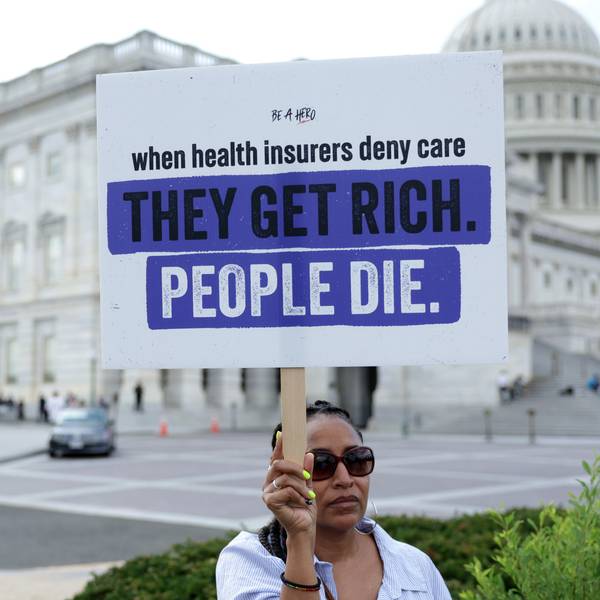
One common definition of a cartel is: an association of manufacturers or suppliers with the purpose of maintaining prices at a high level and restricting competition. Or if you prefer this definition from Merriam-Webster, here you go: car-tel, noun: a group of businesses that agree to fix prices so they all will make more money. I think that pretty much sums up what the U.S. health care system has become.
One common definition of a cartel is: an association of manufacturers or suppliers with the purpose of maintaining prices at a high level and restricting competition. Or if you prefer this definition from Merriam-Webster, here you go: car-tel, noun: a group of businesses that agree to fix prices so they all will make more money. I think that pretty much sums up what the U.S. health care system has become.
If you doubt that collusion exists in the provision of health care in the profit-driven U.S. health care system, please think again. Why and how would all the health insurance prices, drug prices, and sometimes the provider charges and practices all end up being within a small window of pricing and policy? (Oh, and the definition of collusion? Here you go: collusion is a secret cooperation for an illegal or dishonest purpose.) You may try to cite some economic factoring and actuarial analysis as the reasoning behind the pricing, but then how do the profits all balloon to such grotesque levels, too, if not through price fixing and the collusion of the industry to hang as tightly together on the cartel agreements as they possibly can?
As a patient, as a policy holder, and as a caregiver to another patient, I have grown so weary of needing to play my part in the profit-taking every time I am in need of medical help. If holistic or alternative medicine were such a great alternative for the treatment of all illness, I would have gone that route by now, but the costs and the lack of any insurance coverage for most of these alternatives makes that an impossibility even if I believe some of those treatments are really good. So, when I am sick and cannot get better on my own or when my husband is ill and cannot get better on his own, we are at the mercy of the health care cartel.
I often wonder why all this collusion is allowable when the U.S. Justice Department says it isn't legal in the U.S. Check it out, from the U.S. government: When competitors collude, prices are inflated and the customer is cheated. Price fixing, bid rigging, and other forms of collusion are illegal and are subject to criminal prosecution by the Antitrust Division of the United States Department of Justice.
Those who oppose the Affordable Care Act/Obamacare might do better if they argued that the law violates Federal Anti-Trust laws. But the health industry would no doubt argue that health care is a different animal and not subject to the same rules and laws as other businesses. Health care is so co-mingled with public policy and employment law, that it can be very difficult to catch the offenders. Note that I said it would be difficult--not impossible--to prove that health industry professional associations provide the perfect cover for cartel agreements.
One thing that interests me is that within the definition of collusion there is a notation that fixing credit terms and the lack of open advertising of pricing often can be signals of such illegal activity. So far in my life as a patient, I have found the fixing of credit terms and the lack of openly advertised prices to be the norm throughout the health care system. And to ask questions or question policy is so frowned upon that a patient or caregiver must be willing to risk being "fired" as a patient on the spot for being so insolent as to ask such questions.
If we had an improved and expanded Medicare-for-all for life system, financed through a public, single-payer model, our system would be just that--our health care system. We would be the ones making sure that good health care access and fairly negotiated pricing was done in the best interests of us all. Until then, we are at the mercy of the health care cartel that is so powerful that it currently controls almost one-fifth of the U.S. economy. As a good friend once said, "The profits are dear." Do you really think this industry could possibly be this profitable while also failing to perform well and not be cartel-controlled?
An Urgent Message From Our Co-Founder
Dear Common Dreams reader, It’s been nearly 30 years since I co-founded Common Dreams with my late wife, Lina Newhouser. We had the radical notion that journalism should serve the public good, not corporate profits. It was clear to us from the outset what it would take to build such a project. No paid advertisements. No corporate sponsors. No millionaire publisher telling us what to think or do. Many people said we wouldn't last a year, but we proved those doubters wrong. Together with a tremendous team of journalists and dedicated staff, we built an independent media outlet free from the constraints of profits and corporate control. Our mission has always been simple: To inform. To inspire. To ignite change for the common good. Building Common Dreams was not easy. Our survival was never guaranteed. When you take on the most powerful forces—Wall Street greed, fossil fuel industry destruction, Big Tech lobbyists, and uber-rich oligarchs who have spent billions upon billions rigging the economy and democracy in their favor—the only bulwark you have is supporters who believe in your work. But here’s the urgent message from me today. It's never been this bad out there. And it's never been this hard to keep us going. At the very moment Common Dreams is most needed, the threats we face are intensifying. We need your support now more than ever. We don't accept corporate advertising and never will. We don't have a paywall because we don't think people should be blocked from critical news based on their ability to pay. Everything we do is funded by the donations of readers like you. When everyone does the little they can afford, we are strong. But if that support retreats or dries up, so do we. Will you donate now to make sure Common Dreams not only survives but thrives? —Craig Brown, Co-founder |
One common definition of a cartel is: an association of manufacturers or suppliers with the purpose of maintaining prices at a high level and restricting competition. Or if you prefer this definition from Merriam-Webster, here you go: car-tel, noun: a group of businesses that agree to fix prices so they all will make more money. I think that pretty much sums up what the U.S. health care system has become.
If you doubt that collusion exists in the provision of health care in the profit-driven U.S. health care system, please think again. Why and how would all the health insurance prices, drug prices, and sometimes the provider charges and practices all end up being within a small window of pricing and policy? (Oh, and the definition of collusion? Here you go: collusion is a secret cooperation for an illegal or dishonest purpose.) You may try to cite some economic factoring and actuarial analysis as the reasoning behind the pricing, but then how do the profits all balloon to such grotesque levels, too, if not through price fixing and the collusion of the industry to hang as tightly together on the cartel agreements as they possibly can?
As a patient, as a policy holder, and as a caregiver to another patient, I have grown so weary of needing to play my part in the profit-taking every time I am in need of medical help. If holistic or alternative medicine were such a great alternative for the treatment of all illness, I would have gone that route by now, but the costs and the lack of any insurance coverage for most of these alternatives makes that an impossibility even if I believe some of those treatments are really good. So, when I am sick and cannot get better on my own or when my husband is ill and cannot get better on his own, we are at the mercy of the health care cartel.
I often wonder why all this collusion is allowable when the U.S. Justice Department says it isn't legal in the U.S. Check it out, from the U.S. government: When competitors collude, prices are inflated and the customer is cheated. Price fixing, bid rigging, and other forms of collusion are illegal and are subject to criminal prosecution by the Antitrust Division of the United States Department of Justice.
Those who oppose the Affordable Care Act/Obamacare might do better if they argued that the law violates Federal Anti-Trust laws. But the health industry would no doubt argue that health care is a different animal and not subject to the same rules and laws as other businesses. Health care is so co-mingled with public policy and employment law, that it can be very difficult to catch the offenders. Note that I said it would be difficult--not impossible--to prove that health industry professional associations provide the perfect cover for cartel agreements.
One thing that interests me is that within the definition of collusion there is a notation that fixing credit terms and the lack of open advertising of pricing often can be signals of such illegal activity. So far in my life as a patient, I have found the fixing of credit terms and the lack of openly advertised prices to be the norm throughout the health care system. And to ask questions or question policy is so frowned upon that a patient or caregiver must be willing to risk being "fired" as a patient on the spot for being so insolent as to ask such questions.
If we had an improved and expanded Medicare-for-all for life system, financed through a public, single-payer model, our system would be just that--our health care system. We would be the ones making sure that good health care access and fairly negotiated pricing was done in the best interests of us all. Until then, we are at the mercy of the health care cartel that is so powerful that it currently controls almost one-fifth of the U.S. economy. As a good friend once said, "The profits are dear." Do you really think this industry could possibly be this profitable while also failing to perform well and not be cartel-controlled?
One common definition of a cartel is: an association of manufacturers or suppliers with the purpose of maintaining prices at a high level and restricting competition. Or if you prefer this definition from Merriam-Webster, here you go: car-tel, noun: a group of businesses that agree to fix prices so they all will make more money. I think that pretty much sums up what the U.S. health care system has become.
If you doubt that collusion exists in the provision of health care in the profit-driven U.S. health care system, please think again. Why and how would all the health insurance prices, drug prices, and sometimes the provider charges and practices all end up being within a small window of pricing and policy? (Oh, and the definition of collusion? Here you go: collusion is a secret cooperation for an illegal or dishonest purpose.) You may try to cite some economic factoring and actuarial analysis as the reasoning behind the pricing, but then how do the profits all balloon to such grotesque levels, too, if not through price fixing and the collusion of the industry to hang as tightly together on the cartel agreements as they possibly can?
As a patient, as a policy holder, and as a caregiver to another patient, I have grown so weary of needing to play my part in the profit-taking every time I am in need of medical help. If holistic or alternative medicine were such a great alternative for the treatment of all illness, I would have gone that route by now, but the costs and the lack of any insurance coverage for most of these alternatives makes that an impossibility even if I believe some of those treatments are really good. So, when I am sick and cannot get better on my own or when my husband is ill and cannot get better on his own, we are at the mercy of the health care cartel.
I often wonder why all this collusion is allowable when the U.S. Justice Department says it isn't legal in the U.S. Check it out, from the U.S. government: When competitors collude, prices are inflated and the customer is cheated. Price fixing, bid rigging, and other forms of collusion are illegal and are subject to criminal prosecution by the Antitrust Division of the United States Department of Justice.
Those who oppose the Affordable Care Act/Obamacare might do better if they argued that the law violates Federal Anti-Trust laws. But the health industry would no doubt argue that health care is a different animal and not subject to the same rules and laws as other businesses. Health care is so co-mingled with public policy and employment law, that it can be very difficult to catch the offenders. Note that I said it would be difficult--not impossible--to prove that health industry professional associations provide the perfect cover for cartel agreements.
One thing that interests me is that within the definition of collusion there is a notation that fixing credit terms and the lack of open advertising of pricing often can be signals of such illegal activity. So far in my life as a patient, I have found the fixing of credit terms and the lack of openly advertised prices to be the norm throughout the health care system. And to ask questions or question policy is so frowned upon that a patient or caregiver must be willing to risk being "fired" as a patient on the spot for being so insolent as to ask such questions.
If we had an improved and expanded Medicare-for-all for life system, financed through a public, single-payer model, our system would be just that--our health care system. We would be the ones making sure that good health care access and fairly negotiated pricing was done in the best interests of us all. Until then, we are at the mercy of the health care cartel that is so powerful that it currently controls almost one-fifth of the U.S. economy. As a good friend once said, "The profits are dear." Do you really think this industry could possibly be this profitable while also failing to perform well and not be cartel-controlled?