SUBSCRIBE TO OUR FREE NEWSLETTER
Daily news & progressive opinion—funded by the people, not the corporations—delivered straight to your inbox.
5
#000000
#FFFFFF
To donate by check, phone, or other method, see our More Ways to Give page.
President Obama speaking in Berlin on Wednesday took the first step in his 2nd term to address the world's nuclear arsenals. He proposed negotiating the reduction of strategic nuclear weapons by up to 1/3 of its current levels of 1722 as of Sept. 2012 and reducing nuclear weapons in Europe. While any reductions in nuclear arsenals must be applauded and supported, they must be viewed as only the next step in the mandatory elimination of all nuclear weapons. The devastating potential of these reduced arsenals has the ability to inflict catastrophic damage to our world. There is no "acceptable" level of nuclear weapons that is consistent with the ultimate survival of civilization.
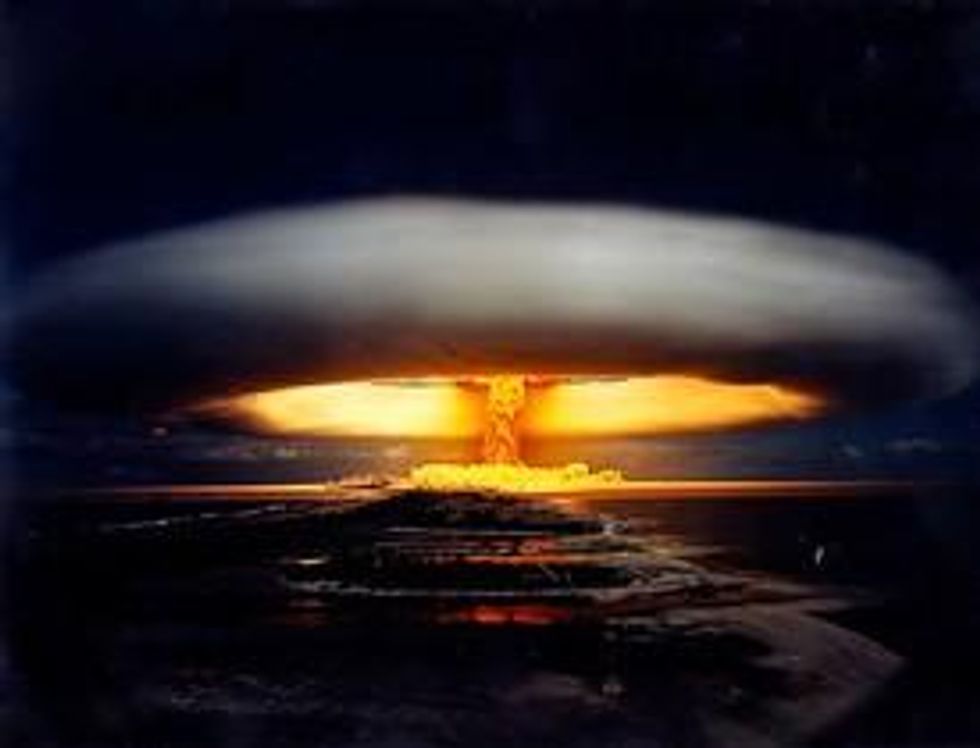
In addition, the entire economic infrastructure on which we depend to sustain our population would be destroyed. The transportation system, the communications network, the public health and banking systems, the food distribution network -- all would be gone. In the months after this war, it is probable that the vast majority of the American population who were not killed in the initial attack would die of starvation, exposure, epidemic disease and radiation poisoning.
The global impact of a nuclear war with the reduced number of weapons proposed by the President was defined in a recent study by Robock, Oman and Stenchikov demonstrating catastrophic climate change due to the release of an estimated 50-100 million tons of soot into the upper atmosphere blocking the sun. This would cause severe drops in global temperatures in a matter of days of up to 36 degrees Fahrenheit (20 degrees Centigrade) devastating agriculture production throughout the world. The ensuing global famine could result in the death of a majority of the human population.
While any reduction in nuclear weapons is an important step to securing our future and we must move to realize these reductions now, ZERO is the only acceptable number. In congress California Representatives, Rep. John Garamendi and Rep. Loretta Sanchez, worked diligently over the past few weeks to curb Congress' excessive spending on new nuclear weapon projects. Now, the issue is moving to the U.S. Senate and Sens. Barbara Boxer and Dianne Feinstein will play a key role in ensuring our taxpayer dollars are not wasted on these relics of the Cold War but rather directed to our real human needs.
Each day that we fail to work toward this goal is one day closer to realizing Albert Einstein's prophecy at the dawn of the nuclear age. "With the unleashed power of the atom, we thus drift toward unparalleled catastrophe unless we change the way we think".
But we can't stop there. This effort must lead to multilateral negotiations involving all nuclear weapons states, negotiations that will produce a nuclear weapons convention banning these weapons once and for all. These negotiations will not be easy, and the treaty they produce will have to be a hard-nosed agreement that establishes mechanisms to verify and enforce compliance. But we don't have an alternative.
Some say it is unrealistic to think we can eliminate nuclear weapons. But in truth, it is unrealistic to think we can maintain nuclear arsenals indefinitely and still avoid a nuclear conflict. These are critical unexamined assumptions that demand reevaluation.
As long as nuclear weapons exist we face a real and imminent danger of catastrophe either by design or accident. It is a matter of shear luck that we survive. Luck is not a viable security policy. We owe it to our children and future generations to abolish all nuclear weapons. The time to act is now.
President Obama speaking in Berlin on Wednesday took the first step in his 2nd term to address the world's nuclear arsenals. He proposed negotiating the reduction of strategic nuclear weapons by up to 1/3 of its current levels of 1722 as of Sept. 2012 and reducing nuclear weapons in Europe. While any reductions in nuclear arsenals must be applauded and supported, they must be viewed as only the next step in the mandatory elimination of all nuclear weapons. The devastating potential of these reduced arsenals has the ability to inflict catastrophic damage to our world. There is no "acceptable" level of nuclear weapons that is consistent with the ultimate survival of civilization.
In addition, the entire economic infrastructure on which we depend to sustain our population would be destroyed. The transportation system, the communications network, the public health and banking systems, the food distribution network -- all would be gone. In the months after this war, it is probable that the vast majority of the American population who were not killed in the initial attack would die of starvation, exposure, epidemic disease and radiation poisoning.
The global impact of a nuclear war with the reduced number of weapons proposed by the President was defined in a recent study by Robock, Oman and Stenchikov demonstrating catastrophic climate change due to the release of an estimated 50-100 million tons of soot into the upper atmosphere blocking the sun. This would cause severe drops in global temperatures in a matter of days of up to 36 degrees Fahrenheit (20 degrees Centigrade) devastating agriculture production throughout the world. The ensuing global famine could result in the death of a majority of the human population.
While any reduction in nuclear weapons is an important step to securing our future and we must move to realize these reductions now, ZERO is the only acceptable number. In congress California Representatives, Rep. John Garamendi and Rep. Loretta Sanchez, worked diligently over the past few weeks to curb Congress' excessive spending on new nuclear weapon projects. Now, the issue is moving to the U.S. Senate and Sens. Barbara Boxer and Dianne Feinstein will play a key role in ensuring our taxpayer dollars are not wasted on these relics of the Cold War but rather directed to our real human needs.
Each day that we fail to work toward this goal is one day closer to realizing Albert Einstein's prophecy at the dawn of the nuclear age. "With the unleashed power of the atom, we thus drift toward unparalleled catastrophe unless we change the way we think".
But we can't stop there. This effort must lead to multilateral negotiations involving all nuclear weapons states, negotiations that will produce a nuclear weapons convention banning these weapons once and for all. These negotiations will not be easy, and the treaty they produce will have to be a hard-nosed agreement that establishes mechanisms to verify and enforce compliance. But we don't have an alternative.
Some say it is unrealistic to think we can eliminate nuclear weapons. But in truth, it is unrealistic to think we can maintain nuclear arsenals indefinitely and still avoid a nuclear conflict. These are critical unexamined assumptions that demand reevaluation.
As long as nuclear weapons exist we face a real and imminent danger of catastrophe either by design or accident. It is a matter of shear luck that we survive. Luck is not a viable security policy. We owe it to our children and future generations to abolish all nuclear weapons. The time to act is now.
President Obama speaking in Berlin on Wednesday took the first step in his 2nd term to address the world's nuclear arsenals. He proposed negotiating the reduction of strategic nuclear weapons by up to 1/3 of its current levels of 1722 as of Sept. 2012 and reducing nuclear weapons in Europe. While any reductions in nuclear arsenals must be applauded and supported, they must be viewed as only the next step in the mandatory elimination of all nuclear weapons. The devastating potential of these reduced arsenals has the ability to inflict catastrophic damage to our world. There is no "acceptable" level of nuclear weapons that is consistent with the ultimate survival of civilization.
In addition, the entire economic infrastructure on which we depend to sustain our population would be destroyed. The transportation system, the communications network, the public health and banking systems, the food distribution network -- all would be gone. In the months after this war, it is probable that the vast majority of the American population who were not killed in the initial attack would die of starvation, exposure, epidemic disease and radiation poisoning.
The global impact of a nuclear war with the reduced number of weapons proposed by the President was defined in a recent study by Robock, Oman and Stenchikov demonstrating catastrophic climate change due to the release of an estimated 50-100 million tons of soot into the upper atmosphere blocking the sun. This would cause severe drops in global temperatures in a matter of days of up to 36 degrees Fahrenheit (20 degrees Centigrade) devastating agriculture production throughout the world. The ensuing global famine could result in the death of a majority of the human population.
While any reduction in nuclear weapons is an important step to securing our future and we must move to realize these reductions now, ZERO is the only acceptable number. In congress California Representatives, Rep. John Garamendi and Rep. Loretta Sanchez, worked diligently over the past few weeks to curb Congress' excessive spending on new nuclear weapon projects. Now, the issue is moving to the U.S. Senate and Sens. Barbara Boxer and Dianne Feinstein will play a key role in ensuring our taxpayer dollars are not wasted on these relics of the Cold War but rather directed to our real human needs.
Each day that we fail to work toward this goal is one day closer to realizing Albert Einstein's prophecy at the dawn of the nuclear age. "With the unleashed power of the atom, we thus drift toward unparalleled catastrophe unless we change the way we think".
But we can't stop there. This effort must lead to multilateral negotiations involving all nuclear weapons states, negotiations that will produce a nuclear weapons convention banning these weapons once and for all. These negotiations will not be easy, and the treaty they produce will have to be a hard-nosed agreement that establishes mechanisms to verify and enforce compliance. But we don't have an alternative.
Some say it is unrealistic to think we can eliminate nuclear weapons. But in truth, it is unrealistic to think we can maintain nuclear arsenals indefinitely and still avoid a nuclear conflict. These are critical unexamined assumptions that demand reevaluation.
As long as nuclear weapons exist we face a real and imminent danger of catastrophe either by design or accident. It is a matter of shear luck that we survive. Luck is not a viable security policy. We owe it to our children and future generations to abolish all nuclear weapons. The time to act is now.