

SUBSCRIBE TO OUR FREE NEWSLETTER
Daily news & progressive opinion—funded by the people, not the corporations—delivered straight to your inbox.
5
#000000
#FFFFFF
To donate by check, phone, or other method, see our More Ways to Give page.
Daily news & progressive opinion—funded by the people, not the corporations—delivered straight to your inbox.
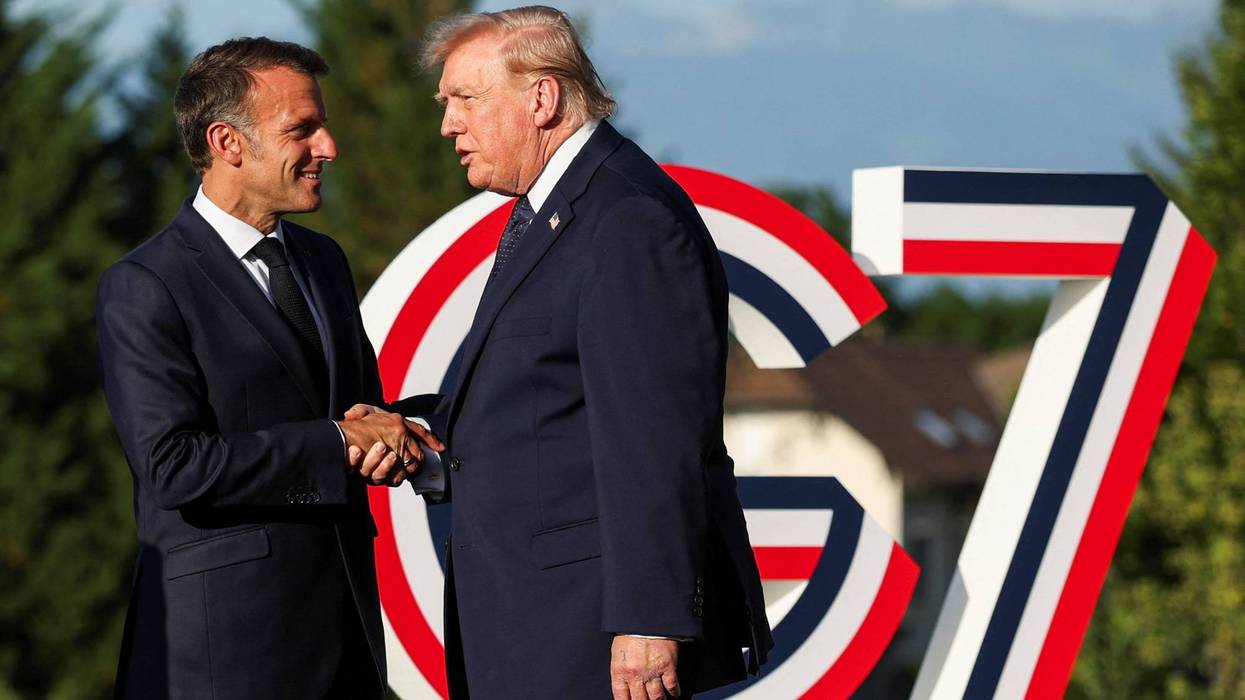
“Conflict devastates countries and costs countless lives, yet for some it is extraordinarily profitable,” said the executive director of Oxfam International.
While much of the world is holding out hope that the US-Israeli war against Iran may finally be reaching an end amid news of a ceasefire agreement, the billionaire owners of some of the world's largest energy companies may not be so thrilled.
A handful of just 41 energy industry barons in Group of Seven (G7) countries collectively increased their wealth by $23.5 billion since the war was launched in late February, according to a report released by Oxfam International on Monday, as the leaders of the world's largest industrialized economies meet in France this week.
The oil shocks resulting from the war have caused fuel prices to spike dramatically, rippling inflation throughout the global economy and straining the pocketbooks of ordinary people around the world. One April report by the United Nations Development Program projected that, as a result of the conflict, an additional 32 million people would be pushed into poverty by the end of the year.
But between March 1 and May 18, owners of the largest oil and energy companies in Canada, France, Germany, Italy, Japan, the US, and the UK were adding $300 million on average per day to their collective wealth, Oxfam found through an analysis of Forbes’ Real-Time Billionaire List.
PRESS RELEASE: G7 energy billionaires pocket $300 million a day since start of unlawful US and Israel war against Iran.
This is equivalent to about $1,000 in the time it takes to blink.
👀https://t.co/UVGHF4a3Tk pic.twitter.com/szSGASCAX8
— Oxfam International Media Team (@newsfromoxfam) June 15, 2026
“Conflict devastates countries and costs countless lives, yet for some it is extraordinarily profitable,” said Oxfam International's executive director Amitabh Behar. “This is a brutal system that redistributes wealth upwards—from workers to shareholders, from the poorest to the richest, from those with the least power to those who already have far too much of it. While families are skipping meals and governments slash life-saving aid, we are witnessing a grotesque billionaire bonanza.”
While their accumulation of wealth cannot solely be attributed to the war, Oxfam noted that the Big Six oil companies—Chevron, Shell, BP, ConocoPhillips, Exxon, and TotalEnergies—are projected to grow their profits this year by 80% above the pre-war forecast, while the average large G7 company in the sample is projected to see just 8% growth.
Global billionaires saw their wealth increase on average by about 0.42% between March and mid-May. During the same period, G7 billionaires in the energy industry grew their riches by 9%, while those in oil and gas specifically became nearly 11% richer.
Oxfam notes that the Iran War has only widened the chasm between the rich and poor that was already gaping, in no small part thanks to nations in the G7.
While billionaire wealth has surged by nearly $10 trillion since 2020, G7 nations, mostly the US under President Donald Trump, have reduced aid to the poorest nations by $48 billion—equivalent to what billionaires in G7 countries accumulated for themselves in just nine days.
Meanwhile, since 2019, the last time France chaired a G7 summit, Oxfam estimated that 44 people per minute have come to be in need of humanitarian aid, based on 2025 data from the United Nations Office for the Coordination of Humanitarian Affairs.
.@Oxfam campaigners posing as #G7 leaders stand around a trash can overflowing with discarded files. The labels read: “gender inequality,” “climate,” and “tax the rich” —critical global issues scrubbed from the agenda to secure President Trump’s attendance at the G7 summit.@AP pic.twitter.com/aE7HkMvKFl
— Oxfam International Media Team (@newsfromoxfam) June 15, 2026
Behar said that in order to secure the participation of the US in this week’s summit, French President Emmanuel Macron has chosen to table any discussions that might offend Trump—including the devastating cost of his war in Iran, Israel’s US-backed wars in Gaza and Lebanon, and anything to do with the climate crisis, which Trump has referred to as "a scam."
"Rather than defending collective governance, Macron and his peers are accommodating its destruction. This will have consequences measured in lives," he said.
Oxfam called for the "G6"—all the Group of Seven member countries, excluding the US—to create a comprehensive plan to protect people from the economic turmoil caused by the war and other spiraling global crises.
“The G6 can’t plead powerlessness,” Behar added. “They can cancel debt. They can tax windfall profits and extreme wealth... They can provide poorer countries with aid. Refusing to act simply because Washington will not join them is not diplomacy—it is cowardice. And it will only accelerate the G6’s slide into global irrelevance.”
A decade after the Panama Papers, the global rich are still hiding more than $2.8 trillion in tax havens. Just a fraction of that money could end extreme hunger and provide clean water to everyone on Earth.
The richest 0.1% of people on Earth are hiding more than $2.8 trillion in offshore accounts to avoid taxes. That money alone is more wealth than is owned by the entire bottom half of humanity, more than 4.1 billion people.
These findings were published in a report released Thursday by Oxfam International on the 10th anniversary of the 2016 Panama Papers, which provided an unprecedented look at how the world's most powerful capitalists, financiers, political leaders, celebrities, and criminals exploited offshore tax havens to stash their money.
"Ten years on, the superrich are still sequestering oceans of wealth in offshore vaults,” said Christian Hallum, Oxfam International’s tax lead.
The percentage of untaxed wealth in offshore accounts has dropped in the past 10 years, in large part due to global reforms like the adoption of the Organization for Economic Cooperation and Development's Automatic Exchange of Information framework (AEOI), which allows revenue authorities around the world to easily share information and crack down on cheats.
However, many nations in the Global South are excluded from this system, even though they need the tax revenue the most.
Oxfam found that a staggering $3.5 trillion, more than 3.2% of the global gross domestic product, still remains in untaxed accounts. That's more than the entire GDP of France and is more than twice the combined wealth of the world's 44 poorest nations.
And while the percentage of untaxed wealth is shrinking, that doesn't mean inequality has shrunk.
On the contrary, the December 2025 "World Inequality Report" found that the richest 0.001% of humanity—fewer than 60,000 multimillionaires and billionaires—now have three times as much wealth as the poorest half of the world’s population combined.
Inequality has surged around the world in part due to taxation policies and pandemic recovery packages that overwhelmingly favor the rich. The most glaring was adopted in the world's financial hub, the United States, last year.
The megabudget passed by Republicans and signed into law by President Donald Trump handed a $1 trillion tax cut to America's wealthiest 1% while slashing more than $1 trillion in spending from Medicaid, food assistance, and other safety net programs. It has been described by some economists as the largest upward transfer of wealth in US history.
While the global top 0.1% holds about 80% of untaxed offshore wealth, an even smaller group of uber-wealthy individuals does most of the cheating. The world's richest 0.01%, who hold at least $50 million apiece, control about half of all money in global tax shelters—$1.7 trillion.
According to the Tax Justice Network's Corporate Tax Haven Index, Caribbean islands under UK ownership, including the British Virgin Islands, the Cayman Islands, and Bermuda, are among the worst offenders. Other notable tax havens include Switzerland, Singapore, Hong Kong, Ireland, and the Netherlands.
A February Oxfam report on Elon Musk, who is well on his way to becoming the world's first trillionaire, found that his company, Tesla—which managed to pay zero dollars on its $2.3 billion income in 2024—has not published a country-by-country report on its taxes and that it has subsidiaries in many countries considered to be tax havens.
Big Pharma companies, including AbbVie and Merck, also used tax shelters to lower their total tax expense in 2025 by more than $1 billion, according to a report released earlier this month by the Financial Accountability & Corporate Transparency Coalition.
"This isn’t just about clever accounting—it’s about power and impunity," Hallum said. "When millionaires and billionaires stash trillions of dollars in offshore tax havens, they place themselves above the obligations that bind the rest of society."
"The consequences are as predictable as they are devastating," he continued. "We see our public hospitals and schools starved of funds, our social fabric shredded by rising inequality, and ordinary people forced to shoulder the costs of a system rigged to enrich a tiny few.”
Even a fraction of the money currently stashed away by the world's wealthiest could alleviate untold amounts of suffering.
In November, the United Nations' World Food Program estimated that extreme hunger, which currently affects more than 318 million people around the world, could be eradicated by 2030 with investments of about $93 billion per year, but that global hunger programs instead remain “slow, fragmented, and underfunded."
According to a 2021 UN Educational, Scientific, and Cultural Organization (UNESCO) report, investments of around $114 billion per year would similarly be enough to ensure that everyone on Earth has access to safe drinking water and sanitation.
Oxfam called on governments around the world to increase coordination to prevent the wealthy from hiding their riches from tax authorities. It also urged them to adopt more aggressive policies to tax the 1%'s wealth at home, including taxes on income and on extreme wealth.
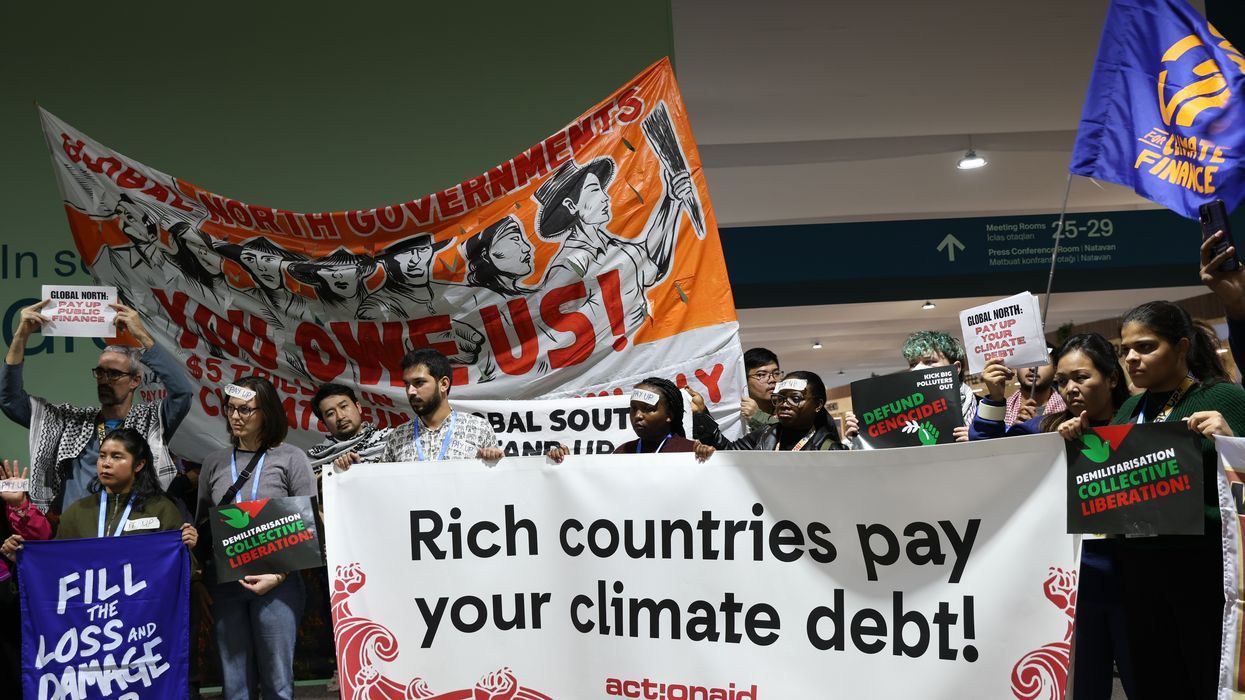
"A just transition must redistribute power and resources, curb overconsumption, and prioritize dignity and rights for all," Oxfam International stresses in a new report.
A report published Wednesday details how "climate colonialism" of wealthier nations "hijacks" investment and profits from the Global South—and lays out how the world can "move beyond extractive models and build an energy system rooted in equality, justice, care, and collective prosperity."
The Oxfam International report notes that "the global energy transition stands at a pivotal moment: It can either dismantle the inequalities driving the climate crisis or deepen them. Today, the transition risks reproducing patterns of extractivism and exploitation, with the most marginalized paying the highest price while elites profit."
"From transition mineral mining to debt burdens and unequal energy access, the current trajectory mirrors centuries of colonial injustice," the publication states. "A just transition must redistribute power and resources, curb overconsumption, and prioritize dignity and rights for all."
The report continues:
Today, the warning signs are clear: The global renewable energy transition is being built on unequal foundations. We are witnessing climate inequality inaction: a transition focused on replacing fossil fuels with green alternatives, without questioning the excessive energy use of the richest, while often leaving lower-income communities to bear the greatest costs, including through the harmful impacts of transition mineral mining, inadequate benefit sharing, and global financial and trade systems rigged against their interests. Put simply, the same dynamics that drove historical colonialism are reaemerging in new forms through the green transition.
These patterns of inequality play out both between and within countries. While stark inequalities exist between the richest and poorest within high-income countries too, global inequality is most sharply felt in the Global South, where structural barriers and historic injustices have left entire nations bearing the brunt of the climate crisis and now shouldering the greatest risks in the renewable energy transition.
"Unless the logic underpinning the transition changes, it will continue to replicate the history of extractivism and exploitation," the report warns. "These inequalities intersect with gender, race, class, age, and other marginalized people or groups, meaning that the costs of an unjust transition fall heaviest on Indigenous peoples, Black communities and other racialized groups, women, workers, peasants, and of course young people and future generations."
"This concentration of wealth and power is mirrored in patterns of energy use: A small minority live in extreme luxury and overconsume planetary resources, while others still lack basic electricity," the report's authors wrote. "If just one year’s energy consumption of the wealthiest 1% were redistributed, it could meet the modern energy needs of all the people in the world without electricity seven times over, while redistributing the consumption of the top 10% global energy consumers could meet the needs of the entire Global South nine times over."
The report also highlights how a "colonial financial system" plays a key role in perpetuating injustice, noting that "while rich countries can pour billions into their own clean energy transitions, the Global South is left with rising debt, punishing interest rates, and shrinking fiscal space."
For every #ElectricVehicle that contains about 3kg of cobalt mined in the Democratic Republic of Congo, Tesla earns approximately $3,150 in profit. While the DRC government receives less than $10 in royalties and the average miner earns just $7!📢 Read our new report to learn more: oxf.am/3W68E2o
[image or embed]
— Oxfam International (@oxfaminternational.bsky.social) September 24, 2025 at 6:46 AM
According to Oxfam:
In 2024, high-income countries accounted for roughly 50% of global clean energy investment, and China for 29%, while Africa accounted for just 2%, despite sub-Saharan Africa being home to 85% of all the people in the world without electricity. The inequality is not only in where finance flows, but in how much it costs: Clean energy projects in the Global South face interest rates of 9–13.5%, compared with just 3–6% in richer countries, slowing the pace of the transition. These costs are not inevitable—they reflect a system that prices risk through the racialized lens of colonial legacies. The impact is stark: Powering 100,000 people with clean energy costs about $95 million in advanced economies like the UK, but $139 million (45% higher) in emerging economies such as India and $188 million (97% higher) in African countries such as Nigeria.
How does the Global South reclaim its energy future from climate colonialism? According to the report's authors, "Rather than treating the energy future as a race with few winners, we must reimagine it as a shared global project."
"Energy should not be hoarded, withheld, or used as leverage for geopolitical or corporate power," the report advises. "This structural change requires reparative justice: making rich polluters pay, redistributing resources, confronting overconsumption, and prioritizing the rights of those historically excluded while embracing economic models that put equality, well-being, and ecological limits at the center.
"Tackling inequality is both a moral imperative and an effective strategy for climate mitigation," the authors stressed, offering the following recommendations:
"There is no single blueprint for a just transition—it will differ across contexts, shaped by diverse histories, knowledge, and needs," the Oxfam report states. "But all just transitions must share one principle: Energy should serve life, not profit."
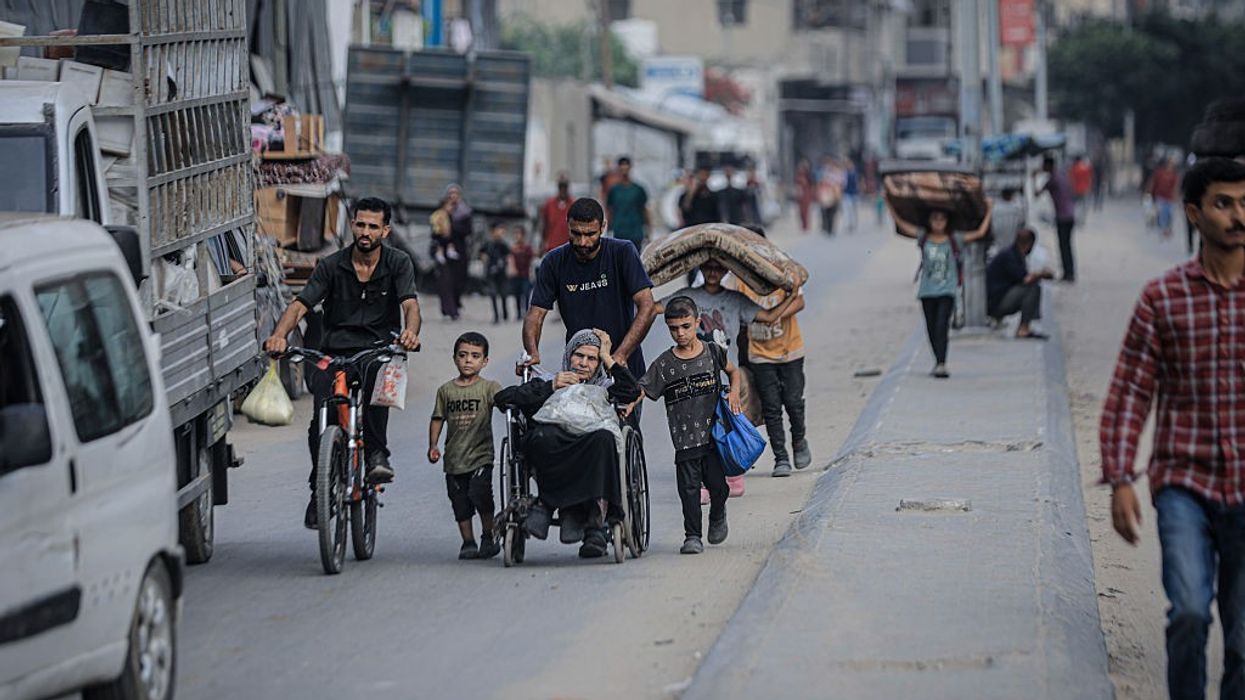
"This is the latest chapter in the genocide that Israel is committing in Gaza and part of a broader campaign of ethnic cleansing engulfing the entire Gaza Strip," said Oxfam International.
Israel's US-backed campaign to ethnically cleanse Palestinians from Gaza City has left nearly 1 million people—half of them starved by design—with nowhere to seek refuge, United Nations agencies and other humanitarian groups warned Wednesday.
"We are witnessing a dangerous escalation in Gaza City, where Israeli forces have stepped up their operations and ordered everyone to move south. This comes two weeks after famine was confirmed in the city and surrounding areas," said the UN Humanitarian Country Team (HCT), a strategic forum of UN agency heads and over 200 nongovernmental organizations (NGOs).
"While Israeli authorities have unilaterally declared an area in the south as 'humanitarian,' it has not taken effective steps to ensure the safety of those forced to move there and neither the size nor scale of services provided is fit to support those already there, let alone new arrivals," HCT continued.
"Nearly 1 million people are now left with no safe or viable options—neither the north nor the south offers safety," HCT added.
One elderly woman caring for an injured 8-year-old girl who is one of tens of thousands of children orphaned by Israeli attacks told Amnesty International Wednesday that "she's all that I have left, and I have tried everything I can to protect her."
"We have been displaced twice just in the last week," the woman added. "We don't have the means to go to the south, and we are tired of being forced to relive this ordeal all over again."
An elderly disabled woman living in a makeshift refugee camp in southern Gaza City told Amnesty that "we were displaced from Sheikh Radwan three weeks ago; my son had to carry me on his shoulders because I have no wheelchair and no transportation could reach our area."
"Now we are ordered to evacuate again. Where do we go?" she asked. "To secure transportation to the south, you have to pay close to 4,000 shekels ($1,200) and to buy a tent, you have to pay at least 3,000 shekels and we don't know if we'll find any land to pitch our tent on."
"We had already spent all our savings to survive this war, looking for food and basics," the woman added. "Every day is like the war is starting all over again, only far worse, but we are totally depleted, we have no will or strength to carry on."
Photos showing hundreds of thousands of Palestinians—including some with donkey-drawn carts—slowly streaming southward from Gaza City evoked images from the Nakba, when more than 750,000 Arabs were ethnically cleansed from Palestine by Zionist terror militias during the establishment of modern Israel.
The World Health Organization (WHO), a UN body, warned Wednesday that "starvation and malnutrition in Gaza are at the highest levels ever since the conflict began almost two years ago," and that "deliberate blocking and delay of large-scale food, health, and humanitarian aid has cost many lives."
"After 22 months of relentless conflict, over half a million people in the Gaza Strip are facing catastrophic conditions characterized by starvation, destitution, and death," the agency added. "Another 1.07 million people (54%) are in 'emergency' (IPC Phase 4), and 396,000 people (20%) are in 'crisis' (IPC Phase 3)."
WHO also cited overall casualties in Gaza—now approaching at least 65,000 deaths, mostly women and children—and 164,000 injuries, according to the Gaza Health Ministry (GHM)—and noted that "as of September 5, 2025, there have been 2,339 reported fatalities among aid-seekers near militarized distribution sites and along convoy routes since May 27."
Oxfam International—a coalition of over 20 independent NGOs focused on alleviating poverty—echoed the UN experts, asserting that "Israel's intent to displace around 1 million civilians, half of whom are living in famine, is impossible and illegal."
"Displacement orders, on leaflets thrown from the sky, or posted on social media, signal grave next steps, a scene all too familiar in Gaza where every order has preceded new waves of destruction and mass casualties," Oxfam said. "This is the latest chapter in the genocide that Israel is committing in Gaza and part of a broader campaign of ethnic cleansing engulfing the entire Gaza Strip, where nothing and no one has been spared."
Heba Morayef, regional director for the Middle East and North Africa at Amnesty International, said Wednesday that Israel's mass displacement order for Gaza City residents "is cruel, unlawful, and further compounds the genocidal conditions of life that Israel is inflicting on Palestinians."
"Gaza City... is now facing complete obliteration," Morayef added. "It is evident that Israel is determined in pursuing its goal to physically destroy Palestinians in the Gaza Strip. It is unconscionable that states with leverage over Israel continue to provide it with arms and diplomatic support to destroy Palestinian lives."
Operation Gideon's Chariots 2—Israel's plan to "conquer, cleanse, and stay" in Gaza and "annihilate everything" there—as Israeli Finance Minister Bezalel Smotrich recently put it—has ramped up in recent days, with intensified Israeli air and artillery strikes and ground troops pushing deeper into Gaza City.
According to GHM, at least 72 Palestinians were killed and a minimum of 356 others were wounded by Israeli forces across Gaza on Thursday, including children and infants. At least 53 of the victims were killed in Gaza City. Israeli strikes reportedly targeted homes, tents housing refugees, and aid distribution points.
Additionally, GHM said that seven Palestinians including a child died from starvation over the past 24 hours, bringing the total number of famine-related deaths in Gaza to at least 411, 142 of them children.
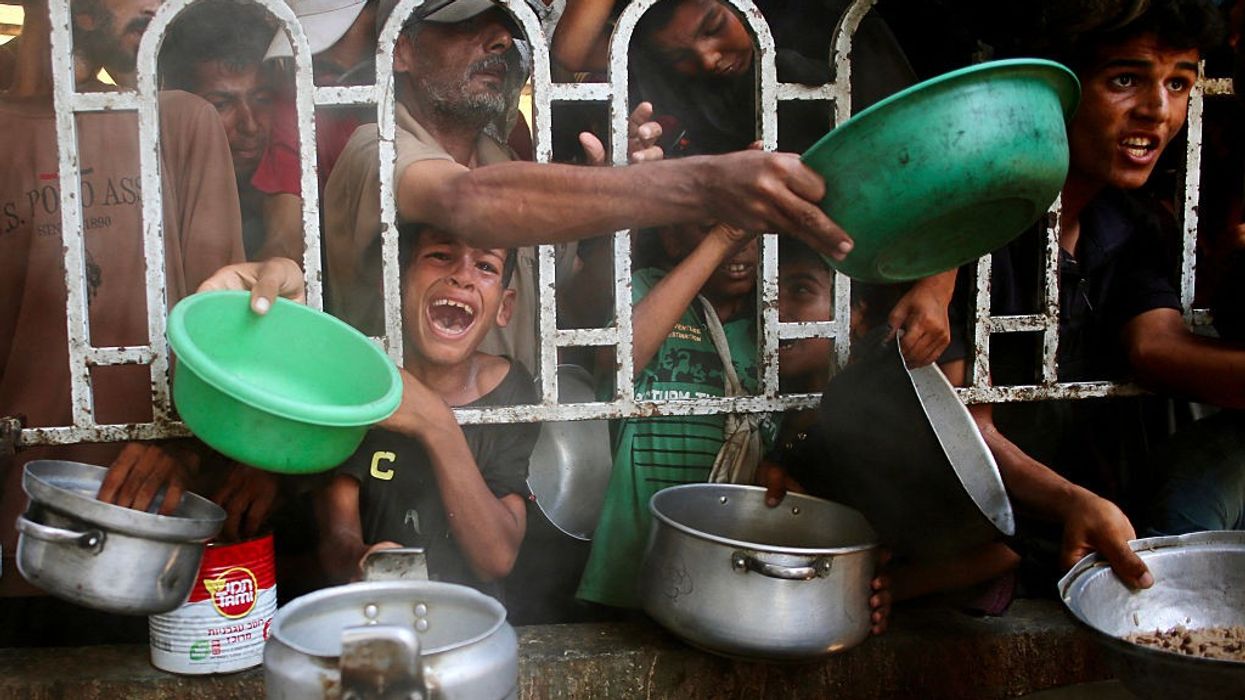
"States can and must save lives before there are none left to save."
A coalition of more than 100 aid organizations issued a dire warning Wednesday about worsening humanitarian conditions on the ground in the Gaza Strip, where starvation continues to spread under the Israeli government's suffocating blockade.
The groups, including Save the Children and Oxfam, called on the international community to pressure Israel to "open all land crossings; restore the full flow of food, clean water, medical supplies, shelter items, and fuel through a principled, U.N.-led mechanism; end the siege, and agree to a cease-fire now."
"Just outside Gaza, in warehouses—and even within Gaza itself—tons of food, clean water, medical supplies, shelter items, and fuel sit untouched with humanitarian organizations blocked from accessing or delivering them," the groups said in a joint statement. "The government of Israel's restrictions, delays, and fragmentation under its total siege have created chaos, starvation, and death."
The aid groups said their colleagues in Gaza are among those impacted. "With supplies now totally depleted," they said, "humanitarian organizations are witnessing their own colleagues and partners waste away before their eyes."
The statement was released amid harrowing evidence that the manufactured hunger emergency in Gaza is rapidly intensifying, with at least 21 Palestinian children dying of starvation over just the past several days. Since May, more than 1,000 Palestinians have been killed while seeking food aid, mostly near hubs run by the U.S.- and Israel-backed Gaza Humanitarian Foundation (GHF). A spokesperson for the Trump State Department declared Tuesday that GHF operations have "been a tremendous success" despite the repeated massacres at its sites and still-spreading famine across the enclave.
"Palestinians are trapped in a cycle of hope and heartbreak, waiting for assistance and cease-fires, only to wake up to worsening conditions," the aid coalition said Wednesday. "It is not just physical torment, but psychological. Survival is dangled like a mirage. The humanitarian system cannot run on false promises. Humanitarians cannot operate on shifting timelines or wait for political commitments that fail to deliver access."
The groups decried inadequate deals—such as the European Union's recent agreement with Israel to increase the flow of humanitarian assistance into Gaza—and "symbolic gestures" like food airdrops as "a smokescreen for inaction."
In the absence of "real change on the ground," the groups said, "children starve while waiting for promises that never arrive."
"They cannot replace states' legal and moral obligations to protect Palestinian civilians and ensure meaningful access at scale," the coalition said. "States can and must save lives before there are none left to save."
The aid groups' warnings echoed those of U.N. officials such as World Food Program emergency director Ross Smith, who said Tuesday that the hunger crisis in Gaza "has reached new and astonishing levels of desperation.
"We have a third of the population who are not eating for multiple days in a row—this includes women and children," said Smith. "We see severe, acute malnutrition surging. Almost 100,000 women and children are suffering from severe, acute malnutrition and need treatment as soon as possible."
"People are dying from lack of humanitarian assistance every day," Smith added. "And we are seeing this escalate, day by day."
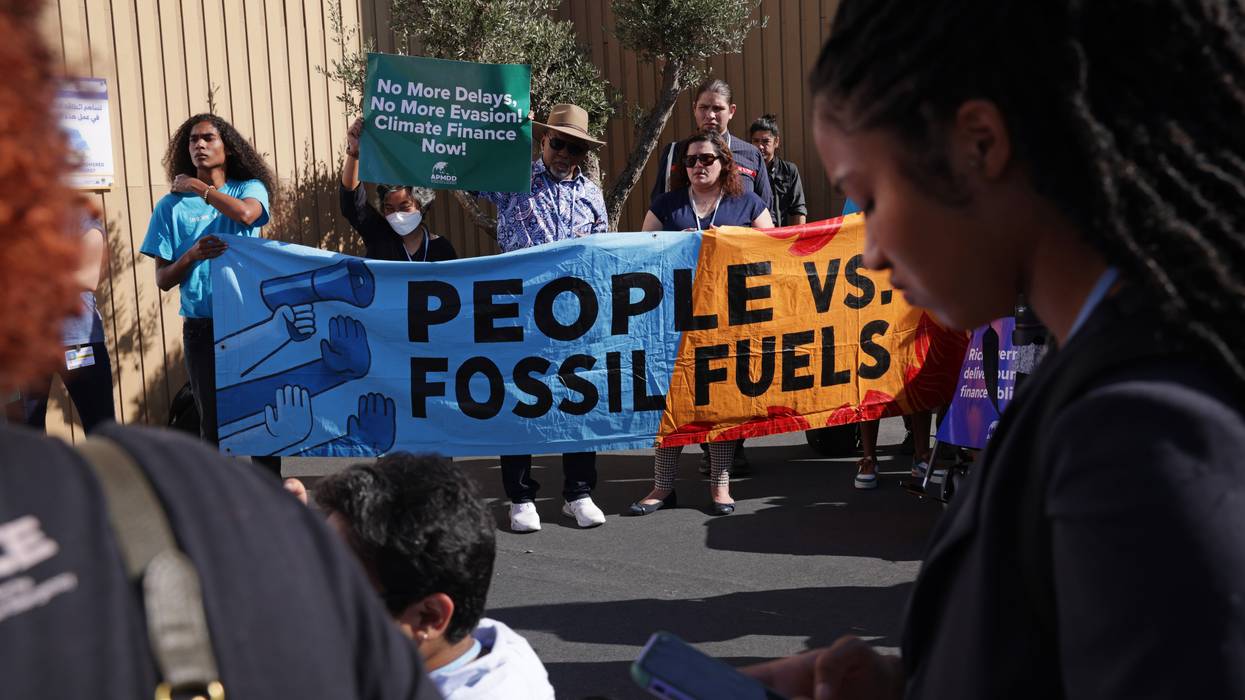
"People are no longer buying the lies. They see the fingerprints of fossil fuel giants all over the storms, floods, droughts, and wildfires devastating their lives, and they want accountability," said the head of one green group.
Large majorities of people around the world support both taxing oil, gas, and coal companies for the environmental damage made worse by fossil fuels and using higher taxes on polluters to support communities most impacted by the climate crisis, according to the results of an international survey released Thursday.
The study, which was jointly commissioned by Greenpeace International and Oxfam International, surveyed roughly 1,200 people in each of these 13 countries: Brazil, Canada, France, Germany, India, Italy, Kenya, Mexico, Philippines, South Africa, Spain, United Kingdom, and the United States. The research was conducted by the data company Dynata, and field work was done between May 9-28, 2025. Greenpeace noted that, taken together, the countries represent close to 50% of the globe's population.
The results of the survey showed a whopping 81% of those surveyed would support taxes fossil fuel companies to pay for damages wrought by "fossil-fuel driven climate disasters."
"These survey results send a clear message: people are no longer buying the lies. They see the fingerprints of fossil fuel giants all over the storms, floods, droughts, and wildfires devastating their lives, and they want accountability," said Mads Christensen, the executive director of Greenpeace International.
"It's only fair that those who caused the crisis should pay for the damage, not those suffering from it," he added.
The study findings come as individual states in the U.S. show a growing interest in passing legislation to force fossil fuel companies to help pay for the recovery cost of climate-related disasters. Vermont became the first state in the country to pass a climate "Superfund" law in 2024, and New York followed suit later that year. Several other states are considering such legislation, according to March reporting from Stateline.
The survey also found that 86% of respondents support channeling revenues "from higher taxes on oil and gas corporations towards communities most impacted by the climate crisis."
Climate campaigners have long sought international financial arrangement that would see rich countries transfer money to developing countries in order to help the latter cut their emissions and adapt to climate change. Last year's United Nations climate negotiations ended with a pledge by donor countries to set at least $300 billion annually for that purpose. That amount was criticized for being inadequate.
The study was launched Thursday at the UN Climate Meetings in Bonn, where government representatives are discussing climate policies, including ways to raise at least $ 1.3 trillion annually for climate mitigation, adaptation, and recovery by 2035 across the Global South.
According to Amitabh Behar, executive director of Oxfam International, "a new tax on polluting industries could provide immediate and significant support to climate-vulnerable countries, and finally incentivize investment in renewables and a just transition."

"The pattern suggests not an effort to neutralize a threat, but a deliberate campaign to dismantle and depopulate Gaza—a process of forced displacement which is a war crime."
Israel's U.S.-backed mass displacement of Palestinians in the Gaza Strip "is entirely erasing Gaza," a leading international charity said Thursday as the United Nations' Middle East peace envoy warned that ongoing airstrikes, forced starvation, and general despair have plunged the embattled coastal enclave into "an abyss."
Since unilaterally breaking a cease-fire on March 2, "Israel issued nearly one displacement order every two days, strangling people into isolated areas covering less than 20% of the Gaza Strip," Nairobi, Kenya-based Oxfam International noted.
"Combined with deliberate deprivation, this reveals a strategy not of targeting militants, but of dismantling and erasing Gaza itself," Oxfam added. Some Israeli leaders have explicitly called for Gaza's "erasure" to avenge the Hamas-led October 7, 2023 attack on Israel.
"People are so exhausted, many would rather face death than flee again."
"For over 600 days, Israel has been saying it's targeting Hamas, but it is civilians who have been corralled, bombed, and killed en masse every day," said Bushra Khalidi, Oxfam's policy lead in the Occupied Palestinian Territory.
"The displacement orders follow a clear and calculated pattern: using the threat of violence to herd civilians into ever-shrinking zones of confinement," Khalidi added. "This isn't counterterrorism, as Israel alleges—it's the systematic clearing of Gaza through militarized force into enclaves of internment."
📽️ WATCH: This map visualizes #Gaza’s systematic erasure. Since breaking the ceasefire, Israel issued nearly one displacement order every two days, strangling people into isolated areas covering less than 20 percent of the Gaza Strip. Find out more: oxf.am/3Hbshlz
[image or embed]
— Oxfam International (@oxfaminternational.bsky.social) May 29, 2025 at 12:58 AM
Oxfam analyzed Israel's more than 30 displacement orders, which, combined with Israel Defense Forces (IDF)-designated "no-go zones," cover more than 80% of the 141-square mile Gaza Strip.
"The sheer scale and relentless frequency of these orders have made it virtually impossible for people to find refuge," the charity said. "The pattern suggests not an effort to neutralize a threat, but a deliberate campaign to dismantle and depopulate Gaza—a process of forced displacement which is a war crime."
As Oxfam noted:
In just the last week (15–20 May), over 160,000 people were displaced—part of a broader total of nearly 600,000 people displaced since March 18, many of them repeatedly. One of the most significant recent orders, issued on 20 May, covered 34.9 square kilometers, roughly 10% of Gaza's land area, that affected 150,000–200,000 people in North Gaza's Beit Lahia and Jabalia. The effect of such orders on already-displaced populations has been devastating.
"Imagine trying to move with four children or an elderly parent in the middle of the night, with no transport and nowhere to go," said Oxfam gender adviser Fidaa Alaraj, who has been displaced with her family several times. "People are so exhausted, many would rather face death than flee again."
Palestinians, United Nations experts, international humanitarian groups, progressive U.S. lawmakers, and others including a former right-wing Israeli defense minister have called Israel's forced displacement ethnic cleansing.
Fugitive Israeli Prime Minister Benjamin Netanyahu—who is wanted by the International Criminal Court for alleged war crimes and crimes against humanity in Gaza, including murder and forced starvation—recently said that Israel will control all of Gaza after Operation Gideon's Chariots, a campaign to conquer, ethnically cleanse, and indefinitely occupy the strip.
Far-right members of Netanyahu's Cabinet and the Israeli Knesset want to permanently seize Gaza and reestablish Jewish-only apartheid colonies in the coastal enclave, which U.S. President Donald Trump has proposed taking over and turning into the "Riviera of the Middle East."
"There is one essential condition: We must not reach a situation of famine, both from a practical standpoint and a diplomatic one," Netanyahu said on May 19. "People simply won't support us."
While 82% of Israelis surveyed in a recent poll said they supported the ethnic cleansing of Gaza—and nearly half backed a biblical genocide of Palestinians—much of the world is aghast at Israel's annihilation of the strip, which has left more than 191,000 people dead, maimed, or missing and around 2 million others forcibly displaced, often more than once.
Meanwhile, the famine against which Netanyahu warned looms larger than ever as hundreds of Gazans, mostly children and the elderly, have recently died from malnutrition and lack of medical care, according to local officials.
On Thursday, Sigrid Kaag, the interim U.N. Special Coordinator for the Middle East Peace Process, warned that Gazans are "being starved and denied the very basics" by Israel, which in March tightened an already crippling "complete siege" of Gaza. The blockade has been cited in the South Africa-led genocide case against Israel currently before the International Court of Justice.
"The entire population of Gaza is facing the risk of famine," she warned, likening the trickle of aid allowed into the strip by Israel to offering "a lifeboat after the ship has sunk."
Kaag highlighted the despair pervasive among Gazans, who she said bid farewell not by saying, "Goodbye, see you tomorrow," but rather with the words "see you in heaven."
"Death is their companion. It's not life, it's not hope," she said.
"Since the collapse of the ceasefire in March, civilians have constantly come under fire, confined to ever-shrinking spaces, and deprived of lifesaving relief," Kaag added. "Israel must halt its devastating strikes on civilian life and infrastructure."
"This annihilation campaign and the bloodshed must end."
Echoing Kaag's remarks, Oxfam's Khalidi said that "this annihilation campaign and the bloodshed must end. It is long past time for Western governments and other influential powers to move beyond statements and apply meaningful pressure on Israel to lift the siege and abandon any designs on annexing Gaza."
"Peace cannot be brokered on the ruins of Gaza nor the theft of Palestinian land," she stressed. "Ahead of the Two-State Solution Summit planned in New York next month, world leaders must urge Israel to lift the siege and abandon any annexation plans of Gaza or the West Bank."
"What's at stake is not only Palestine's future," Khalidi argued, "but the integrity of every nation that claims to uphold international law."

"This isn't a glitch in the system—it's the system working exactly as designed, funneling wealth ever upwards while millions of working people struggle to afford rent, food, and healthcare."
As people worldwide filled the streets Thursday to celebrate International Workers' Day and mobilize against attacks on the working class, a new analysis showed that average global CEO pay has surged 50% since 2019—56 times more than the pay of ordinary employees.
The Oxfam International analysis examined figures from nearly 2,000 corporations across 35 countries where CEOs were paid more than $1 million on average last year, including bonuses and stock options. Across those companies, the average pay of chief executives reached $4.3 million in 2024, up from $2.9 million just five years ago.
By contrast, average worker pay in those 35 nations rose just 0.9% between 2019 and 2024.
"Year after year, we see the same grotesque spectacle: CEO pay explodes while workers' wages barely budge," said Amitabh Behar, Oxfam's executive director. "This isn't a glitch in the system—it's the system working exactly as designed, funneling wealth ever upwards while millions of working people struggle to afford rent, food, and healthcare."
According to Oxfam, global billionaires "pocketed on average $206 billion in new wealth over the last year," or $23,500 an hour. That's more than the average annual income globally—$21,000—in 2023.
To begin redressing global economic inequality, Oxfam called for top marginal tax rates of at least 75% on the highest earners and wage increases to ensure worker pay keeps up with inflation.
"It's time to end the billionaire coup against democracy and put people and planet first."
Luc Triangle, general secretary of the International Trade Union Confederation, said in a statement that the "outrageous pay inequality between CEOs and workers confirms that we lack democracy where it is needed most: at work."
"Around the world, workers are being denied the basics of life while corporations pocket record profits, dodge taxes, and lobby to evade responsibility," Triangle added. "Workers are demanding a New Social Contract that works for them—not the billionaires undermining democracy. Fair taxation, strong public services, living wages, and a just transition are not radical demands—they are the foundation of a just society."
"It's time to end the billionaire coup against democracy and put people and planet first," he added.
In addition to spotlighting the growing chasm between CEO and worker pay, the Oxfam analysis warned that the global working class "is now facing a new threat" in the form of U.S. President Donald Trump's tariff regime. The humanitarian group argued that "these policies pose significant risks for workers worldwide, including job losses and rising costs for basic goods that would stoke extreme inequality everywhere."
"For so many workers worldwide, President Trump's reckless use of tariffs means a push from one cruel order to another: from the frying pan of destructive neoliberal trade policy to the fire of weaponized tariffs," said Behar. "These policies will not only hurt working families in the U.S., but especially harm workers trying to escape poverty in some of the world's poorest countries."

"The extreme emissions of the richest, from their luxury lifestyles and even more from their polluting investments, are fueling inequality, hunger, and—make no mistake—threatening lives."
With the world on track for 3.1°C of warming this century, Oxfam International on Monday blamed global billionaires who—with their superyachts, private jets, and investments—emit more carbon pollution in 90 minutes of their lives than the average person does in a lifetime.
That's according to Carbon Inequality Kills, Oxfam's first-of-its-kind study tracking planet-heating emissions from the pricey transportation and polluting investments of the world's 50 richest people, which was released ahead of COP29, the United Nations climate summit scheduled for next month in Baku, Azerbaijan.
"The superrich are treating our planet like their personal playground, setting it ablaze for pleasure and profit," said Oxfam executive director Amitabh Behar in a statement. "Their dirty investments and luxury toys—private jets and yachts—aren't just symbols of excess; they're a direct threat to people and the planet."
The report explains that "Oxfam was able to identify the private jets belonging to 23 of 50 of the world's richest billionaires; the others either do not own private jets or have kept them out of the public record."
"On average, these 23 billionaires each took 184 flights—spending 425 hours in the air—over a 12-month period. That is equivalent to each of them circumnavigating the globe 10 times," the publication continues. "On average, the private jets of these 23 superrich individuals emitted 2,074 tonnes of carbon a year. This is equivalent to 300 years' worth of emissions for the average person in the world, or over 2,000 years' worth for someone in the global poorest 50%."
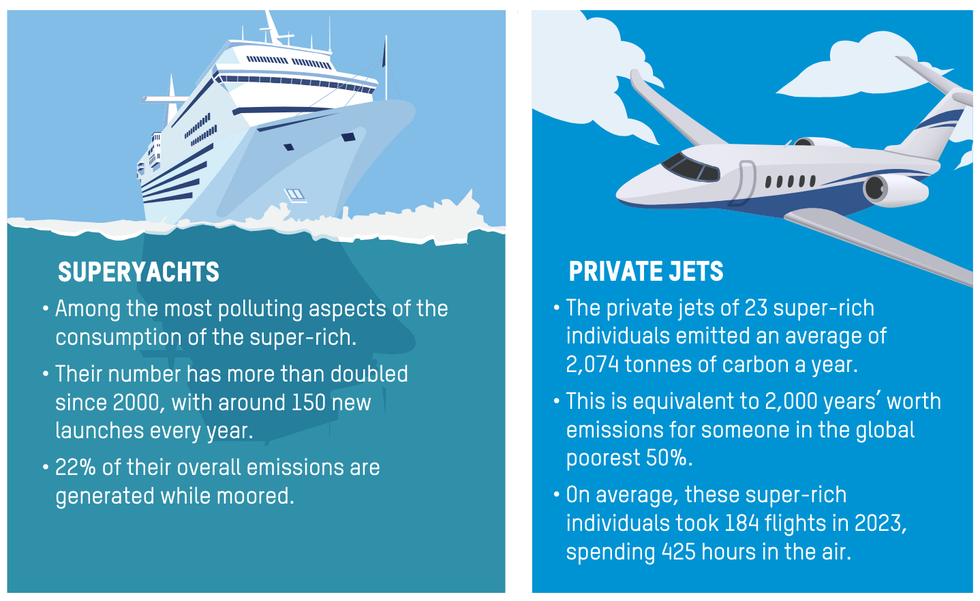
For example, Elon Musk, the world's richest person based on Monday updates to the Bloomberg and Forbes lists, "owns (at least) two private jets which together produce 5,497 tonnes of CO2 per year," the study highlights. "This is the equivalent of 834 years' worth of emissions for the average person in the world, or 5,437 years' worth for someone in the poorest 50%."
"The two private jets owned by Jeff Bezos, founder and executive chairman of Amazon, collectively spent almost 25 days in the air, emitting 2,908 tonnes of CO2. It would take the average U.S. Amazon employee almost 207 years to emit that much," the document adds. Bezos is the world's second- or third-richest person, according to the various billionaire indexes.
The report says that "the number of superyachts has more than doubled since 2000, with around 150 new launches every year. Not only do these giant ships guzzle an immense amount of fuel for propulsion, their air conditioning, swimming pools, and extensive staff further add to emissions. Although they are moored for most of the year, about 22% of their overall emissions are generated during this 'downtime.'"
"Superyachts are exempt from both E.U. carbon pricing and International Maritime Organization emissions rules," the publication points out. "Oxfam was able to identify 23 superyachts owned by 18 of the 50 billionaires in our study. These floating mansions traveled an average of 12,465 nautical miles a year: This is equivalent to each superyacht crossing the Atlantic almost four times."
According to the group:
Oxfam estimates the average annual carbon footprint of each these yachts to be 5,672 tonnes, which is more than three times the emissions of the billionaires' private jets. This is equivalent to 860 years of emissions for the average person in the world, and 5,610 times the average of someone in the global poorest 50%.
The Walton family, heirs of the Walmart retail chain, own three superyachts worth over $500 million. They traveled 56,000 nautical miles in a year with a combined carbon footprint of 18,000 tonnes: This is equivalent to the carbon emissions of around 1,714 Walmart shop workers. The company that has generated their extreme wealth has also been found to drive economic inequality in the USA through low wages, workplace discrimination, and huge CEO pay.
In terms of investments, the study says, "the richest 1% control 43% of global financial assets, and billionaires control (either as CEOs or principal investors) 34% of the 50 largest listed companies in the world, and 7 out of the 10 largest. The investment footprint of the superrich is the most important element of their overall impact on people and the planet."
The organization found that "the average investment emissions of 50 of the world's richest billionaires were around 2.6 million tonnes of CO2 equivalents (CO2e) each. That is around 340 times their emissions from private jets and superyachts combined."
"Each billionaire's investment emissions are equivalent to almost 400,000 years of consumption emissions by the average person, or 2.6 million years of consumption emissions by someone in the poorest 50% of the world," the report says. "Almost 40% of the investments analyzed in Oxfam's research were in highly polluting industries including: oil, mining, shipping, and cement. Only one billionaire, Gautam Adani, has significant investments in renewable energy—which account for 18% of his overall investment portfolio. Just 24% of the companies that these billionaires invested in have set net-zero targets."
The publication also features "a new analysis of the inequality in the impacts of climate breakdown."
Behar concluded that "Oxfam's research makes it painfully clear: The extreme emissions of the richest, from their luxury lifestyles and even more from their polluting investments, are fueling inequality, hunger, and—make no mistake—threatening lives. It's not just unfair that their reckless pollution and unbridled greed is fueling the very crisis threatening our collective future—it's lethal."
The document's final section includes detailed recommendations to reduce the emissions of the richest, make polluters pay, and "reimagine our economies and societies to deliver well-being and planetary flourishing."
The report is a reminder of how rich and powerful people are impeding efforts to meet the goals of the Paris climate agreement, whose government signatories will be gathering in Baku next month to discuss efforts to limit global temperature rise this century to 1.5°C.
"The wealth of the world's 2,781 billionaires has soared to $14.2 trillion," the study notes. "If it was invested in renewable energy and energy efficiency measures by 2030, this wealth could cover the entire funding gap between what governments have pledged and what is needed to keep global warming below 1.5°C, according to estimates by the International Renewable Energy Agency."

"More must be invested in eradicating poverty and fostering peace and development, not fueling war and destruction," said one campaigner.
Despite historic levels of forced displacement due to armed conflict, Group of Seven member countries have increased their military expenditures to record highs while they slash spending on humanitarian aid for people affected by wars that these powerful nations often started or stoked, an analysis published Friday revealed.
According to Birmingham, England-based Islamic Relief Worldwide, military spending by G7 members Canada, France, Italy, Germany, Japan, the United Kingdom, and the United States—which wrapped up Friday in Puglia, Italy—rose to $1.2 trillion last year, the overwhelming bulk of that amount attributable to the U.S.' $886.3 billion Pentagon budget.
"Too many governments are putting far more resources towards acquiring weapons of war than helping those suffering the deadly impacts of conflict."
That's a 7.3% increase over 2022 levels, and 62 times what those countries spent on all humanitarian aid in response to wars and disasters.
"From Gaza to Sudan, Ukraine to Myanmar, we see millions of lives destroyed by war," Islamic Relief head of global advocacy Shahin Ashraf said in a statement. "The humanitarian needs today are greater than ever before, so it's scandalous that many wealthy G7 nations are cutting aid while spending more than ever before on weapons."
It's not just the G7. According to this year's Stockholm International Peace Research Institute annual analysis, global military spending increased 6.8% to a record $2.4 trillion in 2023.
"Too many governments are putting far more resources towards acquiring weapons of war than helping those suffering the deadly impacts of conflict," Ashraf asserted. "More must be invested in eradicating poverty and fostering peace and development, not fueling war and destruction."
Islamic Relief Worldwide said:
While some of the discussions at the G7 summit focus on restricting immigration into rich developed nations, most people displaced by conflict remain in war-torn countries and impoverished neighbouring countries. After more than a year of brutal war, Sudan is now the world's biggest displacement crisis with over 10 million people—about a quarter of the population—now forced from their homes. The vast majority of people fleeing the violence in Sudan remain in the country, with many receiving aid from local communities, youth groups, and mosques.
"As rich nations increasingly shut their borders and cut aid, in places like Sudan it is heartening to see the generosity of some of the world's poorest communities taking displaced people into their homes and sharing their food and water with them," said Ashraf. "But they need more international support, especially from the wealthiest countries."
Another analysis published ahead of the G7 summit by Oxfam International revealed that just 3% of the seven countries' 2023 military expenditures would be enough to "help end world hunger and solve the debt crisis in the Global South."