

SUBSCRIBE TO OUR FREE NEWSLETTER
Daily news & progressive opinion—funded by the people, not the corporations—delivered straight to your inbox.
5
#000000
#FFFFFF
To donate by check, phone, or other method, see our More Ways to Give page.
Daily news & progressive opinion—funded by the people, not the corporations—delivered straight to your inbox.

One campaigner called the law’s passage a “ray of hope for Europe’s nature, future generations, and the livelihoods of rural communities.”
Environmental groups celebrated a "historic" victory on Monday as the European Union adopted a law that seeks to restore at least 20% of land and sea habitats by 2030 and 90% to 100% by 2050, following a narrow vote by the European Council that swung on the vote of an Austrian minister who defied conservatives in her own government.
The new law, aimed at reversing catastrophic biodiversity loss, includes a sweeping array of protections for European ecosystems, from forests to wetlands to coral reefs. It also aims to restore organic soils in agricultural ecosystems, with special provisions for grassland pollinators and farmland birds. It was described as the "first ever" E.U. law aimed at nature recovery.
"After years of intense campaigning and many ups and downs, we are jubilant that this law is now reality—this day will go down in history as a turning point for nature and society," World Wildlife Fund for Nature (WWF) EU, one of several organizations that campaigned for the law under a #RestoreNature banner, wrote on social media.
🚨 BREAKING: We have the EU Nature Restoration Law!
Member States have just adopted the game-changing law for Europe's degraded ecosystems
It's a huge win for the EU's nature, citizens & the economy and the people behind the #RestoreNature campaign!
Thank you all 💚 pic.twitter.com/MmZPOQXzWW
— WWF EU (@WWFEU) June 17, 2024
The law's adoption came after what WWF EU called "one of the most tumultuous journeys in the history of E.U. legislation," a two-year-long saga that was dramatic up until its final moments.
The law's final hurdle was cleared by the European Council on Monday when 20 out of the 27 E.U. environment ministers, collectively representing 66% of the bloc's population—just enough to meet the 65% required by qualified majority rules—voted in favor.
The threshold was met when Leonore Gewessler, Austria's environment minister, moved in favor of the law despite opposition from the leaders of her own coalition government. Gewessler is a member of the Austria's Green party, a junior coalition partner to the conservatives, who oppose the new E.U. law.
The law was nearly adopted by the Council in March, but was derailed when Hungary withdrew support.
On Monday, Hungary, Finland, Italy, the Netherlands, Poland, and Sweden voted against the law; Belgium abstained. It will enter into force in all member states, each of which will now be required to develop national nature restoration plans.
I want to be like @lgewessler - the most brave Envi Minister ever! Despite facing opposition in her own country - #Austria , she decided to support #NatureRestorationLaw! 👏 We will see if it is enough, but nevertheless this act of courage moved me 💚 pic.twitter.com/Q6IRYFQU8J
— Agata Szafraniuk (@AgataSzafraniuk) June 17, 2024
The E.U. parliament had passed the law in February, following trilogue negotiations last year, after which Council passage is normally a formality. But this law was a political lightning rod that threatened normal institutional processes.
"The failure to adopt the law would not only threaten Europe's highly degraded nature but also send a negative signal about established political processes within European institutions," Špela Bandelj Ruiz, a Greenpeace campaigner, told Common Dreams.
Agribusiness groups had waged a sustained campaign against the law while it was being considered by parliament, and it was one of the targets of the many farmer protests in Europe this year. There was an "unprecedented and absurd disinformation campaign," WWF EU said.
The adoption of the law, which was part of the European Green Deal, a set of environmental laws and regulations put in place by the E.U. over the last five years, comes just before a new EU parliament swears in next month, following elections last week. The new parliament will have fewer green party representatives and more conservatives than before, as well as more members from the far-right.
The nature restoration law will be instrumental in helping the E.U. to meet its commitment under the Kunming-Montréal Global Biodiversity Framework signed at the 2022 U.N. Biodiversity Conference (COP15), nonprofit groups and E.U. officials said.
"The European delegation will be able to go to the next COP with its head held high," Alain Maron, minister for Climate Transition, Environment, Energy, and Participatory Democracy of the Government of the Brussels-Capital Region, said in an E.U. statement.
COP16 will be held in October in Colombia. Greenpeace said that failure to adopt the new law would have been an "embarrassment" to the E.U.
The law comes following dire reports about the state of nature in the E.U., where more than 80% of habitats are in poor condition. "Biodiversity in the E.U. continues to decline and faces deteriorating trends from changes in land and sea use, overexploitation and unsustainable management practices, as well as water regime modification, pollution, invasive alien species, and climate change," according to a 2020 report by the European Environment Agency.
Bandelj of Greenpeace told Common Dreams that some of the language on agricultural ecosystems in the law had been watered down during negotiations; for example, some of the targets are effort-based rather than results-based, with lawmakers writing "which shall aim to" rather than using more binding language. Bandelj also expressed concern that an "emergency brake" loophole could be applied, suspending implementation of the law in the event of food security concerns.
Still, Bandelj called the law a "ray of hope for Europe's nature, future generations, and the livelihoods of rural communities."
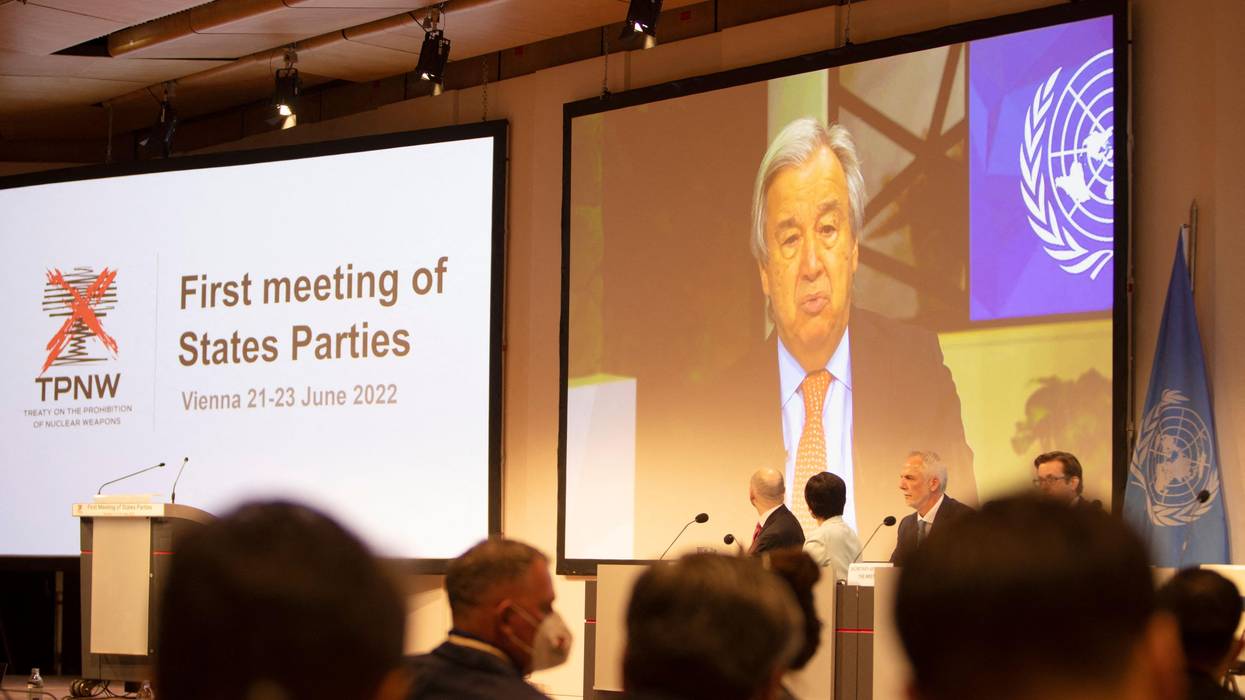
Warning of the heightened threat of nuclear war in a "world rife with geopolitical tensions and mistrust," United Nations Secretary-General Antonio Guterres on Wednesday called upon nuclear nations to join the scores of countries that have adopted a landmark treaty banning atomic weapons.
"The once-unthinkable prospect of nuclear conflict is now back within the realm of possibility."
Addressing the first meeting of state parties to the landmark United Nations Treaty on the Prohibition of Nuclear Weapons (TPNW) in Vienna, Guterres called the world's thermonuclear arsenals "a deadly reminder of countries' inability to solve problems through dialogue and collaboration."
"These weapons offer false promises of security and deterrence--while guaranteeing only destruction, death, and endless brinksmanship," Guterres said in his video message.
"Let's eliminate these weapons," he added, "before they eliminate us."
Guterres lamented that the "terrifying lessons" of the U.S. atomic bombings of Hiroshima and Nagasaki, Japan--the only nuclear war ever waged--are fading from memory. With nine nations now armed with over 13,000 nuclear weapons, the U.N. chief warned that "the once-unthinkable prospect of nuclear conflict is now back within the realm of possibility."
The TPNW was adopted in 2017 and took effect in January 2021 after Honduras became the 50th nation to ratify the accord. To date, 86 countries have signed and 65 have ratified the TPNW. None of the nine nuclear countries--China, France, India, Israel, North Korea, Pakistan, Russia, the United Kingdom, and the United States--have signed the agreement.
"This is a recipe for annihilation," Guterres stressed. "We cannot allow the nuclear weapons wielded by a handful of states to jeopardize all life on our planet. We must stop knocking at doomsday's door."
Related Content

Guterres' remarks come amid heightened nuclear tensions during Russia's invasion and Western powers' arming of Ukraine, and as the world's nuclear stockpile expands for the first time since the last decade of the Cold War a generation ago.
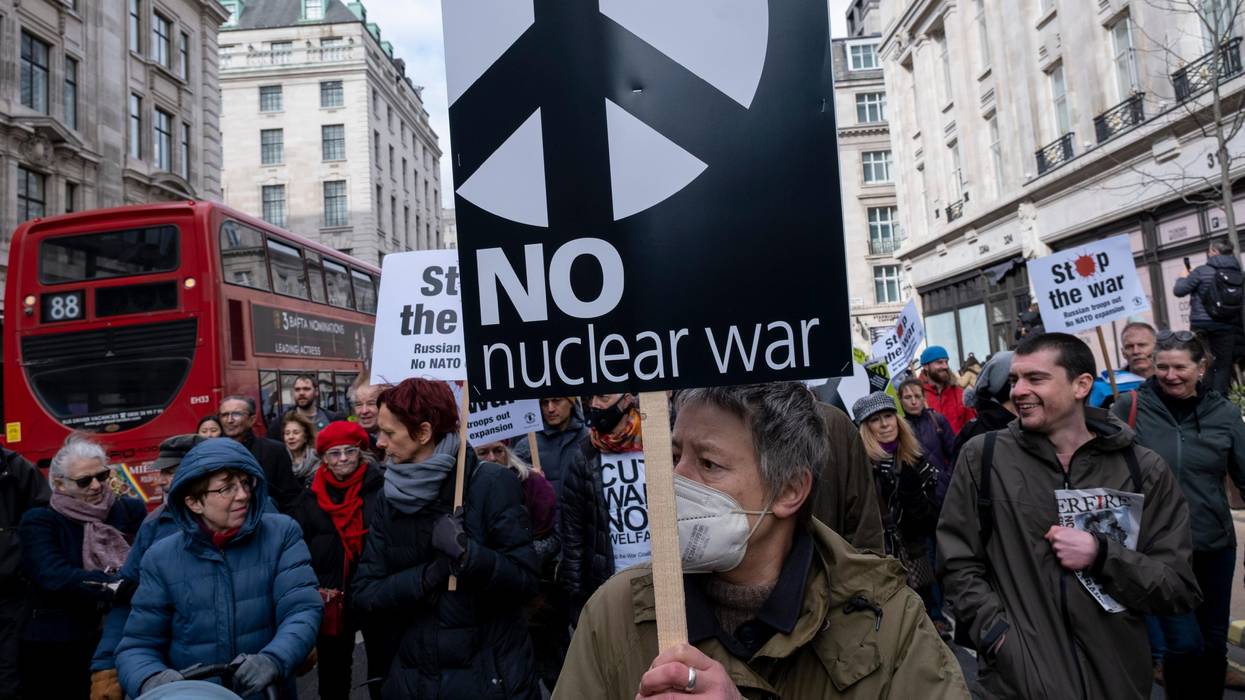
Amid the looming threat of nuclear escalation in Ukraine, a group of U.S. congressional Democrats on Friday urged the Biden administration to send delegates to a key upcoming nuclear disarmament summit in Austria.
In a letter to U.S. Secretary of State Antony Blinken, Sen. Ed Markey (D-Mass.), Sen. Jeff Merkley (D-Ore.), Rep. John Garamendi (D-Calif.), and Rep. Don Beyer (D-Va.)--the four co-chairs of the Nuclear Weapons and Arms Control Working Group--urged the State Department to send senior officials to participate in the 2022 Humanitarian Impact of Nuclear Weapons Conference, which is set to begin in Vienna next week.
The lawmakers note that the conference will take place in the shadow of Russia's invasion of Ukraine, "which has heightened concerns about the use of nuclear weapons in conflict."
"Active U.S. participation in the conference will provide an important platform to discuss the current unsettling state of nuclear affairs in the world and demonstrate U.S. leadership in managing the nuclear threat," the authors argue.
They add that nuclear "saber-rattling" by Russian President Vladimir Putin and his government and Russia's "vast arsenal of tactical or 'battlefield' nuclear weapons" is a "frightening reminder that the conventional war in Ukraine could turn nuclear--whether intentionally, by miscalculation, or even by accident."
Nearly 70% of respondents to a March survey conducted for the American Psychological Association said they feared Russia's war in Ukraine will escalate to include use of nuclear weapons.
Related Content

Highlighting U.S. nuclear history, which includes waging the world's only nuclear war on Japan and exposing people from Nevada to the Marshall Islands with deadly fallout from atomic weapons testing, the lawmakers assert that "the United States has a--sadly--unique perspective on the human consequences of the production, testing, and use of nuclear weapons."
"We would bring a needed and voice and invaluable insight to the conference," the letter contents, adding that U.S. participation "would show our commitment to playing a leadership role in ensuring that nuclear weapons are never used in warfare again."
The letter dismisses the Treaty on the Prohibition of Nuclear Weapons, a historic 2021 agreement signed by scores of nations--but none of the nine nuclear powers--as unrealistic given the world's current atomic landscape.
Instead, the lawmakers affirm former President Barack Obama's nebulous commitment to seek "the peace and security of a world without nuclear weapons."
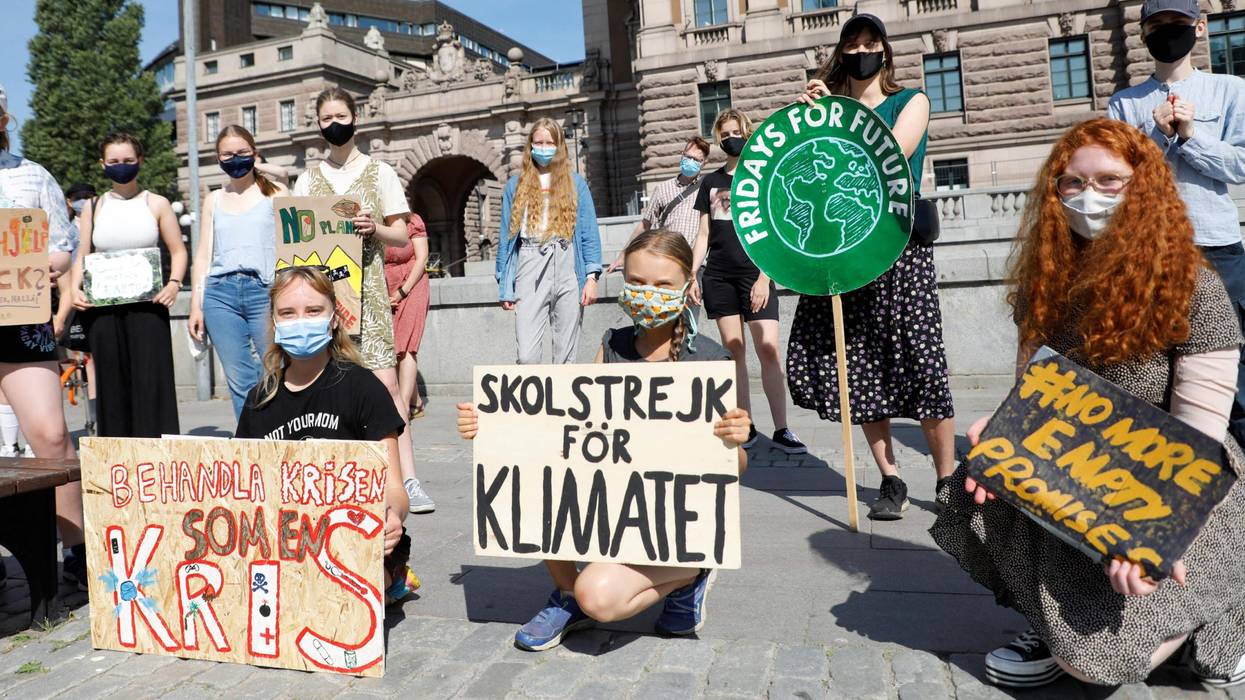
In the wake of the latest failure by the G7 nations to take meaningful steps to combat the climate emergency and record-breaking heatwaves on multiple continents, Swedish campaigner Greta Thunberg on Friday accused world leaders of hypocrisy for persecuting climate activists while "pretending" to take the threat seriously.
"Young people all over this planet are no longer falling for your lies."
--Greta Thunberg to world leaders
Addressing the Austrian World Summit virtually, the 18-year-old Thunberg noted that "more and more people around the world have woken up to the climate and ecological crisis, putting more and more pressure on you, the people in power."
"Eventually the public pressure was too much," said the Fridays for Future founder. "You have the world's eyes on you, so you started to act. Not acting as in taking climate action, but acting as in role-playing. Playing politics, playing with words, and playing with our future. Pretending to take responsibility; acting as saviors as you try to convince us that things are being taken seriously."
"Meanwhile the gap between your rhetoric and reality keeps growing wider and wider," Thunberg continued. "And since the level of awareness is so low you almost get away with it."
"But let's be clear," she stressed, "what you are doing is not about climate action or responding to an emergency. It never was. This is communications tactics dressed as politics."
Thunberg accused leaders of high-income nations of "pretending to change and listen to young people," and in a thinly veiled criticism of U.S. President Joe Biden, by "pretending to take science seriously by saying 'science is back' while holding climate summits without even inviting one single climate scientist as speaker."
She also accused leaders of "pretending to wage war against fossil fuels, while opening up brand-new coal mines, oil fields, and pipelines."
"You don't only continue business as usual," said Thunberg, "in many cases you're even speeding up and scaling up the process, pretending to have the most ambitious climate policies while granting new oil licenses [and] exploring future oil fields."
In another swipe at Biden, Thunberg decried "pretending to 'build back better' after the pandemic even though astronomical sums of money have already been locked in, and not in green projects."
"And when your empty words are not enough, when the protests grow too loud, you respond by making the protests illegal."
--Thunberg
"The G7, as an example, is spending billions more on fossil fuels and fossil fuel infrastructure than on clean energy," she noted.
"And when your empty words are not enough, when the protests grow too loud, you respond by making the protests illegal," Thunberg charged. Her remarks came amid a wave of arrests of climate activists, including members of the youth-led Sunrise Movement in Washington, D.C. and Indigenous-led water protectors protesting the Line 3 tar sands pipeline in Minnesota and elsewhere in recent days and weeks.
"But as your acts continue, more and more of us are seeing through... your role-playing," Thunberg said. "The gap between your actions and words is becoming more impossible to ignore, while more and more extreme weather events are raging all around us. And as a result, young people all over this planet are no longer falling for your lies."
"You say we need to move slowly to bring the public along," Thunberg continued. "However, how do you honestly expect to bring the people along if you don't treat this crisis like a crisis? The climate crisis is today at best being treated only as a business opportunity to create new green jobs, new green businesses and technologies."
"Perhaps playing a role helps you sleep at night," Thunberg speculated. "But while you are busy working the stage, you seem to forget that the climate crisis is not something distant in the future. It is already taking so much from the most affected people in the most affected areas."
"This might just be a game to you, a game to win votes, popularity, points on the stock market, or your next highly paid position in a company or a lobbying firm," she said. "You can and will continue to pretend, but nature and physics will not fall for it."
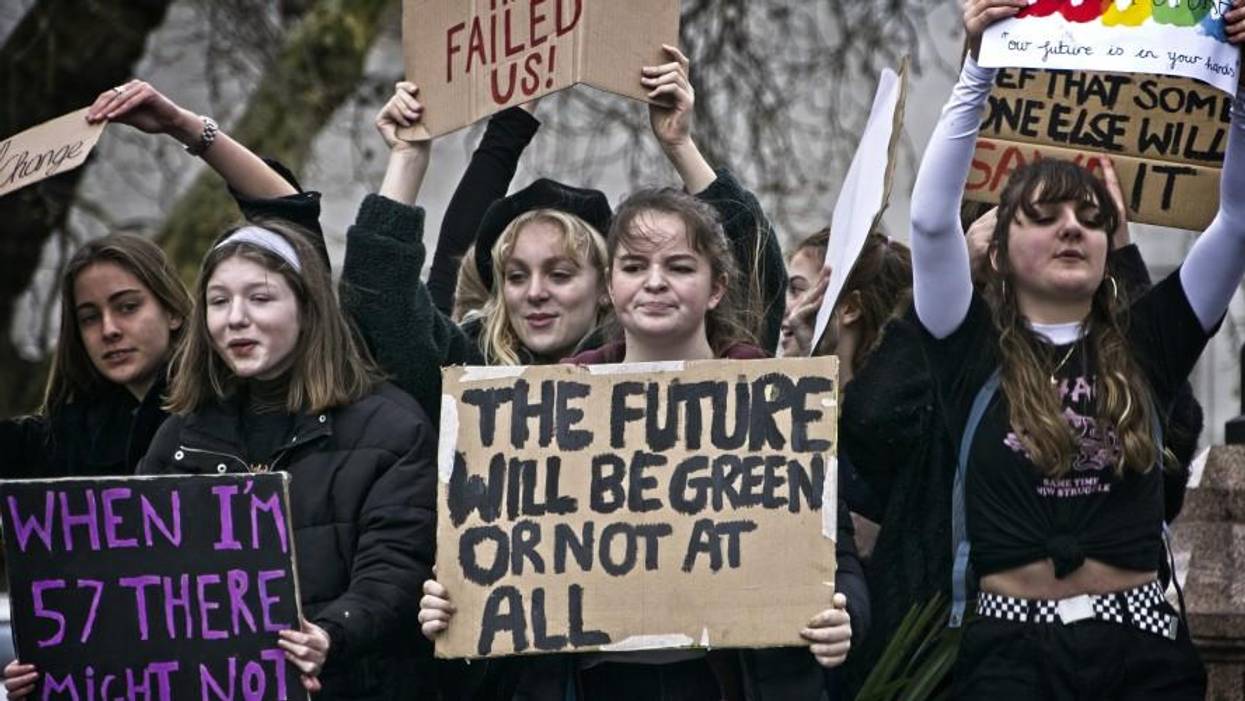
The global climate advocacy group 350.org on Friday welcomed a new demand from 11 member nations of the European Union to use the continent's Green Deal policy guidelines as a framework for economic recovery from the ongoing coronavirus pandemic.
"We have a choice to make now: do we try to tackle one crisis while ignoring another, or do we decide to build back better by tackling the two together, and create a fairer, more prosperous, and sustainable future for us all?"
--Nick Bryer, 350.org Europe
The call for making the European Green Deal "central to a resilient recovery after COVID-19" came Thursday in an open letter signed by the environment and climate ministers from Austria, Denmark, Finland, Italy, Latvia, Luxembourg, the Netherlands, Portugal, Spain, and Sweden. France signed on Friday.
"The countries that have signed this letter are absolutely right to say that the E.U. should use the Green Deal as a starting point for their economic recovery efforts," Nick Bryer, a senior campaigner at 350.org Europe, said in a statement.
"The coronavirus pandemic is having a devastating impact on people's livelihoods across Europe and around the world," he added, "and it is right that E.U. governments and institutions are taking extraordinary measures to minimize this."
The European Green Deal was introduced in December by Ursula von der Leyen, president of the European Commission, the E.U.'s executive arm. Some advocacy groups have charged that the proposal--which came less than two weeks after the European Parliament declared a climate emergency--isn't adequately ambitious.
Despite persistent critiques of the continent's Green Deal, the ministers' new letter was embraced by Oil Change International in a tweet Friday:
The letter noted that after meeting about the coronavirus outbreak by video in March, E.U. leaders ordered (pdf) the European Commission to start developing a comprehensive recovery plan featuring "the measures necessary to get back to a normal functioning of our societies and economies and to sustainable growth, integrating inter alia the green transition and the digital transformation, and drawing all lessons from the crisis."
E.U. leaders' mention of the green transition last month was welcomed by Ester Asin, director of the WWF's European Policy Office, who told Euractiv that "a truly ambitious, people-centered European Green Deal must be part of the response and will leave Europe better equipped to tackle the ongoing climate and biodiversity emergencies."
The ministers concurred in their open letter Thursday, declaring that "the Green Deal provides us with a roadmap to make the right choices in responding to the economic crisis while transforming Europe into a sustainable and climate neutral economy."
The letter acknowledged the "tremendous human tragedy and a historical economic setback" caused by the pandemic and argued that "the lesson from the COVID-19 crisis is that early action is essential. Therefore, we need to maintain ambition in order to mitigate the risks and costs of inaction from climate change and biodiversity losses."
"We should withstand the temptations of short-term solutions in response to the present [coronavirus] crisis that risk locking the E.U. in a fossil fuel economy for decades to come," the letter read. "Instead, we must remain resolved to increase the E.U.'s 2030 target before the end of this year adhering to the timetable of the Paris agreement despite the postponement of COP26, and inspire other global players to raise their ambition as well."
"The Green Deal provides us with a roadmap to make the right choices in responding to the economic crisis while transforming Europe into a sustainable and climate neutral economy."
--11 European ministers
As Common Dreams reported in March, environmental advocates worldwide have responded to the COVID-19 outbreak by pushing policymakers to learn from the public health crisis as pursue a global Green New Deal in an effort to both promote economic recovery and address the climate emergency.
"After the financial crash in 2008, the E.U. saved the banks, and ordinary citizens paid the price with a decade of austerity," 350.org's Bryer said Friday. "As another recession looms, mega-rich polluting corporations, like oil and gas companies, are already trying to seize the moment to secure themselves financial support."
"But we are also in the midst of a climate crisis," he added, "and we have a choice to make now: do we try to tackle one crisis while ignoring another, or do we decide to build back better by tackling the two together, and create a fairer, more prosperous, and sustainable future for us all?"
350.org has joined with hundreds of groups fighting for a "just recovery" to the virus outbreak and emphasizing the importance of considering "the interrelated crises of wealth inequality, racism, and ecological decline--notably the climate crisis--which were in place long before COVID-19, and now risk being intensified."
Specifically, the organizations assert that responses to the pandemic at all levels must uphold the following principles:
As of press time Friday, there were more than 1.677 million confirmed COVID-19 cases and over 101,000 related deaths worldwide, according to Johns Hopkins University's tracker. The E.U. members hardest hit by the public health crisis include Spain, Italy, France, and Germany.
While France endorsed the letter after facing criticism for not being an orignial signatory, Germany has not yet caved to such pressure.
German Chancellor Angela Merkel "was once hailed as a climate champion, but her crown is long lost and gathering dust," Sebastian Bock, a senior campaigner with 350.org in Germany, said Friday. "Germany's absence from this important list of European signatories shows, yet again, that all Merkel has left to offer is words without substance."
"In January the chancellor weakened her government's own commitments on a domestic coal phase-out," added Bock. "Now, during this unprecedented moment in time that calls for solidarity and international cooperation, the German government is undermining E.U. efforts to simultaneously rejuvenate our economies to support the people and also tackle the climate crisis."
Check back for more additions and updates as the #ClimateStrike continues on Friday...
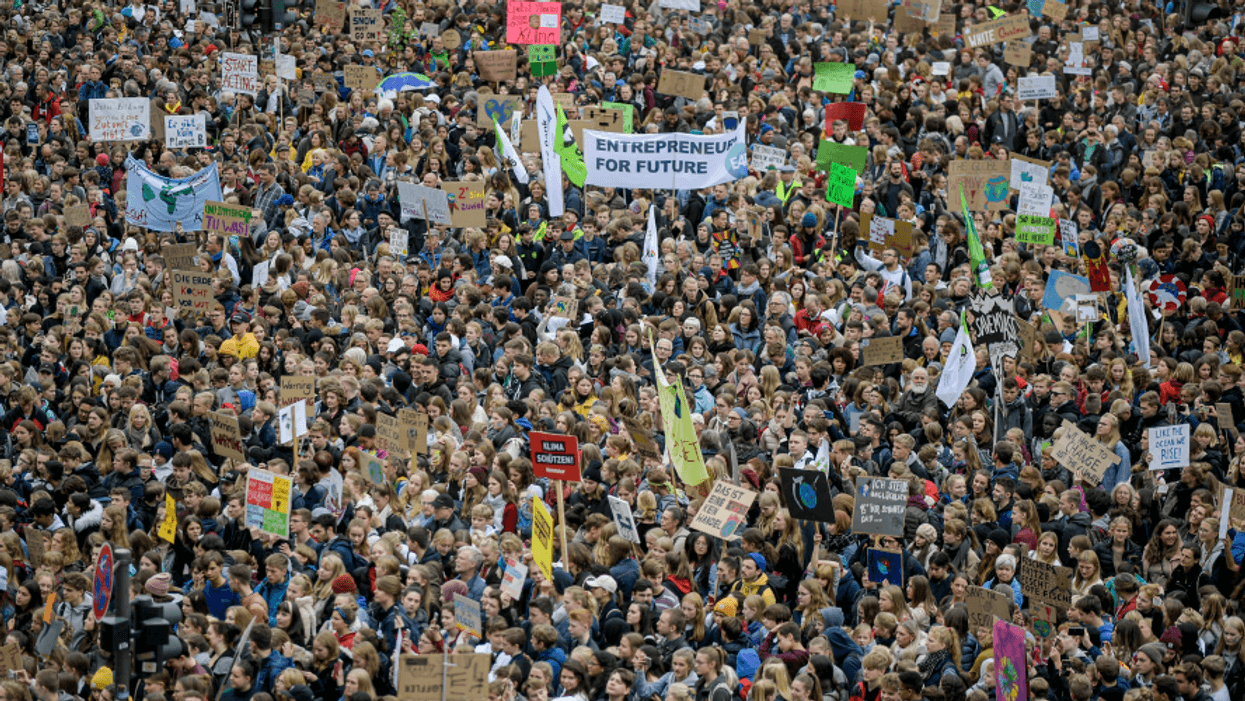
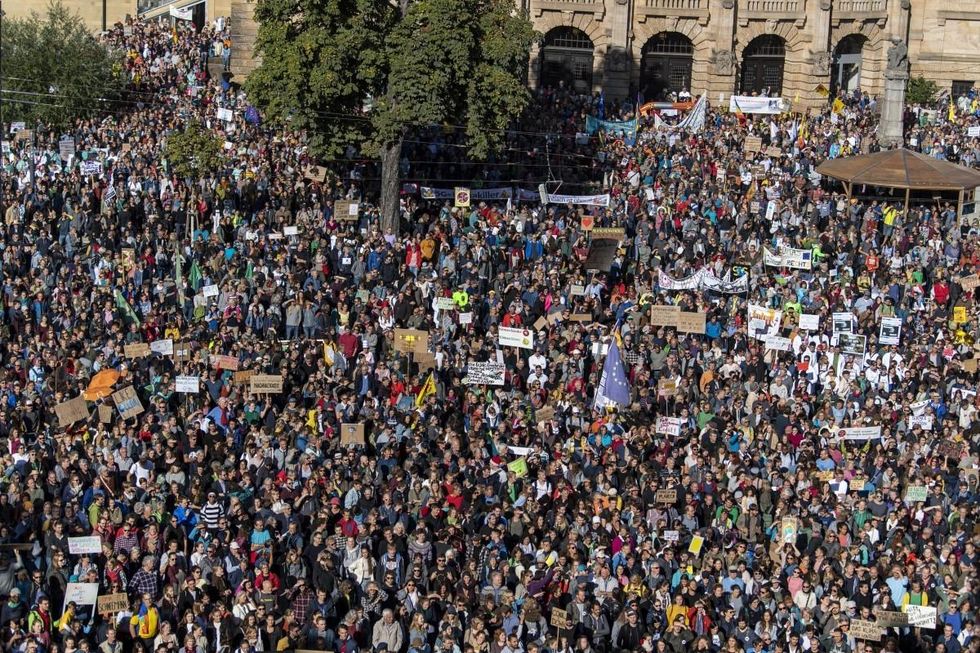
Kicking off what organizers say will be the largest mass climate demonstration in history, millions of young people and their adult allies flooded the streets around the world Friday to take part in the Global Climate Strike and pressure world leaders to confront the ecological crisis with bold and urgent action.
According to 350.org, over 4 million people took part in the collective demonstrations worldwide.
"Today we saw a movement, made up of people from all ages and backgrounds coming together and calling for the end of coal, oil, and gas. No matter what differences we have, we are together now because we are fighting for our future," said May Boeve, executive director of 350.org, in a statement. "September 20th was a demonstration of intent, of four million people who took time off from work or school to say that they are ready. Ready to move on and make the changes we need for a future free from fossil fuels and based in climate equity and justice. And it was only the beginning."
An estimated 400,000 people gathered in Australia alone as hundreds of thousands of others rallied across India, Germany, Austria, Indonesia, Kenya, Pakistan, the U.K., and other nations.
"We have no choice but to act when the alternative is to sit and watch our world burn. We have no choice but to act when the alternative is extinction."
--Vic Barrett
"We're here to reclaim our right to live, our right to breathe, our right to exist," said youth climate activist Aman Sharma, who gathered with thousands in Dehli.
Demonstrations are expected to take place in over 130 nations on Friday, with more than 800 strikes planned in the United States. "I think it's pretty clear this will be the biggest day of climate action in planetary history," said 350.org founder Bill McKibben on Friday as images and videos began to pour in on social media.
The strikes, led by youth climate activists, have drawn enthusiastic support from diverse segments of society, including teachers, scientists, tech workers, labor unions, and lawmakers.
Vic Barrett, a 20-year-old plaintiff in the Juliana v. United States climate lawsuit against the American government, wrote in an op-ed for The Guardian Friday that he is taking part in the Global Climate Strike because "this decade is our last chance to stop the destruction of our people and our planet."
"We have no choice but to act when the alternative is to sit and watch our world burn," wrote Barrett. "We have no choice but to act when the alternative is extinction."
On social media, #ClimateStrike photos and videos were flooding platforms like Twitter with an on-the-ground look from cities and countries from around the world.
Freiburg, Germany:
Sydney, Australia:
Tokyo, Japan:
Narino, Colombia:
Quezon City, Philippines:
Paris, France:
Lahore, Pakistan:
Dublin, Ireland:
New Delhi, India:
Woerdern, Austria:
Funafuti, Tuvalu:
Sao Paulo, Brazil:
Cape Town, South Africa:
San Francisco, California:
London, England:
Stratford-Upon-Avon, England:
Katmandou, Nepal:
Ceara State, Brazil:
And in photos from around the world, the size of the demonstrations and the passion of those striking was palpable.
In Germany:
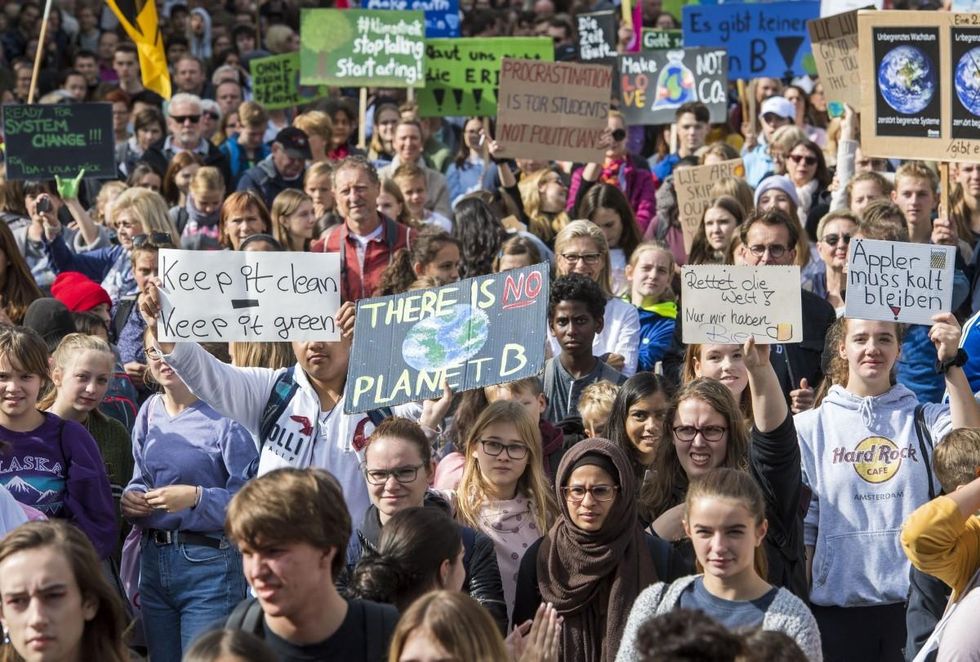
In Indonesia:
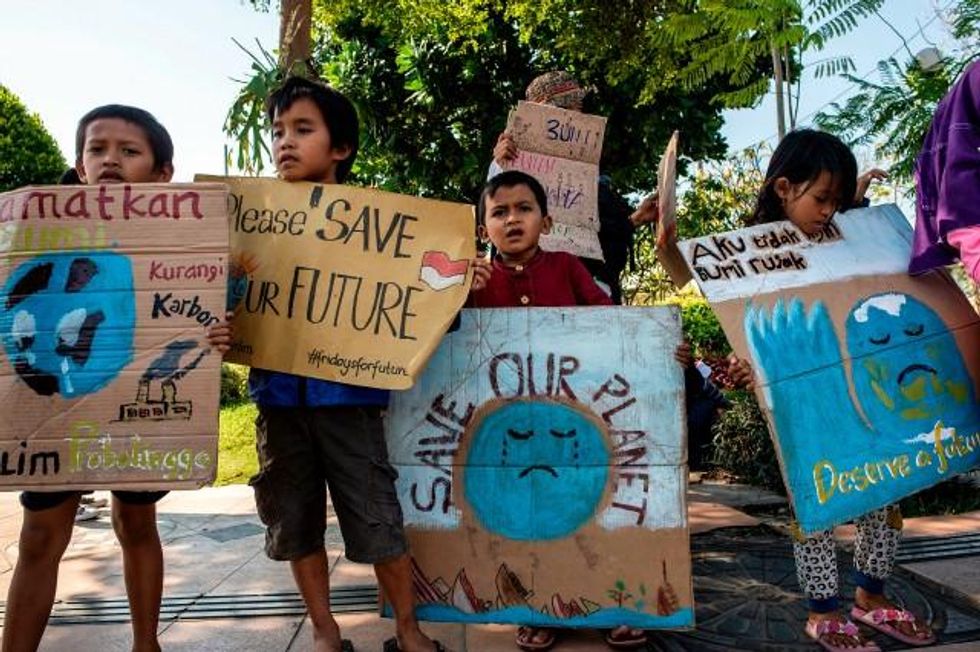
In Kenya:
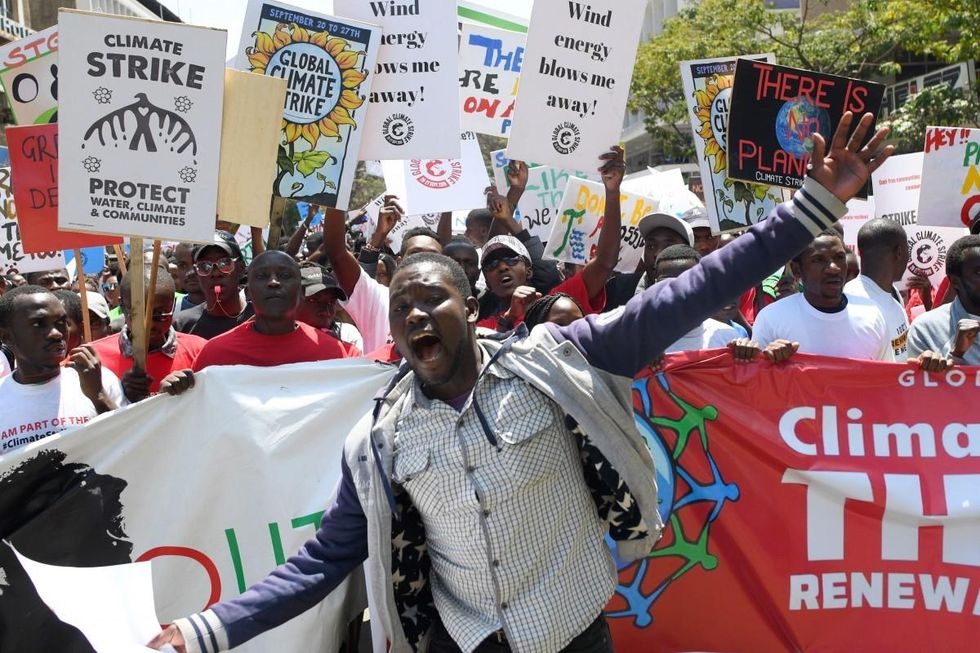
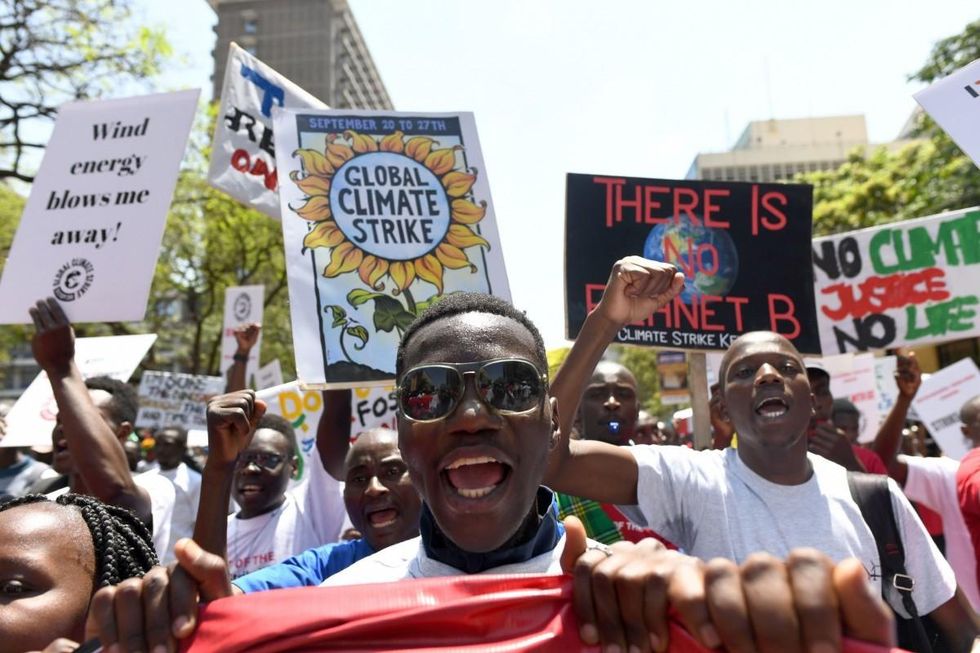
In India:
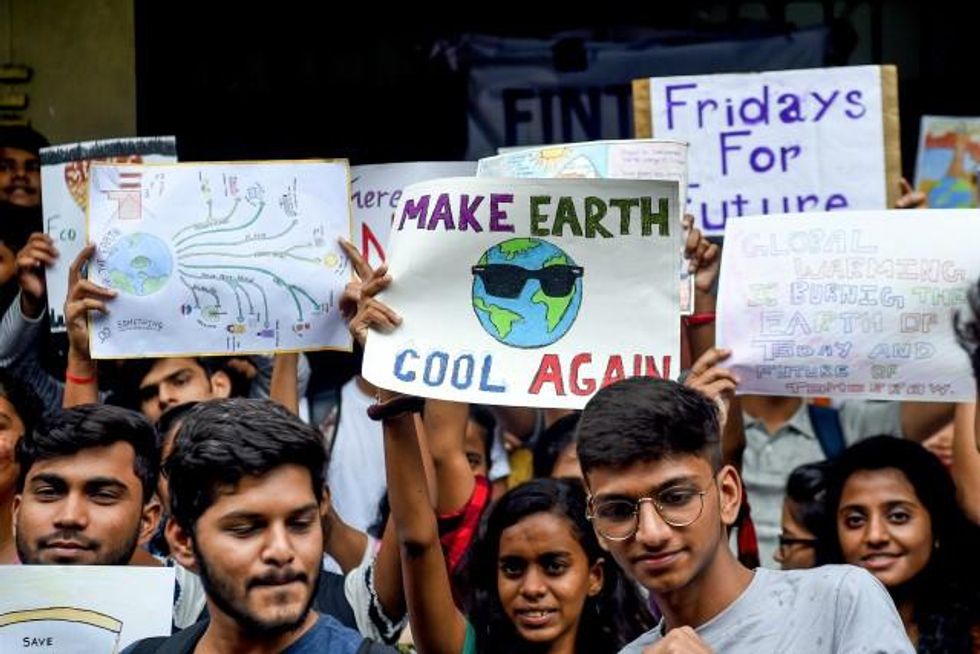
In Scotland:
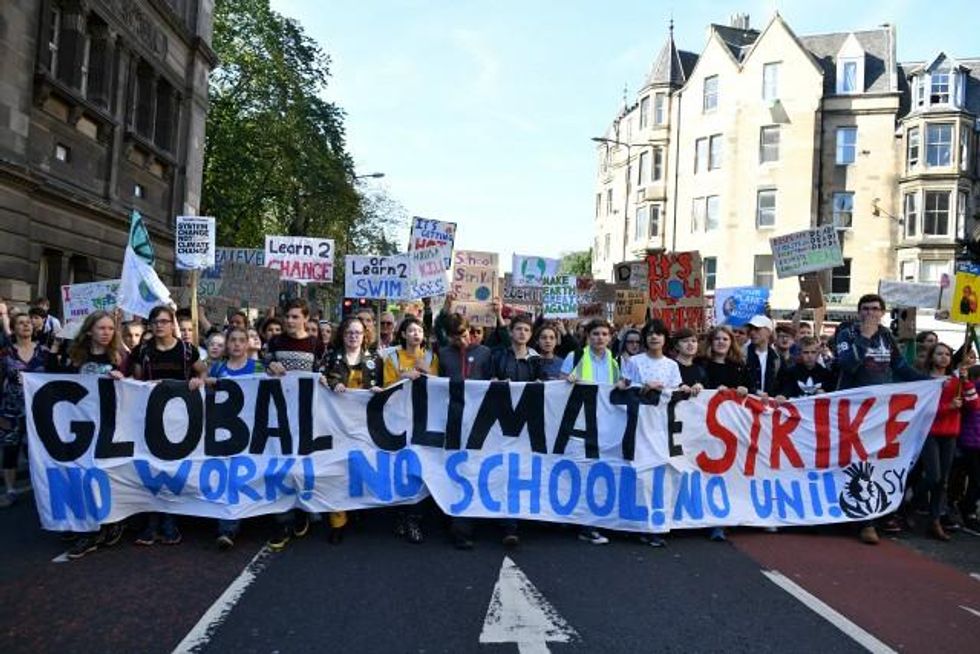
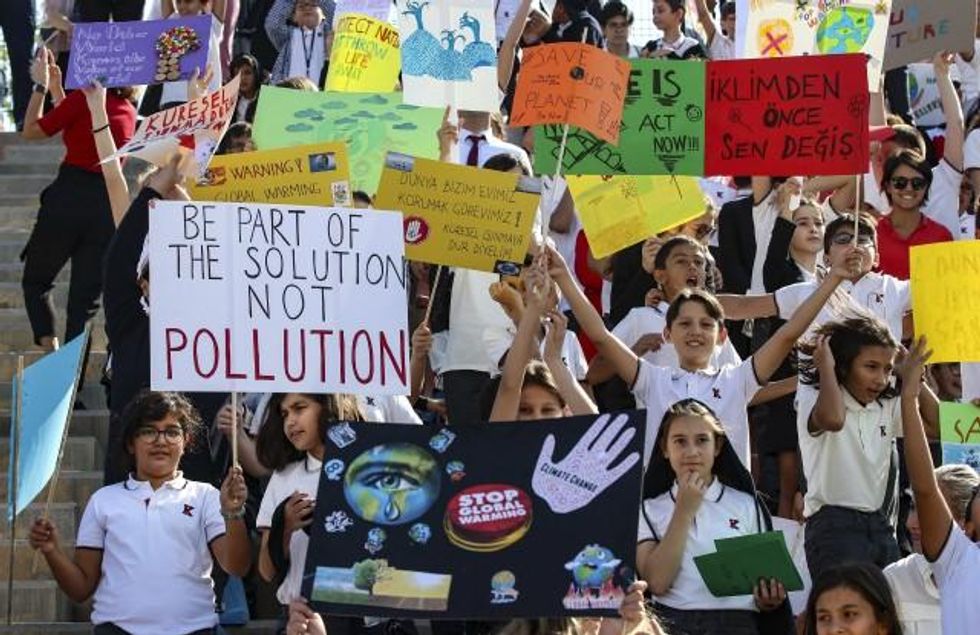
In Turkey:
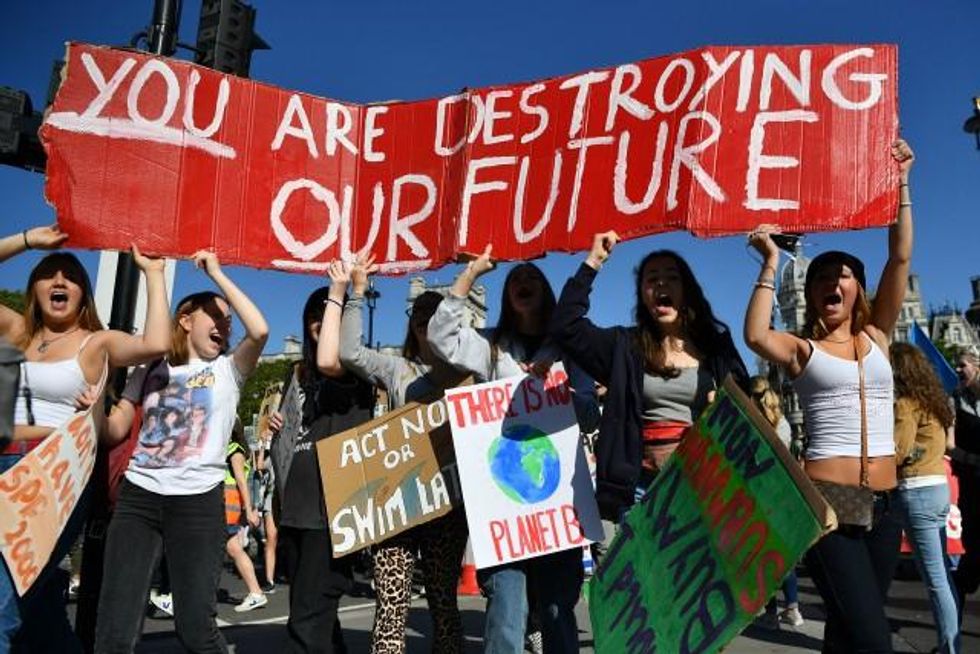
In England:
Check back for more additions and updates as the #ClimateStrike continues on Friday...
The German government announced Wednesday it had agreed on a plan to phase out the use of glyphosate--the key chemical in the weedkiller Roundup--with a total ban set to begin by the end of 2023.
"Way to go, Germany!" tweeted the U.S.-based advocacy group Organic Consumers Association.
Chancellor Angela Merkel's cabinet agreed to the plan Wednesday. The proposal, reported Bloomberg, also says that the "government intends to oppose any request for the E.U. to renew the license to produce the weedkiller, according to a release by the environment ministry."
The European Commission, the E.U.'s rules and regulations body, in 2017 renewed the license for glyphosate in the bloc through the end of 2022.
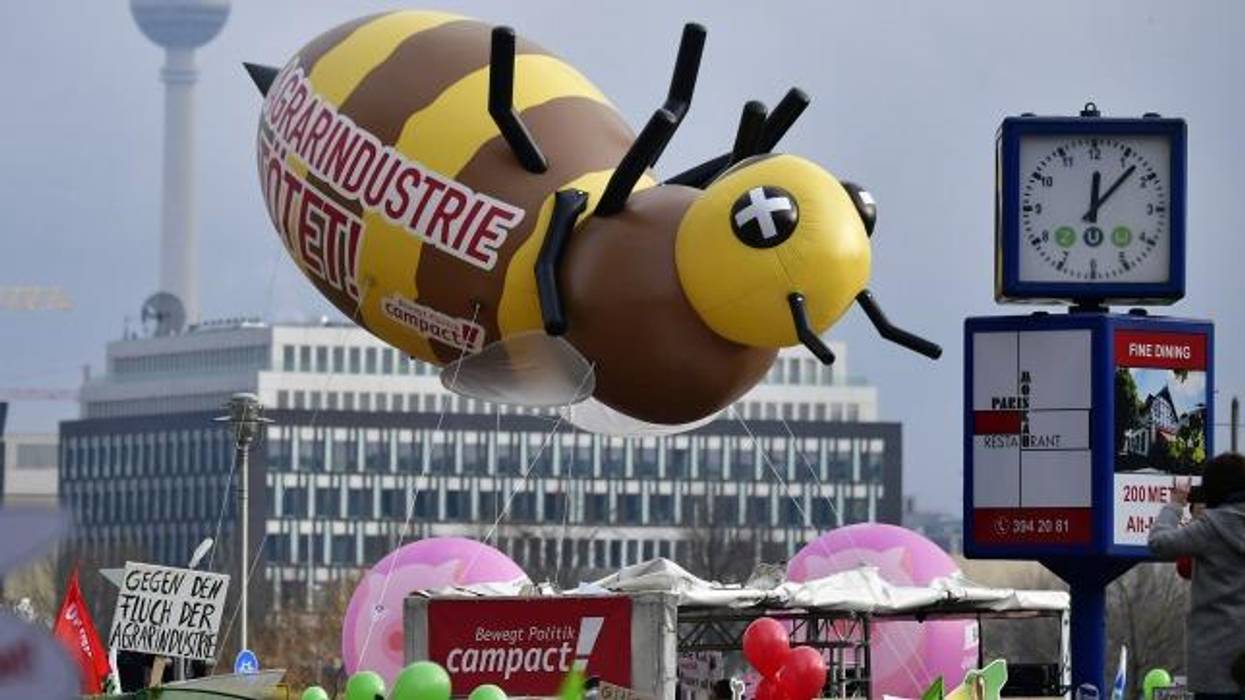
Germany's environment Minister, Svenja Schulze, framed the new move as necessary to protect biodiversity, and said that "a world without insects is not worth living in".
"What harms insects also harms people," Schulze said at a press conference. "What we need is more humming and buzzing."
Glyphosate is no longer exclusive to Monsanto's Roundup, as it "is now off-patent and marketed worldwide by dozens of other chemical groups including Dow Agrosciences and Germany's BASF," as Reuters noted.
That's despite the World Health Organization's International Agency for Research on Cancer's 2015 designation of glyphosate as a "probable carcinogen," increasing concerns over its health effects, and mounting legal woes for Bayer, which acquired Monsanto last year, as multiple juries have found Roundup to have been a factor in plaintiffs' cancers.
Such concerns prompted Austria to become the first E.U. country to ban glyphosate, a step it took in July.
Erwin Preiner, a member of the Austrian parliament who worked on the ban, said at the time, "We want to be a role model for other countries in the E.U. and the world."
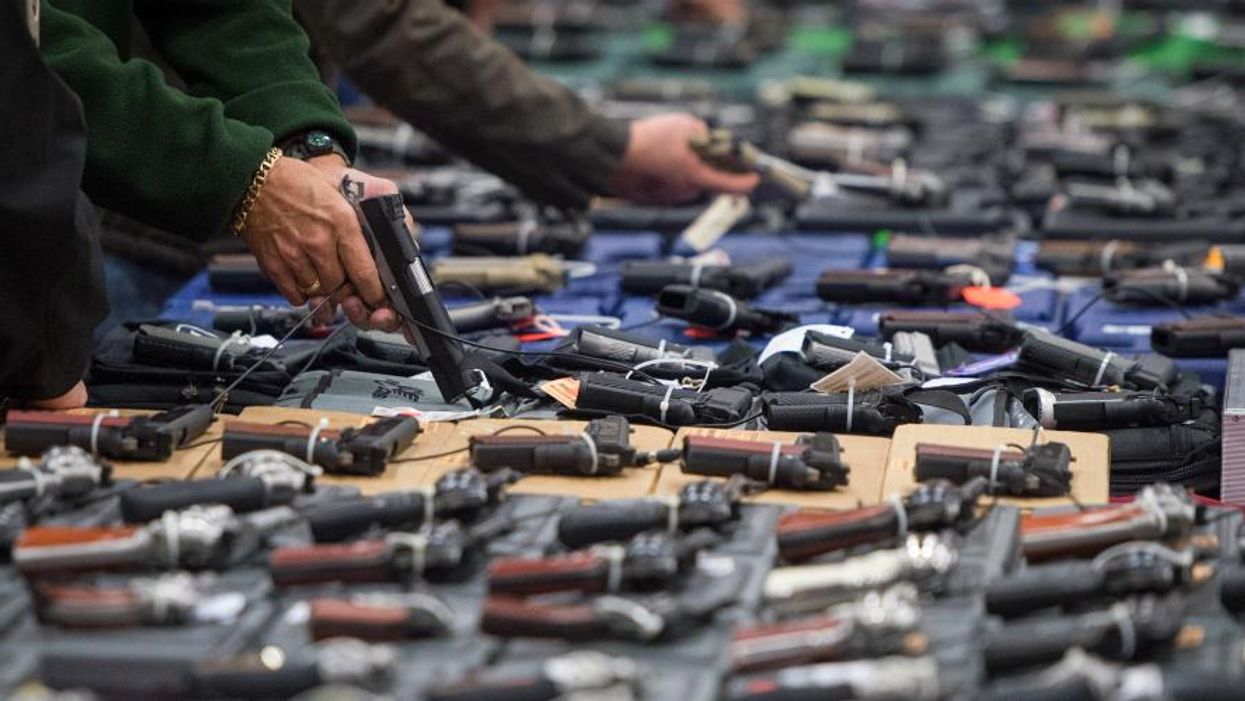
When gun exporters and importers gather at a trade conference at the Trump Hotel in Washington later this month, they will confront mixed trends in their industry.
Gun manufacturing in the United States fell sharply in the first year of the Trump presidency, by more than 27 percent -- a change widely attributed to gun buyers' confidence that Trump would maintain or expand commercial access to firearms, limiting the impulse to stock up over a short period of time. Gun imports into the United States have also dropped significantly, with pistol imports falling by over 20 percent from 2016 to 2018.
But reduced gun production was partly compensated by a record level of U.S. gun exports to other nations, which grew by nearly 30 percent in 2017. U.S. gun companies dramatically increased their firearms exports globally -- to 488,300 guns in 2017, more than in any year on record, according to a report by the Bureau of Alcohol, Tobacco, and Firearms (ATF). The United States exported even more firearms in 2018, according to U.S. Census Bureau data, and the Trump administration seeks to expand such exports even more.
Last year, the administration proposed a regulatory change to transfer the export licensing of guns to the much looser rules of the Commerce Department, which industry leaders expect will "significantly expand their opportunities," while removing congressional oversight and severely reducing the capacity to control the end uses of exported weapons.
The proposed rule would apply to sniper rifles, semi-automatic assault rifles, and other weapons used in warfare around the world. The change would also effectively deregulate the production of 3D-printed weapons, which are currently considered exports.
But the proposed change was set back on July 11, when the House of Representatives approved an amendment sponsored by Rep. Norma Torres (D-CA) to the National Defense Authorization Act (NDAA) that prohibits taking gun exports off the State Department's U.S. Munitions List.
The State Department Trashed Its Own Authority to Control Weapons Sales
The growth in U.S. gun sales outside the country occurred as the Trump administration's weapons export licensing agency was understaffed and in devastating disarray, according to a State Department Inspector General report in February.
The report found that the Directorate of Defense Trade Controls, which reviews and issues licenses to export weaponry, was 28 percent understaffed. The agency also had failed to notify Congress of arms sales as required by law, scrapped a unit for training officers, failed to consult the State Department's regional and human rights bureaus on proposed arms exports, and mistakenly approved an export license (later revoked) for more than a billion dollars of firearms to the Philippines.
Philippines police and military forces are credibly alleged to have committed thousands of extrajudicial killings under current President Rodrigo Duterte. Yet the United States shipped more than 86,000 semiautomatic handguns to the Philippines in 2018, more than six times as many as the previous year, according to U.S. International Trade Commission (USITC) records.
Nearly all of these weapons were Glock handguns exported from Georgia, a comparison of ATF and Census Bureau data reveals. Like other European gun producers, Glock has much moved its production from Austria to the United States to take advantage of the enormous U.S. police and civilian market as well as looser export laws.
Practically the entirety of the uptick in 2017 in foreign gun sales comes from pistols exported by New Hampshire-based Sig Sauer Inc., which more than doubled in number from 2016 to 177,414 pistols in 2017. Sig Sauer accounted for 64 percent of all pistols exported from the U.S. in 2017.
New Hampshire pistol exports amounted to $41.8 million in 2017, according to U.S. Census Bureau data. (Sig Sauer was virtually the only company to export pistols from New Hampshire in 2017, according to the ATF report.) The largest buyers were Thailand ($15 million), followed by United Arab Emirates (UAE, at $4.8 million), Canada, and Germany.
Foreign Gun Sales Were Even Higher in 2018
ATF doesn't publish detailed gun manufacturing and export data until a full year has passed, but the Census Bureau and U.S. International Trade Commission post the data monthly. Exports accounted for 6 percent of U.S. gun production in 2017, a portion that nearly doubled from 2016, when it was only 3.3 percent. The increased exports in 2018 suggest that portion has grown even more.
And total pistol exports from New Hampshire in 2018 grew to more than $64 million, about half more than in 2017. The biggest buyers in 2018 were Thailand -- which received a whopping $39.5 million worth of pistols from New Hampshire -- and UAE, which purchased $5.9 million worth. The UAE is waging war in Yemen, which has led to thousands of deaths and a humanitarian catastrophe.
In 2017, Congress was notified of two licenses for exporting 9mm pistols to Thailand valued at $93.9 million, as well as $48.6 million for five export licenses in various types of firearms to UAE.
Meanwhile, the U.S. exported more than 72 million bullets (valued at $125 million) to Afghanistan in 2018, far more than any other country, and more than eight times the dollar value of bullets exported to Afghanistan in 2017. Most of the ammunition was exported to Afghanistan from Kentucky and Indiana, Census Bureau data shows.
Four of the top ten recipients of ammunition last year were countries with relatively low levels of violence (Canada, Australia, Germany, and UK). But Israel received more than $26 million worth of bullets, while the Philippines received more than $14 million in ammo (most of it exported from Missouri).
Policy Options
Democrats in the House of Representatives have proposed legislation to stem gun violence, including proposals to ban assault weapons and high-capacity magazines. Such measures would have significant impacts in Mexico, where criminal organizations rely heavily on such weaponry, which can be purchased easily in the United States and trafficked over the border.
But it is crucial that the House Democratic majority also consider action to control and reduce the explosive growth of weapons exports to countries all over the world. The NDAA amendment approved by the House to prohibit the transfer of gun export licensing to the Commerce Department is an important step.
In May, more than 100 organizations called on Congress to stop the regulatory change, even proposing to prohibit the change through an NDAA amendment. The House amendment is part of the 1,200-plus-page military spending bill that will go to conference to be reconciled with the Senate version of the NDAA, which did not address gun export rules. The bill then goes to the White House for the president's signature.
More is required. Congress should hold hearings on the devastating atrocities committed with these weapons and fund (and require) the State Department to adequately control weapons export licenses. Organizations working to reduce gun violence should expand their sights to stopping violence from U.S. guns exported beyond our militarized borders. The lives of people all over the world hang in the balance.
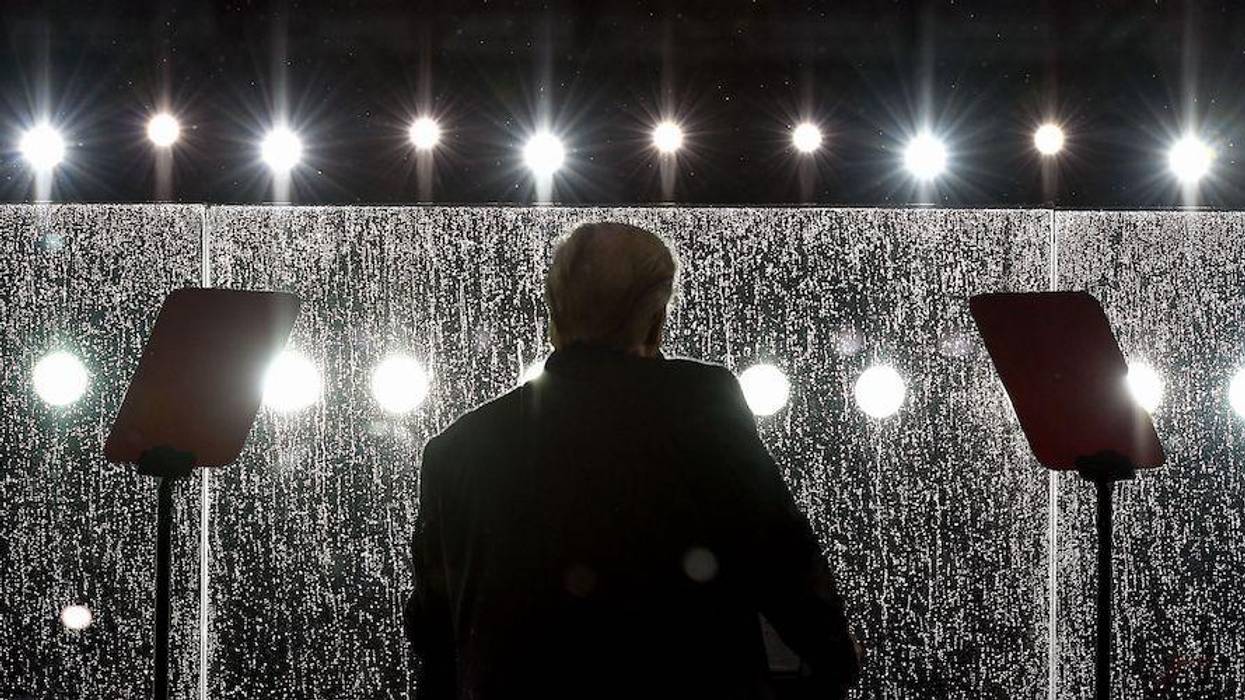
On March 12, 1938, the vaunted German army was to make its triumphant entry into Austria--the infamous Anschluss by which a compliant Austrian government surrendered to the Nazis without a shot.
A grand parade of the Third Reich's might was scheduled for the Austrian capital Vienna but the army's tanks were not as invincible as the generals bragged. They quickly broke down, clogging the roads, stalling the advance, and infuriating Adolph Hitler. And so, French author and filmmaker Eric Vuillard writes in his eloquent essay, The Order of the Day, "the German troops loaded as many tanks as they could onto railroad cars... the trains hauled away the armor the way you'd transport circus equipment." The tanks arrived in Vienna and the parade went on as planned.
It was that image of massive weapons as circus gear that flashed to mind this week when photos were released of tanks on railroad cars in Washington, DC, ready to be placed on display at our National Mall on the orders of Donald Trump. They were part of his plan to hijack the Fourth of July and make our nation's birthday all about him--a "Salute to America," featuring the tanks, military flyovers (including the Blue Angels and Air Force One) and a speech made by the man who calls himself, "Your favorite President, me!" The White House, the Republican National Committee, and the Trump reelect distributed VIP tickets.
As per The New York Times, "Pentagon officials have long been reluctant to parade tanks, missiles, and other weapons through the nation's capital like the authoritarian leaders of North Korea and China. They say the United States, which has the world's most powerful military and spends more on defense than the seven next largest military spenders combined--China, Saudi Arabia, India, France, Russia, Britain, and Germany--does not need to broadcast its strength."
Many former military weren't crazy about the idea either. Retired Army Lt. Gen. David Barno, who commanded troops under George W. Bush, told Politico, "This looks like it's becoming much more of a Republican Party event--a political event about the president--than a national celebration of the Fourth of July, and it's unfortunate to have the military smack dab in the middle of that." Retired Army Maj. Gen. William Nash added, "The president is using the armed forces in a political ploy for his reelection campaign and I think it's absolutely obscene."
(Mother Jones reported on Wednesday that soldiers assigned to the tanks and other armored vehicles plopped down among our national monuments had been given a card by the Pentagon about what to say to the public, including, "I am proud of my job and my vehicle/tank. I am glad to share my experience with American People.")
Anyone who has ever spent a Fourth of July in Washington knows that it's a festive fun day in the capital, albeit wilting hot and sopping humid, usually above politics, featuring a parade, a folk life festival, grand music, and fireworks. But this year, the steps of the Lincoln Memorial, usually a prime vantage point for watching the skyrockets, and the surrounding parkland were cordoned off for the invited guests so that they could watch our egomaniacal president and the first lady make a grand entrance across a red-carpeted stage at the spot where Marian Anderson sang "My Country, 'Tis of Thee" when she was barred from Constitution Hall by the DAR in 1939, and Martin Luther King, Jr., told an eager crowd in 1963 of his dreams for racial harmony and freedom.
Trump's attempt to wedge himself and his reelection into the festivities--using, in part, taxpayer millions diverted from much needed repairs of the national parks--had the grace of that clown who tries to photobomb a group portrait in the high school yearbook, making faces and wiggling fingers in his ears. The speech, which many feared would be a partisan attack similar to the rants he delivers at his campaign rallies, turned out to be standard if dull rhetoric that sounded more like the third-place winning essay in an eighth grade civics contest than a speech by our putative chief executive. It went on at such monotonous length that CNN actually cut away for a commercial break, something I have never in my life seen happen during a presidential address.
Standing behind a wall of bulletproof glass so rain streaked it appeared he was speaking from behind a car windshield during a cloudburst, Trump was at his best when quoting the eloquence of his predecessors rather than the boilerplate of his speechwriters. (Lincoln's "government of the people, by the people, for the people " was trundled out, but there was no mention of Abe's "malice toward none.") He lumbered through a rambling litany of moments in American history and named its greats, glossing over our sins, thanking all the branches of the military, and presenting notables in the audience who had been brought there, State of the Union-style, to be lauded for their achievements.
(One of them, Clarence Henderson, introduced by the president as among the first to participate in the Greensboro lunch counter sit-ins in 1960 and cited by Trump as an exemplar of the success ofcivil rights, has in recent years been an outspoken Trump supporter and president of the North Carolina chapter of the Frederick Douglass Foundation, a group that seeks, according to The Fayetteville Observer, "to grow the ranks of conservative Christian black Republicans.")
Aside from the verbal slips he inevitably stumbles into when reading from a teleprompter ("ramparts/airports") there was no groaner of an improvised joke or insult, although given his draft record, the call for young people to join the military was a little rich. That this failure to further embarrass the nation was cause for kudos from Republican leadership and some in the media gives an idea of how low we've let this man set the presidential performance bar.
But as conservative columnist Jennifer Rubin noted in The Washington Post, Trump misconstrues American traditions: "What should be a commemoration of human rights ('All men ... ') and the unwavering faith in the rule of law and in democratic governance in Trump's hands becomes a caffeinated Armed Services Day. He manages to transform a holiday about the greatest experiment in civilian self-government into a garish military Mardi Gras."
So why spend even a moment wringing hands over such an event when there are horrors perpetrated by this regime on an hourly basis that far eclipse some uninspiring oratory and slipshod pageantry? When Trump perpetually lies, makes policy mayhem worldwide, utters dark threats about the homeless and deportations and allows men, women, and children to cluster in overcrowded squalid cells along our southern border?
Why bother? Because, as Eric Vuillard writes of World War II in The Order of the Day, "Great catastrophes often creep up on us in tiny steps." Because on the same day a company donated $750,000 worth of free fireworks for Trump's Fourth of July party, he dropped a tariff on imported Chinese fireworks that same company had been lobbying against. Because every bit of graft like that, every small indignity inflicted, each gesture and symbol of disdain, are reflective of a greater, potentially fatal insult to democracy and a degradation of the greater good that was idealized by the men who signed the Declaration.
Because, Vuillard warns, "We never fall into the same abyss. But we always fall the same way, in a mixture of ridicule and dread."
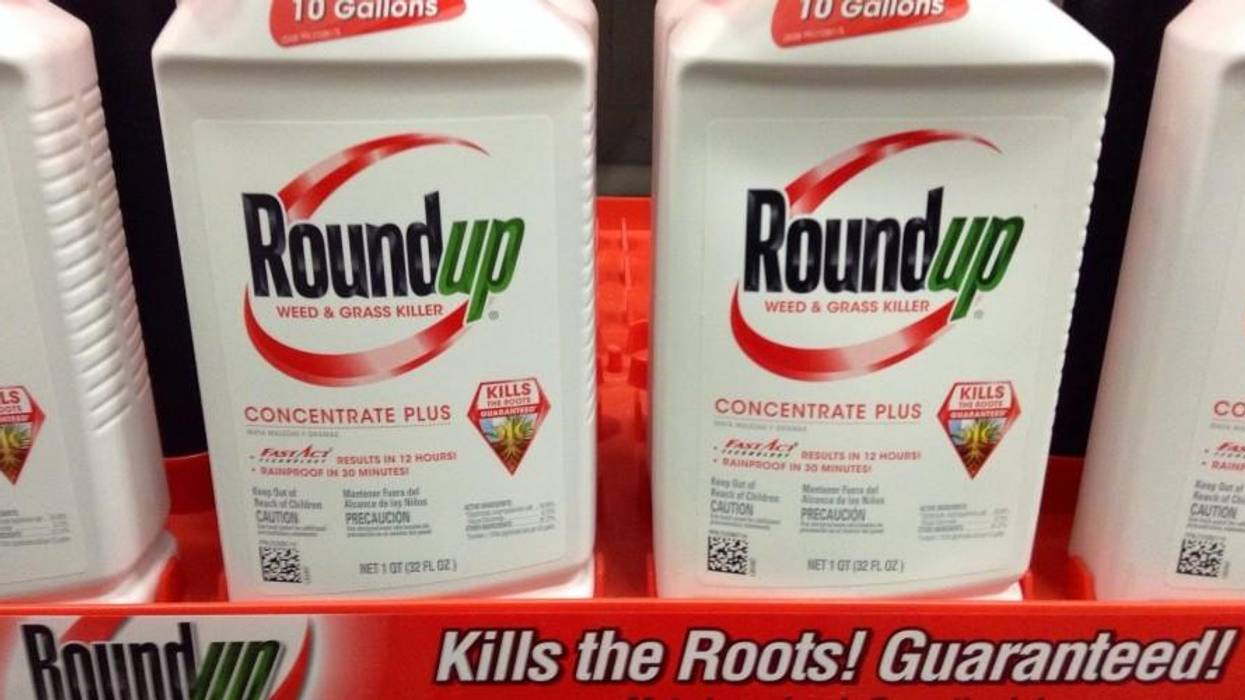
Austria is on track to become the first country in the European Union to fully ban the world's most commonly used herbicide after the nation's lower house of parliament passed a bill Tuesday that would outlaw all uses of glyphosate, which researchers and global health experts have tied to cancer.
"We want to be a role model for other countries in the E.U. and the world."
--Erwin Preiner, Austrian lawmaker
"The scientific evidence of the plant poison's carcinogenic effect is increasing," the leader of Austria's Social Democrats, Pamela Rendi-Wagner, said in a statement. "It is our responsibility to ban this poison from our environment."
Glyphosate is a key ingredient in Roundup--a product of Monsanto, a U.S. company that merged with German pharmaceutical giant Bayer last year. Reuters noted that "it is now off-patent and marketed worldwide by dozens of other chemical groups including Dow Agrosciences and Germany's BASF."
In 2015, glyphosate was classified as a "probable carcinogen" by the World Health Organization's International Agency for Research on Cancer. Despite that designation, mounting public concerns, and a series of ongoing legal battles launched by cancer patients in the United States, Bayer has maintained that Roundup is safe--and regulators in both the U.S. and E.U. have continued to permit the widespread use of the weed killer.
Katharina Rall, a researcher with the Environment and Human Rights Division at Human Rights Watch, welcomed Austrian lawmakers' move as "good news."
Following the lower chamber's vote Tuesday, German broadcaster Deutsche Welle reported that "unless Austria's upper house chooses to object the glyphosate ban, the bill will be signed into law by the country's president, Alexander Van der Bellen."
DW pointed out that the ban, if it takes effect, will put Austria at odds with the E.U. policy on glyphosate.
This ban would apparently clash with E.U. rules, as, in 2017, the bloc cleared the herbicide for use for the next five years. The E.U. relies on the European Food Safety Authority (EFSA) and the European Chemicals Agency which did not classify glyphosate as carcinogenic. However, reports from earlier this year indicated that some European regulators were copying and pasting from studies conducted by Monsanto itself.
A spokesperson for Bayer told the Wall Street Journal, "We expect the European Commission to review this decision critically, as it may be inconsistent with mandatory legal and procedural requirements and scientific reasoning."
The bill was also criticized on legal grounds by Austria's right-wing People's Party (OVP), which opposed the ban as "a slap in the face to farmers," as well as the country's sustainability ministry, which is responsible for agriculture and the environment.
However, Austria's far-right Freedom Party (FPO) joined with the liberal Neos party and the Social Democrats Tuesday in passing the bill. Putting that vote into context, Reuters explained that the country "is currently led by a provisional government of civil servants ahead of a parliamentary election expected in September. Political parties are forming shifting alliances to pass laws that appeal to their voters before parliament goes into recess this week until the election."
Erwin Preiner, a member of the Austrian parliament for the Social Democrats who worked on the ban, told the Journal, "We want to be a role model for other countries in the E.U. and the world."
As of 2017, Austria had the highest portion of organic farmland among all E.U. member states--23.4 percent, compared with the bloc's average of just 7 percent. Though Austria's action targeting glyphosate may be the boldest yet in Europe, the country is not alone in considering strict regulations of the weed killer.
"Among Austria's EU partners, France said in 2017 it hoped to ban glyphosate within three years, but President Emmanuel Macron has since said such a move could not be '100 percent,'" reported Agence France-Presse. "In May 2018, the French government pledged to ban glyphosate 'for its main uses' by 2021, and 'for all of its uses' within five years. In January 2019, French authorities banned the sale of Roundup Pro 360."