August, 23 2016, 10:30am EDT

Civil and Human Rights Coalition Calls for More International Election Monitors in U.S. Presidential Election
WASHINGTON
In advance of the first presidential election in 50 years without a fully operable Voting Rights Act (VRA), an American civil rights group is urging the Organization for Security and Cooperation in Europe (OSCE) to expand its election monitoring mission in the United States and to target resources to states where voter discrimination and intimidation is most likely.
In a letter sent to the OSCE from The Leadership Conference on Civil and Human Rights, the group explains that, "A confluence of factors has made the right to vote more vulnerable to racial discrimination than at any time in recent history. The need for additional election observers is paramount. The unprecedented weakening of the Voting Rights Act has led to a tidal wave of voter discrimination efforts nationwide and has required the United States to drastically scale back its own election monitoring program. In addition, a leading presidential candidate who has made the demonization of racial, ethnic, and religious minorities a hallmark of his campaign has recently urged supporters to challenge voters at polling sites nationwide."
The OSCE is an international multi-lateral organization that sends election monitors to its participating countries, including the United States. The OSCE has sent observers to every presidential election since 2002 and intends to send 500 observers for 2016.
In addition to expanding its mission, the group is urging the OSCE "to target its resources to states that have adopted discriminatory restrictions or will likely see enhanced voter intimidation efforts, including places like Pennsylvania, North Carolina, Alabama, Georgia, Arizona, Wisconsin, North Dakota, and Texas.
"The right to vote is more vulnerable now than at any time in the past 50 years," said Wade Henderson, president and CEO of The Leadership Conference on Civil and Human Rights. "Additional monitors can never replace what we lost when the VRA was gutted but we have to use every possible means to ensure the integrity of this election isn't compromised by racial discrimination and intimidation. We now have to fight in the courts and at ballot box for every voter and even our nation's best and most well-organized efforts will not meet the demand we're confronted with. Congress needs to restore the VRA immediately."
The letter is copied below.
August 20, 2016
Michael Georg Link, Director
Office of Democratic Institutions and Human Rights/
Organization for Security and Cooperation in Europe
Warsaw, Poland
Dear Director Link:
On behalf of The Leadership Conference on Civil and Human Rights, an organization committed to ensuring civil rights, including voting rights, for all Americans, we commend the Organization for Security and Cooperation in Europe (OSCE) for observing the 2016 election in the United States, as it has done in the previous three presidential election cycles.
We write now to emphasize that the OSCE's plans to monitor the upcoming U.S. presidential election will be more essential than ever before and to encourage the OSCE to greatly expand its election monitoring mission in the United States for this election.
A confluence of factors has made the right to vote more vulnerable to racial discrimination than at any time in recent history. The need for additional election observers is paramount. The unprecedented weakening of the Voting Rights Act has led to a tidal wave of voter discrimination efforts nationwide and has required the United States to drastically scale back its own election monitoring program. In addition, a leading presidential candidate who has made the demonization of racial, ethnic, and religious minorities a hallmark of his campaign has recently urged supporters to challenge voters at polling sites nationwide.[i]
This will be the first presidential election in 50 years without the full protections of the Voting Rights Act. Because of that, the U.S. Department of Justice (DOJ) will not be able to send objective election monitors to protect the rights of voters in the vast majority of places that were once covered by Section 5 of the Voting Rights Act.[ii] This means that in the states and localities most likely to enact laws and procedures to disenfranchise voters of color, our federal government will be unable to monitor its own election, making your work even more critical.
Election monitoring is an important component of our democratic process and serves as an additional means of protecting the rights of those who are most likely to be disenfranchised and least able to advocate for their right to vote. But the Department of Justice has determined that the Supreme Court's 2013 decision in Shelby County v. Holder invalidated the part of the Voting Rights Act that authorized it to send election monitors.
In the 2004 general election, the Department of Justice sent 1,463 federal observers to monitor 55 elections in 30 jurisdictions in 14 different states. Because of the Shelby decision, there will be virtually no election observers deployed in 2016.[iii]
According to a Democracy Journal column by a former Department of Justice official,[iv] "There are countless examples of the federal observer program being used to protect voters from racial discrimination at the polls," including:
- In 2012, federal observers monitoring an election in Shelby County, Alabama--the jurisdiction that sued to be removed from VRA preclearance in Shelby County v. Holder--documented the closing of doors on African-American voters before the voting hours were over, as well as voting officials using racial epithets to describe voters.
- That same year, observers were sent to Alameda and Riverside counties in California to gather information regarding reports of serious failures to provide language assistance to voters who needed it.
- In 2011, a federal court relied on observer reports to conclude that Sandoval County, New Mexico, had effectively disenfranchised members of the Keres tribe.
- In 2010, during the early voting period in Harris County, Texas, federal observers documented intimidation and harassment targeting Latino and African-American voters by an organized, well-funded Texas-based organization with clear partisan electoral goals.
Because of the Shelby decision, none of these instances of voter discrimination would likely be prevented or stopped in 2016.
The 2016 presidential campaign has seen a resurgence of bigoted rhetoric against racial, ethnic, and religious minorities, and a former leader of a violent White supremacist hate group, the Ku Klux Klan, is a candidate for the U.S. Senate.
Now a presidential candidate -- who has made demonizing minorities a central part of his campaign strategy -- is encouraging his supporters to challenge voters at polls in "certain sections" of Pennsylvania, an apparent reference to 59 mostly African-American precincts.[v] Efforts at voter intimidation stemming back to the mid-1970s resulted in a federal court banning the Republican Party from engaging in challenge and intimidation efforts aimed at voters of color.[vi]
Non-governmental civil rights and voting rights organizations will also monitor the election where possible, but even the most well-funded and well-organized efforts can't replace the loss of federal election observers or combat a nationwide effort to intimidate voters of color. Voters of color need every possible protection available to them to ensure they can register and cast a ballot. Your ability to shine an international spotlight on this situation is an important component of that protection.
A nationwide litigation effort since the Shelby decision has sought to blunt the tidal wave of voter discrimination laws that were enacted by states and cities. Recent court victories turning back a few of these laws have proven that these efforts are widespread, require massive investments of time and money to litigate, and intentionally discriminate against voters of color. It took years of litigation to strike down intentionally discriminatory laws, meaning countless voters have already been denied the right to cast ballots in the 2014 mid-term election and in this year's presidential primaries. And efforts to ensure that local election officials are complying with those court orders is one important aspect of election observation.
But for every discriminatory statewide law that can be litigated for years, there are countless city, county, and school board changes to voting districts, precinct locations, poll hours, early voting, and new barriers to registering and voting that will never be challenged in court.
Accordingly, we urge the OSCE to greatly expand its election monitoring program in the United States and to target its resources to states that have adopted discriminatory restrictions or will likely see enhanced voter intimidation efforts, including places like Pennsylvania, North Carolina, Alabama, Georgia, Arizona, Wisconsin, North Dakota, and Texas.
We welcome the opportunity to work with the OSCE Election Observation Mission and its international monitors to ensure a free and fair election in the United States. We are available to meet with you and your team at your earliest convenience.
Cc:
Katarzyna Jarosiewicz-Wargan, First Deputy Director of the Office for Democratic Institutions and Human Rights
Alexander Shlyk, Head of the Elections Department of ODIHR
Richard Lappin, Deputy Head of the Elections Department of ODIHR
Sincerely,
Wade Henderson, President & CEO
Nancy Zirkin, Executive Vice President
[i] https://www.washingtonpost.com/news/the-fix/wp/2016/08/13/how-donald-trumps-bizarre-voter-watch-effort-could-get-the-gop-in-trouble/
[v] https://www.washingtonpost.com/news/the-fix/wp/2016/08/12/donald-trump-says-hell-only-lose-pennsylvania-where-hes-down-9-points-is-if-cheating-goes-on/
The Leadership Conference on Civil and Human Rights is a coalition charged by its diverse membership of more than 200 national organizations to promote and protect the civil and human rights of all persons in the United States. Through advocacy and outreach to targeted constituencies, The Leadership Conference works toward the goal of a more open and just society - an America as good as its ideals.
(202) 466-3311LATEST NEWS
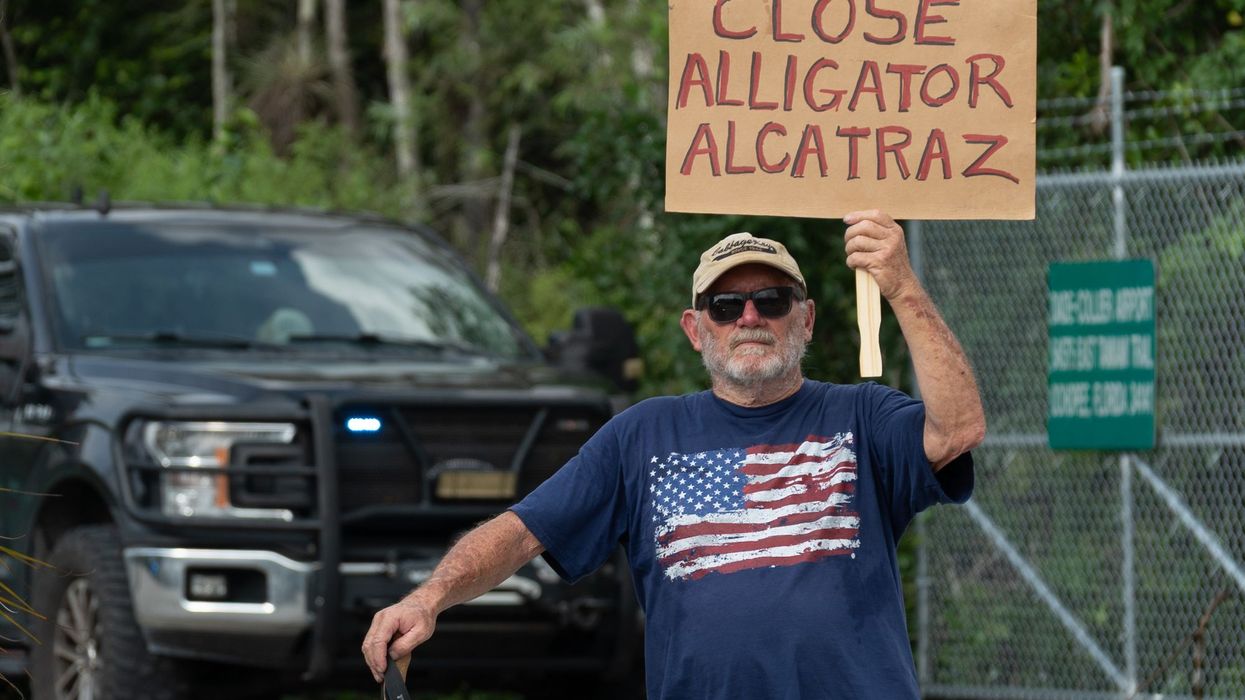
'A Human Rights Disaster': Report Details Torture and Chaos at 'Alligator Alcatraz'
Conditions at Florida detention facilities "represent a deliberate system of cruelty designed to punish people seeking to build a new life in the US,” said an official at Amnesty International.
Dec 04, 2025
Two immigration detention centers in Florida have gained notoriety for inhumane conditions since Republican Gov. Ron DeSantis, in close alignment with President Donald Trump's anti-immigrant agenda, has rapidly scaled up mass detention in the state, and a report released Thursday detailed how human rights violations at the two facilities amount to torture in some cases.
Amnesty International published the report, Torture and Enforced Disappearances in the Sunshine State, with a focus on Krome North Service Processing Center and the Everglades Detention Facility, also known by its nickname, "Alligator Alcatraz."
As Common Dreams has reported, many of the people detained at the facilities have been arbitrarily rounded up by immigration agents, with a majority of the roughly 1,000 people being held at Alligator Alcatraz having been convicted of no criminal offense as of July.
Amnesty's report described unsanitary conditions, with fecal matter overflowing from toilets in detainees' sleeping areas, authorities granting only limited access to showers, and poor quality food and water.
Some of the treatment amounts to torture, the report says, including Alligator Alcatraz's use of "the box"—a 2x2 foot "cage-like structure people are put in as punishment—which inmates have been placed in for hours at a time with their hands and feet attached to restraints on the ground.
“These despicable and nauseating conditions at Alligator Alcatraz reflect a pattern of deliberate neglect designed to dehumanize and punish those detained there,” said Amy Fischer, director of refugee and migrant rights with Amnesty International USA. “This is unreal—where’s the oversight?”
At Krome, detainees have been arbitrarily placed in prolonged solitary confinement—defined as lasting longer than 15 days—which is prohibited under international law.
"The use of prolonged solitary confinement at Krome and the use of the ‘box’ at 'Alligator Alcatraz' amount to torture or other ill-treatment," said Amnesty.
The report elevates concerns raised in September by immigrant rights advocates regarding the lack of federal oversight at Alligator Alcatraz, with nearly 1,000 men detained at the prison having been "administratively disappeared"—their names absent from US Immigration and Customs Enforcement's detainee locator system.
"The absence of registration or tracking mechanisms for those detained at Alligator Alcatraz facilitates incommunicado detention and constitutes enforced disappearances when the whereabouts of a person being detained there is denied to their family, and they are not allowed to contact their lawyer," said Amnesty.
The state of Florida has not publicly confirmed the number of people detained at Alligator Alcatraz.
One man told Amnesty, "My lawyers tried to visit me, but they weren’t let in. They were told that they had to fill out a form, which they did, but nothing happened. I was never able to speak with them confidentially.”
At Krome, detainees described overcrowding, medical neglect, and abuse by guards when Amnesty researchers visited in September. ICE has constructed tents and other semi-permanent structures to hold more people than the facility is designed to detain.
The Amnesty researchers were given a tour of relatively extensive medical facilities at Krome, including a dialysis clinic, dental clinic, and a "state-of-the-art" mental health facility—but despite these resources, detainees described officials' failure to provide medical treatment and delays in health assessments. Four people—Ramesh Amechand, Genry Ruiz Guillen, Maksym Chernyak, and Isidro Pérez—have died this year while detained at Krome.
"It’s a disaster if you want to see the doctor," one man told Amnesty. "I once asked to see the doctor, and it took two weeks for me to finally see him. It’s very slow.”
Researchers with the organization witnessed "a guard violently slam a metal flap of a door to a solitary confinement room against a man’s injured hand," and people reported being "hit and punched" by officials at Krome.
In line with the Trump administration, DeSantis and Republican state lawmakers have sought to make Florida "a testing ground for abusive immigration enforcement policies," said Amnesty, with the state deputizing local law enforcement to make immigration arrests and issuing 34 no-bid contracts totaling more than $360 million for the operation of Alligator Alcatraz—while slashing spending on healthcare, food assistance, and disaster relief. Florida has increased the number of people in immigration detention by more than 50% since Trump took office in January.
The organization called on Florida to redirect detention funding toward healthcare, housing, and other public spending, and to ban "shackling, solitary confinement, and punitive outdoor confinement" in line with international standards.
"At the federal level, the US government must end its cruel mass immigration detention machine, stop the criminalization of migration, and bar the use of state-owned facilities for federal immigration custody," said Amnesty.
Fischer emphasized that the chaotic and abusive conditions Amnesty observed at Alligator Alcatraz and Krome "are not isolated."
"They represent a deliberate system of cruelty designed to punish people seeking to build a new life in the US,” said Fischer. “We must stop detaining our immigrant community members and people seeking safety and instead work toward humane, rights-respecting migration policies.”
Keep ReadingShow Less

'Pro-White Collar Crime': Trump Pardons Former Executive Indicted by His Own DOJ
"This president serves the ultra-wealthy—not working people," said one watchdog group.
Dec 04, 2025
US President Donald Trump on Wednesday granted a full, unconditional pardon to former entertainment venue executive Tim Leiweke, who was indicted just months ago by Trump's own Justice Department for "orchestrating a conspiracy to rig the bidding process for an arena at a public university."
Leiweke, who expressed "profound gratitude" for the pardon, stepped down as CEO of Oak View Group in July, on the same day that the Justice Department’s Antitrust Division announced the indictment.
The longtime sports executive was accused of conspiring with the CEO of a competitor to rig bidding for the development of the $375 million, 15,000-seat Moody Center at the University of Texas at Austin. Assistant Attorney General Abigail Slater said the scheme "deprived a public university and taxpayers of the benefits of competitive bidding."
Leiweke pleaded not guilty to the charge, which carried a maximum prison sentence of 10 years.
Bloomberg observed that the pardon comes "just before Leiweke is scheduled to be deposed by lawyers for the Justice Department and Live Nation Entertainment Inc. on Thursday in the DOJ’s separate civil antitrust case against the company and its subsidiary Ticketmaster."
"Leiweke earlier unsuccessfully tried to avoid the deposition, citing liability from then pending criminal charges, according to court records," Bloomberg added.
Federal investigators have accused Oak View Group, Leiweke's former company, of quietly receiving kickbacks for promoting Ticketmaster services at Oak View Group venues.
The pardon was announced on the same day that Trump granted clemency to US Rep. Henry Cuellar (D-Texas), who faced bribery and money laundering charges. Days earlier, the president commuted the prison sentence of a former private equity executive convicted of defrauding more than 10,000 investors.
"Private equity CEO David Gentile was sentenced to seven years for defrauding investors of 1.6 BILLION," the watchdog group Public Citizen wrote Wednesday. "But Trump commuted his sentence. This isn't the first time Trump has helped the corporate class evade accountability. This president serves the ultra-wealthy—not working people."
Antitrust advocate Matt Stoller accused Trump of advancing a "straightforward pro-white collar crime agenda" by using his pardon power to rescue fraudsters from prison time.
"Trump's pro-white collar crime agenda seems pretty open at this point," Stoller wrote in response to the Cuellar pardon.
As the New York Times reported earlier this year, Trump has employed "the vast power of his office to redefine criminality to suit his needs—using pardons to inoculate criminals he happens to like, downplaying corruption and fraud as crimes, and seeking to stigmatize political opponents by labeling them criminals."
"An offshoot of this strategy is relegating white-collar offenses to a rank of secondary importance behind violent and property crimes," the Times noted. "He has even tried to create a new red-alert category—what he calls 'immigrant crime,' even though studies have shown that immigrants are not more likely to commit violent offenses than people born in the country."
Keep ReadingShow Less

Trump Regulators Ripped for 'Rushed' Approval of Bill Gates' Nuclear Reactor in Wyoming
"Make no mistake, this type of reactor has major safety flaws compared to conventional nuclear reactors that comprise the operating fleet," said one expert.
Dec 03, 2025
A leading nuclear safety expert sounded the alarm Tuesday over the Trump administration's expedited safety review of an experimental nuclear reactor in Wyoming designed by a company co-founded by tech billionaire Bill Gates and derided as a "Cowboy Chernobyl."
On Monday, the US Nuclear Regulatory Commission (NRC) announced that it has "completed its final safety evaluation" for Power Station Unit 1 of TerraPower's Natrium reactor in Kemmerer, Wyoming, adding that it found "no safety aspects that would preclude issuing the construction permit."
Co-founded by Microsoft's Gates, TerraPower received a 50-50 cost-share grant for up to $2 billion from the US Department of Energy’s Advanced Reactor Demonstration Program. The 345-megawatt sodium-cooled small modular reactor (SMR) relies upon so-called passive safety features that experts argue could potentially make nuclear accidents worse.
However, federal regulators "are loosening safety and security requirements for SMRs in ways which could cancel out any safety benefits from passive features," according to Union of Concerned Scientists nuclear power safety director Edwin Lyman.
"The only way they could pull this off is by sweeping difficult safety issues under the rug."
The reactor’s construction permit application—which was submitted in March 2024—was originally scheduled for August 2026 completion but was expedited amid political pressure from the Trump administration and Congress in order to comply with an 18-month timeline established in President Donald Trump’s Executive Order 14300.
“The NRC’s rush to complete the Kemmerer plant’s safety evaluation to meet the recklessly abbreviated schedule dictated by President Trump represents a complete abandonment of its obligation to protect public health, safety, and the environment from catastrophic nuclear power plant accidents or terrorist attacks," Lyman said in a statement Tuesday.
Lyman continued:
The only way the staff could finish its review on such a short timeline is by sweeping serious unresolved safety issues under the rug or deferring consideration of them until TerraPower applies for an operating license, at which point it may be too late to correct any problems. Make no mistake, this type of reactor has major safety flaws compared to conventional nuclear reactors that comprise the operating fleet. Its liquid sodium coolant can catch fire, and the reactor has inherent instabilities that could lead to a rapid and uncontrolled increase in power, causing damage to the reactor’s hot and highly radioactive nuclear fuel.
Of particular concern, NRC staff has assented to a design that lacks a physical containment structure to reduce the release of radioactive materials into the environment if a core melt occurs. TerraPower argues that the reactor has a so-called "functional" containment that eliminates the need for a real containment structure. But the NRC staff plainly states that it "did not come to a final determination of the adequacy and acceptability of functional containment performance due to the preliminary nature of the design and analysis."
"Even if the NRC determines later that the functional containment is inadequate, it would be utterly impractical to retrofit the design and build a physical containment after construction has begun," Lyman added. "The potential for rapid power excursions and the lack of a real containment make the Kemmerer plant a true ‘Cowboy Chernobyl.’”
The proposed reactor still faces additional hurdles before construction can begin, including a final environmental impact assessment. However, given the Trump administration's dramatic regulatory rollback, approval and construction are highly likely.
Former NRC officials have voiced alarm over the Trump administration's tightened control over the agency, which include compelling it to send proposed reactor safety rules to the White House for review and possible editing.
Allison Macfarlane, who was nominated to head the NRC during the Obama administration, said earlier this year that Trump's approach marks “the end of independence of the agency.”
“If you aren’t independent of political and industry influence, then you are at risk of an accident,” she warned.
Keep ReadingShow Less
Most Popular