

SUBSCRIBE TO OUR FREE NEWSLETTER
Daily news & progressive opinion—funded by the people, not the corporations—delivered straight to your inbox.
5
#000000
#FFFFFF
To donate by check, phone, or other method, see our More Ways to Give page.
Daily news & progressive opinion—funded by the people, not the corporations—delivered straight to your inbox.
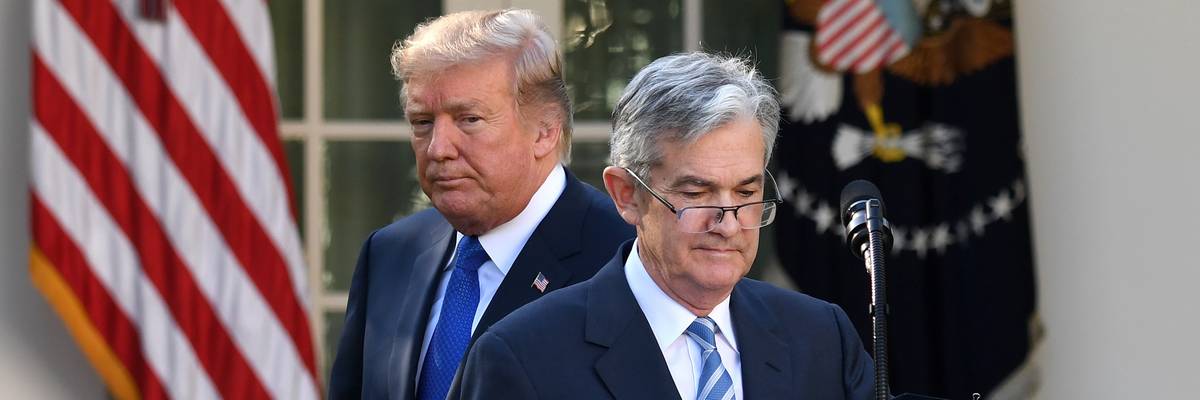
Then-U.S. President Donald Trump and Federal Reserve Chair Jerome Powell were pictured at a White House ceremony on January 23, 2018.
"Under such an approach, the chair would regularly seek Trump's views on interest-rate policy and then negotiate with the committee to steer policy on the president's behalf," The Wall Street Journal reported.
Right-wing allies of former U.S. President Donald Trump are reportedly crafting a plan to give the executive branch control over Federal Reserve policy decisions, an effort that comes as the presumptive GOP nominee continues to signal his authoritarian intentions for a potential second term.
The Wall Street Journal reported Thursday that former Trump administration officials and other supporters of the ex-president "have in recent months discussed a range of proposals, from incremental policy changes to a long-shot assertion that the president himself should play a role in setting interest rates."
"A small group of the president's allies—whose work is so secretive that even some prominent former Trump economic aides weren't aware of it—has produced a roughly 10-page document outlining a policy vision for the central bank," the Journal reported. "The group of Trump allies argues that he should be consulted on interest-rate decisions, and the draft document recommends subjecting Fed regulations to White House review and more forcefully using the Treasury Department as a check on the central bank. The group also contends that Trump, if he returns to the White House, would have the authority to oust Jerome Powell as Fed chair before his four-year term ends in 2026."
During his first four years in the White House, Trump repeatedly criticized Powell—whom the former president appointed in 2017—over the central bank's interest rate policy and insisted he had the authority to oust the Fed chair before the end of his term. The Fed is an independent body subject to limited congressional oversight.
"I have the right to do that," Trump said in 2019 of ousting Powell. "I'm not happy with his actions, I don't think he's done a good job."
The Fed, still under Powell's leadership, has since jacked up interest rates to their highest level in decades in an attempt to combat inflation—an approach that progressive lawmakers and economists have criticized as misguided, arguing that prices were elevated primarily by pandemic-related supply chain disruptions and corporate profiteering and that hiking rates would harm workers. (Progressives have historically pushed for Fed reforms that would make the powerful central bank more accountable to the public.)
Late last year, Trump said interest rates were "too high" but did not say he would pressure the central bank to lower them, saying: "Depends where inflation is. But I would get inflation down."
More recently, Trump suggested the Fed's indication that rate cuts are coming in the near future as inflation cools is a political ploy to "help the Democrats."
"It looks to me like he's trying to lower interest rates for the sake of maybe getting people elected, I don't know," Trump said in a Fox Business appearance in February.
Economist Paul Krugman predicted in his New York Times column earlier this year that "Trumpist attacks on the Fed for cutting interest rates are coming."
"What we don't know is how the Fed will react," Krugman wrote. "In a recent dialogue with me about the economy, my colleague Peter Coy suggested that the Fed may be inhibited from cutting rates because it'll fear accusations from Trump that it's trying to help Biden. I hope Fed officials understand that they'll be betraying their responsibilities if they let themselves be intimidated in this way."
"And I hope that forewarned is forearmed," he added. "MAGA attacks on the Fed are coming; they should be treated as the bad-faith bullying they are."
The Journal reported Thursday that "several people who have spoken with Trump about the Fed said he appears to want someone in charge of the institution who will, in effect, treat the president as an ex officio member of the central bank's rate-setting committee."
"Under such an approach, the chair would regularly seek Trump's views on interest-rate policy and then negotiate with the committee to steer policy on the president's behalf," the newspaper continued. "Some of the former president's advisers have discussed requiring that candidates for Fed chair privately agree to consult informally with Trump on the central bank's decisions... Others have made the case that Trump himself could sit on the Fed's board of governors on an acting basis, an option that several people close to the former president described as far-fetched."
According to earlier Journal reporting, Trump's team has discussed several possible replacements for Powell, including former White House economic adviser Kevin Hassett and Arthur Laffer, a former Reagan adviser and notorious tax-cut enthusiast.
Trump allies' plot to help the former president exert control over Fed policy if he's reelected in November provides further insight into the presumptive Republican nominee's likely approach to a second term.
During his 2024 campaign, Trump—who is facing 88 charges across four criminal cases—has vowed to be a dictator on "day one," wield federal authority to go after his political opponents, launch the "largest domestic deportation operation in American history," and use the U.S. military to crack down on protests.
"If a president is truly determined to make himself a dictator, the question at the end of the day is whether the military and other force-deploying agencies of the federal government are willing to go along," Josh Chafetz, a constitutional law professor at Georgetown University, told The Washington Post in a recent interview. "If they are, there's not much Congress or the courts could do about it."
Dear Common Dreams reader, It’s been nearly 30 years since I co-founded Common Dreams with my late wife, Lina Newhouser. We had the radical notion that journalism should serve the public good, not corporate profits. It was clear to us from the outset what it would take to build such a project. No paid advertisements. No corporate sponsors. No millionaire publisher telling us what to think or do. Many people said we wouldn't last a year, but we proved those doubters wrong. Together with a tremendous team of journalists and dedicated staff, we built an independent media outlet free from the constraints of profits and corporate control. Our mission has always been simple: To inform. To inspire. To ignite change for the common good. Building Common Dreams was not easy. Our survival was never guaranteed. When you take on the most powerful forces—Wall Street greed, fossil fuel industry destruction, Big Tech lobbyists, and uber-rich oligarchs who have spent billions upon billions rigging the economy and democracy in their favor—the only bulwark you have is supporters who believe in your work. But here’s the urgent message from me today. It's never been this bad out there. And it's never been this hard to keep us going. At the very moment Common Dreams is most needed, the threats we face are intensifying. We need your support now more than ever. We don't accept corporate advertising and never will. We don't have a paywall because we don't think people should be blocked from critical news based on their ability to pay. Everything we do is funded by the donations of readers like you. When everyone does the little they can afford, we are strong. But if that support retreats or dries up, so do we. Will you donate now to make sure Common Dreams not only survives but thrives? —Craig Brown, Co-founder |
Right-wing allies of former U.S. President Donald Trump are reportedly crafting a plan to give the executive branch control over Federal Reserve policy decisions, an effort that comes as the presumptive GOP nominee continues to signal his authoritarian intentions for a potential second term.
The Wall Street Journal reported Thursday that former Trump administration officials and other supporters of the ex-president "have in recent months discussed a range of proposals, from incremental policy changes to a long-shot assertion that the president himself should play a role in setting interest rates."
"A small group of the president's allies—whose work is so secretive that even some prominent former Trump economic aides weren't aware of it—has produced a roughly 10-page document outlining a policy vision for the central bank," the Journal reported. "The group of Trump allies argues that he should be consulted on interest-rate decisions, and the draft document recommends subjecting Fed regulations to White House review and more forcefully using the Treasury Department as a check on the central bank. The group also contends that Trump, if he returns to the White House, would have the authority to oust Jerome Powell as Fed chair before his four-year term ends in 2026."
During his first four years in the White House, Trump repeatedly criticized Powell—whom the former president appointed in 2017—over the central bank's interest rate policy and insisted he had the authority to oust the Fed chair before the end of his term. The Fed is an independent body subject to limited congressional oversight.
"I have the right to do that," Trump said in 2019 of ousting Powell. "I'm not happy with his actions, I don't think he's done a good job."
The Fed, still under Powell's leadership, has since jacked up interest rates to their highest level in decades in an attempt to combat inflation—an approach that progressive lawmakers and economists have criticized as misguided, arguing that prices were elevated primarily by pandemic-related supply chain disruptions and corporate profiteering and that hiking rates would harm workers. (Progressives have historically pushed for Fed reforms that would make the powerful central bank more accountable to the public.)
Late last year, Trump said interest rates were "too high" but did not say he would pressure the central bank to lower them, saying: "Depends where inflation is. But I would get inflation down."
More recently, Trump suggested the Fed's indication that rate cuts are coming in the near future as inflation cools is a political ploy to "help the Democrats."
"It looks to me like he's trying to lower interest rates for the sake of maybe getting people elected, I don't know," Trump said in a Fox Business appearance in February.
Economist Paul Krugman predicted in his New York Times column earlier this year that "Trumpist attacks on the Fed for cutting interest rates are coming."
"What we don't know is how the Fed will react," Krugman wrote. "In a recent dialogue with me about the economy, my colleague Peter Coy suggested that the Fed may be inhibited from cutting rates because it'll fear accusations from Trump that it's trying to help Biden. I hope Fed officials understand that they'll be betraying their responsibilities if they let themselves be intimidated in this way."
"And I hope that forewarned is forearmed," he added. "MAGA attacks on the Fed are coming; they should be treated as the bad-faith bullying they are."
The Journal reported Thursday that "several people who have spoken with Trump about the Fed said he appears to want someone in charge of the institution who will, in effect, treat the president as an ex officio member of the central bank's rate-setting committee."
"Under such an approach, the chair would regularly seek Trump's views on interest-rate policy and then negotiate with the committee to steer policy on the president's behalf," the newspaper continued. "Some of the former president's advisers have discussed requiring that candidates for Fed chair privately agree to consult informally with Trump on the central bank's decisions... Others have made the case that Trump himself could sit on the Fed's board of governors on an acting basis, an option that several people close to the former president described as far-fetched."
According to earlier Journal reporting, Trump's team has discussed several possible replacements for Powell, including former White House economic adviser Kevin Hassett and Arthur Laffer, a former Reagan adviser and notorious tax-cut enthusiast.
Trump allies' plot to help the former president exert control over Fed policy if he's reelected in November provides further insight into the presumptive Republican nominee's likely approach to a second term.
During his 2024 campaign, Trump—who is facing 88 charges across four criminal cases—has vowed to be a dictator on "day one," wield federal authority to go after his political opponents, launch the "largest domestic deportation operation in American history," and use the U.S. military to crack down on protests.
"If a president is truly determined to make himself a dictator, the question at the end of the day is whether the military and other force-deploying agencies of the federal government are willing to go along," Josh Chafetz, a constitutional law professor at Georgetown University, told The Washington Post in a recent interview. "If they are, there's not much Congress or the courts could do about it."
Right-wing allies of former U.S. President Donald Trump are reportedly crafting a plan to give the executive branch control over Federal Reserve policy decisions, an effort that comes as the presumptive GOP nominee continues to signal his authoritarian intentions for a potential second term.
The Wall Street Journal reported Thursday that former Trump administration officials and other supporters of the ex-president "have in recent months discussed a range of proposals, from incremental policy changes to a long-shot assertion that the president himself should play a role in setting interest rates."
"A small group of the president's allies—whose work is so secretive that even some prominent former Trump economic aides weren't aware of it—has produced a roughly 10-page document outlining a policy vision for the central bank," the Journal reported. "The group of Trump allies argues that he should be consulted on interest-rate decisions, and the draft document recommends subjecting Fed regulations to White House review and more forcefully using the Treasury Department as a check on the central bank. The group also contends that Trump, if he returns to the White House, would have the authority to oust Jerome Powell as Fed chair before his four-year term ends in 2026."
During his first four years in the White House, Trump repeatedly criticized Powell—whom the former president appointed in 2017—over the central bank's interest rate policy and insisted he had the authority to oust the Fed chair before the end of his term. The Fed is an independent body subject to limited congressional oversight.
"I have the right to do that," Trump said in 2019 of ousting Powell. "I'm not happy with his actions, I don't think he's done a good job."
The Fed, still under Powell's leadership, has since jacked up interest rates to their highest level in decades in an attempt to combat inflation—an approach that progressive lawmakers and economists have criticized as misguided, arguing that prices were elevated primarily by pandemic-related supply chain disruptions and corporate profiteering and that hiking rates would harm workers. (Progressives have historically pushed for Fed reforms that would make the powerful central bank more accountable to the public.)
Late last year, Trump said interest rates were "too high" but did not say he would pressure the central bank to lower them, saying: "Depends where inflation is. But I would get inflation down."
More recently, Trump suggested the Fed's indication that rate cuts are coming in the near future as inflation cools is a political ploy to "help the Democrats."
"It looks to me like he's trying to lower interest rates for the sake of maybe getting people elected, I don't know," Trump said in a Fox Business appearance in February.
Economist Paul Krugman predicted in his New York Times column earlier this year that "Trumpist attacks on the Fed for cutting interest rates are coming."
"What we don't know is how the Fed will react," Krugman wrote. "In a recent dialogue with me about the economy, my colleague Peter Coy suggested that the Fed may be inhibited from cutting rates because it'll fear accusations from Trump that it's trying to help Biden. I hope Fed officials understand that they'll be betraying their responsibilities if they let themselves be intimidated in this way."
"And I hope that forewarned is forearmed," he added. "MAGA attacks on the Fed are coming; they should be treated as the bad-faith bullying they are."
The Journal reported Thursday that "several people who have spoken with Trump about the Fed said he appears to want someone in charge of the institution who will, in effect, treat the president as an ex officio member of the central bank's rate-setting committee."
"Under such an approach, the chair would regularly seek Trump's views on interest-rate policy and then negotiate with the committee to steer policy on the president's behalf," the newspaper continued. "Some of the former president's advisers have discussed requiring that candidates for Fed chair privately agree to consult informally with Trump on the central bank's decisions... Others have made the case that Trump himself could sit on the Fed's board of governors on an acting basis, an option that several people close to the former president described as far-fetched."
According to earlier Journal reporting, Trump's team has discussed several possible replacements for Powell, including former White House economic adviser Kevin Hassett and Arthur Laffer, a former Reagan adviser and notorious tax-cut enthusiast.
Trump allies' plot to help the former president exert control over Fed policy if he's reelected in November provides further insight into the presumptive Republican nominee's likely approach to a second term.
During his 2024 campaign, Trump—who is facing 88 charges across four criminal cases—has vowed to be a dictator on "day one," wield federal authority to go after his political opponents, launch the "largest domestic deportation operation in American history," and use the U.S. military to crack down on protests.
"If a president is truly determined to make himself a dictator, the question at the end of the day is whether the military and other force-deploying agencies of the federal government are willing to go along," Josh Chafetz, a constitutional law professor at Georgetown University, told The Washington Post in a recent interview. "If they are, there's not much Congress or the courts could do about it."

