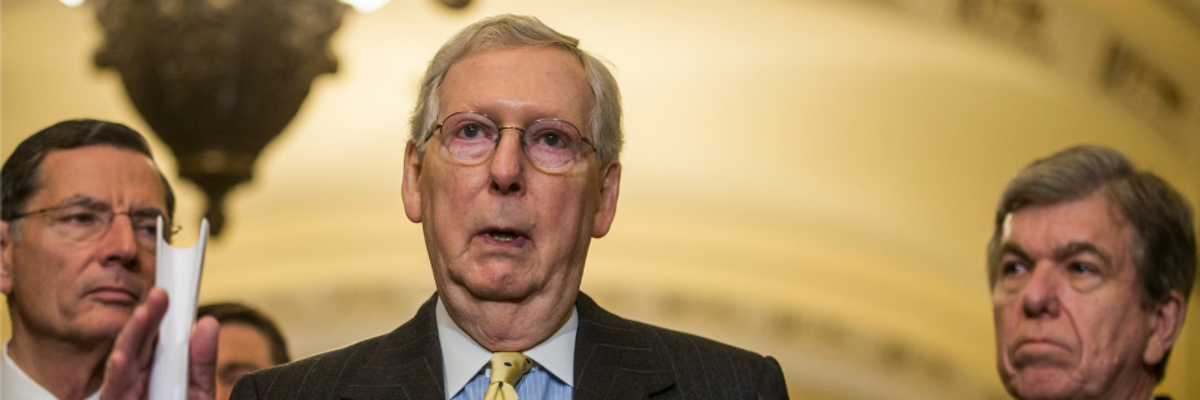
Senate Majority Leader Mitch McConnell (R-Ky.) speaks during a news conference on April 2, 2019 in Washington, D.C. (Photo: Zach Gibson/Getty Images)
McConnell Dubbed 'Moscow Mitch' for Blocking Debate on Election Security Bill Just As Senate Report Details 2016 Russian Interference
"Moscow Mitch should be the focus of everyone who cares about America. Forget the current occupant of the White House, he is irrelevant without Mitch providing his safety net."
Senate Majority Leader Mitch McConnell earned the nickname "Moscow Mitch" Friday after blocking lawmakers from taking action to prevent foreign interference in U.S. elections just as the legislature he leads concluded that Russians meddled in the 2016 elections in all 50 states.
MSNBC's "Morning Joe" anchor, Joe Scarborough, coined the name on his show Friday morning, condemning the Kentucky Republican for refusing to defend the country's electoral system when McConnell blocked the Senate from considering a House bill which would strengthen election systems across the country, mandate the use of paper ballots to prevent election results from being hacked, and require all campaigns to notify authorities if they are offered assistance from a foreign country.
The nickname took off on social media:
As McConnell blocked lawmakers from debating the bill, the Republican-led Senate Intelligence Committee concluded that "cyberactors" in Russia waged "an unprecedented level of activity against state election infrastructure" during the 2016 elections, interfering with elections in all 50 states. While there was no evidence that Russians changed any votes cast by U.S. voters, they "were in a position to delete or change voter data" in some states.
"McConnell is right! Legislation to secure our elections is partisan. And the fact that it's partisan shows just how pathological the Republican Party has become in its determination to hold on to power."
--Paul WaldmanThe committee said it appeared that Russia "intended to exploit vulnerabilities in the election infrastructure during the 2016 elections and, for unknown reasons, decided not to execute those options"--and may have been conducting research into possible methods of interference "for use at a later date."
As Scarborough noted, McConnell's refusal to consider the legislation also came a day after former Special Counsel Robert Mueller testified before the House Judiciary Committee, warning lawmakers that "many more countries" are developing the ability to disrupt American elections and that without requiring campaigns and candidates to publicize efforts by foreign countries to aid them, foreign meddling could become "the new normal."
Mueller's report concluded that in 2016, Trump's son, Donald, Jr., welcomed a meeting with a Russian official who offered incriminating information about his father's opponent, Hillary Clinton. Trump's re-election campaign has refused to commit to notifying the federal government if they are offered help in 2020.
"How can Moscow Mitch so willingly turn a blind eye not only this year to what his Republican chairman of the Intel Committee is saying, to what Robert Mueller is saying, to what the FBI director is saying, to what the DNI is saying, to what the CIA is saying, to what the United States military [intelligence] community is saying?" said Scarborough.
McConnell dismissed the proposals to protect U.S. elections as "highly partisan."
As journalist Paul Waldman wrote at The Washington Post, "McConnell is right! Legislation to secure our elections is partisan."
"And the fact that it's partisan," he added, "shows just how pathological the Republican Party has become in its determination to hold on to power."
Urgent. It's never been this bad.
Dear Common Dreams reader, It’s been nearly 30 years since I co-founded Common Dreams with my late wife, Lina Newhouser. We had the radical notion that journalism should serve the public good, not corporate profits. It was clear to us from the outset what it would take to build such a project. No paid advertisements. No corporate sponsors. No millionaire publisher telling us what to think or do. Many people said we wouldn't last a year, but we proved those doubters wrong. Together with a tremendous team of journalists and dedicated staff, we built an independent media outlet free from the constraints of profits and corporate control. Our mission from the outset was simple. To inform. To inspire. To ignite change for the common good. Building Common Dreams was not easy. Our survival was never guaranteed. When you take on the most powerful forces—Wall Street greed, fossil fuel industry destruction, Big Tech lobbyists, and uber-rich oligarchs who have spent billions upon billions rigging the economy and democracy in their favor—the only bulwark you have is supporters who believe in your work. But here’s the urgent message from me today. It’s never been this bad out there. And it’s never been this hard to keep us going. At the very moment Common Dreams is most needed and doing some of its best and most important work, the threats we face are intensifying. Right now, with just two days to go in our Spring Campaign, we're falling short of our make-or-break goal. When everyone does the little they can afford, we are strong. But if that support retreats or dries up, so do we. Can you make a gift right now to make sure Common Dreams not only survives but thrives? There is no backup plan or rainy day fund. There is only you. —Craig Brown, Co-founder |
Senate Majority Leader Mitch McConnell earned the nickname "Moscow Mitch" Friday after blocking lawmakers from taking action to prevent foreign interference in U.S. elections just as the legislature he leads concluded that Russians meddled in the 2016 elections in all 50 states.
MSNBC's "Morning Joe" anchor, Joe Scarborough, coined the name on his show Friday morning, condemning the Kentucky Republican for refusing to defend the country's electoral system when McConnell blocked the Senate from considering a House bill which would strengthen election systems across the country, mandate the use of paper ballots to prevent election results from being hacked, and require all campaigns to notify authorities if they are offered assistance from a foreign country.
The nickname took off on social media:
As McConnell blocked lawmakers from debating the bill, the Republican-led Senate Intelligence Committee concluded that "cyberactors" in Russia waged "an unprecedented level of activity against state election infrastructure" during the 2016 elections, interfering with elections in all 50 states. While there was no evidence that Russians changed any votes cast by U.S. voters, they "were in a position to delete or change voter data" in some states.
"McConnell is right! Legislation to secure our elections is partisan. And the fact that it's partisan shows just how pathological the Republican Party has become in its determination to hold on to power."
--Paul WaldmanThe committee said it appeared that Russia "intended to exploit vulnerabilities in the election infrastructure during the 2016 elections and, for unknown reasons, decided not to execute those options"--and may have been conducting research into possible methods of interference "for use at a later date."
As Scarborough noted, McConnell's refusal to consider the legislation also came a day after former Special Counsel Robert Mueller testified before the House Judiciary Committee, warning lawmakers that "many more countries" are developing the ability to disrupt American elections and that without requiring campaigns and candidates to publicize efforts by foreign countries to aid them, foreign meddling could become "the new normal."
Mueller's report concluded that in 2016, Trump's son, Donald, Jr., welcomed a meeting with a Russian official who offered incriminating information about his father's opponent, Hillary Clinton. Trump's re-election campaign has refused to commit to notifying the federal government if they are offered help in 2020.
"How can Moscow Mitch so willingly turn a blind eye not only this year to what his Republican chairman of the Intel Committee is saying, to what Robert Mueller is saying, to what the FBI director is saying, to what the DNI is saying, to what the CIA is saying, to what the United States military [intelligence] community is saying?" said Scarborough.
McConnell dismissed the proposals to protect U.S. elections as "highly partisan."
As journalist Paul Waldman wrote at The Washington Post, "McConnell is right! Legislation to secure our elections is partisan."
"And the fact that it's partisan," he added, "shows just how pathological the Republican Party has become in its determination to hold on to power."
Senate Majority Leader Mitch McConnell earned the nickname "Moscow Mitch" Friday after blocking lawmakers from taking action to prevent foreign interference in U.S. elections just as the legislature he leads concluded that Russians meddled in the 2016 elections in all 50 states.
MSNBC's "Morning Joe" anchor, Joe Scarborough, coined the name on his show Friday morning, condemning the Kentucky Republican for refusing to defend the country's electoral system when McConnell blocked the Senate from considering a House bill which would strengthen election systems across the country, mandate the use of paper ballots to prevent election results from being hacked, and require all campaigns to notify authorities if they are offered assistance from a foreign country.
The nickname took off on social media:
As McConnell blocked lawmakers from debating the bill, the Republican-led Senate Intelligence Committee concluded that "cyberactors" in Russia waged "an unprecedented level of activity against state election infrastructure" during the 2016 elections, interfering with elections in all 50 states. While there was no evidence that Russians changed any votes cast by U.S. voters, they "were in a position to delete or change voter data" in some states.
"McConnell is right! Legislation to secure our elections is partisan. And the fact that it's partisan shows just how pathological the Republican Party has become in its determination to hold on to power."
--Paul WaldmanThe committee said it appeared that Russia "intended to exploit vulnerabilities in the election infrastructure during the 2016 elections and, for unknown reasons, decided not to execute those options"--and may have been conducting research into possible methods of interference "for use at a later date."
As Scarborough noted, McConnell's refusal to consider the legislation also came a day after former Special Counsel Robert Mueller testified before the House Judiciary Committee, warning lawmakers that "many more countries" are developing the ability to disrupt American elections and that without requiring campaigns and candidates to publicize efforts by foreign countries to aid them, foreign meddling could become "the new normal."
Mueller's report concluded that in 2016, Trump's son, Donald, Jr., welcomed a meeting with a Russian official who offered incriminating information about his father's opponent, Hillary Clinton. Trump's re-election campaign has refused to commit to notifying the federal government if they are offered help in 2020.
"How can Moscow Mitch so willingly turn a blind eye not only this year to what his Republican chairman of the Intel Committee is saying, to what Robert Mueller is saying, to what the FBI director is saying, to what the DNI is saying, to what the CIA is saying, to what the United States military [intelligence] community is saying?" said Scarborough.
McConnell dismissed the proposals to protect U.S. elections as "highly partisan."
As journalist Paul Waldman wrote at The Washington Post, "McConnell is right! Legislation to secure our elections is partisan."
"And the fact that it's partisan," he added, "shows just how pathological the Republican Party has become in its determination to hold on to power."