SUBSCRIBE TO OUR FREE NEWSLETTER
Daily news & progressive opinion—funded by the people, not the corporations—delivered straight to your inbox.
5
#000000
#FFFFFF
To donate by check, phone, or other method, see our More Ways to Give page.
Daily news & progressive opinion—funded by the people, not the corporations—delivered straight to your inbox.
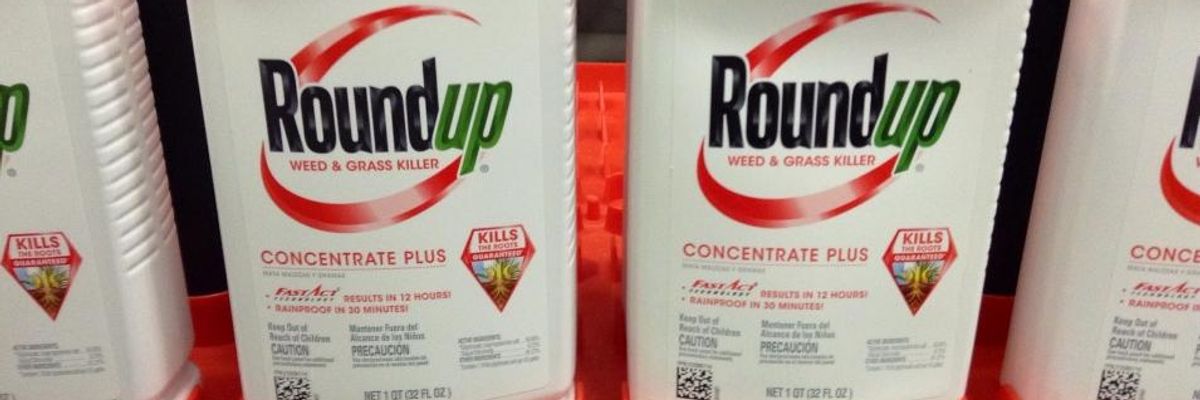
A California judge on Monday upheld a verdict against Monsanto but slashed the $289 million the company had been ordered to pay. (Photo: Mike Mozart/Flickr)
A judge in California on Monday upheld a landmark verdict in a case brought by a terminal cancer patient who successfully argued his illness resulted from his exposure to Monsanto's weedkiller RoundUp, but slashed the damages the agrochemical giant was originally required to pay from $289 million down to just $78 million and said she would order a retrial if former groundskeeper Dewayne "Lee" Johnson rejects the payout.
"The evidence presented to this jury was, quite frankly, overwhelming... We are happy the jury's voice was acknowledged by the Court, even if slightly muted."
--Johnson's team
Jurors had come forward to demand that San Francisco Superior Court Judge Suzanne Bolanos respect their historic verdict, issued in August. The judge had been considering a request for a retrial from Monsanto, but decided (pdf) instead to cut the punitive damages from $250 to $39 million.
A spokeswoman for Johnson, a 46-year-old father of three who is battling non-Hodgkin lymphoma, and his lawyers told NBC News, "Although we believe a reduction in punitive damages was unwarranted and we are weighing the options, we are pleased the court did not disturb the verdict." They have until Dec. 7 to make a decision.
While Johnson's team considers their next move, critics of Monsanto--which recently merged with the German pharmaceutical company Bayer and ditched its name--celebrated that Bolanos upheld the verdict. The Organic Consumers Association tweeted:
While Monsanto maintains that its herbicides "are safe when used as directed," the state of California and the International Agency for Research on Cancer (IARC)--a branch of the World Health Organization (WHO)--have classified glyphosate, RoundUp's active ingredient, as a probable human carcinogen. Despite that designation, U.S. and European regulators still allow farmers to use the world's most common herbicide.
"The evidence presented to this jury was, quite frankly, overwhelming. And, as we saw in recent days, this jury was intelligent, diligent, and followed the letter of the law. We are happy the jury's voice was acknowledged by the Court, even if slightly muted," Johnson's team added. "We are still reviewing whether we will accept the proposed remittitur or retry the punitive damages. That said, today is a triumph for our legal system."
Bayer, meanwhile, said in a statement that the judge's ruling was "a step in the right direction, but we continue to believe that the liability verdict and damage awards are not supported by the evidence at trial or the law and plan to file an appeal with the California Court of Appeal."
No matter the ultimate outcome, Johnson's case was the first to go to trial and opened the door for other cancer patients seeking to hold Monsanto accountable. In July, even before the initial verdict, a federal judge ruled that hundreds of similar cases could proceed to trial. According to U.S. Right to Know, some 8,000 plaintiffs have alleged in state court that the company's products have made them sick.
"I hope [Monsanto] gets the message that people in America and across the world are not ignorant. They have already done their own research," Johnson told the Guardian late last month. "I'm hoping that it snowballs and people really get the picture and they start to make decisions about what they eat, what they spray in their farms."
Dear Common Dreams reader, It’s been nearly 30 years since I co-founded Common Dreams with my late wife, Lina Newhouser. We had the radical notion that journalism should serve the public good, not corporate profits. It was clear to us from the outset what it would take to build such a project. No paid advertisements. No corporate sponsors. No millionaire publisher telling us what to think or do. Many people said we wouldn't last a year, but we proved those doubters wrong. Together with a tremendous team of journalists and dedicated staff, we built an independent media outlet free from the constraints of profits and corporate control. Our mission has always been simple: To inform. To inspire. To ignite change for the common good. Building Common Dreams was not easy. Our survival was never guaranteed. When you take on the most powerful forces—Wall Street greed, fossil fuel industry destruction, Big Tech lobbyists, and uber-rich oligarchs who have spent billions upon billions rigging the economy and democracy in their favor—the only bulwark you have is supporters who believe in your work. But here’s the urgent message from me today. It's never been this bad out there. And it's never been this hard to keep us going. At the very moment Common Dreams is most needed, the threats we face are intensifying. We need your support now more than ever. We don't accept corporate advertising and never will. We don't have a paywall because we don't think people should be blocked from critical news based on their ability to pay. Everything we do is funded by the donations of readers like you. When everyone does the little they can afford, we are strong. But if that support retreats or dries up, so do we. Will you donate now to make sure Common Dreams not only survives but thrives? —Craig Brown, Co-founder |
A judge in California on Monday upheld a landmark verdict in a case brought by a terminal cancer patient who successfully argued his illness resulted from his exposure to Monsanto's weedkiller RoundUp, but slashed the damages the agrochemical giant was originally required to pay from $289 million down to just $78 million and said she would order a retrial if former groundskeeper Dewayne "Lee" Johnson rejects the payout.
"The evidence presented to this jury was, quite frankly, overwhelming... We are happy the jury's voice was acknowledged by the Court, even if slightly muted."
--Johnson's team
Jurors had come forward to demand that San Francisco Superior Court Judge Suzanne Bolanos respect their historic verdict, issued in August. The judge had been considering a request for a retrial from Monsanto, but decided (pdf) instead to cut the punitive damages from $250 to $39 million.
A spokeswoman for Johnson, a 46-year-old father of three who is battling non-Hodgkin lymphoma, and his lawyers told NBC News, "Although we believe a reduction in punitive damages was unwarranted and we are weighing the options, we are pleased the court did not disturb the verdict." They have until Dec. 7 to make a decision.
While Johnson's team considers their next move, critics of Monsanto--which recently merged with the German pharmaceutical company Bayer and ditched its name--celebrated that Bolanos upheld the verdict. The Organic Consumers Association tweeted:
While Monsanto maintains that its herbicides "are safe when used as directed," the state of California and the International Agency for Research on Cancer (IARC)--a branch of the World Health Organization (WHO)--have classified glyphosate, RoundUp's active ingredient, as a probable human carcinogen. Despite that designation, U.S. and European regulators still allow farmers to use the world's most common herbicide.
"The evidence presented to this jury was, quite frankly, overwhelming. And, as we saw in recent days, this jury was intelligent, diligent, and followed the letter of the law. We are happy the jury's voice was acknowledged by the Court, even if slightly muted," Johnson's team added. "We are still reviewing whether we will accept the proposed remittitur or retry the punitive damages. That said, today is a triumph for our legal system."
Bayer, meanwhile, said in a statement that the judge's ruling was "a step in the right direction, but we continue to believe that the liability verdict and damage awards are not supported by the evidence at trial or the law and plan to file an appeal with the California Court of Appeal."
No matter the ultimate outcome, Johnson's case was the first to go to trial and opened the door for other cancer patients seeking to hold Monsanto accountable. In July, even before the initial verdict, a federal judge ruled that hundreds of similar cases could proceed to trial. According to U.S. Right to Know, some 8,000 plaintiffs have alleged in state court that the company's products have made them sick.
"I hope [Monsanto] gets the message that people in America and across the world are not ignorant. They have already done their own research," Johnson told the Guardian late last month. "I'm hoping that it snowballs and people really get the picture and they start to make decisions about what they eat, what they spray in their farms."
A judge in California on Monday upheld a landmark verdict in a case brought by a terminal cancer patient who successfully argued his illness resulted from his exposure to Monsanto's weedkiller RoundUp, but slashed the damages the agrochemical giant was originally required to pay from $289 million down to just $78 million and said she would order a retrial if former groundskeeper Dewayne "Lee" Johnson rejects the payout.
"The evidence presented to this jury was, quite frankly, overwhelming... We are happy the jury's voice was acknowledged by the Court, even if slightly muted."
--Johnson's team
Jurors had come forward to demand that San Francisco Superior Court Judge Suzanne Bolanos respect their historic verdict, issued in August. The judge had been considering a request for a retrial from Monsanto, but decided (pdf) instead to cut the punitive damages from $250 to $39 million.
A spokeswoman for Johnson, a 46-year-old father of three who is battling non-Hodgkin lymphoma, and his lawyers told NBC News, "Although we believe a reduction in punitive damages was unwarranted and we are weighing the options, we are pleased the court did not disturb the verdict." They have until Dec. 7 to make a decision.
While Johnson's team considers their next move, critics of Monsanto--which recently merged with the German pharmaceutical company Bayer and ditched its name--celebrated that Bolanos upheld the verdict. The Organic Consumers Association tweeted:
While Monsanto maintains that its herbicides "are safe when used as directed," the state of California and the International Agency for Research on Cancer (IARC)--a branch of the World Health Organization (WHO)--have classified glyphosate, RoundUp's active ingredient, as a probable human carcinogen. Despite that designation, U.S. and European regulators still allow farmers to use the world's most common herbicide.
"The evidence presented to this jury was, quite frankly, overwhelming. And, as we saw in recent days, this jury was intelligent, diligent, and followed the letter of the law. We are happy the jury's voice was acknowledged by the Court, even if slightly muted," Johnson's team added. "We are still reviewing whether we will accept the proposed remittitur or retry the punitive damages. That said, today is a triumph for our legal system."
Bayer, meanwhile, said in a statement that the judge's ruling was "a step in the right direction, but we continue to believe that the liability verdict and damage awards are not supported by the evidence at trial or the law and plan to file an appeal with the California Court of Appeal."
No matter the ultimate outcome, Johnson's case was the first to go to trial and opened the door for other cancer patients seeking to hold Monsanto accountable. In July, even before the initial verdict, a federal judge ruled that hundreds of similar cases could proceed to trial. According to U.S. Right to Know, some 8,000 plaintiffs have alleged in state court that the company's products have made them sick.
"I hope [Monsanto] gets the message that people in America and across the world are not ignorant. They have already done their own research," Johnson told the Guardian late last month. "I'm hoping that it snowballs and people really get the picture and they start to make decisions about what they eat, what they spray in their farms."