SUBSCRIBE TO OUR FREE NEWSLETTER
Daily news & progressive opinion—funded by the people, not the corporations—delivered straight to your inbox.
5
#000000
#FFFFFF
To donate by check, phone, or other method, see our More Ways to Give page.
Daily news & progressive opinion—funded by the people, not the corporations—delivered straight to your inbox.
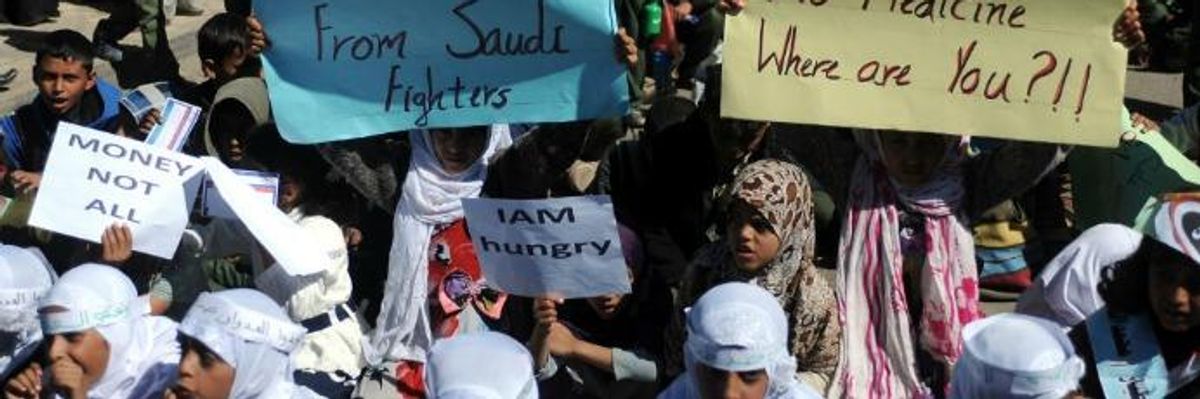
Yemeni children take part in a protest outside the United Nations Office on November 20, 2017 in Sana'a, Yemen. (Photo: Mohammed Hamoud/Getty Images)
With a "green light" from the Trump administration and essential military support from the U.S. government, Saudi-led forces plowed ahead with an assault on the Yemeni port city of Hodeida on Wednesday, brushing aside dire warnings from international humanitarian organizations and a small group of American lawmakers that an attack on the key aid harbor could spark a full-blown famine and endanger millions of lives.
"We thought it could not get any worse, but unfortunately we were wrong."
--Jolien Veldwijk, CARE
Responding to the early stages of the attack--which began with an estimated 30 Saudi airstrikes within half an hour, guided by U.S. military intelligence--Win Without War wrote on Twitter that the attack is "a dark moment of shame for the United States. We could have stopped this."
Hodeidah is currently home to around 600,000 civilians, and around 80 percent of all humanitarian aid that flows into Yemen arrives at the city's port, which is currently controlled by Houthi rebels. International observers have warned that a military fight over the port city could halt life-saving food and medicine and cause the starvation of millions.
"Some civilians are entrapped, others forced from their homes," Jolien Veldwijk--acting country director for the humanitarian group CARE, which is still operating in Yemen--told Reuters on Wednesday as the U.S.-backed Saudi assault on Hodeida began. "We thought it could not get any worse, but unfortunately we were wrong."
As Common Dreams reported earlier this month, the Trump administration has been considering deepening U.S. military involvement in the Saudi bombardment of Yemen, which has pushed eight million Yemenis to the brink of famine. In a report on Tuesday, the Wall Street Journal confirmed that the U.S. is providing the Saudis with "intelligence to fine-tune their list of airstrike targets" in Hodeida.
Martin Griffiths, United Nations special envoy to Yemen, wrote on Wednesday that he is "extremely concerned" with the Saudi-led military escalation and said he is working with both parties to avert further disaster.
In a statement responding to the potentially catastrophic attack on Hodeidah, Lindsey German, convenor of the Stop the War Coalition, took aim at both the U.S. and the United Kingdom for providing crucial political and military support for the Saudi-led assault, arguing that such complicity reveals "the true face of their foreign policy."
"Trump and his close ally, [U.K. Prime Minister] Theresa May, have been escalating military involvement in Yemen without pushing for a political settlement to the Saudi-led war," German said. "Their total support for Saudi Arabia and its allies is making the world's worst humanitarian crisis even more severe. It gives an even greater urgency to those in favor of peace to build the biggest possible protest to Trump when he visits the U.K. in July."
Dear Common Dreams reader, It’s been nearly 30 years since I co-founded Common Dreams with my late wife, Lina Newhouser. We had the radical notion that journalism should serve the public good, not corporate profits. It was clear to us from the outset what it would take to build such a project. No paid advertisements. No corporate sponsors. No millionaire publisher telling us what to think or do. Many people said we wouldn't last a year, but we proved those doubters wrong. Together with a tremendous team of journalists and dedicated staff, we built an independent media outlet free from the constraints of profits and corporate control. Our mission has always been simple: To inform. To inspire. To ignite change for the common good. Building Common Dreams was not easy. Our survival was never guaranteed. When you take on the most powerful forces—Wall Street greed, fossil fuel industry destruction, Big Tech lobbyists, and uber-rich oligarchs who have spent billions upon billions rigging the economy and democracy in their favor—the only bulwark you have is supporters who believe in your work. But here’s the urgent message from me today. It's never been this bad out there. And it's never been this hard to keep us going. At the very moment Common Dreams is most needed, the threats we face are intensifying. We need your support now more than ever. We don't accept corporate advertising and never will. We don't have a paywall because we don't think people should be blocked from critical news based on their ability to pay. Everything we do is funded by the donations of readers like you. When everyone does the little they can afford, we are strong. But if that support retreats or dries up, so do we. Will you donate now to make sure Common Dreams not only survives but thrives? —Craig Brown, Co-founder |
With a "green light" from the Trump administration and essential military support from the U.S. government, Saudi-led forces plowed ahead with an assault on the Yemeni port city of Hodeida on Wednesday, brushing aside dire warnings from international humanitarian organizations and a small group of American lawmakers that an attack on the key aid harbor could spark a full-blown famine and endanger millions of lives.
"We thought it could not get any worse, but unfortunately we were wrong."
--Jolien Veldwijk, CARE
Responding to the early stages of the attack--which began with an estimated 30 Saudi airstrikes within half an hour, guided by U.S. military intelligence--Win Without War wrote on Twitter that the attack is "a dark moment of shame for the United States. We could have stopped this."
Hodeidah is currently home to around 600,000 civilians, and around 80 percent of all humanitarian aid that flows into Yemen arrives at the city's port, which is currently controlled by Houthi rebels. International observers have warned that a military fight over the port city could halt life-saving food and medicine and cause the starvation of millions.
"Some civilians are entrapped, others forced from their homes," Jolien Veldwijk--acting country director for the humanitarian group CARE, which is still operating in Yemen--told Reuters on Wednesday as the U.S.-backed Saudi assault on Hodeida began. "We thought it could not get any worse, but unfortunately we were wrong."
As Common Dreams reported earlier this month, the Trump administration has been considering deepening U.S. military involvement in the Saudi bombardment of Yemen, which has pushed eight million Yemenis to the brink of famine. In a report on Tuesday, the Wall Street Journal confirmed that the U.S. is providing the Saudis with "intelligence to fine-tune their list of airstrike targets" in Hodeida.
Martin Griffiths, United Nations special envoy to Yemen, wrote on Wednesday that he is "extremely concerned" with the Saudi-led military escalation and said he is working with both parties to avert further disaster.
In a statement responding to the potentially catastrophic attack on Hodeidah, Lindsey German, convenor of the Stop the War Coalition, took aim at both the U.S. and the United Kingdom for providing crucial political and military support for the Saudi-led assault, arguing that such complicity reveals "the true face of their foreign policy."
"Trump and his close ally, [U.K. Prime Minister] Theresa May, have been escalating military involvement in Yemen without pushing for a political settlement to the Saudi-led war," German said. "Their total support for Saudi Arabia and its allies is making the world's worst humanitarian crisis even more severe. It gives an even greater urgency to those in favor of peace to build the biggest possible protest to Trump when he visits the U.K. in July."
With a "green light" from the Trump administration and essential military support from the U.S. government, Saudi-led forces plowed ahead with an assault on the Yemeni port city of Hodeida on Wednesday, brushing aside dire warnings from international humanitarian organizations and a small group of American lawmakers that an attack on the key aid harbor could spark a full-blown famine and endanger millions of lives.
"We thought it could not get any worse, but unfortunately we were wrong."
--Jolien Veldwijk, CARE
Responding to the early stages of the attack--which began with an estimated 30 Saudi airstrikes within half an hour, guided by U.S. military intelligence--Win Without War wrote on Twitter that the attack is "a dark moment of shame for the United States. We could have stopped this."
Hodeidah is currently home to around 600,000 civilians, and around 80 percent of all humanitarian aid that flows into Yemen arrives at the city's port, which is currently controlled by Houthi rebels. International observers have warned that a military fight over the port city could halt life-saving food and medicine and cause the starvation of millions.
"Some civilians are entrapped, others forced from their homes," Jolien Veldwijk--acting country director for the humanitarian group CARE, which is still operating in Yemen--told Reuters on Wednesday as the U.S.-backed Saudi assault on Hodeida began. "We thought it could not get any worse, but unfortunately we were wrong."
As Common Dreams reported earlier this month, the Trump administration has been considering deepening U.S. military involvement in the Saudi bombardment of Yemen, which has pushed eight million Yemenis to the brink of famine. In a report on Tuesday, the Wall Street Journal confirmed that the U.S. is providing the Saudis with "intelligence to fine-tune their list of airstrike targets" in Hodeida.
Martin Griffiths, United Nations special envoy to Yemen, wrote on Wednesday that he is "extremely concerned" with the Saudi-led military escalation and said he is working with both parties to avert further disaster.
In a statement responding to the potentially catastrophic attack on Hodeidah, Lindsey German, convenor of the Stop the War Coalition, took aim at both the U.S. and the United Kingdom for providing crucial political and military support for the Saudi-led assault, arguing that such complicity reveals "the true face of their foreign policy."
"Trump and his close ally, [U.K. Prime Minister] Theresa May, have been escalating military involvement in Yemen without pushing for a political settlement to the Saudi-led war," German said. "Their total support for Saudi Arabia and its allies is making the world's worst humanitarian crisis even more severe. It gives an even greater urgency to those in favor of peace to build the biggest possible protest to Trump when he visits the U.K. in July."