
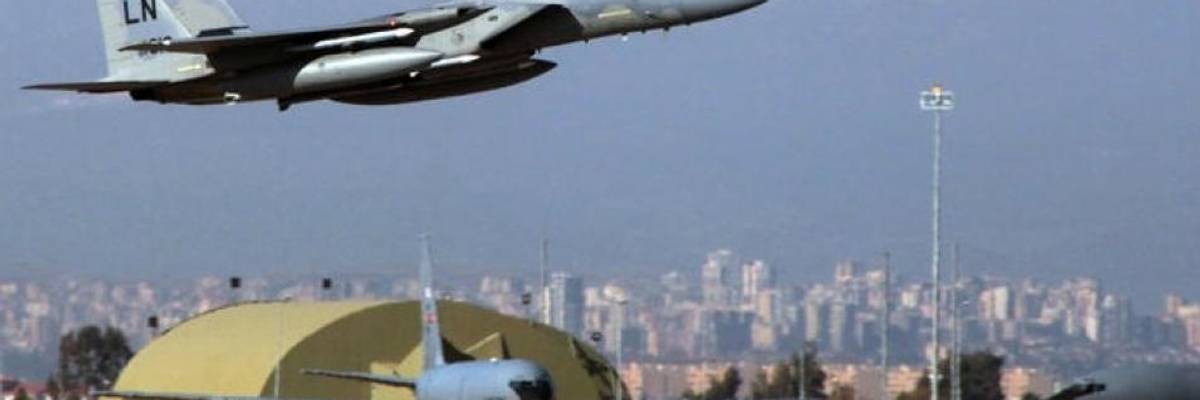
A U.S. Air Force F-15 fighter jet takes off from Incirlik Air Base in Turkey on Dec. 15, 2015. (Photo: Associated Press)
Syria Denounces 'New Aggression' After US Warplanes Bomb Government Forces
"The presence of US military in eastern Syria, acts as a standing pretext for a wider US war in Syria. Had US personnel been killed yesterday, you can only imagine how Trump would react."
The Syrian government of President Bashar Al-Assad accused the United States of "new aggression" on Thursday after American warplanes bombed government soldiers in the eastern part of the country.
Syria's state-sponsored news agency SANA said the attack--which it decried as an "attempt to support terrorism" in the province of Deir Ezzor--left "scores of persons dead and others injured."
The U.S. military officials confirmed the bombings against Syrian forces, but its military coalition characterized the airstrikes as "self defense" in nature.
With U.S. soldiers on the ground in Deir Ezzor, where they are embedded with Syrian Democratic Force (SDF) fighters, the U.S.-backed coalition said an SDF base came under attack from government forces and the airstrikes were a counter-measure against the assault.
As Middle East historian Juan Cole warns on his Informed Comment blog Thursday, the presence of U.S. soldiers inside Syria--a sovereign country with which the U.S. is not officially at war--creates an inherent risk of larger escalation as the various proxy militias battle for territory in the country ravaged by civil war. "The presence of US military in eastern Syria," writes Cole, "acts as a standing pretext for a wider US war in Syria. Had US personnel been killed yesterday, you can only imagine how Trump would react."
As Common Dreams reported in 2015, when President Obama expanded the U.S. military footprint inside Syria, critics denounced the move as "pouring gasoline on the fire."
"US Special Ops headed to Syria to 'advise and assist.' This should end really well," said journalist Jeremy Scahill, with sarcasm, at the time.
According to the Washington Post:
The clash was the biggest confrontation yet between the U.S. military and the pro-Syrian government alliance that includes Russia and Iran, since U.S. troops began deploying in Syria in 2015 in support of local Kurdish and Arab fighters taking on the Islamic State.
It coincides with heightened tensions between the United States and the Syrian government as the Islamic State war winds down, leaving eastern Syria roughly partitioned between U.S.-backed forces and the Russian-backed Syrian government.
The Syrian government has repeatedly called for U.S. troops to leave Syria now that the ISIS war is over, and has regularly threatened to push them out by force.
Thursday's escalation comes amid separate reporting from Middle East Eye that the U.S., as well as other European allies like France, are "considering new military strikes" against the Assad government.
As Jason Ditz at Antiwar points out, the growing tensions in Syria, and Thursday's development's specifically, "reflect the reality that, after the defeat of ISIS, the US has said troops in Syria are there primarily with an eye toward imposing regime change in Syria, and picking fights with the Iranians."
Meanwhile, the suffering of the Syrian people continues to intensify with the United Nation's assistant secretary general and regional humanitarian coordinator for Syria, Panos Moumtzis, saying this week that there has been "dramatic deterioration in the humanitarian situation" over the last two months. The crisis, he said, is more "extreme" than at any time in the country's 8-year civil war.
"There is a misperception that the de-escalation areas have resulted in peace and stability. If anything, these have been serious escalation areas," said Moumtzis. "We feel really outraged. Dramatic developments have been building up and it has reached a point where we can no longer stay silent. These are multiple fires we have to respond to, with a dramatic deterioration in many places."
An Urgent Message From Our Co-Founder
Dear Common Dreams reader, It’s been nearly 30 years since I co-founded Common Dreams with my late wife, Lina Newhouser. We had the radical notion that journalism should serve the public good, not corporate profits. It was clear to us from the outset what it would take to build such a project. No paid advertisements. No corporate sponsors. No millionaire publisher telling us what to think or do. Many people said we wouldn't last a year, but we proved those doubters wrong. Together with a tremendous team of journalists and dedicated staff, we built an independent media outlet free from the constraints of profits and corporate control. Our mission has always been simple: To inform. To inspire. To ignite change for the common good. Building Common Dreams was not easy. Our survival was never guaranteed. When you take on the most powerful forces—Wall Street greed, fossil fuel industry destruction, Big Tech lobbyists, and uber-rich oligarchs who have spent billions upon billions rigging the economy and democracy in their favor—the only bulwark you have is supporters who believe in your work. But here’s the urgent message from me today. It's never been this bad out there. And it's never been this hard to keep us going. At the very moment Common Dreams is most needed, the threats we face are intensifying. We need your support now more than ever. We don't accept corporate advertising and never will. We don't have a paywall because we don't think people should be blocked from critical news based on their ability to pay. Everything we do is funded by the donations of readers like you. When everyone does the little they can afford, we are strong. But if that support retreats or dries up, so do we. Will you donate now to make sure Common Dreams not only survives but thrives? —Craig Brown, Co-founder |
The Syrian government of President Bashar Al-Assad accused the United States of "new aggression" on Thursday after American warplanes bombed government soldiers in the eastern part of the country.
Syria's state-sponsored news agency SANA said the attack--which it decried as an "attempt to support terrorism" in the province of Deir Ezzor--left "scores of persons dead and others injured."
The U.S. military officials confirmed the bombings against Syrian forces, but its military coalition characterized the airstrikes as "self defense" in nature.
With U.S. soldiers on the ground in Deir Ezzor, where they are embedded with Syrian Democratic Force (SDF) fighters, the U.S.-backed coalition said an SDF base came under attack from government forces and the airstrikes were a counter-measure against the assault.
As Middle East historian Juan Cole warns on his Informed Comment blog Thursday, the presence of U.S. soldiers inside Syria--a sovereign country with which the U.S. is not officially at war--creates an inherent risk of larger escalation as the various proxy militias battle for territory in the country ravaged by civil war. "The presence of US military in eastern Syria," writes Cole, "acts as a standing pretext for a wider US war in Syria. Had US personnel been killed yesterday, you can only imagine how Trump would react."
As Common Dreams reported in 2015, when President Obama expanded the U.S. military footprint inside Syria, critics denounced the move as "pouring gasoline on the fire."
"US Special Ops headed to Syria to 'advise and assist.' This should end really well," said journalist Jeremy Scahill, with sarcasm, at the time.
According to the Washington Post:
The clash was the biggest confrontation yet between the U.S. military and the pro-Syrian government alliance that includes Russia and Iran, since U.S. troops began deploying in Syria in 2015 in support of local Kurdish and Arab fighters taking on the Islamic State.
It coincides with heightened tensions between the United States and the Syrian government as the Islamic State war winds down, leaving eastern Syria roughly partitioned between U.S.-backed forces and the Russian-backed Syrian government.
The Syrian government has repeatedly called for U.S. troops to leave Syria now that the ISIS war is over, and has regularly threatened to push them out by force.
Thursday's escalation comes amid separate reporting from Middle East Eye that the U.S., as well as other European allies like France, are "considering new military strikes" against the Assad government.
As Jason Ditz at Antiwar points out, the growing tensions in Syria, and Thursday's development's specifically, "reflect the reality that, after the defeat of ISIS, the US has said troops in Syria are there primarily with an eye toward imposing regime change in Syria, and picking fights with the Iranians."
Meanwhile, the suffering of the Syrian people continues to intensify with the United Nation's assistant secretary general and regional humanitarian coordinator for Syria, Panos Moumtzis, saying this week that there has been "dramatic deterioration in the humanitarian situation" over the last two months. The crisis, he said, is more "extreme" than at any time in the country's 8-year civil war.
"There is a misperception that the de-escalation areas have resulted in peace and stability. If anything, these have been serious escalation areas," said Moumtzis. "We feel really outraged. Dramatic developments have been building up and it has reached a point where we can no longer stay silent. These are multiple fires we have to respond to, with a dramatic deterioration in many places."
The Syrian government of President Bashar Al-Assad accused the United States of "new aggression" on Thursday after American warplanes bombed government soldiers in the eastern part of the country.
Syria's state-sponsored news agency SANA said the attack--which it decried as an "attempt to support terrorism" in the province of Deir Ezzor--left "scores of persons dead and others injured."
The U.S. military officials confirmed the bombings against Syrian forces, but its military coalition characterized the airstrikes as "self defense" in nature.
With U.S. soldiers on the ground in Deir Ezzor, where they are embedded with Syrian Democratic Force (SDF) fighters, the U.S.-backed coalition said an SDF base came under attack from government forces and the airstrikes were a counter-measure against the assault.
As Middle East historian Juan Cole warns on his Informed Comment blog Thursday, the presence of U.S. soldiers inside Syria--a sovereign country with which the U.S. is not officially at war--creates an inherent risk of larger escalation as the various proxy militias battle for territory in the country ravaged by civil war. "The presence of US military in eastern Syria," writes Cole, "acts as a standing pretext for a wider US war in Syria. Had US personnel been killed yesterday, you can only imagine how Trump would react."
As Common Dreams reported in 2015, when President Obama expanded the U.S. military footprint inside Syria, critics denounced the move as "pouring gasoline on the fire."
"US Special Ops headed to Syria to 'advise and assist.' This should end really well," said journalist Jeremy Scahill, with sarcasm, at the time.
According to the Washington Post:
The clash was the biggest confrontation yet between the U.S. military and the pro-Syrian government alliance that includes Russia and Iran, since U.S. troops began deploying in Syria in 2015 in support of local Kurdish and Arab fighters taking on the Islamic State.
It coincides with heightened tensions between the United States and the Syrian government as the Islamic State war winds down, leaving eastern Syria roughly partitioned between U.S.-backed forces and the Russian-backed Syrian government.
The Syrian government has repeatedly called for U.S. troops to leave Syria now that the ISIS war is over, and has regularly threatened to push them out by force.
Thursday's escalation comes amid separate reporting from Middle East Eye that the U.S., as well as other European allies like France, are "considering new military strikes" against the Assad government.
As Jason Ditz at Antiwar points out, the growing tensions in Syria, and Thursday's development's specifically, "reflect the reality that, after the defeat of ISIS, the US has said troops in Syria are there primarily with an eye toward imposing regime change in Syria, and picking fights with the Iranians."
Meanwhile, the suffering of the Syrian people continues to intensify with the United Nation's assistant secretary general and regional humanitarian coordinator for Syria, Panos Moumtzis, saying this week that there has been "dramatic deterioration in the humanitarian situation" over the last two months. The crisis, he said, is more "extreme" than at any time in the country's 8-year civil war.
"There is a misperception that the de-escalation areas have resulted in peace and stability. If anything, these have been serious escalation areas," said Moumtzis. "We feel really outraged. Dramatic developments have been building up and it has reached a point where we can no longer stay silent. These are multiple fires we have to respond to, with a dramatic deterioration in many places."