SUBSCRIBE TO OUR FREE NEWSLETTER
Daily news & progressive opinion—funded by the people, not the corporations—delivered straight to your inbox.
5
#000000
#FFFFFF
To donate by check, phone, or other method, see our More Ways to Give page.
"We have truly crossed a new Rubicon," one campaign finance expert says in response to new data showing record levels of outside spending pouring into high-stakes Senate races this election cycle.
According to an analysis released Tuesday by the Brennan Center for Justice at NYU School of Law, outside groups--free from contribution limits and sometimes able to conceal their donors from the public--are outspending both political parties and candidates "in the battle for control of the U.S. Senate."
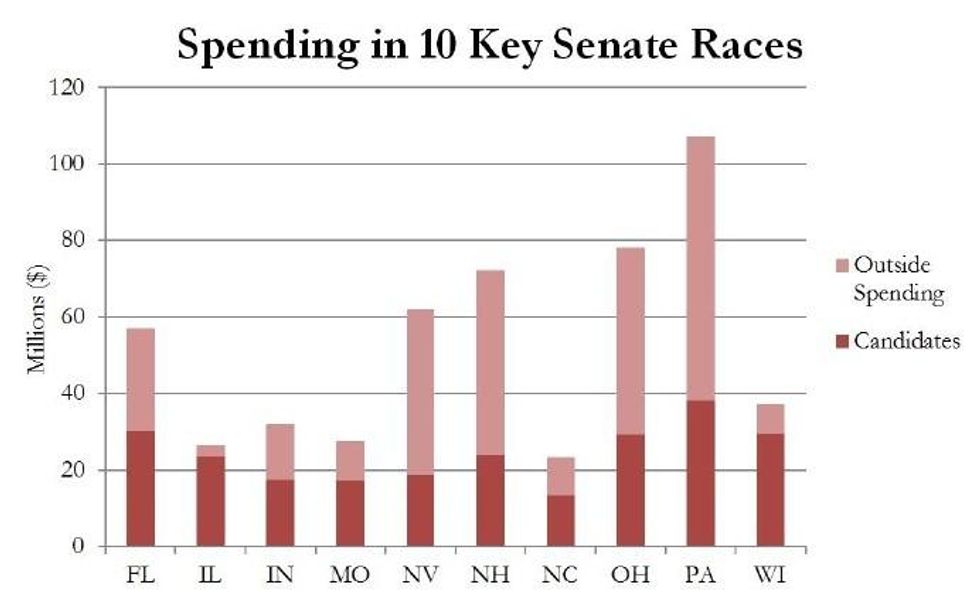
In fact, of the $557 million spent so far in 10 key Senate contests, the Brennan Center says such groups are responsible for $282 million, or 51 percent. Further, in each of the four most expensive contests--Nevada, New Hampshire, Ohio, and Pennsylvania--candidates account for 37 percent or less of total spending.
"This may be a new high for non-party outside spending, although direct comparisons to past cycles are hindered by a lack of available data," the report states.
The analysis takes into account "shadow party groups--super PACs and nonprofits run by former top staff of party committees or party leaders and able to mimic party spending strategy--as nonparty outside groups," the Brennan Center explains. "This is because these groups, despite being controlled to some degree by the parties, take unlimited contributions and sometimes hide their donors. That the parties are increasingly outsourcing their finances to unregulated shadow parties severely weakens the campaign finance system's protections against corruption and undue influence."
Among the report's other notable findings:
"The precipitous rise of outside groups is problematic for a few reasons," said study author Ian Vandewalker, counsel in the Brennan Center's democracy program.
"Unlike the parties and candidates, they are free to accept donations of unlimited size and can conceal their funders from the public," he continued. "So the bigger a role they play in an election, the more political power is concentrated in the hands of a few million-dollar funders and professional political operatives, with a consequent loss in power for the millions of Americans who can't afford jumbo donations. While this problem was created in part by 2010's Citizens United decision, the 2016 data shows we have truly crossed a new Rubicon."
To snatch back some of that power, the Brennan Center calls for the U.S. Supreme Court to reverse its damaging decision in Citizens United; for stronger rules against coordination between candidates and outside groups; for improved disclosure and transparency laws; and "most fundamentally" for a public campaign financing system to "provide an alternative to the incentives to chase bigger and bigger checks that currently drive political spending, allowing candidates to fund competitive campaigns without relying on the wealthiest donors."
Two such public financing systems are on statewide ballots this November.
"We have truly crossed a new Rubicon," one campaign finance expert says in response to new data showing record levels of outside spending pouring into high-stakes Senate races this election cycle.
According to an analysis released Tuesday by the Brennan Center for Justice at NYU School of Law, outside groups--free from contribution limits and sometimes able to conceal their donors from the public--are outspending both political parties and candidates "in the battle for control of the U.S. Senate."
In fact, of the $557 million spent so far in 10 key Senate contests, the Brennan Center says such groups are responsible for $282 million, or 51 percent. Further, in each of the four most expensive contests--Nevada, New Hampshire, Ohio, and Pennsylvania--candidates account for 37 percent or less of total spending.
"This may be a new high for non-party outside spending, although direct comparisons to past cycles are hindered by a lack of available data," the report states.
The analysis takes into account "shadow party groups--super PACs and nonprofits run by former top staff of party committees or party leaders and able to mimic party spending strategy--as nonparty outside groups," the Brennan Center explains. "This is because these groups, despite being controlled to some degree by the parties, take unlimited contributions and sometimes hide their donors. That the parties are increasingly outsourcing their finances to unregulated shadow parties severely weakens the campaign finance system's protections against corruption and undue influence."
Among the report's other notable findings:
"The precipitous rise of outside groups is problematic for a few reasons," said study author Ian Vandewalker, counsel in the Brennan Center's democracy program.
"Unlike the parties and candidates, they are free to accept donations of unlimited size and can conceal their funders from the public," he continued. "So the bigger a role they play in an election, the more political power is concentrated in the hands of a few million-dollar funders and professional political operatives, with a consequent loss in power for the millions of Americans who can't afford jumbo donations. While this problem was created in part by 2010's Citizens United decision, the 2016 data shows we have truly crossed a new Rubicon."
To snatch back some of that power, the Brennan Center calls for the U.S. Supreme Court to reverse its damaging decision in Citizens United; for stronger rules against coordination between candidates and outside groups; for improved disclosure and transparency laws; and "most fundamentally" for a public campaign financing system to "provide an alternative to the incentives to chase bigger and bigger checks that currently drive political spending, allowing candidates to fund competitive campaigns without relying on the wealthiest donors."
Two such public financing systems are on statewide ballots this November.
"We have truly crossed a new Rubicon," one campaign finance expert says in response to new data showing record levels of outside spending pouring into high-stakes Senate races this election cycle.
According to an analysis released Tuesday by the Brennan Center for Justice at NYU School of Law, outside groups--free from contribution limits and sometimes able to conceal their donors from the public--are outspending both political parties and candidates "in the battle for control of the U.S. Senate."
In fact, of the $557 million spent so far in 10 key Senate contests, the Brennan Center says such groups are responsible for $282 million, or 51 percent. Further, in each of the four most expensive contests--Nevada, New Hampshire, Ohio, and Pennsylvania--candidates account for 37 percent or less of total spending.
"This may be a new high for non-party outside spending, although direct comparisons to past cycles are hindered by a lack of available data," the report states.
The analysis takes into account "shadow party groups--super PACs and nonprofits run by former top staff of party committees or party leaders and able to mimic party spending strategy--as nonparty outside groups," the Brennan Center explains. "This is because these groups, despite being controlled to some degree by the parties, take unlimited contributions and sometimes hide their donors. That the parties are increasingly outsourcing their finances to unregulated shadow parties severely weakens the campaign finance system's protections against corruption and undue influence."
Among the report's other notable findings:
"The precipitous rise of outside groups is problematic for a few reasons," said study author Ian Vandewalker, counsel in the Brennan Center's democracy program.
"Unlike the parties and candidates, they are free to accept donations of unlimited size and can conceal their funders from the public," he continued. "So the bigger a role they play in an election, the more political power is concentrated in the hands of a few million-dollar funders and professional political operatives, with a consequent loss in power for the millions of Americans who can't afford jumbo donations. While this problem was created in part by 2010's Citizens United decision, the 2016 data shows we have truly crossed a new Rubicon."
To snatch back some of that power, the Brennan Center calls for the U.S. Supreme Court to reverse its damaging decision in Citizens United; for stronger rules against coordination between candidates and outside groups; for improved disclosure and transparency laws; and "most fundamentally" for a public campaign financing system to "provide an alternative to the incentives to chase bigger and bigger checks that currently drive political spending, allowing candidates to fund competitive campaigns without relying on the wealthiest donors."
Two such public financing systems are on statewide ballots this November.