SUBSCRIBE TO OUR FREE NEWSLETTER
Daily news & progressive opinion—funded by the people, not the corporations—delivered straight to your inbox.
5
#000000
#FFFFFF
To donate by check, phone, or other method, see our More Ways to Give page.
Another month, another temperature record shattered.
NASA data released Monday shows that last month was the hottest August since record-keeping started in 1880 and tied with July for the warmest month in the previous 136 years.
According to NASA's Goddard Institute for Space Studies, August 2016's temperature was 0.16 degrees Celsius warmer than the previous warmest August in 2014. Last month, it was also 0.98 degrees Celsius warmer than the mean August temperature from 1951 to 1980.
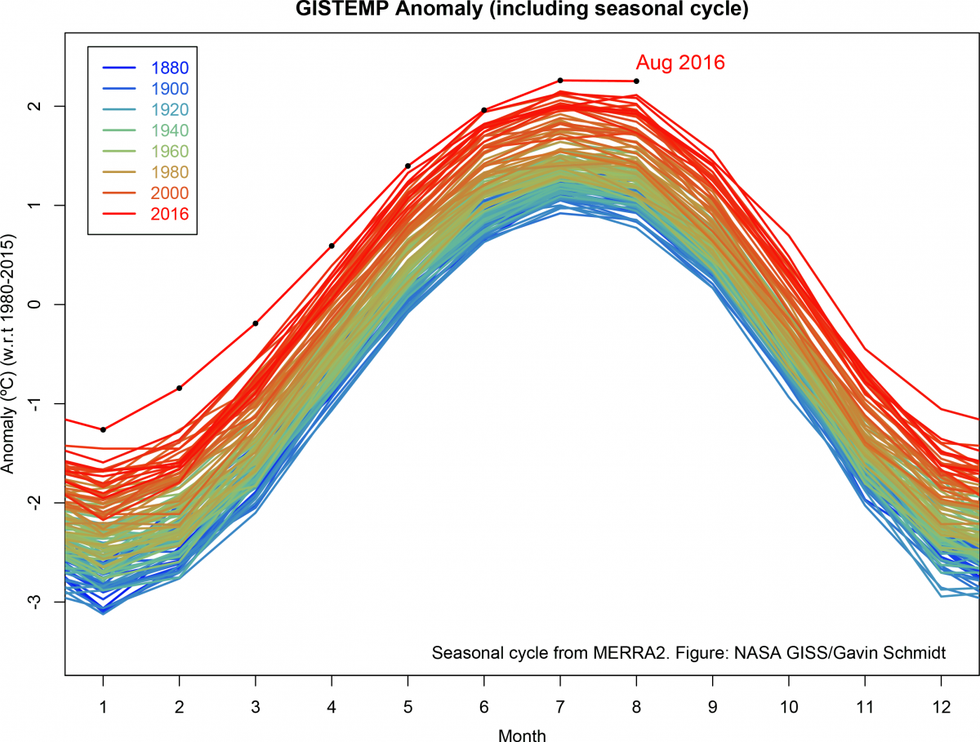
Notably, NASA points out, "the seasonal temperature cycle typically peaks in July."
But recent months have been anything but typical. "The record warm August continued a streak of 11 consecutive months dating back to October 2015 that have set new monthly high-temperature records," NASA said in a press release.
What's more, climate scientist Stefan Rahmstorf pointed out on Twitter that the temperature has risen even though this year's unusually strong El Nino is on the wane.
The National Oceanic and Atmospheric Administration (NOAA) will release its own August figures later this month.
Regardless, Mary Beth Griggs wrote for Popular Science, "this heat streak continues to put 2016 in the running to be be the hottest year since 2015, which broke the record set by 2014."
And while the endless string of "hottest months" may induce fatigue among some observers, Astrid Caldas of the Union of Concerned Scientists explains in a blog post on Monday why the string of broken records is still "big news."
"While there may be a tendency to be complacent about the recurring record temperatures, with each month come more climate-related consequences that cannot be ignored, and they make for big news stories," Caldas writes. "From wildfires and droughts to devastating floods, climate change fingerprint is all around us and does play a role in making events more extreme. An example are the recent Louisiana floods, caused by intense rains which, according to the science of attribution, were at least 40% more likely to happen because of climate change."
"Climate change is here, its effects are being already felt in a variety of ways...and we do not need to wait years or decades to see its effects," she says. "We should heed the warnings and act now, investing in preparedness and emissions reductions, so as to minimize possible added (and maybe worse) future risks and impacts."
Another month, another temperature record shattered.
NASA data released Monday shows that last month was the hottest August since record-keeping started in 1880 and tied with July for the warmest month in the previous 136 years.
According to NASA's Goddard Institute for Space Studies, August 2016's temperature was 0.16 degrees Celsius warmer than the previous warmest August in 2014. Last month, it was also 0.98 degrees Celsius warmer than the mean August temperature from 1951 to 1980.
Notably, NASA points out, "the seasonal temperature cycle typically peaks in July."
But recent months have been anything but typical. "The record warm August continued a streak of 11 consecutive months dating back to October 2015 that have set new monthly high-temperature records," NASA said in a press release.
What's more, climate scientist Stefan Rahmstorf pointed out on Twitter that the temperature has risen even though this year's unusually strong El Nino is on the wane.
The National Oceanic and Atmospheric Administration (NOAA) will release its own August figures later this month.
Regardless, Mary Beth Griggs wrote for Popular Science, "this heat streak continues to put 2016 in the running to be be the hottest year since 2015, which broke the record set by 2014."
And while the endless string of "hottest months" may induce fatigue among some observers, Astrid Caldas of the Union of Concerned Scientists explains in a blog post on Monday why the string of broken records is still "big news."
"While there may be a tendency to be complacent about the recurring record temperatures, with each month come more climate-related consequences that cannot be ignored, and they make for big news stories," Caldas writes. "From wildfires and droughts to devastating floods, climate change fingerprint is all around us and does play a role in making events more extreme. An example are the recent Louisiana floods, caused by intense rains which, according to the science of attribution, were at least 40% more likely to happen because of climate change."
"Climate change is here, its effects are being already felt in a variety of ways...and we do not need to wait years or decades to see its effects," she says. "We should heed the warnings and act now, investing in preparedness and emissions reductions, so as to minimize possible added (and maybe worse) future risks and impacts."
Another month, another temperature record shattered.
NASA data released Monday shows that last month was the hottest August since record-keeping started in 1880 and tied with July for the warmest month in the previous 136 years.
According to NASA's Goddard Institute for Space Studies, August 2016's temperature was 0.16 degrees Celsius warmer than the previous warmest August in 2014. Last month, it was also 0.98 degrees Celsius warmer than the mean August temperature from 1951 to 1980.
Notably, NASA points out, "the seasonal temperature cycle typically peaks in July."
But recent months have been anything but typical. "The record warm August continued a streak of 11 consecutive months dating back to October 2015 that have set new monthly high-temperature records," NASA said in a press release.
What's more, climate scientist Stefan Rahmstorf pointed out on Twitter that the temperature has risen even though this year's unusually strong El Nino is on the wane.
The National Oceanic and Atmospheric Administration (NOAA) will release its own August figures later this month.
Regardless, Mary Beth Griggs wrote for Popular Science, "this heat streak continues to put 2016 in the running to be be the hottest year since 2015, which broke the record set by 2014."
And while the endless string of "hottest months" may induce fatigue among some observers, Astrid Caldas of the Union of Concerned Scientists explains in a blog post on Monday why the string of broken records is still "big news."
"While there may be a tendency to be complacent about the recurring record temperatures, with each month come more climate-related consequences that cannot be ignored, and they make for big news stories," Caldas writes. "From wildfires and droughts to devastating floods, climate change fingerprint is all around us and does play a role in making events more extreme. An example are the recent Louisiana floods, caused by intense rains which, according to the science of attribution, were at least 40% more likely to happen because of climate change."
"Climate change is here, its effects are being already felt in a variety of ways...and we do not need to wait years or decades to see its effects," she says. "We should heed the warnings and act now, investing in preparedness and emissions reductions, so as to minimize possible added (and maybe worse) future risks and impacts."