SUBSCRIBE TO OUR FREE NEWSLETTER
Daily news & progressive opinion—funded by the people, not the corporations—delivered straight to your inbox.
5
#000000
#FFFFFF
To donate by check, phone, or other method, see our More Ways to Give page.
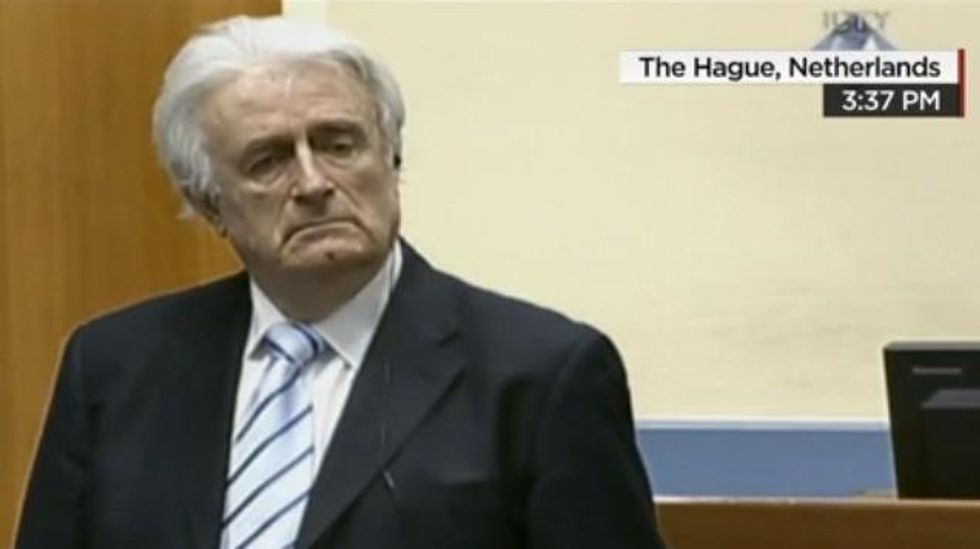
In a decision welcomed by human rights groups as a step towards justice, a UN tribunal on Thursday convicted former Bosnian Serb leader Radovan Karadzic of genocide, crimes against humanity, and war crimes and sentenced him to 40 years in prison.
Out of the 11 charges he faced at the International Criminal Tribunal for the former Yugoslavia (ICTY) for atrocities in the 1990s during the Bosnian war, the 70-year old, sometimes referred to as the Butcher of Bosnia, escaped on just one.
CNN reports that it "was seen as one of the most important war crimes trials since World War II."
Summarizing the verdict, which Karadzic will appeal, Reuters reports:
Judges said the 44-month siege of Sarajevo could not have happened without his support; that he committed crimes against humanity in an attempt to purge Muslims and Croats from parts of Bosnia; and that he had intended to eliminate the Bosnian Muslim males of the town of Srebrenica.
In 1995, Srebrenica was the site of "the worst systematic slaughter of the war: the slayings of 8,000 Muslim men and boys," the Washington Post reports.
Karadzic's "intent [was] that every able-bodied Bosnian Muslim male from Srebrenica be killed, which amounts to the intent to destroy the Bosnian Muslims in Srebrenica as such," a statement from the tribunal reads.
It adds that Karadzic helped "carry out a campaign of sniping and shelling against the civilian population of Sarajevo, aimed to spread terror among the civilian citizens."
"Karadzic master-minded the confinement, rape, torture, and murder of thousands of people; the shelling of civilians; the siege of Sarajevo; and the extensive destruction and plunder of property, including Muslim and Roman Catholic places of worship," he said.
Also welcoming the verdict was John Dalhuisen, Amnesty International's Director for Europe and Central Asia, who said, "This is a very important day for international justice and for victims who waited 13 years for Karadzic's arrest, and then another eight years for today's verdict."
"We should not forget, however, that more than 20 years after the Bosnian War, thousands of cases of enforced disappearances are unresolved, with a disturbing lack of political will still blocking access to justice, truth and reparation for victims," he added.
The judgment fell short for Hatidza Mehmedovic, who lost all of her family at Srebrenica. "[Karadzic] can live in a cushy prison while I have to live in Srebrenica, where his ideology is still in place," she told Reuters.
Peter Maas argues at The Intercept that the verdict may also offer some hope for those in demanding accountability and justice for post-9/11 torture and other abuses, because as unlikely as that seems now, "it was even more unlikely in the 1990s to think that the hand of justice--the justice of a fair trial, not a mob's noose or a precision-guided missile--would get close to Karadzic and his prime collaborators."
The ICTY has indicted 161 persons for crimes under international law committed in the former Yugoslavia since the tribunal's inception in 1993. The trial for Bosnian-Serb military leader Ratko Mladic, who was arrested in 2011, is ongoing.
In a decision welcomed by human rights groups as a step towards justice, a UN tribunal on Thursday convicted former Bosnian Serb leader Radovan Karadzic of genocide, crimes against humanity, and war crimes and sentenced him to 40 years in prison.
Out of the 11 charges he faced at the International Criminal Tribunal for the former Yugoslavia (ICTY) for atrocities in the 1990s during the Bosnian war, the 70-year old, sometimes referred to as the Butcher of Bosnia, escaped on just one.
CNN reports that it "was seen as one of the most important war crimes trials since World War II."
Summarizing the verdict, which Karadzic will appeal, Reuters reports:
Judges said the 44-month siege of Sarajevo could not have happened without his support; that he committed crimes against humanity in an attempt to purge Muslims and Croats from parts of Bosnia; and that he had intended to eliminate the Bosnian Muslim males of the town of Srebrenica.
In 1995, Srebrenica was the site of "the worst systematic slaughter of the war: the slayings of 8,000 Muslim men and boys," the Washington Post reports.
Karadzic's "intent [was] that every able-bodied Bosnian Muslim male from Srebrenica be killed, which amounts to the intent to destroy the Bosnian Muslims in Srebrenica as such," a statement from the tribunal reads.
It adds that Karadzic helped "carry out a campaign of sniping and shelling against the civilian population of Sarajevo, aimed to spread terror among the civilian citizens."
"Karadzic master-minded the confinement, rape, torture, and murder of thousands of people; the shelling of civilians; the siege of Sarajevo; and the extensive destruction and plunder of property, including Muslim and Roman Catholic places of worship," he said.
Also welcoming the verdict was John Dalhuisen, Amnesty International's Director for Europe and Central Asia, who said, "This is a very important day for international justice and for victims who waited 13 years for Karadzic's arrest, and then another eight years for today's verdict."
"We should not forget, however, that more than 20 years after the Bosnian War, thousands of cases of enforced disappearances are unresolved, with a disturbing lack of political will still blocking access to justice, truth and reparation for victims," he added.
The judgment fell short for Hatidza Mehmedovic, who lost all of her family at Srebrenica. "[Karadzic] can live in a cushy prison while I have to live in Srebrenica, where his ideology is still in place," she told Reuters.
Peter Maas argues at The Intercept that the verdict may also offer some hope for those in demanding accountability and justice for post-9/11 torture and other abuses, because as unlikely as that seems now, "it was even more unlikely in the 1990s to think that the hand of justice--the justice of a fair trial, not a mob's noose or a precision-guided missile--would get close to Karadzic and his prime collaborators."
The ICTY has indicted 161 persons for crimes under international law committed in the former Yugoslavia since the tribunal's inception in 1993. The trial for Bosnian-Serb military leader Ratko Mladic, who was arrested in 2011, is ongoing.
In a decision welcomed by human rights groups as a step towards justice, a UN tribunal on Thursday convicted former Bosnian Serb leader Radovan Karadzic of genocide, crimes against humanity, and war crimes and sentenced him to 40 years in prison.
Out of the 11 charges he faced at the International Criminal Tribunal for the former Yugoslavia (ICTY) for atrocities in the 1990s during the Bosnian war, the 70-year old, sometimes referred to as the Butcher of Bosnia, escaped on just one.
CNN reports that it "was seen as one of the most important war crimes trials since World War II."
Summarizing the verdict, which Karadzic will appeal, Reuters reports:
Judges said the 44-month siege of Sarajevo could not have happened without his support; that he committed crimes against humanity in an attempt to purge Muslims and Croats from parts of Bosnia; and that he had intended to eliminate the Bosnian Muslim males of the town of Srebrenica.
In 1995, Srebrenica was the site of "the worst systematic slaughter of the war: the slayings of 8,000 Muslim men and boys," the Washington Post reports.
Karadzic's "intent [was] that every able-bodied Bosnian Muslim male from Srebrenica be killed, which amounts to the intent to destroy the Bosnian Muslims in Srebrenica as such," a statement from the tribunal reads.
It adds that Karadzic helped "carry out a campaign of sniping and shelling against the civilian population of Sarajevo, aimed to spread terror among the civilian citizens."
"Karadzic master-minded the confinement, rape, torture, and murder of thousands of people; the shelling of civilians; the siege of Sarajevo; and the extensive destruction and plunder of property, including Muslim and Roman Catholic places of worship," he said.
Also welcoming the verdict was John Dalhuisen, Amnesty International's Director for Europe and Central Asia, who said, "This is a very important day for international justice and for victims who waited 13 years for Karadzic's arrest, and then another eight years for today's verdict."
"We should not forget, however, that more than 20 years after the Bosnian War, thousands of cases of enforced disappearances are unresolved, with a disturbing lack of political will still blocking access to justice, truth and reparation for victims," he added.
The judgment fell short for Hatidza Mehmedovic, who lost all of her family at Srebrenica. "[Karadzic] can live in a cushy prison while I have to live in Srebrenica, where his ideology is still in place," she told Reuters.
Peter Maas argues at The Intercept that the verdict may also offer some hope for those in demanding accountability and justice for post-9/11 torture and other abuses, because as unlikely as that seems now, "it was even more unlikely in the 1990s to think that the hand of justice--the justice of a fair trial, not a mob's noose or a precision-guided missile--would get close to Karadzic and his prime collaborators."
The ICTY has indicted 161 persons for crimes under international law committed in the former Yugoslavia since the tribunal's inception in 1993. The trial for Bosnian-Serb military leader Ratko Mladic, who was arrested in 2011, is ongoing.