SUBSCRIBE TO OUR FREE NEWSLETTER
Daily news & progressive opinion—funded by the people, not the corporations—delivered straight to your inbox.
5
#000000
#FFFFFF
To donate by check, phone, or other method, see our More Ways to Give page.


Daily news & progressive opinion—funded by the people, not the corporations—delivered straight to your inbox.
Human rights defenders and aid organizations are issuing dire warnings this week after witnessing the hellish conditions of an encampment of stranded refugees in the freezing forests of Bosnia and Herzegovina.
An envoy of officials on Tuesday visited the camp known as Vucjak--situated approximately five miles from the nearby border with Croatia in a forest that has grown atop a former landfill--where they saw hundreds of migrants huddled in leaking and drafty tents as temperatures in the region have dropped to freezing or below.
"Vucjak must be shut down today," said Dunja Mijatovic, commissioner for human rights at the Council of Europe and a member of the delegation. "Otherwise the people here will start dying."
Mijatovic said that as a citizen of Bosnia, she was "ashamed" of how the refugees were being treated, decried the conditions of the refugee camp as "not for human beings," and called for immediate relief for those languishing there.
According to Reuters:
Bosnia is struggling to deal with an upsurge in migrant numbers since Croatia, Hungary and Slovenia closed their borders against undocumented immigration. The migrants hope to get to wealthy western Europe and find work there.
Some lacked warm clothes and were wrapped in blankets, some traipsed through the snow and mud in flip-flops to collect firewood. One man brushed snow from the roof of his tent to prevent it collapsing.
Al-Jazeera also reported Tuesday from the Vucjak camp:
An 24-year-old Afghan man identified as Mauloddin, who set off from his war-torn homeland more than three years ago to seek refuge in Europe, told Reuters, "You see... it's very cold weather, (there is) no sleeping, no food."
"People are people," he added, "not animals."
Rezwanullay Niazy, also a 24-year-old Afghan, said: "We spent all our money... We came close to Europe, and now they closed the Croatian and Slovenian borders. When we go there they strike us, they hit us."
This month marks the 20th anniversary of Operation Allied Force, NATO's 78-day air war against Yugoslavia. It was a war waged as much against Serbian civilians--hundreds of whom perished--as it was against Slobodan Milosevic's forces, and it was a campaign of breathtaking hypocrisy and selective outrage. More than anything, it was a war that by President Bill Clinton's own admission was fought for the sake of NATO's credibility.
One Man's Terrorist...
Our story begins not in the war-torn Balkans of the 1990s but rather in the howling wilderness of Afghanistan at the end of the 1980s as defeated Soviet invaders withdrew from a decade of guerrilla warfare into the twilight of a once-mighty empire. The United States, which had provided arms, funding and training for the mujahideen fighters who had so bravely resisted the Soviet occupation, stopped supporting the jihadis as soon as the last Red Army units rolled across the Hairatan Bridge and back into the USSR. Afghanistan descended deeper into civil war.
The popular narrative posits that Osama bin Laden and his al-Qaeda network, Washington's former mujahideen allies, turned on the West after the US stationed hundreds of thousands of infidel troops in Saudi Arabia--home to two out of three of Sunni Islam's holiest sites--during Operation Desert Shield in 1990. Since then, the story goes, the relationship between the jihadists and their former benefactors has been one of enmity, characterized by sporadic terror attacks and fierce US retribution. The real story, however, is something altogether different.
From 1992 to 1995, the Pentagon flew thousands of al-Qaeda mujahideen, often accompanied by US Special Forces, from Central Asia to Europe to reinforce Bosnian Muslims as they fought Serbs to gain their independence from the Federal Republic of Yugoslavia. The Clinton administration armed and trained these fighters in flagrant violation of United Nations accords; weapons purchased by Saudi Arabia, Turkey and Iran were secretly shipped to the jihadists via Croatia, which netted a hefty profit from each transaction. The official Dutch inquiry into the 1995 Srebrenica massacre, in which thousands of Bosniak (Bosnian Muslim) men and boys were slaughtered by Bosnian Serb and Serbian paramilitary forces, concluded that the United States was "very closely involved" in these arms transfers.
When the Bosnian war ended in 1995 the United States was faced with the problem of thousands of Islamist warriors on European soil. Many of them joined the burgeoning Kosovo Liberation Army (KLA), which mainly consisted of ethnic Albanian Kosovars from what was still southwestern Yugoslavia. Emboldened by the success of the Slovenes, Croats, Macedonians and Bosnians who had won their independence from Belgrade as Yugoslavia literally balkanized, KLA fighters began to violently expel as many non-Albanians from Kosovo as they could. Roma, Jews, Turks and, above all, Serbs were all victims of Albanian ethnic cleansing.
The United States was initially very honest in its assessment of the KLA. Robert Gelbard, the US special envoy to Bosnia, called it "without any question a terrorist group." KLA backers allegedly included Osama bin Laden and other Islamic radicals; the group largely bankrolled its activities by trafficking heroin and sex slaves. The State Department accordingly added the KLA to its list of terrorist organizations in 1998.
However, despite all its nastiness the KLA endeared itself to Washington by fighting the defiant Yugoslavian President Slobodan Milosevic. By this time Yugoslavia, once composed of eight nominally autonomous republics, had been reduced by years of bloody civil war to a rump of Serbia, Montenegro and Kosovo. To Serbs, the dominant ethnic group in what remained of the country, Kosovo is regarded as the very birthplace of their nation. Belgrade wasn't about to let it go without a fight and everyone knew it, especially the Clinton administration. Clinton's hypocrisy was immediately evident; when Chechnya fought for its independence from Moscow and Russian forces committed horrific atrocities in response, the American president called the war an internal Russian affair and barely criticized Russian President Boris Yeltsin. But when Milosevic resorted to brute force in an attempt to prevent Yugoslavia from further fracturing, he soon found himself a marked man.
Although NATO called the KLA "the main initiator of the violence" in Kosovo and blasted "what appears to be a deliberate campaign of provocation" against the Serbs, the Clinton administration was nevertheless determined to attack the Milosevic regime. US intelligence confirmed that the KLA was indeed provoking harsh retaliatory strikes by Serb forces in a bid to draw the United States and NATO into the conflict. President Clinton, however, apparently wasn't listening. The NATO powers, led by the United States, issued Milosevic an ultimatum they knew he could never accept: allow NATO to occupy all of Kosovo and have free reign in Serbia as well. Assistant US Secretary of State James Rubin later admitted that "publicly we had to make clear we were seeking an agreement but privately we knew the chances of the Serbs agreeing were quite small."
Wagging the Dog?
In 1997 the film "Wag the Dog" debuted to rave reviews. The dark comedy concerns a Washington, DC spin doctor and a Hollywood producer who fabricate a fictional war in Albania to distract American voters from a presidential sex scandal. Many observers couldn't help but draw parallels between the film and the real-life events of 1998-99, which included the Monica Lewinsky scandal, Clinton's impeachment and a very real war brewing in the Balkans. As in "Wag the Dog," there were exaggerated or completely fabricated tales of atrocities, and as in the film the US and NATO powers tried to sell their war as a humanitarian intervention. An attack on Yugoslavia, we were told, was needed to avert Serb ethnic cleansing of Albanians.
There were two main problems with this. First, there was no Serb ethnic cleansing of Albanian Kosovars until after NATO began mercilessly bombing Yugoslavia. The German government issued several reports confirming this. One, from October 1998, reads, in part:
The violent actions of the Yugoslav military and police since February 1998 were aimed at separatist activities and are no proof of a persecution of the whole Albanian ethnic group in Kosovo or a part of it. What was involved in the Yugoslav violent actions and excesses since February 1998 was a selective forcible action against the military underground movement (especially the KLA)... A state program or persecution aimed at the whole ethnic group of Albanians exists neither now nor earlier.
Subsequent German government reports issued through the winter of 1999 tell a similar story. "Events since February and March 1998 do not evidence a persecution program based on Albanian ethnicity," stated one report released exactly one month before the NATO bombing started. "The measures taken by the armed Serbian forces are in the first instance directed toward combatting the KLA and its supposed adherents and supporters."
While Serbs certainly did commit atrocities (especially after the ferocious NATO air campaign began), these were often greatly exaggerated by the Clinton administration and the US corporate mainstream media. Clinton claimed--and the media dutifully parroted--that 600,000 Albanians were "trapped within Kosovo... lacking shelter, short of food, afraid to go home or buried in mass graves." This was completely false. US diplomat David Scheffer claimed that "225,000 ethnic Albanian men... are missing, presumed dead." Again, a total fabrication. The FBI, International War Crimes Tribunal and global forensics experts flocked to Kosovo in droves after the NATO bombs stopped falling; the total number of victims they found was around 1 percent of the figure claimed by the United States.
However, once NATO attacked, the Serb response was predictably furious. Shockingly, NATO commander Gen. Wesley Clark declared that the ensuing Serbian atrocities against the Albanian Kosovar population had been "fully anticipated" and were apparently of little concern to Washington. Not only did NATO and the KLA provoke a war with Yugoslavia, they did so knowing that many innocent civilians would be killed, maimed or displaced by the certain and severe reprisals carried out by enraged Serb forces. Michael McGwire, a former top NATO planner, acknowledged that "to describe the bombing as a humanitarian intervention is really grotesque."
Bloody Hypocrites
The other big problem with the US claiming it was attacking Yugoslavia on humanitarian grounds was that the Clinton administration had recently allowed--and was at the time allowing--far worse humanitarian catastrophes to rage without American intervention. More than 800,000 men, women and children were slaughtered while Clinton and other world leaders stood idly by during the 1994 Rwandan genocide. The US also courted the medievally brutal Taliban regime in hopes of achieving stability in Afghanistan and with an eye toward building a gas pipeline from Turkmenistan through Afghanistan to Pakistan. Clinton also did nothing to stop Russian forces from viciously crushing nationalist uprisings in the Caucuses, where Chechen rebels were fighting for their independence much the same as Albanian Kosovars were fighting the Serbs.
Colombia, the Western Hemisphere's leading recipient of US military and economic aid, was waging a fierce, decades-long campaign of terror against leftist insurgents and long-suffering indigenous peoples. Despite horrific brutality and pervasive human rights violations, US aid to Bogota increased year after year. In Turkey, not only did Clinton do nothing to prevent government forces from committing widespread atrocities against Kurdish separatists, the administration positively encouraged its NATO ally with billions of dollars in loans and arms sales. Saudi Arabia, home to the most repressive fundamentalist regime this side of Afghanistan, was--and remains--a favored US ally despite having one of the world's worst human rights records. The list goes on and on.
Much closer to the conflict at hand, the United States tacitly approved the largest ethnic cleansing campaign in Europe since the Holocaust when as many as 200,000 Serbs were forcibly expelled from the Krajina region of Croatia by that country's US-trained military during Operation Storm in August 1995. Krajina Serbs had purged the region of its Croat minority four years earlier in their own ethnic cleansing campaign; now it was the Serbs' turn to be on the receiving end of the horror. Croatian forces stormed through Krajina, shelling towns and slaughtering innocent civilians. The sick and the elderly who couldn't escape were executed or burned alive in their homes as Croatian soldiers machine-gunned convoys of fleeing refugees.
"Painful for the Serbs"
Washington's selective indignation at Serb crimes both real and imagined is utterly inexcusable when held up to the horrific and seemingly indiscriminate atrocities committed during the NATO air campaign against Yugoslavia. The prominent Australian journalist John Pilger noted that "in the attack on Serbia, 2 percent of NATO's missiles hit military targets, the rest hit hospitals, schools, factories, churches and broadcast studios." There is little doubt that US and allied warplanes and missiles were targeting the Serbian people as much as, or even more than, Serb forces. The bombing knocked out electricity in 70 percent of the country as well as much of its water supply.
NATO warplanes also deliberately bombed a building containing the headquarters of Serbian state television and radio in the middle of densely populated central Belgrade. The April 23, 1999 attack occurred without warning while 200 employees were at work in the building. Among the 16 people killed were a makeup artist, a cameraman, a program director, an editor and three security guards. There is no doubt that the attack was meant to demoralize the Serbian people. There is also no doubt that those who ordered the bombing knew exactly what outcome to expect: a NATO planning document viewed by Bill Clinton, UK Prime Minister Tony Blair and French President Jacques Chirac forecast as many as 350 deaths in the event of such an attack, with as many as 250 of the victims expected to be innocent civilians living in nearby apartments.
Allied commanders wanted to fight a "zero casualty war" in Yugoslavia. As in zero casualties for NATO forces, not the people they were bombing. "This will be painful for the Serbs," Pentagon spokesman Kenneth Bacon sadistically predicted. It sure was. NATO warplanes flew sorties at 15,000 feet (4,500 meters), a safe height for the pilots. But this decreased accuracy and increased civilian casualties on the ground. One attack on central Belgrade mistakenly hit Dragisa Misovic hospital with a laser-guided "precision" bomb, obliterating an intensive care unit and destroying a children's ward while wounding several pregnant women who had the misfortune of being in labor at the time of the attack. Dragana Krstic, age 23, was recovering from cancer surgery--she just had a 10-pound (4.5 kg) tumor removed from her stomach--when the bombs blew jagged shards of glass into her neck and shoulders. "I don't know which hurts more," she lamented, "my stomach, my shoulder or my heart."
Dragisa Misovic wasn't the only hospital bombed by NATO. Cluster bombs dropped by fighter jets of the Royal Netherlands Air Force struck a hospital and a market in the city of Nis on May 7, killing 15 people and wounding 60 more. An emergency clinic and medical dispensary were also bombed in the mining town of Aleksinac on April 6, killing at least five people and wounding dozens more.
Bridges were favorite targets of NATO bombing. An international passenger train traveling from Belgrade to Thessaloniki, Greece was blown apart by two missiles as it crossed over Grdelica gorge on April 12. Children and a pregnant woman were among the 15 people killed in the attack; 16 other passengers were wounded. Allied commander Gen. Wesley Clark claimed the train, which had been damaged by the first missile, had been traveling too rapidly for the pilot to abort the second strike on the bridge. He then offered up a doctored video that was sped up more than three times so that the pilot's behavior would appear acceptable.
On May 1, at least 24 civilians, many of them children, were killed when NATO warplanes bombed a bridge in Luzane just as a bus was crossing. An ambulance rushing to the scene of the carnage was struck by a second bomb. On the sunny spring afternoon of May 30, a bridge over the Velika Morava River in the small town of Vavarin was bombed by low-flying German Air Force F-16 fighters while hundreds of local residents gathered nearby to celebrate an Orthodox Christian holiday. Eleven people died, most of them when the warplanes returned and bombed the people who rushed to the bridge to help those wounded in the first strike.
No One Is Safe
The horrors suffered by the villagers of Surdulica shows that no one in Serbia was safe from NATO's fury. They endured some 175 bombardments during one three-week period alone, with 50 houses destroyed and 600 others damaged in a town with only around 10,000 residents. On April 27, 20 civilians, including 12 children, died when bombs meant to destroy an army barracks slammed into a residential neighborhood. As many as 100 others were wounded in the incident. Tragedy befell the tiny town again on May 31 when NATO warplanes returned to bomb an ammunition depot but instead hit an old people's home; 23 civilians, most of them helpless elderly men and women, were blown to pieces. Dozens more were wounded. The US military initially said "there were no errant weapons" in the attack. However, Deputy Defense Secretary John Hamre later testified before Congress that it "was a case of the pilot getting confused."
The CIA was also apparently confused when it relied on what it claimed was an outdated map to approve a Stealth Bomber strike on what turned out to be the Chinese Embassy in Belgrade. Three Chinese journalists were killed and 27 other people were wounded. Some people aren't so sure the attack was an accident--Britain's Observer later reported that the US deliberately bombed the embassy after discovering it was being used to transmit Yugoslav army communications.
There were plenty of other accidents, some of them horrifically tragic and others just downright bizarre. Two separate attacks on the very Albanians NATO was claiming to help killed 160 people, many of them women and children. On April 14, NATO warplanes bombed refugees along a 12-mile (19-km) stretch of road between the towns of Gjakova and Decan in western Kosovo, killing 73 people including 16 children and wounding 36 more. Journalists reported a grisly scene of "bodies charred or blown to pieces, tractors reduced to twisted wreckage and houses in ruins." Exactly one month later, another column of refugees was bombed near Korisa, killing 87--mostly women, children and the elderly--and wounding 60 others. In the downright bizarre category, a wildly errant NATO missile struck a residential neighborhood in the Bulgarian capital Sofia, some 40 miles (64 km) outside of Serbia. The American AGM-88 HARM missile blew the roof off of a man's house while he was shaving in his bathroom.
NATO's "Murderous Thugs"
As the people of Yugoslavia were being terrorized by NATO's air war, the terrorists of the Kosovo Liberation Army stepped up their atrocities against Serbs and Roma in Kosovo. NATO troops deployed there to keep the peace often failed to protect these people from the KLA's brutal campaign. More than 164,000 Serbs fled or were forcibly driven from the Albanian-dominated province and by the summer of 2001 KLA ethnic cleansing had rendered Kosovo almost entirely Albanian, with just a few die-hard Serb holdouts living in fear and surrounded by barbed wire.
The KLA soon expanded its war into neighboring Macedonia. Although NATO Secretary-General Lord Robertson called the terror group "murderous thugs," the United States--now with George W. Bush as president--continued to offer its invaluable support. National Security Advisor Condoleezza Rice personally intervened in an attempt to persuade Ukraine to halt arms sales to the Macedonian army and when a group of 400 KLA fighters were surrounded at Aracinovo in June 2001, NATO ordered Macedonian forces to hold off their attack while a convoy of US Army vehicles rescued the besieged militants. It later emerged that 17 American military advisers were embedded with the KLA at Aracinovo.
Credibility Conundrum
The bombing of Yugoslavia was really about preserving the credibility of the United States and NATO. The alliance's saber rattling toward Belgrade had painted it into a corner from which the only way out was with guns blazing. Failure to follow threats with deadly action, said President Clinton, "would discredit NATO." Clinton added that "our mission is clear, to demonstrate the seriousness of NATO's purpose." The president seemed willfully ignorant of NATO's real purpose, which is to defend member states from outside attack. British Prime Minister Tony Blair agreed with Clinton, declaring on the eve of the war that "to walk away now would... destroy NATO's credibility." Gary Dempsey, a foreign policy analyst at the libertarian Cato Institute, wrote that the Clinton administration "transformed a conflict that posed no threat to the territorial integrity, national sovereignty or general welfare of the United States into a major test of American resolve."
Waging or prolonging war for credibility's sake is always dangerous and seems always to yield disastrous results. Tens of thousands of US troops and many times as many Vietnamese, Laotian and Cambodian soldiers and civilians died while Richard Nixon sought an "honorable" way out of Vietnam. Ronald Reagan's dogged defense of US credibility cost the lives of 299 American and French troops killed in Hezbollah's 1983 Beirut barracks bombing. This time, ensuring American credibility meant backing the vicious KLA--some of whose fighters had trained at Osama bin Laden's terror camps in Afghanistan. This, despite the fact that al-Qaeda had already been responsible for deadly attacks against the United States, including the 1998 embassy bombings in Kenya and Tanzania.
It is highly questionable whether bombing Yugoslavia affirmed NATO's credibility in the short term. In the long term, it certainly did not. The war marked the first and only time NATO had ever attacked a sovereign state. It did so unilaterally, absent any threat to any member nation, and without the approval of the United Nations Security Council. "If NATO can go for military action without international blessing, it calls into question the reliability of NATO as a security partner," Russian Ambassador Sergey Kislyak, then Moscow's ambassador to NATO, told me at a San Francisco reception.
Twenty years later, Operation Allied force has been all but forgotten in the United States. In a country that has been waging nonstop war on terrorism for almost the entire 21st century, the 1999 NATO air war is but a footnote in modern American history. Serbs, however, still seethe at the injustice and hypocrisy of it all. The bombed-out ruins of the old Yugoslav Ministry of Defense, Radio Television of Serbia headquarters and other buildings serve as constant, painful reminders of the horrors endured by the Serbian people in service of NATO's credibility.
Thank you, President Trump! Finally you have made a foreign policy recommendation that is logical, overdue, and in the long-term interest of the United States. Congress will probably reject it, but you deserve credit for making the effort.
Trump's budget for the coming fiscal year proposes to gut the National Endowment for Democracy by cutting two-thirds of its budget. The endowment is one of the main instruments by which the United States subverts and undermines foreign governments. In a less Orwellian world, it might be called the "National Endowment for Attacking Democracy." Cutting the budget would signal that we are re-thinking our policy of relentlessly interfering in the politics of other countries.
That kind of interference is the National Endowment's mission. Whenever the government of another country challenges or defies the United States, questions the value of unrestrained capitalism, limits the rights of foreign corporations, or adopts policies that we consider socialist, the Endowment swings into action. It pours over $170 million each year into labor unions, political factions, student clubs, civic groups, and other organizations dedicated to protecting or installing pro-American regimes. From Central America to Central Asia, it is a vivid and familiar face of US intervention.
President Ronald Reagan established the program in 1983, following years of scandals that tarnished the Central Intelligence Agency. Soon it took over many of the tasks that the CIA used to perform. When the United States wanted to interfere in the Italian election of 1948, for example, the CIA did the job. Decades later, when Washington sought to push its favored candidate into the presidency of Nicaragua, our instrument was the National Endowment for Democracy. More recently, it has sought to influence elections in Mongolia, Albania, Bulgaria, and Slovakia. "A lot of what we do today was done covertly 25 years ago by the CIA," one of the organization's founders explained during the 1990s.
By its own account, the Endowment is "on the leading edge of democratic struggles everywhere," donating money to "groups abroad who are working for democratic goals." Its central principle is that the only proper way to run a country is the American way. Governments that disagree become its targets.
Because its job is to shape the course of other countries, the Endowment has become a darling of Washington's regime-change crowd. Shortly after ordering invasions of Afghanistan and Iraq, President George W. Bush pushed to double its budget. That made sense, because bombing and organizing "peaceful" revolutions are two ways of achieving the same goal: forcing countries to bend to our will. Both reflect our insistence on judging foreign governments, deciding which may survive and which must be attacked.
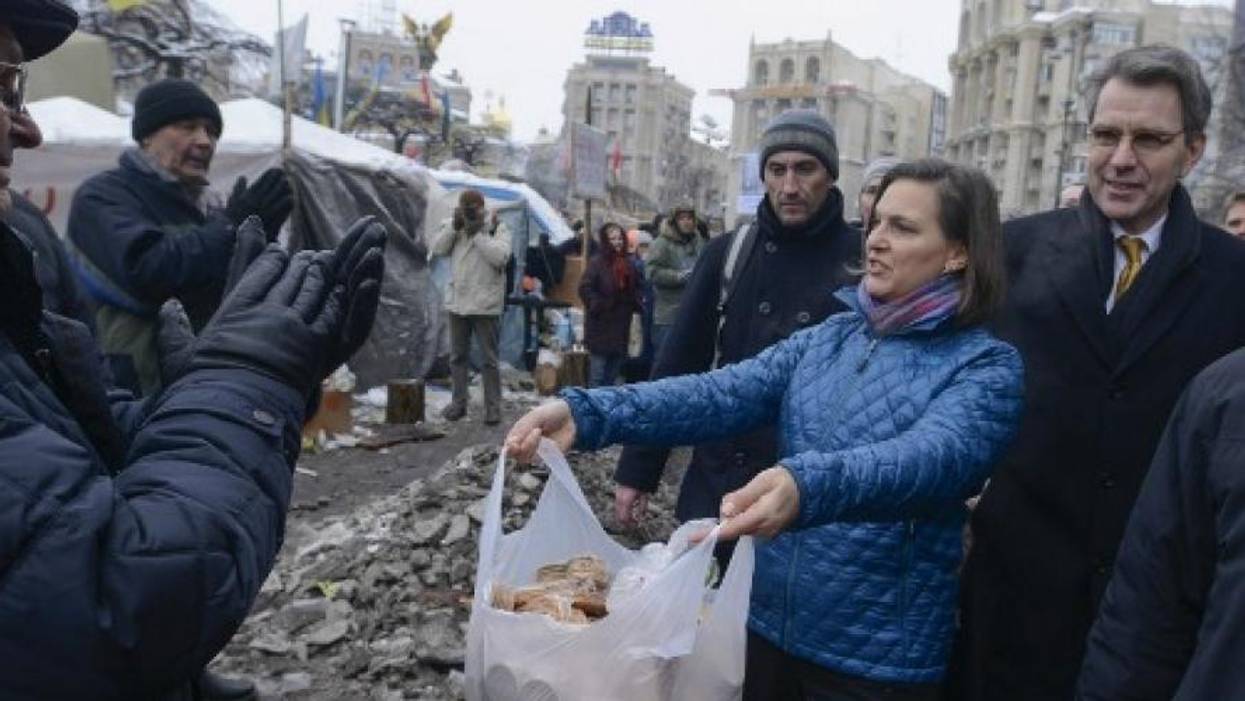
Leaders of the Endowment include some of our country's most militant interventionists. One of its board members is Elliott Abrams, who helped direct anti-Sandinista projects in Nicaragua during the 1980s and was later convicted of lying to Congress about the Iran-Contra affair. Another is Victoria Nuland, who as assistant secretary of state in 2016 flew to Ukraine to encourage protesters to overthrow their government.
Many grants are funneled through two sub-groups that reflect the bipartisan Washington consensus favoring intervention in foreign countries. One, the International Republican Institute, is run by a board headed by Senator John McCain, who never saw a war he didn't like and salivates at the thought of deposing unfriendly regimes. Its counterpart, the National Democratic Institute, is headed by Madeleine Albright, who famously pronounced the principle that the United States should guide the world because "we are the indispensable nation, we stand tall and we see further than other countries."
Abrams, Nuland, McCain, and Albright exemplify the interventionist mindset that has brought the United States and the world so much pain and grief. The National Endowment for Democracy is one of their cherished projects. McCain protested the proposed budget cut by saying group's mission "is at the heart of who we are as a country." So it is.
As soon as the leftist Hugo Chavez was elected president of Venezuela 20 years ago, the Endowment began pouring money into Venezuelan opposition groups. It has also subsidized groups working to undermine Presidents Oscar Arias of Costa Rica, Jean-Bertrand Aristide of Haiti, and Manuel Zelaya of Honduras, all of whom committed the sin of pursuing independent foreign policies. In 2013 the Endowment issued a report saying that "Russia remains the main priority country." Soon afterward, the Russian government announced that it was banning the Endowment from operating on its territory.
In response, the organization has intensified its efforts build anti-Russia movements in nearby countries, focusing on Ukraine, Belarus, Moldova, Georgia, Serbia, Kosovo, and Bosnia-Herzegovina. It provides training material and advice on how to publish newspapers, run computer networks, and organize political meetings. Once a group agrees to accept American money, the Endowment hails it as an "independent" agent of freedom and liberation.
American politicians and news outlets are howling about Russian interference in our last presidential election. Against this background, the National Endowment for Democracy seems more glaringly hypocritical than ever. Promoting democracy is a wonderful idea. We should begin at home. If we want other countries not to meddle in our politics, we should refrain from meddling in theirs.
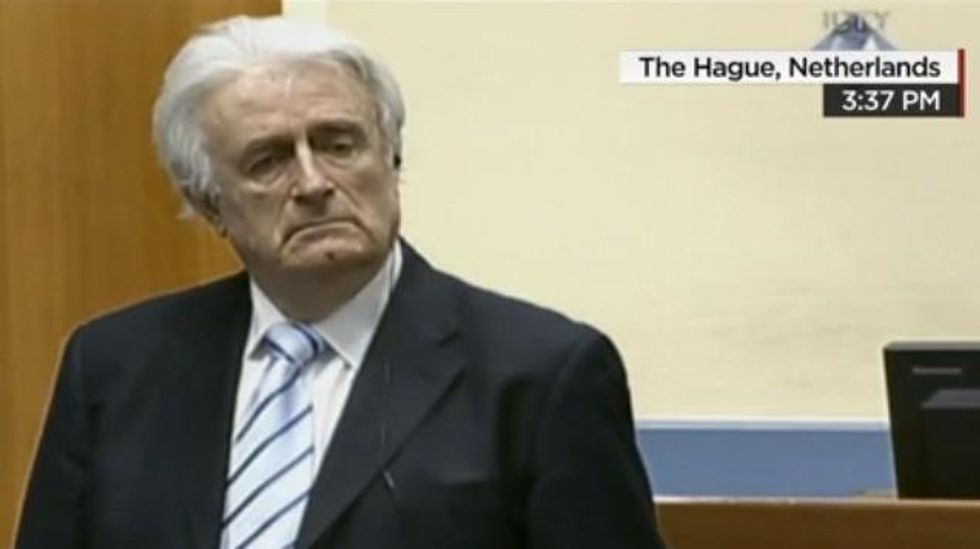
In a decision welcomed by human rights groups as a step towards justice, a UN tribunal on Thursday convicted former Bosnian Serb leader Radovan Karadzic of genocide, crimes against humanity, and war crimes and sentenced him to 40 years in prison.
Out of the 11 charges he faced at the International Criminal Tribunal for the former Yugoslavia (ICTY) for atrocities in the 1990s during the Bosnian war, the 70-year old, sometimes referred to as the Butcher of Bosnia, escaped on just one.
CNN reports that it "was seen as one of the most important war crimes trials since World War II."
Summarizing the verdict, which Karadzic will appeal, Reuters reports:
Judges said the 44-month siege of Sarajevo could not have happened without his support; that he committed crimes against humanity in an attempt to purge Muslims and Croats from parts of Bosnia; and that he had intended to eliminate the Bosnian Muslim males of the town of Srebrenica.
In 1995, Srebrenica was the site of "the worst systematic slaughter of the war: the slayings of 8,000 Muslim men and boys," the Washington Post reports.
Karadzic's "intent [was] that every able-bodied Bosnian Muslim male from Srebrenica be killed, which amounts to the intent to destroy the Bosnian Muslims in Srebrenica as such," a statement from the tribunal reads.
It adds that Karadzic helped "carry out a campaign of sniping and shelling against the civilian population of Sarajevo, aimed to spread terror among the civilian citizens."

"Karadzic master-minded the confinement, rape, torture, and murder of thousands of people; the shelling of civilians; the siege of Sarajevo; and the extensive destruction and plunder of property, including Muslim and Roman Catholic places of worship," he said.
Also welcoming the verdict was John Dalhuisen, Amnesty International's Director for Europe and Central Asia, who said, "This is a very important day for international justice and for victims who waited 13 years for Karadzic's arrest, and then another eight years for today's verdict."
"We should not forget, however, that more than 20 years after the Bosnian War, thousands of cases of enforced disappearances are unresolved, with a disturbing lack of political will still blocking access to justice, truth and reparation for victims," he added.
The judgment fell short for Hatidza Mehmedovic, who lost all of her family at Srebrenica. "[Karadzic] can live in a cushy prison while I have to live in Srebrenica, where his ideology is still in place," she told Reuters.
Peter Maas argues at The Intercept that the verdict may also offer some hope for those in demanding accountability and justice for post-9/11 torture and other abuses, because as unlikely as that seems now, "it was even more unlikely in the 1990s to think that the hand of justice--the justice of a fair trial, not a mob's noose or a precision-guided missile--would get close to Karadzic and his prime collaborators."
The ICTY has indicted 161 persons for crimes under international law committed in the former Yugoslavia since the tribunal's inception in 1993. The trial for Bosnian-Serb military leader Ratko Mladic, who was arrested in 2011, is ongoing.
Razor-wire fences, detention centres, xenophobic rhetoric and political disarray; nothing illustrates the tendency of governments to aggressively pursue nationalistic interests more starkly than their inhumane response to refugees fleeing conflict and war. With record numbers of asylum seekers predicted to reach Europe this year and a morally acceptable humanitarian response nowhere in sight, the immediate problem is more apparent than ever: the abject failure of the international community to share the responsibility, burden and resources needed to safeguard the basic rights of asylum seekers in accordance with international law.
Of immediate concern across the European Union, however, is the mounting pressure that policymakers are under from the far-right and anti-immigration groups, whose influence is skewing the public debate on the divisive issue of how governments should deal with refugees and immigrants. With racial intolerance steadily growing among citizens, the traditionally liberal attitude of European states is fast diminishing and governments are increasingly adopting a cynical interpretation of international refugee law that lacks any sense of justice or compassion.
"There can be little doubt that the European response to refugees has been discriminatory, morally objectionable and politically dangerous."
The 1951 Refugee Convention, which was implemented in response to Europe's last major refugee crisis during World War II, states that governments need only safeguard the human rights of asylum seekers when they are inside their territory. In violation of the spirit of this landmark human rights legislation, the response from most European governments has been to prevent rather than facilitate the arrival of refugees in order to minimise their legal responsibility towards them. In order to achieve their aim, the EU has even gone so far as making a flawed and legally questionable deal with President Erdogan to intercept migrant families crossing the Aegean Sea and return them to Turkey against their will.
Instead of providing 'safe and legal routes' to refugees, a growing number of countries on the migration path from Greece to Western Europe are adopting the Donald Trump solution of building walls, militarising boarders and constructing barbed wire barriers to stop people entering their country. Undocumented refugees (a majority of them women and children) who are trying to pass through Europe's no-longer borderless Schengen area are at times subjected to humiliation and violence or are detained in rudimentary camps with minimal access to the essentials they need to survive. Unable to travel to their desired destination, tens of thousands of refugees have been bottlenecked in Greece which has become a warehouse for abandoned souls in a country on the brink of its own humanitarian crisis.
Ostensibly, the extreme reaction of many EU member states to those risking their lives to escape armed conflict is tantamount to officially sanctioned racial discrimination. Unsurprisingly, this unwarranted government response has been welcomed by nationalist parties who are now polling favourably among voters in the UK, France, Germany, the Netherlands, Denmark and Poland. The same is true in Hungary, where the government has even agreed Nazi-era demands to confiscate cash and jewellery from refugees to fund their anti-humanitarian efforts.
There can be little doubt that the European response to refugees has been discriminatory, morally objectionable and politically dangerous. It's also self-defeating since curtailing civil liberties and discarding long-held social values has the potential to destabilise Europe far more than simply providing the assistance guaranteed to refugees under the UN convention. Albeit unwittingly, the reactionary attitude of governments also plays directly into the hands of Islamic State and other jihadi groups whose broader intentions include inciting Islamophobia, provoking instability and conflict within western countries, and recruiting support for terrorism in the Middle East and across Europe.
With the public increasingly divided about how governments should respond to the influx of people escaping violent conflict, it's crucial that the pervasive myths peddled by right-wing extremists are exposed for what they are: bigotry, hyperbole and outright lies designed to exacerbate fear and discord within society.
Forced migration is a global phenomenon and, compared with other continents, Europe is not being subjected to the 'invasion of refugees' widely portrayed in the mainstream media. Of the world's 60 million refugees, nine out of ten are not seeking asylum in the EU, and the vast majority remain displaced within their own countries. Most of those that do settle in Europe will return to their country of origin when they are no longer at risk (as happened at the end of the Balkan Wars of the 1990s when 70% of refugees who had fled to Germany returned to Serbia, Bosnia-Herzegovina, Croatia, Kosovo, Albania and Slovenia).
"It's crucial that the pervasive myths peddled by right-wing extremists are exposed for what they are: bigotry, hyperbole and outright lies designed to exacerbate fear and discord within society."
The real emergency is taking place outside of Europe, where there is a desperate need for more assistance from the international community. For example, Turkey is now home to over 3 million refugees; Jordan hosts 2.7 million refugees - a staggering 41 percent of its population; and Lebanon has 1.5 million Syrian refugees who make up a third of its population. Unsurprisingly, social and economic systems are under severe strain in these and the other countries that host the majority of global refugees - especially since they are mainly based in developing countries with soaring unemployment rates, inadequate welfare systems and high levels of social unrest. In stark comparison (and with the notable exception of Germany), the 28 relatively prosperous EU member states have collectively pledged to resettle a mere 160,000 of the one million refugees that entered Europe in 2015. Not only does this amount to less than 0.25% of their combined population, governments have only relocated a few hundred have so far.
The spurious claim that there are insufficient resources available to share with those seeking asylum in the EU or that asylum seekers will 'take our homes, our jobs and our welfare services' is little more than a justification for racial discrimination. Aside from the overriding moral and legal obligation for states to provide emergency assistance to anyone fleeing war or persecution, the economic rationale for resettling asylum seekers throughout Europe (and globally) is sound: in countries experiencing declining birth rates and ageing populations - as is the case across the EU as a whole - migration levels need to be significantly increased in order to continue financing systems of state welfare.
The facts are incontrovertible: evidence from OECD countries demonstrates that immigrant households contribute $2,800 more to the economy in taxes alone than they receive in public provision. In the UK, non-European immigrants contributed PS5 billion ($7.15 billion) in taxes between 2000 and 2011. They are also less likely to receive state benefits than the rest of the population, more likely to start businesses, and less likely to commit serious crimes than natives. Overall, economists at the European Commission calculate that the influx of people from conflict zones will have a positive effect on employment rates and long-term public finances in the most affected countries.
If migrant families contribute significantly to society and many European countries with low birth rates actually need them in greater numbers, why are governments and a growing sector of the population so reluctant to honour international commitments and assist refugees in need? The widely held belief that public resources are too scarce to share with asylum seekers is most likely born of fear and insecurity in an age of economic austerity, when many European citizens are struggling to make ends meet.
Just as the number of people forcibly displaced from developing countries begins to surge, economic conditions in most European countries have made it politically unfeasible to provide incoming refugees with shelter and basic welfare. Voluntary and compulsory austerity measures adopted by governments after spending trillions of dollars bailing out the banks in the aftermath of the 2008 financial crisis have resulted in deep spending cuts to essential public services such as healthcare, education and pensions schemes. The resulting economic crisis has led to rising unemployment, social discontent, growing levels of inequality and public services that are being stretched to breaking point.
"The widely held belief that public resources are too scarce to share with asylum seekers is most likely born of fear and insecurity in an age of economic austerity, when many European citizens are struggling to make ends meet." The same neoliberal ideology that underpins austerity in Europe is also responsible for creating widespread economic insecurity across the Global South and facilitating an exodus of so-called 'economic migrants', many of who are also making their way to Europe. Economic austerity has been central to the 'development' policies foisted onto low-income countries for decades by the IMF and World Bank in exchange for loans and international aid. They constitute a modern form of economic colonialism that in many cases has decimated essential public services, thwarted poverty reduction programmes and increased the likelihood of social unrest, sectarian violence and civil war. By prioritising international loan repayments over the basic welfare of citizens, these neoliberal policies are directly responsible for creating a steady flow of 'refugees from globalisation' who are in search of basic economic security in an increasingly unequal world.
Instead of pointing the finger of blame at governments for mismanaging the economy, public anger across Europe is being wrongly directed at a far easier target: refugees from foreign lands who have become society's collective scapegoats at a time of grinding austerity. It's high time that people in both 'rich' and 'poor' countries recognise that their hardship stems from a parallel set of neoliberal policies that have prioritised market forces above social needs. By emphasising this mutual cause and promoting solidarity between people and nations, citizens can begin overturning prejudiced attitudes and supporting progressive agendas geared towards safeguarding the common good of all humanity.
It's also clear that any significant change in the substance and direction of economic policy must go hand-in-hand with a dramatic shift away from aggressive foreign policy agendas that are overtly based on securing national interests at all costs - such as appropriating the planet's increasingly scarce natural resources. Indeed, it will remain impossible to address the root causes of the refugee crisis until the UK, US, France and other NATO countries fully accept that their misguided foreign policies are largely responsible for the current predicament.
Not only are many western powers responsible for selling arms to abusive regimes in the Middle East, their wider foreign policy objectives and military ambitions have displaced large swathes of the world's population, particularly as a consequence of the illegal occupation of Iraq, the war in Afghanistan and the ill-conceived invasion of Libya. The connection between the military interventions of recent years, the perpetuation of terrorism and the plight of refugees across the Middle East and North Africa has been succinctly explained by Professor Noam Chomsky:
"the US-UK invasion of Iraq ... dealt a nearly lethal blow to a country that had already been devastated by a massive military attack twenty years earlier followed by virtually genocidal US-UK sanctions. The invasion displaced millions of people, many of whom fled and were absorbed in the neighboring countries, poor countries that are left to deal somehow with the detritus of our crimes. One outgrowth of the invasion is the ISIS/Daesh monstrosity, which is contributing to the horrifying Syrian catastrophe. Again, the neighboring countries have been absorbing the flow of refugees. The second sledgehammer blow destroyed Libya, now a chaos of warring groups, an ISIS base, a rich source of jihadis and weapons from West Africa to the Middle East, and a funnel for flow of refugees from Africa."
After this series of blundered invasions by the US and NATO forces, which continue to destabilise an entire region, one might think that militarily powerful nations would finally accept the need for a very different foreign policy framework. No longer can governments ignore the imperative to engender trust between nations and replace the prevailing culture of war with one of peace and nonviolent means of conflict resolution. In the immediate future, the priority for states must be to deescalate emerging cold war tensions and diffuse what is essentially a proxy war in the Middle East being played out in Syria. Yet this remains a huge challenge at a time when military intervention is still favoured over compromise and diplomacy, even when common sense and experience tells us that this outdated approach only exacerbates violent conflict and causes further geopolitical instability.
Given the deplorably inadequate response from most EU governments to the global exodus of refugees thus far, the stage is set for a rapid escalation of the crisis in 2016 and beyond. Some ten million refugees are expected to make their way to Europe in 2016 alone, and this figure is likely to rise substantially with population growth in developing countries over the coming decades. But it's climate change that will bring the real emergency, with far higher migration levels accompanied by floods, droughts and sudden hikes in global food prices.
Although largely overlooked by politicians and the mainstream media, the number of people fleeing conflict is already dwarfed by 'environmental refugees' displaced by severe ecological conditions - whose numbers could rise to 200 million by 2050. It's clear that unless nations collectively pursue a radically different approach to managing forced displacement, international discord and social tensions will continue to mount and millions of additional refugees will be condemned to oversized and inhumane camps on the outer edges of civilisation.
The fundamentals of an effective and morally acceptable response to the crisis are already articulated in the Refugee Convention, which sets out the core responsibilities that states have towards those seeking asylum - even though governments have interpreted the treaty erroneously and failed to implement it effectively. In the short term, it's evident that governments must mobilise the resources needed to provide urgent humanitarian assistance to those escaping war, regardless of where in the world they have been displaced. Like the Marshall Plan that was initiated after the Second World War, a globally coordinated emergency response to the refugee crisis will require a significant redistribution of finance from the world's richest countries to those most in need - which should be provided on the basis of 'enlightened self-interest' if not from a genuine sense of compassion and altruism.
"Immediate humanitarian interventions would have to be accompanied by a new and more effective system for administrating the protection of refugees in a way that is commensurate with international refugee law."
Immediate humanitarian interventions would have to be accompanied by a new and more effective system for administrating the protection of refugees in a way that is commensurate with international refugee law. In simple terms, such a mechanism could be coordinated by a reformed and revitalised UN Refugee Agency (the UNHCR) which would ensure that both the responsibility and resources needed to protect refugees is shared fairly among nations. A mechanism for sharing global responsibility would also mean that states only provide assistance in accordance with their individual capacity and circumstances, which would prevent less developed nations from shouldering the greatest burden of refugees as is currently the case.
Even though the UN's refugee convention has already been agreed by 145 nations, policymakers in the EU seem incapable and unwilling to demonstrate any real leadership in tackling this or indeed any other pressing transnational issue. Not only does the resulting refugee fiasco demonstrate the extent to which self-interest dominates the political status quo across the European Union, it confirms the suspicion that the union as a whole is increasingly devoid of social conscience and in urgent need of reform.
Thankfully, ordinary citizens are leading the way on this critical issue and putting elected representatives to shame by providing urgent support to refugee families in immediate need of help. In their thousands, volunteers stationed along Europe's boarders have been welcoming asylum seekers by providing much needed food, shelter and clothing, and have even provided search and rescue services for those who have risked their lives being trafficked into Europe in rubber dinghies. Nowhere is this spirit of compassion and generosity more apparent than on Lesbos and other Geek islands, where residents have been collectively nominated for the 2016 Nobel Peace Prize for their humanitarian efforts.
The selfless actions of these dedicated volunteers should remind the world that people have a responsibility and a natural inclination to serve one another in times of need - regardless of differences in race, religion and nationality. Instead of building militarised borders and ignoring popular calls for a just and humanitarian response to the refugee crisis, governments should take the lead from these people of goodwill and prioritise the needs of the world's most vulnerable above all other concerns. For European leaders and policymakers in all countries, it's this instinctively humane response to the refugee crisis - which is based firmly on the principle of sharing - that holds the key to addressing the whole spectrum of interconnected social, economic and environmental challenges in the critical period ahead.
The following are the prepared remarks by the Nobel Peace Prize winner Mairead Maguire to be delivered at the international Sarajevo Peace Event which begins in Bosnia and Herzegovin on Friday:
Today, June 6, people from all corners of the world gather here in Sarajevo, Bosnia, to explore a plethora of ideas on the road forward to a world in peace.
The following are the prepared remarks by the Nobel Peace Prize winner Mairead Maguire to be delivered at the international Sarajevo Peace Event which begins in Bosnia and Herzegovin on Friday:
Today, June 6, people from all corners of the world gather here in Sarajevo, Bosnia, to explore a plethora of ideas on the road forward to a world in peace.
Sarajevo once was the scene of the assassination of Archduke Ferdinand that led to the start of the First World War in 1914. The shot fired in Sarajevo a century ago set off, like a starting pistol, a race for power, two global wars, a Cold War, a century of immense, rapid explosion of death and destruction technology, all extremely costly, and extremely risky.
A huge step in the history of war, but also a decisive turning point in the history of peace. The peace movement has never been as strong politically as in the last three decades before the break-out of the First World War. It was a factor in political life, literature, organization, and planning, the Hague Peace Conferences, the Hague Peace Palace and the International Court of Arbitration, and Bertha von Suttner's bestseller, 'Lay Down Your Arms!'.
Optimism was high as to what this 'new science' of peace could mean to humankind. Parliaments, Kings and Emperors, great cultural and business personalities involved themselves. The great strength of the movement was that it did not limit itself to civilizing and slowing down militarism, it demanded its total abolition. People were presented with an alternative, and they saw common interest in this alternative road forward for humankind.
What happened in Sarajevo a hundred years ago was a devastating blow from which the movement never really recovered. Now, 100 years later, must be the time for a thorough reappraisal of the merits of the original vision of disarmament, what we have done without it, the need for a recommitment, a new ambitious start offering new hope to a humanity suffering under the scourge of militarism and wars.
People are tired of armaments and war. They have seen that they release uncontrollable forces of tribalism and nationalism. We need to acknowledge that our common humanity and human dignity are more important than our different traditions. We can solve our problems without killing each other. We need to accept and celebrate diversity and otherness. We need to give and accept forgiveness, and choose non-killing and non-violence as ways to solve our problems.
We are also challenged to build structures through which we can cooperate and which reflect our interdependence. The vision of the European Union (EU) founders to link countries together economically in order to lessen the likelihood of war among the nations is a worthy endeavor.
Unfortunately instead of providing help for E.U. citizens, we are witnessing the growing militarization of Europe, its role as a driving force, under the leadership of the United States/NATO, towards rearmament and a new 'cold' war and military aggression. The EU and many of its countries used to take initiatives in the United Nations for peaceful settlements of conflicts. Traditionally peaceful countries, like Norway and Sweden, are now among the most important U.S./NATO war assets. The EU is a threat to the survival of neutrality.
Many nations have been drawn into being complicity in breaking international law through U.S./U.K./NATO wars in Afghanistan, Iraq, Libya, and so on. I believe that NATO should be abolished and that the United Nations should be reformed and actively take up its mandate to save the world from the scourge of war.
But there is hope. People are saying no to militarism and war and insisting on disarmament. Now is the time to take inspiration from many who have gone before us, like Bertha von Suttner, who was the first woman to win the Nobel Peace Prize in l905.
It was Von Suttner who moved Alfred Nobel to set up the Nobel Peace Prize award and it was her movement and ideas that Nobel decided to support in his testament for the 'Champions of Peace', that is, those who struggled for disarmament and replacing power with law and International relations.
That these ideas were what Nobel wished to support is clearly confirmed by three expressions in his will, about creating the fraternity of nations, work for abolition of armies, and the holding of peace congresses. It is important the Nobel Committee be faithful to his wishes and that prizes go to the true Champions of Peace that Nobel had in mind.
This 100-year-old program for global disarmament confronted militarism in a fundamental way. It challenges today's peace movement to rethink. Is it sufficient to ask for improvements and reforms, or is it necessary to be an alternative to militarism? This aberration and dysfunctional system goes completely against the true spirit of men and women, which is to love and be loved and solve our problems through cooperation, dialogue, non-violence and conflict resolution.
The Sarajevo event gathers a diversity of activists together and lets them feel the warmth and strength of being among thousands of friends and enriched by the variety of peace people, and ideas. Participants will be inspired and energized to pursue their different projects, be it arms trade, nuclear, non-violence, culture of peace, drone warfare, etc. But soon they shall be back home, and know all too well how they often are being met with indifference or a remote stare.
The problem is not that people do not like what they say; what they understand correctly is that little can be done, as the world is. But peace people want a different world. Diverse as their work is, a common vision of a world without arms, militarism and war is indispensable for success. Can the movement achieve real change if it does not confront and reject militarism entirely, as the aberration, or dysfunction, that it is in human history? Is it not time that all countries come together in an agreement to abolish all weapons and war, and to commit to always sort out all differences through international law and institutions?
While it is impossible in Sarajevo to make a common peace program, it must be possible to commit to a common goal. If the common dream is a world without weapons and militarism, why not say so? Why be silent about it?
It would make a world of difference if peace work no longer be scattered attempts to modify the military. Each activist should see their effort as part of a great, global endeavor. Across all divisions of national borders, religions and races, one goal should be clear: to be an alternative, insisting on an end to militarism and violence. This would mean, for each one, an entirely different chance to be listened to and taken seriously.
Tens of thousands are fleeing their homes in the Balkans amidst epic floods triggered by unprecedented rainfall that have already claimed the lives of dozens.
Three months worth of rain fell on the region in just three days.
"This is a catastrophe unseen in Serbia," Predrag Maric, the head of the the Serbian Interior Ministry's emergencies unit, said at a news conference.
On Sunday water levels in Serbia's River Sava "are expected to peak," BBC News reports, "threatening the country's biggest power plant." Reuters reports that
Serbia's EPS power utility said a fresh flood wave from the Sava and Mlava rivers threatened the Nikola Tesla and Kostolac power plants. Capacity has already been cut back at the Nikola Tesla plant in Obrenovac, Serbia's largest.
The Mlava overwhelmed sandbag flood defenses on Sunday morning near Kostolac, threatening to flood coal mines and the plant itself.
"These are the kind of waters not seen in 1,000 years, let alone 100," Serbia's Prime Minister Aleksandar Vucic said during a televised cabinet session.
At least 12 people have been reported dead from the flooding in Serbia.
Like Serbia, neighboring Bosnia-Herzegovina has declared a sate of emergency due to the flooding, and at least 19 people were reported killed as of Saturday.
The flooding in Bosnia has unleashed another danger: the thousands of landmines that litter the country from the 1992-1995 war.
The flooding has swept away warning signs indicating where there was landmine danger, and may have unburied some landmines.
The Associated Press reports that the landmines could pose an "international problem" because they could be carried away by floodwaters to rivers and potentially travel "through half of southeast Europe or get stuck in the turbines of a hydroelectric dam."
Croatia has reported one death and two missing so far as a result of the epic flooding in the region as well.

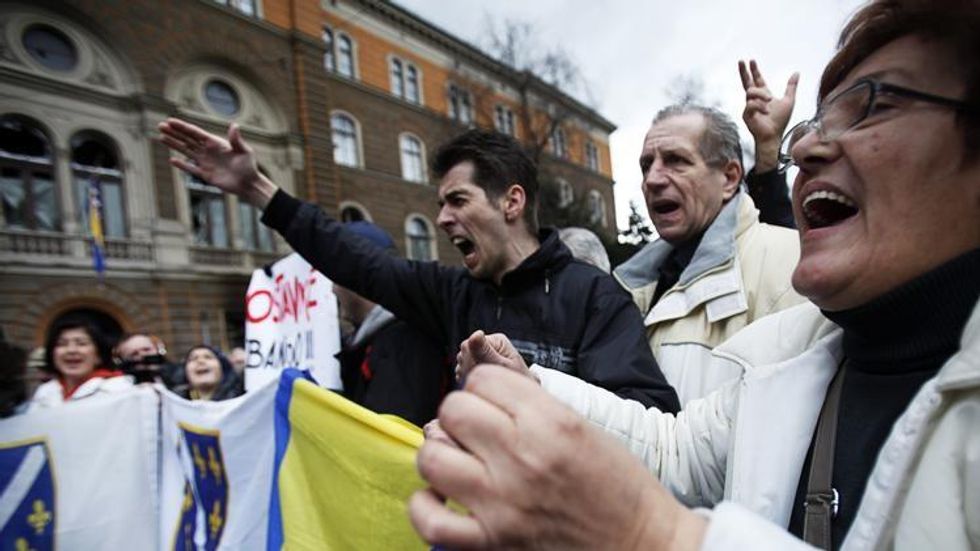
According to the New York Times, the demonstrators chanted slogans against the "criminals" in government and urged those in authority to "resign today."
Sparked by a demonstration in the city of Tuzla last week--where recently laid-off workers rose up against the failed privatization of previously state-owned companies--the protests have spread across Bosnia-Herzegovina in more than 30 cities, thus far forcing the resignation of the leaders of four regional cantons.
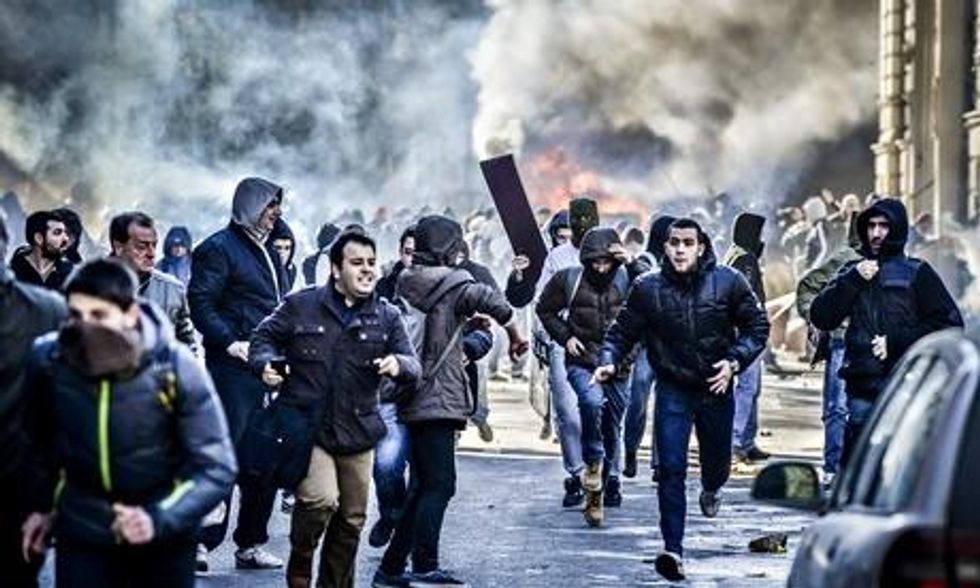
On Friday, demonstrators -- which according to The New York Times included "unemployed youths, war veterans and disgruntled workers, among others"-- set fire to government buildings in the capital and across the country.
Most remarkable about the uprising, witnesses note, is how it has connected the disparate and frequently-feuding ethnic groups.
"In one of the photos from the protests, we see the demonstrators waving three flags side by side: Bosnian, Serb, Croat," writes Slavoj Zizek, international director of the Birkbeck Institute for the Humanities at the University of London. "[W]e are dealing with a rebellion against nationalist elites: the people of Bosnia have finally understood who their true enemy is: not other ethnic groups, but their own leaders who pretend to protect them from others."
"I think the biggest fear of our politicians is a united people," demonstrator Lejla Kusturica told the New York Times.
With overall unemployment estimated to be as high as 40 percent among the general population, and 70 percent among young people, the protesters are denouncing the overly-bureaucratic system which they say only divides the population and caters to elites.
As the New York Times explains:
The Dayton accords among the leaders of warring Serbs, Croats and Muslims -- the latter now called Bosniaks -- brought an end to the 1992-95 civil war by constructing a decentralized state that gave each a share of power and none of them dominance. [...] But the Bosnians have since added layers of complexity to the original design that have entrenched the political elite while often hindering economic development.
According to Zizek, one of the primary targets of the protesters is the EU administration overseeing the Bosnian state which, he says, "entrenches partitions" by only dealing with "national elites as their privileged partners."
_____________________

The events gave rise to conspiracy theories (for example, that the Serb government had organised the protests to topple the Bosnian leadership), but one should safely ignore them since it is clear that, whatever lurks behind, the protesters' despair is authentic. One is tempted to paraphrase Mao Zedong's famous phrase here: there is chaos in Bosnia, the situation is excellent!
"What Max Horkheimer said about fascism and capitalism back in the 1930s (that those who do not want to talk critically about capitalism should also keep quiet about fascism) should be applied to today's fundamentalism: those who do not want to talk critically about liberal democracy should also keep quiet about religious fundamentalism."
Why? Because the protesters' demands were as simple as they can be - jobs, a chance of decent life, an end to corruption - but they mobilised people in Bosnia, a country which, in the last decades, has become synonymous with ferocious ethnic cleansing.
Before now, the only mass protests in Bosnia and other post-Yugoslav states were about ethnic or religious passions. In the middle of 2013, two public protests were organised in Croatia, a country in deep economic crisis, with high unemployment and a deep sense of despair: trade unions tried to organise a rally in support of workers' rights, while rightwing nationalists started a protest movement against the use of cyrillic letters on public buildings in cities with a Serb minority. The first initiative brought a couple of hundred people to a square in Zagreb; the second mobilised hundreds of thousands, as had an earlier fundamentalist movement against gay marriages.
Croatia is far from being an exception: from the Balkans to Scandinavia, from the US to Israel, from central Africa to India, a new Dark Age is looming, with ethnic and religious passions exploding and Enlightenment values receding. These passions were lurking in the background all the time, but what is new is the outright shamelessness of their display.
So what are we to do? Mainstream liberals are telling us that when basic democratic values are under threat by ethnic or religious fundamentalists, we must all unite behind the liberal-democratic agenda of cultural tolerance, save what can be saved and put aside dreams of a more radical social transformation. Our task, we are told, is clear: we must choose between liberal freedom and fundamentalist oppression.
However, when we are triumphantly asked a (purely rhetorical) question such as "Do you want women to be excluded from public life?" or "Do you want every critic of religion to be punished by death?", what should make us suspicious is the very self-evidence of the answer. The problem is that such a simplistic liberal universalism long ago lost its innocence. The conflict between liberal permissiveness and fundamentalism is ultimately a false conflict - a vicious cycle of the two poles generating and presupposing each other.
What Max Horkheimer said about fascism and capitalism back in the 1930s (that those who do not want to talk critically about capitalism should also keep quiet about fascism) should be applied to today's fundamentalism: those who do not want to talk critically about liberal democracy should also keep quiet about religious fundamentalism.
Reacting to the characterisation of Marxism as "the Islam of the 20th century", Jean-Pierre Taguieff wrote that Islam was turning out to be "the Marxism of the 21st century" prolonging, after the decline of Communism, its violent anti-capitalism.
However, the recent vicissitudes of Muslim fundamentalism can be said to confirm Walter Benjamin's old insight that "every rise of fascism bears witness to a failed revolution". The rise of fascism is, in other words, both the left's failure, and simultaneously proof that there was a revolutionary potential, a dissatisfaction, which the left was not able to mobilise. And does the same not hold for today's so-called "Islamo-fascism"? Is the rise of radical Islamism not exactly correlative to the disappearance of the secular left in Muslim countries?
When Afghanistan is portrayed as the utmost Islamic fundamentalist country, who still remembers that 40 years ago it was a country with strong secular tradition, including a powerful Communist party which took power there independently of the Soviet Union?
It is against this background that one should understand the latest events in Bosnia. In one of the photos from the protests, we see the demonstrators waving three flags side by side: Bosnian, Serb, Croat, expressing the will to ignore ethnic differences. In short, we are dealing with a rebellion against nationalist elites: the people of Bosnia have finally understood who their true enemy is: not other ethnic groups, but their own leaders who pretend to protect them from others. It is as if the old and much-abused Titoist motto of the "brotherhood and unity" of Yugoslav nations acquired new actuality.
One of the protesters' targets was the EU administration which oversees the Bosnian state, enforcing peace between the three nations and providing significant financial help to enable the state to function. This may seem surprising, since the goals of the protesters are nominally the same as the goals of Brussels: prosperity and the end of both ethnic tensions and corruption. However, the way the EU effectively governs Bosnia entrenches partitions: it deals with nationalist elites as their privileged partners, mediating within them.
What the Bosnian outburst confirms is that one cannot genuinely overcome ethnic passions by imposing a liberal agenda: what brought the protesters together is a radical demand for justice. The next and most difficult step would have been to organise the protests into a new social movement that ignores ethnic divisions, and to organise further protests - can one imagine a scene of enraged Bosnians and Serbs demonstrating together in Sarajevo?
Even if the protests gradually lose their power, they will remain a brief spark of hope, something like the enemy soldiers fraternising across the trenches in the first world war. Authentic emancipatory events always involve such ignoring of particular identities.
And the same holds for the recent visit of the two Pussy Riot members to New York: in a big gala show, they were introduced by Madonna in the presence of Bob Geldof, Richard Gere, etc: the usual human rights gang. What they should have done there was to express their solidarity with Edward Snowden, to assert that Pussy Riot and Snowden are part of the same global movement. Without such gestures which bring together what, in our ordinary ideological experience, appears incompatible (Muslims, Serbs and Croats in Bosnia; Turkish secularists and anti-capitalist Muslims in Turkey, etc), protest movements will be always manipulated by one superpower in its struggle against another.

A localized protest movement against the failed privatization of key state-owned companies in Bosnia appears to be growing across the country as anger spreads over workers were left unpaid when the new owners declared bankruptcy and closed their doors.
What began in the city of Tuzla earlier this week as a small-scale protest by workers angered about their lost jobs and wages is now spreading, according to reports, as the anger aimed at the ruling government over its economic and social policies has seemingly catalyzed a brewing resentment among the people.
As EuroNews reports:
Tuzla is the third largest city in the former Yugoslav republic and the industrial heart of the north. But many of its once thriving chemical factories halted production after being privatised, leaving hundreds of workers without jobs.
With unemployment sky-high and tension building, one of the hundreds of protesters in the city said: "This is the start of the Bosnian Spring."
Watch the video:
Factory closures trigger clashes in BosniaThe closure of factories and firms has sparked clashes in Bosnia, as economic and social woes deepen almost 20 years since the ...
According to Associated Press coverage:
Residents of buildings in Tuzla yelled insults and threw buckets of water at the officers who passed by in full riot gear. Elderly neighbors were seen banging cooking pots on their windows and balconies.
The four former state-owned companies, which included furniture and washing powder factories, employed most of the population of Tuzla. After they were privatized, contracts obliged them to invest in them and make them profitable. But the owners sold the assets, stopped paying workers and filed for bankruptcy between 2000 and 2008.
The leader of the Tuzla region, Sead Causevic, told Bosnian state TV that the "rip-off privatization" was already concluded when his government took power and that the workers' demands are legitimate. He blamed the courts for obstructing justice, saying the workers have turned to them years ago, but no judgment has ever been passed.
And as Reuters adds, the protests appear to be spreading:
Hundreds of people turned out in solidarity in the capital Sarajevo, the central town of Zenica and Bihac in the west. Teenagers threw eggs and stones at a government building and fought with police. Four officers were taken to hospital, officials said.
Some of the Sarajevo protesters were heard chanting "Killers!" and "Revolution!"
"It was our government that sold state assets for peanuts and left the people without pensions, jobs or health insurance," said 24-year-old Hana Obradovic, an unemployed graduate. "Their families have nothing to eat while (the politicians) sit in the institutions and steal from the people."