

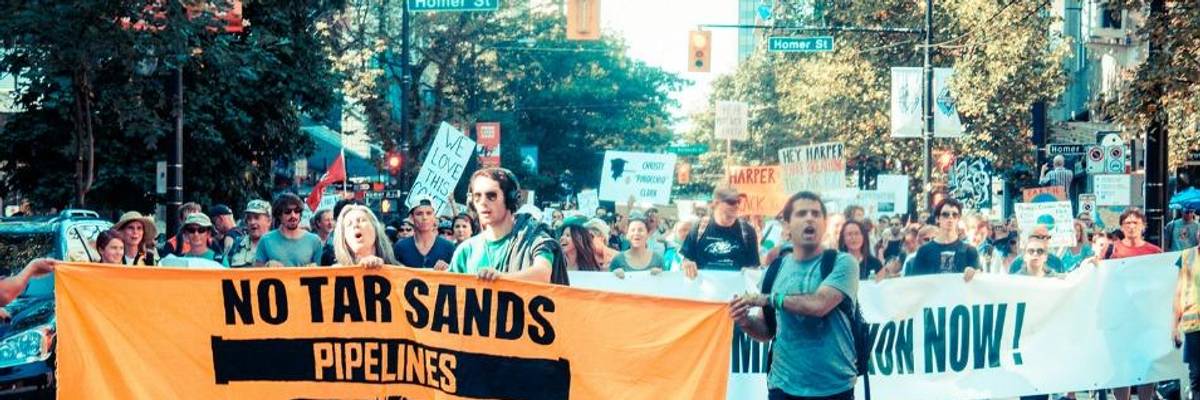
Oil Change International credits a growing people's climate movement for slowing tar sands growth. (Photo: Chris Yakimov/flickr/cc)
In Face of Rising Climate Movement, Tar Sands on Life Support: Report
Evidence of struggling tar sands sector suggests opportunity to slow the rate of growth 'significantly'
With dozens of carbon-intensive tar sands projects delayed or on hold, a new report released Friday confidently declares: "The case for the tar sands is crumbling."
A new analysis by Oil Change International identifies 39 projects--representing more than 1.61 million barrels per day (bpd) of potential tar sands oil production capacity--that companies are currently unable or unwilling to invest in.
That's good news for the climate and the environment, as well as for frontline communities that bear the brunt of the toxic tar sands production.
And it's bad news for the tar sands sector, which now finds itself "struggling to justify many new projects," says Hannah McKinnon, senior campaigner on private finance at Oil Change International.
According to the report, On the Edge: 1.6 Million Barrels per Day of Proposed Tar Sands Oil on Life Support (pdf), the delayed and on-hold projects include three open pit mine projects with a combined capacity of over 450,000 bpd, and over 30 drilling projects with nearly 1.2 million bpd capacity. The total extractable tar sands oil in these projects is almost 13 billion barrels. If all of that resource was extracted and burned, around 7.8 billion metric tons of carbon dioxide would be emitted--equivalent to 40 years of emissions from 51 average U.S. coal-fired power plants.
Furthermore, the Oil Change analysis found that an additional 550,000 bpd of production capacity is owned by companies that have filed for bankruptcy--"another clear indicator of weakness in the sector," the authors write.
A number of factors have led to this decline, the report says, pointing to plummeting oil prices; shifting politics in the 'tar sands capital' of Alberta, Canada; and the rise of both alternative energy technologies and the grassroots climate movement.
Still, the authors warn against growing complacent in the face of an industry that will fight tooth and nail to maintain its dominance.
"This report is some good news for the climate, but the battle is far from over. Every day of delay for tar sands projects is a good day for our future, but this is an industry determined to dig it up," said Lorne Stockman, Research Director at Oil Change International. "But while the industry puts its head down and tries to charge ahead, people around the continent are rising up to defend our communities and climate, and their efforts are clearly paying dividends."
An Urgent Message From Our Co-Founder
Dear Common Dreams reader, It’s been nearly 30 years since I co-founded Common Dreams with my late wife, Lina Newhouser. We had the radical notion that journalism should serve the public good, not corporate profits. It was clear to us from the outset what it would take to build such a project. No paid advertisements. No corporate sponsors. No millionaire publisher telling us what to think or do. Many people said we wouldn't last a year, but we proved those doubters wrong. Together with a tremendous team of journalists and dedicated staff, we built an independent media outlet free from the constraints of profits and corporate control. Our mission has always been simple: To inform. To inspire. To ignite change for the common good. Building Common Dreams was not easy. Our survival was never guaranteed. When you take on the most powerful forces—Wall Street greed, fossil fuel industry destruction, Big Tech lobbyists, and uber-rich oligarchs who have spent billions upon billions rigging the economy and democracy in their favor—the only bulwark you have is supporters who believe in your work. But here’s the urgent message from me today. It's never been this bad out there. And it's never been this hard to keep us going. At the very moment Common Dreams is most needed, the threats we face are intensifying. We need your support now more than ever. We don't accept corporate advertising and never will. We don't have a paywall because we don't think people should be blocked from critical news based on their ability to pay. Everything we do is funded by the donations of readers like you. When everyone does the little they can afford, we are strong. But if that support retreats or dries up, so do we. Will you donate now to make sure Common Dreams not only survives but thrives? —Craig Brown, Co-founder |
With dozens of carbon-intensive tar sands projects delayed or on hold, a new report released Friday confidently declares: "The case for the tar sands is crumbling."
A new analysis by Oil Change International identifies 39 projects--representing more than 1.61 million barrels per day (bpd) of potential tar sands oil production capacity--that companies are currently unable or unwilling to invest in.
That's good news for the climate and the environment, as well as for frontline communities that bear the brunt of the toxic tar sands production.
And it's bad news for the tar sands sector, which now finds itself "struggling to justify many new projects," says Hannah McKinnon, senior campaigner on private finance at Oil Change International.
According to the report, On the Edge: 1.6 Million Barrels per Day of Proposed Tar Sands Oil on Life Support (pdf), the delayed and on-hold projects include three open pit mine projects with a combined capacity of over 450,000 bpd, and over 30 drilling projects with nearly 1.2 million bpd capacity. The total extractable tar sands oil in these projects is almost 13 billion barrels. If all of that resource was extracted and burned, around 7.8 billion metric tons of carbon dioxide would be emitted--equivalent to 40 years of emissions from 51 average U.S. coal-fired power plants.
Furthermore, the Oil Change analysis found that an additional 550,000 bpd of production capacity is owned by companies that have filed for bankruptcy--"another clear indicator of weakness in the sector," the authors write.
A number of factors have led to this decline, the report says, pointing to plummeting oil prices; shifting politics in the 'tar sands capital' of Alberta, Canada; and the rise of both alternative energy technologies and the grassroots climate movement.
Still, the authors warn against growing complacent in the face of an industry that will fight tooth and nail to maintain its dominance.
"This report is some good news for the climate, but the battle is far from over. Every day of delay for tar sands projects is a good day for our future, but this is an industry determined to dig it up," said Lorne Stockman, Research Director at Oil Change International. "But while the industry puts its head down and tries to charge ahead, people around the continent are rising up to defend our communities and climate, and their efforts are clearly paying dividends."
With dozens of carbon-intensive tar sands projects delayed or on hold, a new report released Friday confidently declares: "The case for the tar sands is crumbling."
A new analysis by Oil Change International identifies 39 projects--representing more than 1.61 million barrels per day (bpd) of potential tar sands oil production capacity--that companies are currently unable or unwilling to invest in.
That's good news for the climate and the environment, as well as for frontline communities that bear the brunt of the toxic tar sands production.
And it's bad news for the tar sands sector, which now finds itself "struggling to justify many new projects," says Hannah McKinnon, senior campaigner on private finance at Oil Change International.
According to the report, On the Edge: 1.6 Million Barrels per Day of Proposed Tar Sands Oil on Life Support (pdf), the delayed and on-hold projects include three open pit mine projects with a combined capacity of over 450,000 bpd, and over 30 drilling projects with nearly 1.2 million bpd capacity. The total extractable tar sands oil in these projects is almost 13 billion barrels. If all of that resource was extracted and burned, around 7.8 billion metric tons of carbon dioxide would be emitted--equivalent to 40 years of emissions from 51 average U.S. coal-fired power plants.
Furthermore, the Oil Change analysis found that an additional 550,000 bpd of production capacity is owned by companies that have filed for bankruptcy--"another clear indicator of weakness in the sector," the authors write.
A number of factors have led to this decline, the report says, pointing to plummeting oil prices; shifting politics in the 'tar sands capital' of Alberta, Canada; and the rise of both alternative energy technologies and the grassroots climate movement.
Still, the authors warn against growing complacent in the face of an industry that will fight tooth and nail to maintain its dominance.
"This report is some good news for the climate, but the battle is far from over. Every day of delay for tar sands projects is a good day for our future, but this is an industry determined to dig it up," said Lorne Stockman, Research Director at Oil Change International. "But while the industry puts its head down and tries to charge ahead, people around the continent are rising up to defend our communities and climate, and their efforts are clearly paying dividends."