SUBSCRIBE TO OUR FREE NEWSLETTER
Daily news & progressive opinion—funded by the people, not the corporations—delivered straight to your inbox.
5
#000000
#FFFFFF
To donate by check, phone, or other method, see our More Ways to Give page.
Daily news & progressive opinion—funded by the people, not the corporations—delivered straight to your inbox.
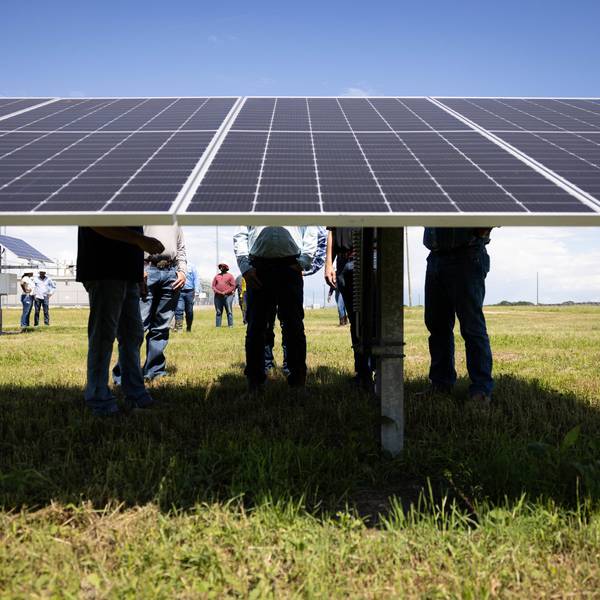
ROME, Italy - Driven by solar and wind, world investments in renewable energy reversed a two-year dip last year, brushing aside the challenge from sharply lower oil prices and registering a 17 percent leap over the previous year to stand at 270 billion dollars.
ROME, Italy - Driven by solar and wind, world investments in renewable energy reversed a two-year dip last year, brushing aside the challenge from sharply lower oil prices and registering a 17 percent leap over the previous year to stand at 270 billion dollars.
These investments helped see an additional 103Gw of generating capacity - roughly that of all U.S. nuclear plants combined -around the world, making 2014 the best year ever for newly-installed capacity, according to the 9th annual "Global Trends in Renewable Energy Investments" report from the U.N. Environment Programme (UNEP) released Mar. 31.
Prepared by the Frankfurt School-UNEP Collaborating Centre and Bloomberg New Energy Finance, the report says that a continuing sharp decline in technology costs - particularly in solar but also in wind - means that every dollar invested in renewable energy bought significantly more generating capacity in 2014.
"Climate-friendly energy technologies are now an indispensable component of the global energy mix and their importance will only increase as markets mature, technology prices continue to fall and the need to rein in carbon emissions becomes ever more urgent" - Achim Steiner, Executive Director of UNEPIn what was called "a year of eye-catching steps forward for renewable energy", the report notes that wind, solar, biomass and waste-to-power, geothermal, small hydro and marine power contributed an estimated 9.1 percent of world electricity generation in 2014, up from 8.5 percent in 2013.
This, says the report, means that the world's electricity systems emitted 1.3 gigatonnes of CO2 - roughly twice the emissions of the world's airline industry - less than it would have if that 9.1 percent had been produced by the same fossil-dominated mix generating the other 90.9 percent of world power.
"Once again in 2014, renewables made up nearly half of the net power capacity added worldwide," said Achim Steiner, Executive Director of UNEP. "These climate-friendly energy technologies are now an indispensable component of the global energy mix and their importance will only increase as markets mature, technology prices continue to fall and the need to rein in carbon emissions becomes ever more urgent."
China saw by far the biggest renewable energy investments last year - a record 83.3 billion dollars, up 39 percent from 2013. The United States was second at 38.3 billion dollars, up seven percent on the year (although below its all-time high reached in 2011). Third came Japan at 35.7 billion dollars, 10 percent higher than in 2013 and its biggest total ever.
According to the report, a prominent feature of 2014 was the rapid expansion of renewables into new markets in developing countries, where investments jumped 36 percent to 131.3 billion dollars. China with 83.3 billion, Brazil (7.6 billion), India (7.4 billion) and South Africa (5.5 billion) were all in the top 10 investing countries, while more than one billion dollars was invested in Indonesia, Chile, Mexico, Kenya and Turkey.
Although 2014 was said to be a turnaround year for renewables after two years of shrinkage, multiple challenges remain in the form of policy uncertainty, structural issues in the electricity system and even the very nature of wind and solar generation which are dependent on breeze and sunlight.
Another challenge, says the report, is the impact of the more than 50 percent collapse in oil prices in the second half of last year. However, according to Udo Steffens, President of the Frankfurt School of Finance and Management, the price of oil is only likely to dampen investor confidence in parts of the sector, such as solar in oil-exporting countries and biofuels in most parts of the world.
"Oil and renewables do not directly compete for power investment dollars," said Steffens. "Wind and solar sectors should be able to carry on flourishing, particularly if they continue to cut costs per MWh. Their long-term story is just more convincing."
Of greater concern is the erosion of investor confidence caused by increasing uncertainty surrounding government support policies for renewables.
"Europe was the first mover in clean energy, but it is still in a process of restructuring those early support mechanisms," according to Michael Liebreich, Chairman of the Advisory Board for Bloomberg New Energy Finance. "In the United Kingdom and Germany we are seeing a move away from feed-in tariffs and green certificates, towards reverse auctions and subsidy caps, aimed at capping the cost of the transition to consumers.
"Southern Europe is still almost a no-go area for investors because of retroactive policy changes, most recently those affecting solar farms in Italy. In the United States there is uncertainty over the future of the Production Tax Credit for wind, but costs are now so low that the sector is more insulated than in the past. Meanwhile the rooftop solar sector is becoming unstoppable."
A media release announcing publication of the UNEP report said that if the positive investment trends of 2014 are to continue, "it is increasingly clear that major electricity market reforms will be needed of the sort that Germany is now attempting with its Energiewende [energy transition]."
The structural challenges to be overcome are not simple," it added, "but are of the sort that have only arisen because of the very success of renewables and their over two trillion dollars of investment mobilised since 2004."
Dear Common Dreams reader, It’s been nearly 30 years since I co-founded Common Dreams with my late wife, Lina Newhouser. We had the radical notion that journalism should serve the public good, not corporate profits. It was clear to us from the outset what it would take to build such a project. No paid advertisements. No corporate sponsors. No millionaire publisher telling us what to think or do. Many people said we wouldn't last a year, but we proved those doubters wrong. Together with a tremendous team of journalists and dedicated staff, we built an independent media outlet free from the constraints of profits and corporate control. Our mission has always been simple: To inform. To inspire. To ignite change for the common good. Building Common Dreams was not easy. Our survival was never guaranteed. When you take on the most powerful forces—Wall Street greed, fossil fuel industry destruction, Big Tech lobbyists, and uber-rich oligarchs who have spent billions upon billions rigging the economy and democracy in their favor—the only bulwark you have is supporters who believe in your work. But here’s the urgent message from me today. It's never been this bad out there. And it's never been this hard to keep us going. At the very moment Common Dreams is most needed, the threats we face are intensifying. We need your support now more than ever. We don't accept corporate advertising and never will. We don't have a paywall because we don't think people should be blocked from critical news based on their ability to pay. Everything we do is funded by the donations of readers like you. When everyone does the little they can afford, we are strong. But if that support retreats or dries up, so do we. Will you donate now to make sure Common Dreams not only survives but thrives? —Craig Brown, Co-founder |
ROME, Italy - Driven by solar and wind, world investments in renewable energy reversed a two-year dip last year, brushing aside the challenge from sharply lower oil prices and registering a 17 percent leap over the previous year to stand at 270 billion dollars.
These investments helped see an additional 103Gw of generating capacity - roughly that of all U.S. nuclear plants combined -around the world, making 2014 the best year ever for newly-installed capacity, according to the 9th annual "Global Trends in Renewable Energy Investments" report from the U.N. Environment Programme (UNEP) released Mar. 31.
Prepared by the Frankfurt School-UNEP Collaborating Centre and Bloomberg New Energy Finance, the report says that a continuing sharp decline in technology costs - particularly in solar but also in wind - means that every dollar invested in renewable energy bought significantly more generating capacity in 2014.
"Climate-friendly energy technologies are now an indispensable component of the global energy mix and their importance will only increase as markets mature, technology prices continue to fall and the need to rein in carbon emissions becomes ever more urgent" - Achim Steiner, Executive Director of UNEPIn what was called "a year of eye-catching steps forward for renewable energy", the report notes that wind, solar, biomass and waste-to-power, geothermal, small hydro and marine power contributed an estimated 9.1 percent of world electricity generation in 2014, up from 8.5 percent in 2013.
This, says the report, means that the world's electricity systems emitted 1.3 gigatonnes of CO2 - roughly twice the emissions of the world's airline industry - less than it would have if that 9.1 percent had been produced by the same fossil-dominated mix generating the other 90.9 percent of world power.
"Once again in 2014, renewables made up nearly half of the net power capacity added worldwide," said Achim Steiner, Executive Director of UNEP. "These climate-friendly energy technologies are now an indispensable component of the global energy mix and their importance will only increase as markets mature, technology prices continue to fall and the need to rein in carbon emissions becomes ever more urgent."
China saw by far the biggest renewable energy investments last year - a record 83.3 billion dollars, up 39 percent from 2013. The United States was second at 38.3 billion dollars, up seven percent on the year (although below its all-time high reached in 2011). Third came Japan at 35.7 billion dollars, 10 percent higher than in 2013 and its biggest total ever.
According to the report, a prominent feature of 2014 was the rapid expansion of renewables into new markets in developing countries, where investments jumped 36 percent to 131.3 billion dollars. China with 83.3 billion, Brazil (7.6 billion), India (7.4 billion) and South Africa (5.5 billion) were all in the top 10 investing countries, while more than one billion dollars was invested in Indonesia, Chile, Mexico, Kenya and Turkey.
Although 2014 was said to be a turnaround year for renewables after two years of shrinkage, multiple challenges remain in the form of policy uncertainty, structural issues in the electricity system and even the very nature of wind and solar generation which are dependent on breeze and sunlight.
Another challenge, says the report, is the impact of the more than 50 percent collapse in oil prices in the second half of last year. However, according to Udo Steffens, President of the Frankfurt School of Finance and Management, the price of oil is only likely to dampen investor confidence in parts of the sector, such as solar in oil-exporting countries and biofuels in most parts of the world.
"Oil and renewables do not directly compete for power investment dollars," said Steffens. "Wind and solar sectors should be able to carry on flourishing, particularly if they continue to cut costs per MWh. Their long-term story is just more convincing."
Of greater concern is the erosion of investor confidence caused by increasing uncertainty surrounding government support policies for renewables.
"Europe was the first mover in clean energy, but it is still in a process of restructuring those early support mechanisms," according to Michael Liebreich, Chairman of the Advisory Board for Bloomberg New Energy Finance. "In the United Kingdom and Germany we are seeing a move away from feed-in tariffs and green certificates, towards reverse auctions and subsidy caps, aimed at capping the cost of the transition to consumers.
"Southern Europe is still almost a no-go area for investors because of retroactive policy changes, most recently those affecting solar farms in Italy. In the United States there is uncertainty over the future of the Production Tax Credit for wind, but costs are now so low that the sector is more insulated than in the past. Meanwhile the rooftop solar sector is becoming unstoppable."
A media release announcing publication of the UNEP report said that if the positive investment trends of 2014 are to continue, "it is increasingly clear that major electricity market reforms will be needed of the sort that Germany is now attempting with its Energiewende [energy transition]."
The structural challenges to be overcome are not simple," it added, "but are of the sort that have only arisen because of the very success of renewables and their over two trillion dollars of investment mobilised since 2004."
ROME, Italy - Driven by solar and wind, world investments in renewable energy reversed a two-year dip last year, brushing aside the challenge from sharply lower oil prices and registering a 17 percent leap over the previous year to stand at 270 billion dollars.
These investments helped see an additional 103Gw of generating capacity - roughly that of all U.S. nuclear plants combined -around the world, making 2014 the best year ever for newly-installed capacity, according to the 9th annual "Global Trends in Renewable Energy Investments" report from the U.N. Environment Programme (UNEP) released Mar. 31.
Prepared by the Frankfurt School-UNEP Collaborating Centre and Bloomberg New Energy Finance, the report says that a continuing sharp decline in technology costs - particularly in solar but also in wind - means that every dollar invested in renewable energy bought significantly more generating capacity in 2014.
"Climate-friendly energy technologies are now an indispensable component of the global energy mix and their importance will only increase as markets mature, technology prices continue to fall and the need to rein in carbon emissions becomes ever more urgent" - Achim Steiner, Executive Director of UNEPIn what was called "a year of eye-catching steps forward for renewable energy", the report notes that wind, solar, biomass and waste-to-power, geothermal, small hydro and marine power contributed an estimated 9.1 percent of world electricity generation in 2014, up from 8.5 percent in 2013.
This, says the report, means that the world's electricity systems emitted 1.3 gigatonnes of CO2 - roughly twice the emissions of the world's airline industry - less than it would have if that 9.1 percent had been produced by the same fossil-dominated mix generating the other 90.9 percent of world power.
"Once again in 2014, renewables made up nearly half of the net power capacity added worldwide," said Achim Steiner, Executive Director of UNEP. "These climate-friendly energy technologies are now an indispensable component of the global energy mix and their importance will only increase as markets mature, technology prices continue to fall and the need to rein in carbon emissions becomes ever more urgent."
China saw by far the biggest renewable energy investments last year - a record 83.3 billion dollars, up 39 percent from 2013. The United States was second at 38.3 billion dollars, up seven percent on the year (although below its all-time high reached in 2011). Third came Japan at 35.7 billion dollars, 10 percent higher than in 2013 and its biggest total ever.
According to the report, a prominent feature of 2014 was the rapid expansion of renewables into new markets in developing countries, where investments jumped 36 percent to 131.3 billion dollars. China with 83.3 billion, Brazil (7.6 billion), India (7.4 billion) and South Africa (5.5 billion) were all in the top 10 investing countries, while more than one billion dollars was invested in Indonesia, Chile, Mexico, Kenya and Turkey.
Although 2014 was said to be a turnaround year for renewables after two years of shrinkage, multiple challenges remain in the form of policy uncertainty, structural issues in the electricity system and even the very nature of wind and solar generation which are dependent on breeze and sunlight.
Another challenge, says the report, is the impact of the more than 50 percent collapse in oil prices in the second half of last year. However, according to Udo Steffens, President of the Frankfurt School of Finance and Management, the price of oil is only likely to dampen investor confidence in parts of the sector, such as solar in oil-exporting countries and biofuels in most parts of the world.
"Oil and renewables do not directly compete for power investment dollars," said Steffens. "Wind and solar sectors should be able to carry on flourishing, particularly if they continue to cut costs per MWh. Their long-term story is just more convincing."
Of greater concern is the erosion of investor confidence caused by increasing uncertainty surrounding government support policies for renewables.
"Europe was the first mover in clean energy, but it is still in a process of restructuring those early support mechanisms," according to Michael Liebreich, Chairman of the Advisory Board for Bloomberg New Energy Finance. "In the United Kingdom and Germany we are seeing a move away from feed-in tariffs and green certificates, towards reverse auctions and subsidy caps, aimed at capping the cost of the transition to consumers.
"Southern Europe is still almost a no-go area for investors because of retroactive policy changes, most recently those affecting solar farms in Italy. In the United States there is uncertainty over the future of the Production Tax Credit for wind, but costs are now so low that the sector is more insulated than in the past. Meanwhile the rooftop solar sector is becoming unstoppable."
A media release announcing publication of the UNEP report said that if the positive investment trends of 2014 are to continue, "it is increasingly clear that major electricity market reforms will be needed of the sort that Germany is now attempting with its Energiewende [energy transition]."
The structural challenges to be overcome are not simple," it added, "but are of the sort that have only arisen because of the very success of renewables and their over two trillion dollars of investment mobilised since 2004."