
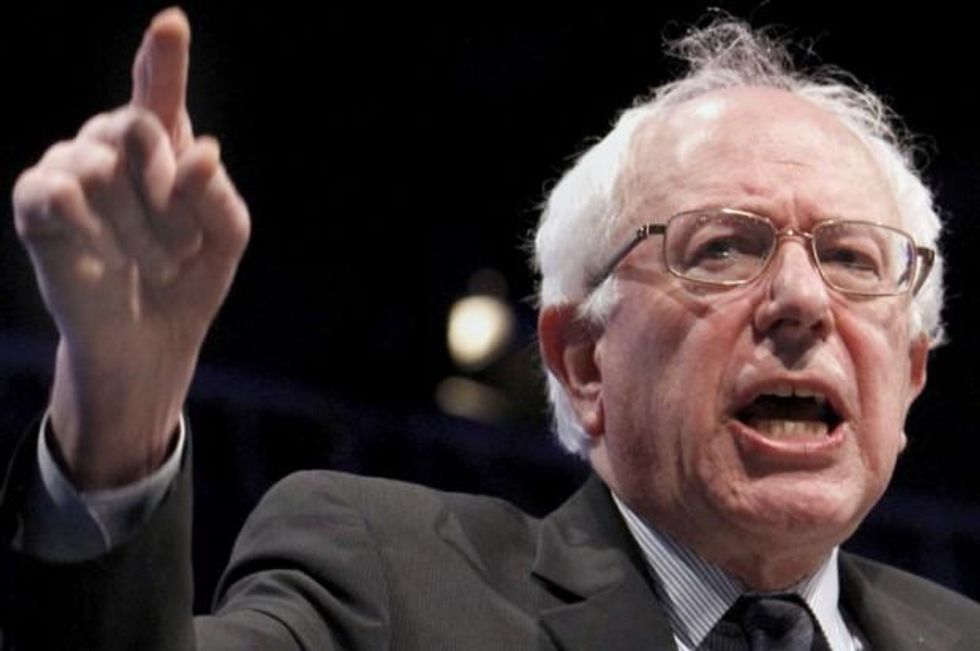
Recent signals by Vermont's Independent Senator Bernie Sanders that he would consider a run for president in 2016 in order to "take on Wall Street, address the collapse of the middle class, tackle the spread of poverty... and address global warming," perked the ears of progressives who look out at the Democratic Party and see no other candidate--especially the presumed frontrunner Hillary Clinton--likely to speak for them on a core set of issues.
And now, a survey prompted by Sanders' comments shows that among those who closely identify as "progressive" support for his candidacy is at more than 80 percent.
Conducted by RootsAction.org--a progressive online activism, advocacy and lobbying organization--the survey asked the group's members to offer their opinion on a Sanders run for the nation's highest office.
Asked if he should run, 81 percent said 'Yes.' Only 9 percent said 'No,' and the remaining 10 percent were unsure.
"Nearly 20,000 people responded to our survey, from every state in the nation," said RootsAction.org co-founder Jeff Cohen. "Though not a scientific sampling, it reflects Bernie Sanders' huge popularity among progressives. And that there's a ready-made base for him - or perhaps another progressive candidate - in a campaign that challenges the Democratic establishment and ostensible frontrunner Hillary Clinton."
In the letter sent to members that accompanied the survey, RootsAction told its members:
[We] rarely focuses on elections because, quite frankly, few politicians make us enthusiastic. But Bernie Sanders is different. He has long been a strong advocate of enhanced Medicare for all, taxing Wall Street, cutting the military, opposing corporate trade pacts, etc. In 2010, he touched a national nerve when he filibustered against the Obama-GOP deal extending Bush-era tax cuts for the rich.
Bernie told Politico: "Obviously if I did not think I had a reasonable chance to win I wouldn't run . . . It is not my intention to be some kind of spoiler and play the role of just draining votes away to allow my voice to be heard."
In addition to whether or not he should run, respondents were also asked to offer input on strategy. As a follow-up question, they were asked: "Would you be more likely to support a Bernie presidential campaign if he were to run inside Democratic caucuses and primaries -- or, if he ran outside as an independent '3rd-party' candidate?"
On that question there was a clear majority which thought he should challenge Democrats from within (45 percent) and much a smaller number who thought running as an outside candidate would be good (24 percent). Those who remain unsure of the best strategy actually came in second place with 31 percent.
As Cohen commented: "While a spectrum of our country's progressive base represented in our online membership is overwhelmingly supportive of a Sanders campaign, there's less of a consensus on strategy - with those favoring an inside the Democratic caucuses and primaries approach about 2 to 1 over those wanting an outside approach."
____________________________________________
Recent signals by Vermont's Independent Senator Bernie Sanders that he would consider a run for president in 2016 in order to "take on Wall Street, address the collapse of the middle class, tackle the spread of poverty... and address global warming," perked the ears of progressives who look out at the Democratic Party and see no other candidate--especially the presumed frontrunner Hillary Clinton--likely to speak for them on a core set of issues.
And now, a survey prompted by Sanders' comments shows that among those who closely identify as "progressive" support for his candidacy is at more than 80 percent.
Conducted by RootsAction.org--a progressive online activism, advocacy and lobbying organization--the survey asked the group's members to offer their opinion on a Sanders run for the nation's highest office.
Asked if he should run, 81 percent said 'Yes.' Only 9 percent said 'No,' and the remaining 10 percent were unsure.
"Nearly 20,000 people responded to our survey, from every state in the nation," said RootsAction.org co-founder Jeff Cohen. "Though not a scientific sampling, it reflects Bernie Sanders' huge popularity among progressives. And that there's a ready-made base for him - or perhaps another progressive candidate - in a campaign that challenges the Democratic establishment and ostensible frontrunner Hillary Clinton."
In the letter sent to members that accompanied the survey, RootsAction told its members:
[We] rarely focuses on elections because, quite frankly, few politicians make us enthusiastic. But Bernie Sanders is different. He has long been a strong advocate of enhanced Medicare for all, taxing Wall Street, cutting the military, opposing corporate trade pacts, etc. In 2010, he touched a national nerve when he filibustered against the Obama-GOP deal extending Bush-era tax cuts for the rich.
Bernie told Politico: "Obviously if I did not think I had a reasonable chance to win I wouldn't run . . . It is not my intention to be some kind of spoiler and play the role of just draining votes away to allow my voice to be heard."
In addition to whether or not he should run, respondents were also asked to offer input on strategy. As a follow-up question, they were asked: "Would you be more likely to support a Bernie presidential campaign if he were to run inside Democratic caucuses and primaries -- or, if he ran outside as an independent '3rd-party' candidate?"
On that question there was a clear majority which thought he should challenge Democrats from within (45 percent) and much a smaller number who thought running as an outside candidate would be good (24 percent). Those who remain unsure of the best strategy actually came in second place with 31 percent.
As Cohen commented: "While a spectrum of our country's progressive base represented in our online membership is overwhelmingly supportive of a Sanders campaign, there's less of a consensus on strategy - with those favoring an inside the Democratic caucuses and primaries approach about 2 to 1 over those wanting an outside approach."
____________________________________________
Recent signals by Vermont's Independent Senator Bernie Sanders that he would consider a run for president in 2016 in order to "take on Wall Street, address the collapse of the middle class, tackle the spread of poverty... and address global warming," perked the ears of progressives who look out at the Democratic Party and see no other candidate--especially the presumed frontrunner Hillary Clinton--likely to speak for them on a core set of issues.
And now, a survey prompted by Sanders' comments shows that among those who closely identify as "progressive" support for his candidacy is at more than 80 percent.
Conducted by RootsAction.org--a progressive online activism, advocacy and lobbying organization--the survey asked the group's members to offer their opinion on a Sanders run for the nation's highest office.
Asked if he should run, 81 percent said 'Yes.' Only 9 percent said 'No,' and the remaining 10 percent were unsure.
"Nearly 20,000 people responded to our survey, from every state in the nation," said RootsAction.org co-founder Jeff Cohen. "Though not a scientific sampling, it reflects Bernie Sanders' huge popularity among progressives. And that there's a ready-made base for him - or perhaps another progressive candidate - in a campaign that challenges the Democratic establishment and ostensible frontrunner Hillary Clinton."
In the letter sent to members that accompanied the survey, RootsAction told its members:
[We] rarely focuses on elections because, quite frankly, few politicians make us enthusiastic. But Bernie Sanders is different. He has long been a strong advocate of enhanced Medicare for all, taxing Wall Street, cutting the military, opposing corporate trade pacts, etc. In 2010, he touched a national nerve when he filibustered against the Obama-GOP deal extending Bush-era tax cuts for the rich.
Bernie told Politico: "Obviously if I did not think I had a reasonable chance to win I wouldn't run . . . It is not my intention to be some kind of spoiler and play the role of just draining votes away to allow my voice to be heard."
In addition to whether or not he should run, respondents were also asked to offer input on strategy. As a follow-up question, they were asked: "Would you be more likely to support a Bernie presidential campaign if he were to run inside Democratic caucuses and primaries -- or, if he ran outside as an independent '3rd-party' candidate?"
On that question there was a clear majority which thought he should challenge Democrats from within (45 percent) and much a smaller number who thought running as an outside candidate would be good (24 percent). Those who remain unsure of the best strategy actually came in second place with 31 percent.
As Cohen commented: "While a spectrum of our country's progressive base represented in our online membership is overwhelmingly supportive of a Sanders campaign, there's less of a consensus on strategy - with those favoring an inside the Democratic caucuses and primaries approach about 2 to 1 over those wanting an outside approach."
____________________________________________