SUBSCRIBE TO OUR FREE NEWSLETTER
Daily news & progressive opinion—funded by the people, not the corporations—delivered straight to your inbox.
5
#000000
#FFFFFF
To donate by check, phone, or other method, see our More Ways to Give page.
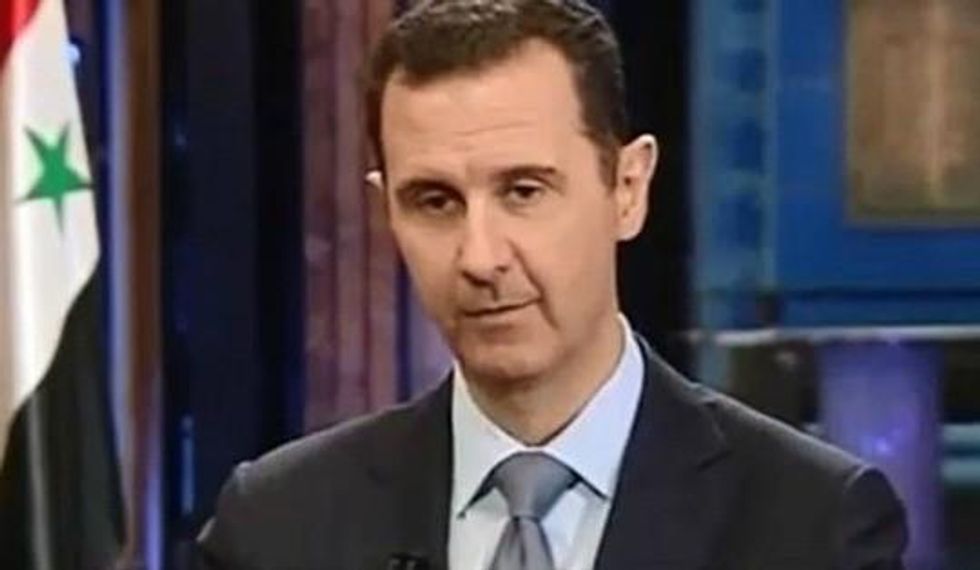
Conducted by Fox's foreign correspondent Greg Palkot and news contributor Dennis Kucinich, a former U.S. congressman and presidential candidate from Ohio, the interview with Assad found him unwilling to admit that the chemical weapons used in an attack last month were deployed by his forces.
"We have evidence that terrorist groups (have) used sarin gas," Assad said in the interview. "The whole story (that the Syrian government used them) doesn't even hold together. ... We didn't use any chemical weapons."
Assad said that his country is now willing to destroy its stockpiles, but that doing so is both complicated and expensive.
"I think it is a very complicated technically and it needs a lot of money," said Assad about the weapons, adding that it could cost as much as $1 billion to do so safely.
Asked whether he would consider handing over his stockpiles directly to the US government, Assad said: "It is very detrimental to the environment. If the American administration is ready to pay this money and take the responsibility of bringing toxic materials to the United States, why don't they do it?"
A UN report released earlier this week found conclusive evidence that sarin gas was the chemical agent that killed hundreds of people in Ghouta on August 21st, but the report itself made no conclusions about who was reasonable for the attack.
However, in response to that report, the U.S., the British, and the French--key members of the Security Council--all claimed that the evidence presented in the report bolstered their claims that Assad forces were behind the attack.
Meanwhile, the Russian government--which has proven itself adept so fat at countering a U.S. push for military intervention in Syria's civil war--continues to say there exists evidence that counters the dominant narrative being pushed by western nations.
Amidst Assad's willingness to declare and give over his chemical weapons for destruction, the main sticking point at the UN remains whether or not the U.S. will be able to push through its continued demand that the "threat of military force" be attached to any agreed to resolution.
Russia's foreign minister Sergei Lavrov continues to warn against including such language or invoking Chapter VII of the UN Charter, saying the threat of force will only hamper efforts to achieve a peaceful solution to the crisis. Lavrov has also said Russia will provide additional evidence about the gas attack itself to the Security Council, promising that all information will be assessed to find out "who did it," he said.
As the Guardian reports:
... Lavrov's deputy Sergei Ryabkov said an initial UN security council resolution supporting a deal for Syria to scrap its chemical arms should be limited to that purpose, suggesting Moscow would oppose any threat of force.
Speaking in Damascus after meeting Assad, Ryabkov also criticized the UN's report.
He accused the investigators of all but ignoring evidence presented by the Syrian government that he said supported rebel culpability.
"We are disappointed that there is no due attention paid to this evidence in the report which the [UN] group presented in New York earlier this week," he told reporters in Damascus in televised remarks.
"One cannot be as one-sided and as flawed as we have seen, laying the full [blame for the] incident in Ghouta upon the Syrian government," he said.
He said the report was limited in scope and reiterated Russian calls for further investigation that would include accounts from sources including the internet and government evidence of alleged chemical arms use in the days after 12 August.
The US-Russia deal, reached on Saturday, calls for Syria to account fully for its chemical weapons within a week and for the removal and destruction of the entire arsenal by mid-2014.
Diplomats from the permanent UN security council members - Russia, the United States, Britain, France and China - began talks on Tuesday on a resolution intended to support the deal.
_______________________________________________
Conducted by Fox's foreign correspondent Greg Palkot and news contributor Dennis Kucinich, a former U.S. congressman and presidential candidate from Ohio, the interview with Assad found him unwilling to admit that the chemical weapons used in an attack last month were deployed by his forces.
"We have evidence that terrorist groups (have) used sarin gas," Assad said in the interview. "The whole story (that the Syrian government used them) doesn't even hold together. ... We didn't use any chemical weapons."
Assad said that his country is now willing to destroy its stockpiles, but that doing so is both complicated and expensive.
"I think it is a very complicated technically and it needs a lot of money," said Assad about the weapons, adding that it could cost as much as $1 billion to do so safely.
Asked whether he would consider handing over his stockpiles directly to the US government, Assad said: "It is very detrimental to the environment. If the American administration is ready to pay this money and take the responsibility of bringing toxic materials to the United States, why don't they do it?"
A UN report released earlier this week found conclusive evidence that sarin gas was the chemical agent that killed hundreds of people in Ghouta on August 21st, but the report itself made no conclusions about who was reasonable for the attack.
However, in response to that report, the U.S., the British, and the French--key members of the Security Council--all claimed that the evidence presented in the report bolstered their claims that Assad forces were behind the attack.
Meanwhile, the Russian government--which has proven itself adept so fat at countering a U.S. push for military intervention in Syria's civil war--continues to say there exists evidence that counters the dominant narrative being pushed by western nations.
Amidst Assad's willingness to declare and give over his chemical weapons for destruction, the main sticking point at the UN remains whether or not the U.S. will be able to push through its continued demand that the "threat of military force" be attached to any agreed to resolution.
Russia's foreign minister Sergei Lavrov continues to warn against including such language or invoking Chapter VII of the UN Charter, saying the threat of force will only hamper efforts to achieve a peaceful solution to the crisis. Lavrov has also said Russia will provide additional evidence about the gas attack itself to the Security Council, promising that all information will be assessed to find out "who did it," he said.
As the Guardian reports:
... Lavrov's deputy Sergei Ryabkov said an initial UN security council resolution supporting a deal for Syria to scrap its chemical arms should be limited to that purpose, suggesting Moscow would oppose any threat of force.
Speaking in Damascus after meeting Assad, Ryabkov also criticized the UN's report.
He accused the investigators of all but ignoring evidence presented by the Syrian government that he said supported rebel culpability.
"We are disappointed that there is no due attention paid to this evidence in the report which the [UN] group presented in New York earlier this week," he told reporters in Damascus in televised remarks.
"One cannot be as one-sided and as flawed as we have seen, laying the full [blame for the] incident in Ghouta upon the Syrian government," he said.
He said the report was limited in scope and reiterated Russian calls for further investigation that would include accounts from sources including the internet and government evidence of alleged chemical arms use in the days after 12 August.
The US-Russia deal, reached on Saturday, calls for Syria to account fully for its chemical weapons within a week and for the removal and destruction of the entire arsenal by mid-2014.
Diplomats from the permanent UN security council members - Russia, the United States, Britain, France and China - began talks on Tuesday on a resolution intended to support the deal.
_______________________________________________
Conducted by Fox's foreign correspondent Greg Palkot and news contributor Dennis Kucinich, a former U.S. congressman and presidential candidate from Ohio, the interview with Assad found him unwilling to admit that the chemical weapons used in an attack last month were deployed by his forces.
"We have evidence that terrorist groups (have) used sarin gas," Assad said in the interview. "The whole story (that the Syrian government used them) doesn't even hold together. ... We didn't use any chemical weapons."
Assad said that his country is now willing to destroy its stockpiles, but that doing so is both complicated and expensive.
"I think it is a very complicated technically and it needs a lot of money," said Assad about the weapons, adding that it could cost as much as $1 billion to do so safely.
Asked whether he would consider handing over his stockpiles directly to the US government, Assad said: "It is very detrimental to the environment. If the American administration is ready to pay this money and take the responsibility of bringing toxic materials to the United States, why don't they do it?"
A UN report released earlier this week found conclusive evidence that sarin gas was the chemical agent that killed hundreds of people in Ghouta on August 21st, but the report itself made no conclusions about who was reasonable for the attack.
However, in response to that report, the U.S., the British, and the French--key members of the Security Council--all claimed that the evidence presented in the report bolstered their claims that Assad forces were behind the attack.
Meanwhile, the Russian government--which has proven itself adept so fat at countering a U.S. push for military intervention in Syria's civil war--continues to say there exists evidence that counters the dominant narrative being pushed by western nations.
Amidst Assad's willingness to declare and give over his chemical weapons for destruction, the main sticking point at the UN remains whether or not the U.S. will be able to push through its continued demand that the "threat of military force" be attached to any agreed to resolution.
Russia's foreign minister Sergei Lavrov continues to warn against including such language or invoking Chapter VII of the UN Charter, saying the threat of force will only hamper efforts to achieve a peaceful solution to the crisis. Lavrov has also said Russia will provide additional evidence about the gas attack itself to the Security Council, promising that all information will be assessed to find out "who did it," he said.
As the Guardian reports:
... Lavrov's deputy Sergei Ryabkov said an initial UN security council resolution supporting a deal for Syria to scrap its chemical arms should be limited to that purpose, suggesting Moscow would oppose any threat of force.
Speaking in Damascus after meeting Assad, Ryabkov also criticized the UN's report.
He accused the investigators of all but ignoring evidence presented by the Syrian government that he said supported rebel culpability.
"We are disappointed that there is no due attention paid to this evidence in the report which the [UN] group presented in New York earlier this week," he told reporters in Damascus in televised remarks.
"One cannot be as one-sided and as flawed as we have seen, laying the full [blame for the] incident in Ghouta upon the Syrian government," he said.
He said the report was limited in scope and reiterated Russian calls for further investigation that would include accounts from sources including the internet and government evidence of alleged chemical arms use in the days after 12 August.
The US-Russia deal, reached on Saturday, calls for Syria to account fully for its chemical weapons within a week and for the removal and destruction of the entire arsenal by mid-2014.
Diplomats from the permanent UN security council members - Russia, the United States, Britain, France and China - began talks on Tuesday on a resolution intended to support the deal.
_______________________________________________