SUBSCRIBE TO OUR FREE NEWSLETTER
Daily news & progressive opinion—funded by the people, not the corporations—delivered straight to your inbox.
5
#000000
#FFFFFF
To donate by check, phone, or other method, see our More Ways to Give page.
Daily news & progressive opinion—funded by the people, not the corporations—delivered straight to your inbox.
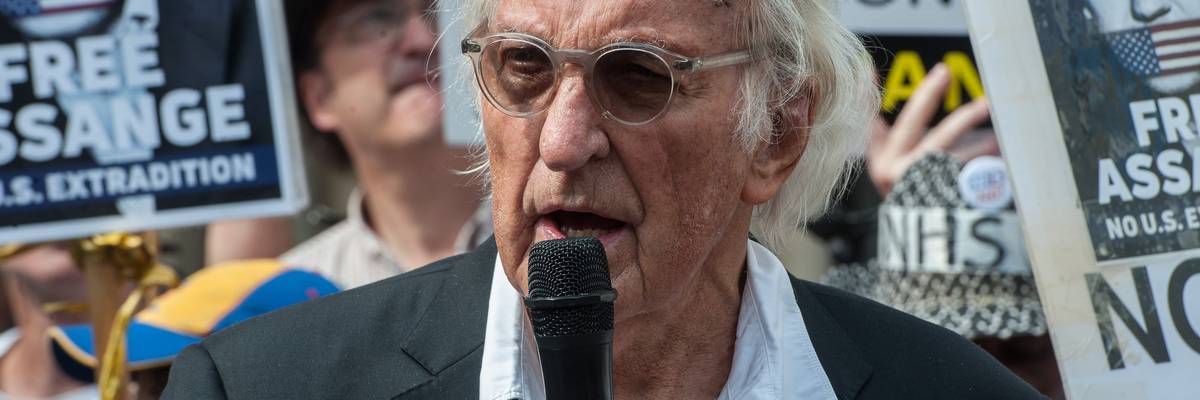
Journalist John Pilger addresses a crowd of Julian Assange supporters demanding his release in London on August 11, 2021.
His death, especially during these difficult times, is a major loss for humanity, but I know that, deep down, John must have known that things would eventually get better.
The first and the last time I met John Pilger in person was in 2018.
I was invited to deliver a speech at the New South Wales Parliament in Sydney, Australia. Among the large crowd were many that I knew and respected—a former foreign minister, socially conscientious members of parliament, morally driven intellectuals and activists, and so on.
As I stood at the podium, glancing at the crowd, I saw John Pilger. He had a big smile on his face, as if he was in great anticipation to hear me talk.
The reality was entirely different. I would have rather listened to John than to lecture before him.
He stood firmly on the side of oppressed people, spoke strongly against the injustices meted out by the powerful, and uncompromisingly defended free speech whenever it was threatened.
As I expressed my many “Thank yous,” I made a point of emphasizing that I have modeled my journalism around that of John Pilger.
The painful truth is that, growing up in a refugee camp in Gaza, we rarely affiliated Western media, intellect, or journalists with truth-telling, in general. Though, with time, I realized that this wholesale assumption was hardly fair, associating bias with everything Western had its own justification, if not logic.
Aside from the typical corporate biased media narrative on Palestine, the Middle East, the Arab and Muslim world—in fact, the entirety of the Global South—there were those who were identified as part of the “left.”
We were told that those supposed leftist are the exception to the norm. But experience has taught me that, aside from ideological nuances, even the so-called left still saw the non-Western world based on a different set of unique biases. They perceived the rest of the world through judgmental eyes, as if they, and they alone, had access to a moral code according to which the rest of us must be filtered.
Those “leftists” are only against certain kinds of wars, especially if they perceive military interventions to be channeled by imperialist agendas. For them, so-called humanitarian intervention is morally justified, although there is no evidence that Western interventions of that kind ever bode well for any country.
Ultimately, that reasoning tends to have little impact on the outcome of international conflicts. Worse, some leftists often find themselves siding with the very imperialist powers they supposedly loathe, whenever it is convenient.
And then, there are the John Pilgers of this world: Principled to the core, and able to understand, dissect, and convey the political, cultural, and historical complexities of conflicts to millions of people around the world.
“We are beckoned to see the world through a one-way mirror, as if we are threatened and innocent and the rest of humanity is threatening, or wretched, or expendable,” Pilger said at his Sydney Peace Prize acceptance speech in 2009.
For the Australian-born journalist, whose impact on our understanding of major global conflicts is arguably unparalleled in modern history, these were not mere words but principles to which he adhered to throughout his life, until his passing on December 30.
In his book and documentary The New Rulers of the World, Pilger brilliantly connects the dots of major global issues—social injustice, inequality, the so-called war on terror, and more—demonstrating the powerful maxim that “injustice everywhere is a threat to justice everywhere.”
Pilger’s enemies were never a certain race, a nation, or even an ideology. He simply served as the sharp critic and, at times, the mobilizer against all sorts of government-orchestrated injustices, whether within national boundaries or internationally.
He challenged imperialism in all of its forms, colonialism wherever it may be. This put him on a crash course with Washington, Canberra, London, and other Western capitals.
His dedication to the causes of Indigenous people, from Australia to Palestine to Indonesia, were all reflected in great volumes and documentaries, such as Utopia, Palestine is Still the Issue, and The New Rulers of the World.
Pilger’s powerful texts as an academic, an author, and a journalist must not distract from his equally powerful and hard-hitting documentaries as a filmmaker. More important than the many awards he had achieved as a filmmaker, starting with The Quiet Mutiny, was the impact of these films on the way that millions of people around the world perceived issues, conflicts, and wars that had only been communicated through non-critical eyes.
“Many journalists now are no more than channelers and echoers of what George Orwell called the ‘official truth.’ They simply cipher and transmit lies,” he said during an interview with David Barsamian in 2007.
Though, at times, some intellectuals of Pilger’s caliber may have deviated from their commitment to the uncompromising moral code of principled journalism and intellect, Pilger’s legacy suggests otherwise.
He stood firmly on the side of oppressed people, spoke strongly against the injustices meted out by the powerful, and uncompromisingly defended free speech whenever it was threatened.
Indeed, Pilger was one of the most stalwart supporters of Julian Assange in his war against censorship in all of its forms.
“This is not about the survival of a free press. There is no longer a free press... The paramount issue is justice and our most precious human right: to be free,” Pilger wrote in an article in July 2023.
Before our meeting, I exchanged many messages with John. The first time he responded to my request for an endorsement of a book, I was truly thrilled. I was also moved by his kind response to a young author who was merely starting his own quest for a just world.
Many messages and years later, we finally met in person. I quickly made my way to him through the crowd to thank him for all that he has done for Palestine and for all the oppressed people of this world.
His death, especially during these difficult times, is a major loss for humanity. But I know that, deep down, John must have known that things would eventually get better. He did his part, and much more.
Dear Common Dreams reader, It’s been nearly 30 years since I co-founded Common Dreams with my late wife, Lina Newhouser. We had the radical notion that journalism should serve the public good, not corporate profits. It was clear to us from the outset what it would take to build such a project. No paid advertisements. No corporate sponsors. No millionaire publisher telling us what to think or do. Many people said we wouldn't last a year, but we proved those doubters wrong. Together with a tremendous team of journalists and dedicated staff, we built an independent media outlet free from the constraints of profits and corporate control. Our mission has always been simple: To inform. To inspire. To ignite change for the common good. Building Common Dreams was not easy. Our survival was never guaranteed. When you take on the most powerful forces—Wall Street greed, fossil fuel industry destruction, Big Tech lobbyists, and uber-rich oligarchs who have spent billions upon billions rigging the economy and democracy in their favor—the only bulwark you have is supporters who believe in your work. But here’s the urgent message from me today. It's never been this bad out there. And it's never been this hard to keep us going. At the very moment Common Dreams is most needed, the threats we face are intensifying. We need your support now more than ever. We don't accept corporate advertising and never will. We don't have a paywall because we don't think people should be blocked from critical news based on their ability to pay. Everything we do is funded by the donations of readers like you. When everyone does the little they can afford, we are strong. But if that support retreats or dries up, so do we. Will you donate now to make sure Common Dreams not only survives but thrives? —Craig Brown, Co-founder |
The first and the last time I met John Pilger in person was in 2018.
I was invited to deliver a speech at the New South Wales Parliament in Sydney, Australia. Among the large crowd were many that I knew and respected—a former foreign minister, socially conscientious members of parliament, morally driven intellectuals and activists, and so on.
As I stood at the podium, glancing at the crowd, I saw John Pilger. He had a big smile on his face, as if he was in great anticipation to hear me talk.
The reality was entirely different. I would have rather listened to John than to lecture before him.
He stood firmly on the side of oppressed people, spoke strongly against the injustices meted out by the powerful, and uncompromisingly defended free speech whenever it was threatened.
As I expressed my many “Thank yous,” I made a point of emphasizing that I have modeled my journalism around that of John Pilger.
The painful truth is that, growing up in a refugee camp in Gaza, we rarely affiliated Western media, intellect, or journalists with truth-telling, in general. Though, with time, I realized that this wholesale assumption was hardly fair, associating bias with everything Western had its own justification, if not logic.
Aside from the typical corporate biased media narrative on Palestine, the Middle East, the Arab and Muslim world—in fact, the entirety of the Global South—there were those who were identified as part of the “left.”
We were told that those supposed leftist are the exception to the norm. But experience has taught me that, aside from ideological nuances, even the so-called left still saw the non-Western world based on a different set of unique biases. They perceived the rest of the world through judgmental eyes, as if they, and they alone, had access to a moral code according to which the rest of us must be filtered.
Those “leftists” are only against certain kinds of wars, especially if they perceive military interventions to be channeled by imperialist agendas. For them, so-called humanitarian intervention is morally justified, although there is no evidence that Western interventions of that kind ever bode well for any country.
Ultimately, that reasoning tends to have little impact on the outcome of international conflicts. Worse, some leftists often find themselves siding with the very imperialist powers they supposedly loathe, whenever it is convenient.
And then, there are the John Pilgers of this world: Principled to the core, and able to understand, dissect, and convey the political, cultural, and historical complexities of conflicts to millions of people around the world.
“We are beckoned to see the world through a one-way mirror, as if we are threatened and innocent and the rest of humanity is threatening, or wretched, or expendable,” Pilger said at his Sydney Peace Prize acceptance speech in 2009.
For the Australian-born journalist, whose impact on our understanding of major global conflicts is arguably unparalleled in modern history, these were not mere words but principles to which he adhered to throughout his life, until his passing on December 30.
In his book and documentary The New Rulers of the World, Pilger brilliantly connects the dots of major global issues—social injustice, inequality, the so-called war on terror, and more—demonstrating the powerful maxim that “injustice everywhere is a threat to justice everywhere.”
Pilger’s enemies were never a certain race, a nation, or even an ideology. He simply served as the sharp critic and, at times, the mobilizer against all sorts of government-orchestrated injustices, whether within national boundaries or internationally.
He challenged imperialism in all of its forms, colonialism wherever it may be. This put him on a crash course with Washington, Canberra, London, and other Western capitals.
His dedication to the causes of Indigenous people, from Australia to Palestine to Indonesia, were all reflected in great volumes and documentaries, such as Utopia, Palestine is Still the Issue, and The New Rulers of the World.
Pilger’s powerful texts as an academic, an author, and a journalist must not distract from his equally powerful and hard-hitting documentaries as a filmmaker. More important than the many awards he had achieved as a filmmaker, starting with The Quiet Mutiny, was the impact of these films on the way that millions of people around the world perceived issues, conflicts, and wars that had only been communicated through non-critical eyes.
“Many journalists now are no more than channelers and echoers of what George Orwell called the ‘official truth.’ They simply cipher and transmit lies,” he said during an interview with David Barsamian in 2007.
Though, at times, some intellectuals of Pilger’s caliber may have deviated from their commitment to the uncompromising moral code of principled journalism and intellect, Pilger’s legacy suggests otherwise.
He stood firmly on the side of oppressed people, spoke strongly against the injustices meted out by the powerful, and uncompromisingly defended free speech whenever it was threatened.
Indeed, Pilger was one of the most stalwart supporters of Julian Assange in his war against censorship in all of its forms.
“This is not about the survival of a free press. There is no longer a free press... The paramount issue is justice and our most precious human right: to be free,” Pilger wrote in an article in July 2023.
Before our meeting, I exchanged many messages with John. The first time he responded to my request for an endorsement of a book, I was truly thrilled. I was also moved by his kind response to a young author who was merely starting his own quest for a just world.
Many messages and years later, we finally met in person. I quickly made my way to him through the crowd to thank him for all that he has done for Palestine and for all the oppressed people of this world.
His death, especially during these difficult times, is a major loss for humanity. But I know that, deep down, John must have known that things would eventually get better. He did his part, and much more.
The first and the last time I met John Pilger in person was in 2018.
I was invited to deliver a speech at the New South Wales Parliament in Sydney, Australia. Among the large crowd were many that I knew and respected—a former foreign minister, socially conscientious members of parliament, morally driven intellectuals and activists, and so on.
As I stood at the podium, glancing at the crowd, I saw John Pilger. He had a big smile on his face, as if he was in great anticipation to hear me talk.
The reality was entirely different. I would have rather listened to John than to lecture before him.
He stood firmly on the side of oppressed people, spoke strongly against the injustices meted out by the powerful, and uncompromisingly defended free speech whenever it was threatened.
As I expressed my many “Thank yous,” I made a point of emphasizing that I have modeled my journalism around that of John Pilger.
The painful truth is that, growing up in a refugee camp in Gaza, we rarely affiliated Western media, intellect, or journalists with truth-telling, in general. Though, with time, I realized that this wholesale assumption was hardly fair, associating bias with everything Western had its own justification, if not logic.
Aside from the typical corporate biased media narrative on Palestine, the Middle East, the Arab and Muslim world—in fact, the entirety of the Global South—there were those who were identified as part of the “left.”
We were told that those supposed leftist are the exception to the norm. But experience has taught me that, aside from ideological nuances, even the so-called left still saw the non-Western world based on a different set of unique biases. They perceived the rest of the world through judgmental eyes, as if they, and they alone, had access to a moral code according to which the rest of us must be filtered.
Those “leftists” are only against certain kinds of wars, especially if they perceive military interventions to be channeled by imperialist agendas. For them, so-called humanitarian intervention is morally justified, although there is no evidence that Western interventions of that kind ever bode well for any country.
Ultimately, that reasoning tends to have little impact on the outcome of international conflicts. Worse, some leftists often find themselves siding with the very imperialist powers they supposedly loathe, whenever it is convenient.
And then, there are the John Pilgers of this world: Principled to the core, and able to understand, dissect, and convey the political, cultural, and historical complexities of conflicts to millions of people around the world.
“We are beckoned to see the world through a one-way mirror, as if we are threatened and innocent and the rest of humanity is threatening, or wretched, or expendable,” Pilger said at his Sydney Peace Prize acceptance speech in 2009.
For the Australian-born journalist, whose impact on our understanding of major global conflicts is arguably unparalleled in modern history, these were not mere words but principles to which he adhered to throughout his life, until his passing on December 30.
In his book and documentary The New Rulers of the World, Pilger brilliantly connects the dots of major global issues—social injustice, inequality, the so-called war on terror, and more—demonstrating the powerful maxim that “injustice everywhere is a threat to justice everywhere.”
Pilger’s enemies were never a certain race, a nation, or even an ideology. He simply served as the sharp critic and, at times, the mobilizer against all sorts of government-orchestrated injustices, whether within national boundaries or internationally.
He challenged imperialism in all of its forms, colonialism wherever it may be. This put him on a crash course with Washington, Canberra, London, and other Western capitals.
His dedication to the causes of Indigenous people, from Australia to Palestine to Indonesia, were all reflected in great volumes and documentaries, such as Utopia, Palestine is Still the Issue, and The New Rulers of the World.
Pilger’s powerful texts as an academic, an author, and a journalist must not distract from his equally powerful and hard-hitting documentaries as a filmmaker. More important than the many awards he had achieved as a filmmaker, starting with The Quiet Mutiny, was the impact of these films on the way that millions of people around the world perceived issues, conflicts, and wars that had only been communicated through non-critical eyes.
“Many journalists now are no more than channelers and echoers of what George Orwell called the ‘official truth.’ They simply cipher and transmit lies,” he said during an interview with David Barsamian in 2007.
Though, at times, some intellectuals of Pilger’s caliber may have deviated from their commitment to the uncompromising moral code of principled journalism and intellect, Pilger’s legacy suggests otherwise.
He stood firmly on the side of oppressed people, spoke strongly against the injustices meted out by the powerful, and uncompromisingly defended free speech whenever it was threatened.
Indeed, Pilger was one of the most stalwart supporters of Julian Assange in his war against censorship in all of its forms.
“This is not about the survival of a free press. There is no longer a free press... The paramount issue is justice and our most precious human right: to be free,” Pilger wrote in an article in July 2023.
Before our meeting, I exchanged many messages with John. The first time he responded to my request for an endorsement of a book, I was truly thrilled. I was also moved by his kind response to a young author who was merely starting his own quest for a just world.
Many messages and years later, we finally met in person. I quickly made my way to him through the crowd to thank him for all that he has done for Palestine and for all the oppressed people of this world.
His death, especially during these difficult times, is a major loss for humanity. But I know that, deep down, John must have known that things would eventually get better. He did his part, and much more.