SUBSCRIBE TO OUR FREE NEWSLETTER
Daily news & progressive opinion—funded by the people, not the corporations—delivered straight to your inbox.
5
#000000
#FFFFFF
To donate by check, phone, or other method, see our More Ways to Give page.
Daily news & progressive opinion—funded by the people, not the corporations—delivered straight to your inbox.
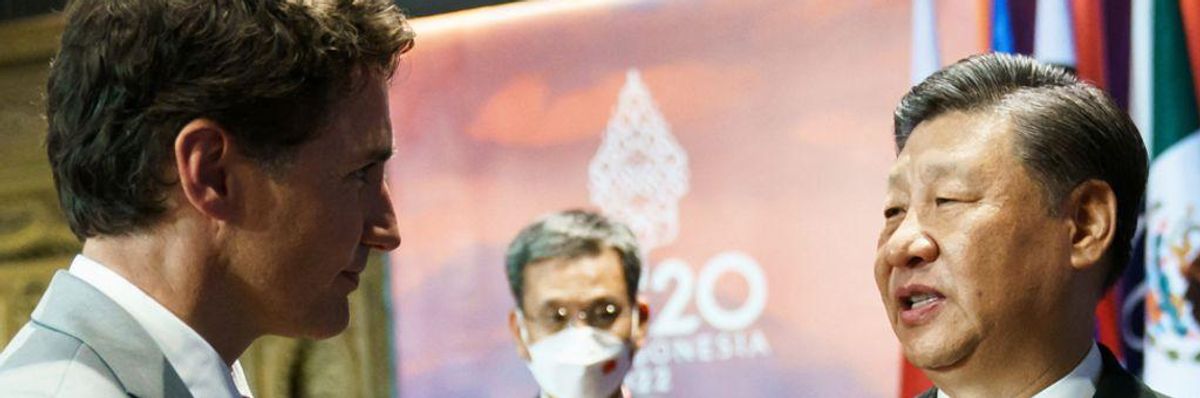
China's Xi confronts Canada's Trudeau at G20 over media leaks
Though brief, the exchange between Chinese President Xi Jinping and Canadian Prime Minister Justin Trudeau on the sidelines of the G20 summit in Indonesia on November 16 has become a social media sensation. Xi, assertive if not domineering, lectured the visibly apprehensive Trudeau about the etiquette of diplomacy. This exchange can be considered another watershed moment in China's relationship with the West.
"If there was sincerity on your part," the Chinese President told Trudeau, "then we shall conduct our discussion with an attitude of mutual respect, otherwise there might be unpredictable consequences."
At the end of the awkward conversation, Xi was the first to walk away, leaving Trudeau
uncomfortably making his way out of the room.
For the significance of this moment to be truly appreciated, it has to be viewed through a historical prism.
When western colonial powers began the process of exploiting China in earnest - early to mid-19th century - the total size of the Chinese economy was estimated to be one-third of the world's entire economic output. In 1949, when Chinese nationalists managed to win their independence following hundreds of years of colonialism, political meddling and economic exploitation, China's total GDP merely accounted for 4 percent of the world's total economy.
In the period between the first Opium War in 1839 and China's independence, over a hundred years later, tens of millions of Chinese perished as a result of direct wars, subsequent rebellions and famines. The so-called Boxer Rebellion (1899-1901) was one of the many desperate attempts by the Chinese people to reclaim a degree of independence and assert nominal sovereignty over their land. The outcome, however, was devastating, as the rebels, along with the Chinese military, were crushed by the mostly Western alliance, which involved the United States, Austria-Hungary, Britain, France and others.
The death toll was catastrophic, with moderate estimations putting it at over 100,000. And subsequently, once more, China was forced to toe the line as it has done in the two Opium Wars and many other occasions in the past.
China's independence in 1949 did not automatically signal the return of China to its past grandeur as a global, or even an Asian power. The process of rebuilding was long, costly and sometimes even devastating: Trials and errors, internal conflicts, cultural revolutions, periods of 'great leaps forward' but sometimes, also great stagnation.
Seven decades later, China is back at the center of global affairs. Good news for some. Terrible news for others.
The 2022 US National Security Strategy document released on October 22, describes China as "the only competitor with both the intent to reshape the international order and, increasingly, the economic, diplomatic, military and technological power to do it."
The US position is not at all surprising, because the West continues to define its relationship with Beijing based on a colonial inheritance, a legacy that spans hundreds of years.
For the West, the re-rise of China is problematic, not because of its human rights record but because of its growing share of the global economy which, in 2021, accounted for 18.56%. This economic power, coupled with growing military prowess, practically means that Beijing will soon be able to dictate political outcomes in its growing sphere of influence in the Pacific region, and also worldwide.
The irony in all of this is that, once upon a time, it was China, along with most of Asia and the Global South that were divided into spheres of influence. Seeing Beijing creating its own equivalence to the West's geopolitical dominance must be quite unsettling for Western governments.
For many years, Western powers have used the pretense of China's human rights record to provide a moral foundation for meddling. Purporting to defend human rights and champion democracy have historically been convenient Western tools that provided a nominal ethical foundation for interventions. Indeed, in the Chinese context, the Eight-Nations Alliance, which crushed the Boxer Rebellion, was predicated on similar principles.
The charade continues until this day, with the defense of Taiwan and the rights of the Uyghurs and other minorities being placed on top of the US and Western agendas respectively.
Of course, human rights have very little to do with the US-Western attitude towards China. As much as 'human rights' and 'democracy' were hardly the motivator behind the US-Western invasion of Iraq in 2003. The difference between Iraq, an isolated and weakened Arab country at the height of American military dominance in the Middle East, and China today is massive. The latter represents the backbone of the global economy. Its military power and growing geopolitical import will prove difficult - if at all possible - to curtail.
In fact, language emanating from Washington indicates that the US is taking the first steps in acknowledging China's inevitable rise as a global competitor. Prior to his meeting with President Xi in Indonesia on November 15, Biden had finally, although subtly acknowledged the uncontested new reality when he said that "We're going to compete vigorously but I'm not looking for conflict. I'm looking to manage this competition responsibly."
Xi's attitude towards Trudeau at the G20 summit may be read as another episode of China's so-called 'Wolf Diplomacy'. However, the dramatic event - the words, the body language and the subtle nuances - indicate that China does not only see itself as deserving of global importance and respect, but also as a superpower.
Dear Common Dreams reader, It’s been nearly 30 years since I co-founded Common Dreams with my late wife, Lina Newhouser. We had the radical notion that journalism should serve the public good, not corporate profits. It was clear to us from the outset what it would take to build such a project. No paid advertisements. No corporate sponsors. No millionaire publisher telling us what to think or do. Many people said we wouldn't last a year, but we proved those doubters wrong. Together with a tremendous team of journalists and dedicated staff, we built an independent media outlet free from the constraints of profits and corporate control. Our mission has always been simple: To inform. To inspire. To ignite change for the common good. Building Common Dreams was not easy. Our survival was never guaranteed. When you take on the most powerful forces—Wall Street greed, fossil fuel industry destruction, Big Tech lobbyists, and uber-rich oligarchs who have spent billions upon billions rigging the economy and democracy in their favor—the only bulwark you have is supporters who believe in your work. But here’s the urgent message from me today. It's never been this bad out there. And it's never been this hard to keep us going. At the very moment Common Dreams is most needed, the threats we face are intensifying. We need your support now more than ever. We don't accept corporate advertising and never will. We don't have a paywall because we don't think people should be blocked from critical news based on their ability to pay. Everything we do is funded by the donations of readers like you. When everyone does the little they can afford, we are strong. But if that support retreats or dries up, so do we. Will you donate now to make sure Common Dreams not only survives but thrives? —Craig Brown, Co-founder |
Though brief, the exchange between Chinese President Xi Jinping and Canadian Prime Minister Justin Trudeau on the sidelines of the G20 summit in Indonesia on November 16 has become a social media sensation. Xi, assertive if not domineering, lectured the visibly apprehensive Trudeau about the etiquette of diplomacy. This exchange can be considered another watershed moment in China's relationship with the West.
"If there was sincerity on your part," the Chinese President told Trudeau, "then we shall conduct our discussion with an attitude of mutual respect, otherwise there might be unpredictable consequences."
At the end of the awkward conversation, Xi was the first to walk away, leaving Trudeau
uncomfortably making his way out of the room.
For the significance of this moment to be truly appreciated, it has to be viewed through a historical prism.
When western colonial powers began the process of exploiting China in earnest - early to mid-19th century - the total size of the Chinese economy was estimated to be one-third of the world's entire economic output. In 1949, when Chinese nationalists managed to win their independence following hundreds of years of colonialism, political meddling and economic exploitation, China's total GDP merely accounted for 4 percent of the world's total economy.
In the period between the first Opium War in 1839 and China's independence, over a hundred years later, tens of millions of Chinese perished as a result of direct wars, subsequent rebellions and famines. The so-called Boxer Rebellion (1899-1901) was one of the many desperate attempts by the Chinese people to reclaim a degree of independence and assert nominal sovereignty over their land. The outcome, however, was devastating, as the rebels, along with the Chinese military, were crushed by the mostly Western alliance, which involved the United States, Austria-Hungary, Britain, France and others.
The death toll was catastrophic, with moderate estimations putting it at over 100,000. And subsequently, once more, China was forced to toe the line as it has done in the two Opium Wars and many other occasions in the past.
China's independence in 1949 did not automatically signal the return of China to its past grandeur as a global, or even an Asian power. The process of rebuilding was long, costly and sometimes even devastating: Trials and errors, internal conflicts, cultural revolutions, periods of 'great leaps forward' but sometimes, also great stagnation.
Seven decades later, China is back at the center of global affairs. Good news for some. Terrible news for others.
The 2022 US National Security Strategy document released on October 22, describes China as "the only competitor with both the intent to reshape the international order and, increasingly, the economic, diplomatic, military and technological power to do it."
The US position is not at all surprising, because the West continues to define its relationship with Beijing based on a colonial inheritance, a legacy that spans hundreds of years.
For the West, the re-rise of China is problematic, not because of its human rights record but because of its growing share of the global economy which, in 2021, accounted for 18.56%. This economic power, coupled with growing military prowess, practically means that Beijing will soon be able to dictate political outcomes in its growing sphere of influence in the Pacific region, and also worldwide.
The irony in all of this is that, once upon a time, it was China, along with most of Asia and the Global South that were divided into spheres of influence. Seeing Beijing creating its own equivalence to the West's geopolitical dominance must be quite unsettling for Western governments.
For many years, Western powers have used the pretense of China's human rights record to provide a moral foundation for meddling. Purporting to defend human rights and champion democracy have historically been convenient Western tools that provided a nominal ethical foundation for interventions. Indeed, in the Chinese context, the Eight-Nations Alliance, which crushed the Boxer Rebellion, was predicated on similar principles.
The charade continues until this day, with the defense of Taiwan and the rights of the Uyghurs and other minorities being placed on top of the US and Western agendas respectively.
Of course, human rights have very little to do with the US-Western attitude towards China. As much as 'human rights' and 'democracy' were hardly the motivator behind the US-Western invasion of Iraq in 2003. The difference between Iraq, an isolated and weakened Arab country at the height of American military dominance in the Middle East, and China today is massive. The latter represents the backbone of the global economy. Its military power and growing geopolitical import will prove difficult - if at all possible - to curtail.
In fact, language emanating from Washington indicates that the US is taking the first steps in acknowledging China's inevitable rise as a global competitor. Prior to his meeting with President Xi in Indonesia on November 15, Biden had finally, although subtly acknowledged the uncontested new reality when he said that "We're going to compete vigorously but I'm not looking for conflict. I'm looking to manage this competition responsibly."
Xi's attitude towards Trudeau at the G20 summit may be read as another episode of China's so-called 'Wolf Diplomacy'. However, the dramatic event - the words, the body language and the subtle nuances - indicate that China does not only see itself as deserving of global importance and respect, but also as a superpower.
Though brief, the exchange between Chinese President Xi Jinping and Canadian Prime Minister Justin Trudeau on the sidelines of the G20 summit in Indonesia on November 16 has become a social media sensation. Xi, assertive if not domineering, lectured the visibly apprehensive Trudeau about the etiquette of diplomacy. This exchange can be considered another watershed moment in China's relationship with the West.
"If there was sincerity on your part," the Chinese President told Trudeau, "then we shall conduct our discussion with an attitude of mutual respect, otherwise there might be unpredictable consequences."
At the end of the awkward conversation, Xi was the first to walk away, leaving Trudeau
uncomfortably making his way out of the room.
For the significance of this moment to be truly appreciated, it has to be viewed through a historical prism.
When western colonial powers began the process of exploiting China in earnest - early to mid-19th century - the total size of the Chinese economy was estimated to be one-third of the world's entire economic output. In 1949, when Chinese nationalists managed to win their independence following hundreds of years of colonialism, political meddling and economic exploitation, China's total GDP merely accounted for 4 percent of the world's total economy.
In the period between the first Opium War in 1839 and China's independence, over a hundred years later, tens of millions of Chinese perished as a result of direct wars, subsequent rebellions and famines. The so-called Boxer Rebellion (1899-1901) was one of the many desperate attempts by the Chinese people to reclaim a degree of independence and assert nominal sovereignty over their land. The outcome, however, was devastating, as the rebels, along with the Chinese military, were crushed by the mostly Western alliance, which involved the United States, Austria-Hungary, Britain, France and others.
The death toll was catastrophic, with moderate estimations putting it at over 100,000. And subsequently, once more, China was forced to toe the line as it has done in the two Opium Wars and many other occasions in the past.
China's independence in 1949 did not automatically signal the return of China to its past grandeur as a global, or even an Asian power. The process of rebuilding was long, costly and sometimes even devastating: Trials and errors, internal conflicts, cultural revolutions, periods of 'great leaps forward' but sometimes, also great stagnation.
Seven decades later, China is back at the center of global affairs. Good news for some. Terrible news for others.
The 2022 US National Security Strategy document released on October 22, describes China as "the only competitor with both the intent to reshape the international order and, increasingly, the economic, diplomatic, military and technological power to do it."
The US position is not at all surprising, because the West continues to define its relationship with Beijing based on a colonial inheritance, a legacy that spans hundreds of years.
For the West, the re-rise of China is problematic, not because of its human rights record but because of its growing share of the global economy which, in 2021, accounted for 18.56%. This economic power, coupled with growing military prowess, practically means that Beijing will soon be able to dictate political outcomes in its growing sphere of influence in the Pacific region, and also worldwide.
The irony in all of this is that, once upon a time, it was China, along with most of Asia and the Global South that were divided into spheres of influence. Seeing Beijing creating its own equivalence to the West's geopolitical dominance must be quite unsettling for Western governments.
For many years, Western powers have used the pretense of China's human rights record to provide a moral foundation for meddling. Purporting to defend human rights and champion democracy have historically been convenient Western tools that provided a nominal ethical foundation for interventions. Indeed, in the Chinese context, the Eight-Nations Alliance, which crushed the Boxer Rebellion, was predicated on similar principles.
The charade continues until this day, with the defense of Taiwan and the rights of the Uyghurs and other minorities being placed on top of the US and Western agendas respectively.
Of course, human rights have very little to do with the US-Western attitude towards China. As much as 'human rights' and 'democracy' were hardly the motivator behind the US-Western invasion of Iraq in 2003. The difference between Iraq, an isolated and weakened Arab country at the height of American military dominance in the Middle East, and China today is massive. The latter represents the backbone of the global economy. Its military power and growing geopolitical import will prove difficult - if at all possible - to curtail.
In fact, language emanating from Washington indicates that the US is taking the first steps in acknowledging China's inevitable rise as a global competitor. Prior to his meeting with President Xi in Indonesia on November 15, Biden had finally, although subtly acknowledged the uncontested new reality when he said that "We're going to compete vigorously but I'm not looking for conflict. I'm looking to manage this competition responsibly."
Xi's attitude towards Trudeau at the G20 summit may be read as another episode of China's so-called 'Wolf Diplomacy'. However, the dramatic event - the words, the body language and the subtle nuances - indicate that China does not only see itself as deserving of global importance and respect, but also as a superpower.