SUBSCRIBE TO OUR FREE NEWSLETTER
Daily news & progressive opinion—funded by the people, not the corporations—delivered straight to your inbox.
5
#000000
#FFFFFF
To donate by check, phone, or other method, see our More Ways to Give page.
Daily news & progressive opinion—funded by the people, not the corporations—delivered straight to your inbox.
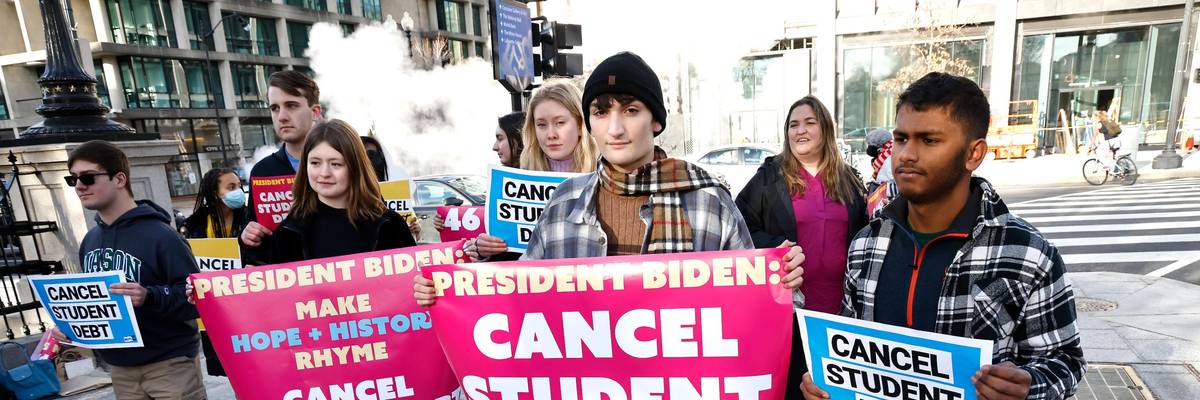
The Too Much Talent Band and local activists hold a protest outside the White House urging President Joe Biden to cancel student debt on March 15, 2022 in Washington, D.C. (Photo: Paul Morigi/Getty Images for We The 45 Million)
We're told that higher education is one of the best ways to overcome poverty. But for many indebted borrowers, it's been just the opposite.
Millions of American students, especially low-income students of color, end up taking on tens or even hundreds of thousands of dollars in debt.
Since 1980, the cost of college has increased at nearly 9 times the rate of paychecks. If you're poor and don't join the military, land a full scholarship, or gain a mysterious wealthy benefactor, you have one option: borrowing against your future prospects.
That's what I did. My family was poor enough for me to qualify for both Pell grants (federal aid packages awarded to students with "exceptional financial need") and Perkins loans (which were low-interest subsidized loans, unfortunately no longer available). Many semesters, I also took work study jobs.
Even so, I had to borrow $10,000--a lifeline that came with a clear threat.
Before graduating, every senior who'd received financial aid at my university had to pile into a cavernous lecture room, where a financial aid officer put the fear of God into us about what would happen if we ever defaulted on our payments. For hours, we watched slides about fallen credit scores, lost jobs and housing, bankruptcy--all part of the slippery slope from missing a payment to inexorable ruin.
After the presentation, we each had to sign a "master promissory note"--a fancy I.O.U.--and estimate our annual post-graduation income to calculate monthly payments. They made us do this even if we hadn't landed a job yet, or if the job we'd landed paid too little for us to afford a payment.
These fear-mongering tactics made a deep impression--I've skipped meals rather than miss a payment. But even after paying for years, I still have a couple thousand dollars hanging over my head.
And I'm one of the lucky ones.
Millions of American students, especially low-income students of color, end up taking on tens or even hundreds of thousands of dollars in debt. They've had to find a way to make far larger payments than mine with stagnant wages while also covering the rising costs of rent and health care--or while supporting family members.
That's why President Biden's order to cancel student loan debt up to $10,000 for all individual borrowers who earn under $125,000 annually--and up to $20,000 for Pell grant recipients--is such a big deal.
According to the Student Borrower Protection Center, 41 million Americans are eligible for up to $10,000 in debt relief, while 25 million are eligible for up to $20,000. And 20 million of us could have our entire debt canceled, going from negative wealth to positive for the first time in our lives.
That will free up a significant portion of people's paychecks, supercharge our economy, and combat a major source of inequality among hardworking Americans of all ages and backgrounds.
Biden's order will help in other ways, too. It will now forgive future loan balances after 10 years of payments for borrowers with loan balances of $12,000 or less. And as long as they make their monthly payments, borrowers won't see their balances increase--even when that monthly payment is $0 due to low income.
That's huge for people who've struggled for years or even decades under the crushing weight of student debt. It's also the floor of what's needed, not the ceiling.
Canceling all student debt would go further toward unrigging our economy and giving our communities more upward mobility. We also need to crack down on predatory private loans, which can leave borrowers paying down interest for years only to owe more than their original loan amount.
And finally, we need to push for making public higher education free so no one has to purchase their ticket to a better future on credit.
Dear Common Dreams reader, It’s been nearly 30 years since I co-founded Common Dreams with my late wife, Lina Newhouser. We had the radical notion that journalism should serve the public good, not corporate profits. It was clear to us from the outset what it would take to build such a project. No paid advertisements. No corporate sponsors. No millionaire publisher telling us what to think or do. Many people said we wouldn't last a year, but we proved those doubters wrong. Together with a tremendous team of journalists and dedicated staff, we built an independent media outlet free from the constraints of profits and corporate control. Our mission has always been simple: To inform. To inspire. To ignite change for the common good. Building Common Dreams was not easy. Our survival was never guaranteed. When you take on the most powerful forces—Wall Street greed, fossil fuel industry destruction, Big Tech lobbyists, and uber-rich oligarchs who have spent billions upon billions rigging the economy and democracy in their favor—the only bulwark you have is supporters who believe in your work. But here’s the urgent message from me today. It's never been this bad out there. And it's never been this hard to keep us going. At the very moment Common Dreams is most needed, the threats we face are intensifying. We need your support now more than ever. We don't accept corporate advertising and never will. We don't have a paywall because we don't think people should be blocked from critical news based on their ability to pay. Everything we do is funded by the donations of readers like you. When everyone does the little they can afford, we are strong. But if that support retreats or dries up, so do we. Will you donate now to make sure Common Dreams not only survives but thrives? —Craig Brown, Co-founder |
We're told that higher education is one of the best ways to overcome poverty. But for many indebted borrowers, it's been just the opposite.
Millions of American students, especially low-income students of color, end up taking on tens or even hundreds of thousands of dollars in debt.
Since 1980, the cost of college has increased at nearly 9 times the rate of paychecks. If you're poor and don't join the military, land a full scholarship, or gain a mysterious wealthy benefactor, you have one option: borrowing against your future prospects.
That's what I did. My family was poor enough for me to qualify for both Pell grants (federal aid packages awarded to students with "exceptional financial need") and Perkins loans (which were low-interest subsidized loans, unfortunately no longer available). Many semesters, I also took work study jobs.
Even so, I had to borrow $10,000--a lifeline that came with a clear threat.
Before graduating, every senior who'd received financial aid at my university had to pile into a cavernous lecture room, where a financial aid officer put the fear of God into us about what would happen if we ever defaulted on our payments. For hours, we watched slides about fallen credit scores, lost jobs and housing, bankruptcy--all part of the slippery slope from missing a payment to inexorable ruin.
After the presentation, we each had to sign a "master promissory note"--a fancy I.O.U.--and estimate our annual post-graduation income to calculate monthly payments. They made us do this even if we hadn't landed a job yet, or if the job we'd landed paid too little for us to afford a payment.
These fear-mongering tactics made a deep impression--I've skipped meals rather than miss a payment. But even after paying for years, I still have a couple thousand dollars hanging over my head.
And I'm one of the lucky ones.
Millions of American students, especially low-income students of color, end up taking on tens or even hundreds of thousands of dollars in debt. They've had to find a way to make far larger payments than mine with stagnant wages while also covering the rising costs of rent and health care--or while supporting family members.
That's why President Biden's order to cancel student loan debt up to $10,000 for all individual borrowers who earn under $125,000 annually--and up to $20,000 for Pell grant recipients--is such a big deal.
According to the Student Borrower Protection Center, 41 million Americans are eligible for up to $10,000 in debt relief, while 25 million are eligible for up to $20,000. And 20 million of us could have our entire debt canceled, going from negative wealth to positive for the first time in our lives.
That will free up a significant portion of people's paychecks, supercharge our economy, and combat a major source of inequality among hardworking Americans of all ages and backgrounds.
Biden's order will help in other ways, too. It will now forgive future loan balances after 10 years of payments for borrowers with loan balances of $12,000 or less. And as long as they make their monthly payments, borrowers won't see their balances increase--even when that monthly payment is $0 due to low income.
That's huge for people who've struggled for years or even decades under the crushing weight of student debt. It's also the floor of what's needed, not the ceiling.
Canceling all student debt would go further toward unrigging our economy and giving our communities more upward mobility. We also need to crack down on predatory private loans, which can leave borrowers paying down interest for years only to owe more than their original loan amount.
And finally, we need to push for making public higher education free so no one has to purchase their ticket to a better future on credit.
We're told that higher education is one of the best ways to overcome poverty. But for many indebted borrowers, it's been just the opposite.
Millions of American students, especially low-income students of color, end up taking on tens or even hundreds of thousands of dollars in debt.
Since 1980, the cost of college has increased at nearly 9 times the rate of paychecks. If you're poor and don't join the military, land a full scholarship, or gain a mysterious wealthy benefactor, you have one option: borrowing against your future prospects.
That's what I did. My family was poor enough for me to qualify for both Pell grants (federal aid packages awarded to students with "exceptional financial need") and Perkins loans (which were low-interest subsidized loans, unfortunately no longer available). Many semesters, I also took work study jobs.
Even so, I had to borrow $10,000--a lifeline that came with a clear threat.
Before graduating, every senior who'd received financial aid at my university had to pile into a cavernous lecture room, where a financial aid officer put the fear of God into us about what would happen if we ever defaulted on our payments. For hours, we watched slides about fallen credit scores, lost jobs and housing, bankruptcy--all part of the slippery slope from missing a payment to inexorable ruin.
After the presentation, we each had to sign a "master promissory note"--a fancy I.O.U.--and estimate our annual post-graduation income to calculate monthly payments. They made us do this even if we hadn't landed a job yet, or if the job we'd landed paid too little for us to afford a payment.
These fear-mongering tactics made a deep impression--I've skipped meals rather than miss a payment. But even after paying for years, I still have a couple thousand dollars hanging over my head.
And I'm one of the lucky ones.
Millions of American students, especially low-income students of color, end up taking on tens or even hundreds of thousands of dollars in debt. They've had to find a way to make far larger payments than mine with stagnant wages while also covering the rising costs of rent and health care--or while supporting family members.
That's why President Biden's order to cancel student loan debt up to $10,000 for all individual borrowers who earn under $125,000 annually--and up to $20,000 for Pell grant recipients--is such a big deal.
According to the Student Borrower Protection Center, 41 million Americans are eligible for up to $10,000 in debt relief, while 25 million are eligible for up to $20,000. And 20 million of us could have our entire debt canceled, going from negative wealth to positive for the first time in our lives.
That will free up a significant portion of people's paychecks, supercharge our economy, and combat a major source of inequality among hardworking Americans of all ages and backgrounds.
Biden's order will help in other ways, too. It will now forgive future loan balances after 10 years of payments for borrowers with loan balances of $12,000 or less. And as long as they make their monthly payments, borrowers won't see their balances increase--even when that monthly payment is $0 due to low income.
That's huge for people who've struggled for years or even decades under the crushing weight of student debt. It's also the floor of what's needed, not the ceiling.
Canceling all student debt would go further toward unrigging our economy and giving our communities more upward mobility. We also need to crack down on predatory private loans, which can leave borrowers paying down interest for years only to owe more than their original loan amount.
And finally, we need to push for making public higher education free so no one has to purchase their ticket to a better future on credit.