
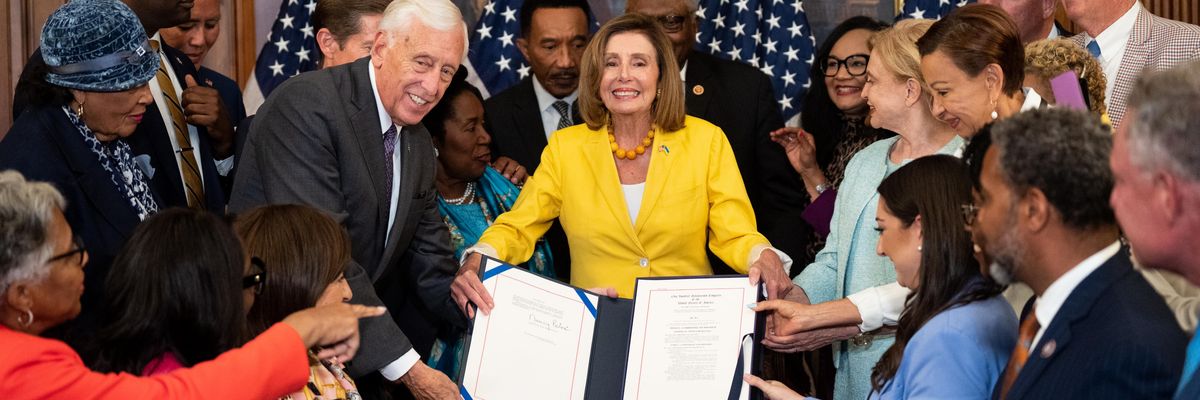
House Speaker Nancy Pelosi (D-Calif.) and House Majority Leader Steny Hoyer (D-Md.) hold up the Inflation Reduction Act bill during an August 12, 2022 enrollment ceremony at the U.S. Capitol in Washington, D.C. (Photo: Bill Clark/CQ-Roll Call, Inc. via Getty Images)
Investments in Projects Over People: An Equity Point of View on the Inflation Reduction Act
Until the work of communities of color is seen as essential and not optional for climate, our work remains unfinished.
The United States has crossed a threshold after decades of intrepid attempts to build political will for climate action. While it is important to recognize the shift in momentum, and its value, we can't dismiss that it prioritizes investments in projects over people, again.
While it is important to recognize the shift in momentum, and its value, we can't dismiss that it prioritizes investments in projects over people, again.
The movement for people and planet has taken shape since the era of industrialization as Indigenous, enslaved and colonized peoples transformed these lands through their labor, warning of extraction, pollution and degradation over generations. Modern movements marked the struggle with the formation of the environmental justice movement, the development of the 17 principles in 1991, the Jemez principles in 1996 and the emergence of whole organizations focused on conservation and the nonprofit industrial complex.
The United States has crossed a threshold after decades of intrepid attempts to build political will for climate action. While it is important to recognize the shift in momentum, and its value, we can't dismiss that it prioritizes investments in projects over people, again.
The movement for people and planet has taken shape since the era of industrialization as Indigenous, enslaved and colonized peoples transformed these lands through their labor, warning of extraction, pollution and degradation over generations. Modern movements marked the struggle with the formation of the environmental justice movement, the development of the 17 principles in 1991, the Jemez principles in 1996 and the emergence of whole organizations focused on conservation and the nonprofit industrial complex.
As news of the compromise that led to new law spread faster than the details within the legislation, communities voiced concerns about the opaqueness of dealmaking and demanded protection of vulnerable places and people. The release of the final text confirmed those fears and about the closed-door nature of the negotiation in contravention to community practice of participatory coalitions. And all that trust-building practice is how we collectively determine our trajectory for emissions, conditions of survival, loss and damage.
The next step to realizing any benefits of the Inflation Reduction Act is understanding the forewarnings of our movement partners. The work of the environmental movement is actually multitudes of strategy, tactics and agendas that come together for as an expansive a vision that has ever existed because it includes all of us. And that kind of power needs to be tended, coordinated, and mended in moments like these. We cannot do the work of people and planet without deferential commitments to the most vulnerable, that include resource redistribution and a non-negotiable practice of racial equity that is sensitive to the reality that the ways are as important as the means. It matters that Black, Indigenous, and all people of color, the chronically poor and people who live in regions where energy extraction threatens their lives are raising concerns. And it matters right now.
Now is the time when the connections between environmental degradation in the U.S. South and global south matter. Now is the time when race-based discrimination and systemic exclusion should sharpen our focus on the priority, sequence and scale of investments for innovation. It is only by widening the lens of our policy and practice that we reach the scale the environmental crisis requires, and restore public lands, watersheds, coastal communities, rural and urban communities with sustainable, replicable and life-sustaining energy. A win in this moment is one that aligns with the principles of just transition which require a just redistribution of resources that meet the litmus test of community benefits, not just market demands.
As the conversation about this landmark legislation shifts to a staid pace of regulatory, state, local, community and territorial forums the true impact of the legislation will be borne out. In the meantime, the whole movement should be making plans to undergird the people and places that the bargain leaves vulnerable for deep extraction, incumbent permits, pipelines and bureaucratic process. Because despite the global calls for racial equity we haven't made it a political reality here at home. And until the work of communities of color is seen as essential and not optional for climate, our work remains unfinished. Until the work of justice for racialized peoples is irrevocable in environment and climate wins, we should not dare to declare victory.
An Urgent Message From Our Co-Founder
Dear Common Dreams reader, It’s been nearly 30 years since I co-founded Common Dreams with my late wife, Lina Newhouser. We had the radical notion that journalism should serve the public good, not corporate profits. It was clear to us from the outset what it would take to build such a project. No paid advertisements. No corporate sponsors. No millionaire publisher telling us what to think or do. Many people said we wouldn't last a year, but we proved those doubters wrong. Together with a tremendous team of journalists and dedicated staff, we built an independent media outlet free from the constraints of profits and corporate control. Our mission has always been simple: To inform. To inspire. To ignite change for the common good. Building Common Dreams was not easy. Our survival was never guaranteed. When you take on the most powerful forces—Wall Street greed, fossil fuel industry destruction, Big Tech lobbyists, and uber-rich oligarchs who have spent billions upon billions rigging the economy and democracy in their favor—the only bulwark you have is supporters who believe in your work. But here’s the urgent message from me today. It's never been this bad out there. And it's never been this hard to keep us going. At the very moment Common Dreams is most needed, the threats we face are intensifying. We need your support now more than ever. We don't accept corporate advertising and never will. We don't have a paywall because we don't think people should be blocked from critical news based on their ability to pay. Everything we do is funded by the donations of readers like you. When everyone does the little they can afford, we are strong. But if that support retreats or dries up, so do we. Will you donate now to make sure Common Dreams not only survives but thrives? —Craig Brown, Co-founder |
The United States has crossed a threshold after decades of intrepid attempts to build political will for climate action. While it is important to recognize the shift in momentum, and its value, we can't dismiss that it prioritizes investments in projects over people, again.
While it is important to recognize the shift in momentum, and its value, we can't dismiss that it prioritizes investments in projects over people, again.
The movement for people and planet has taken shape since the era of industrialization as Indigenous, enslaved and colonized peoples transformed these lands through their labor, warning of extraction, pollution and degradation over generations. Modern movements marked the struggle with the formation of the environmental justice movement, the development of the 17 principles in 1991, the Jemez principles in 1996 and the emergence of whole organizations focused on conservation and the nonprofit industrial complex.
The United States has crossed a threshold after decades of intrepid attempts to build political will for climate action. While it is important to recognize the shift in momentum, and its value, we can't dismiss that it prioritizes investments in projects over people, again.
The movement for people and planet has taken shape since the era of industrialization as Indigenous, enslaved and colonized peoples transformed these lands through their labor, warning of extraction, pollution and degradation over generations. Modern movements marked the struggle with the formation of the environmental justice movement, the development of the 17 principles in 1991, the Jemez principles in 1996 and the emergence of whole organizations focused on conservation and the nonprofit industrial complex.
As news of the compromise that led to new law spread faster than the details within the legislation, communities voiced concerns about the opaqueness of dealmaking and demanded protection of vulnerable places and people. The release of the final text confirmed those fears and about the closed-door nature of the negotiation in contravention to community practice of participatory coalitions. And all that trust-building practice is how we collectively determine our trajectory for emissions, conditions of survival, loss and damage.
The next step to realizing any benefits of the Inflation Reduction Act is understanding the forewarnings of our movement partners. The work of the environmental movement is actually multitudes of strategy, tactics and agendas that come together for as an expansive a vision that has ever existed because it includes all of us. And that kind of power needs to be tended, coordinated, and mended in moments like these. We cannot do the work of people and planet without deferential commitments to the most vulnerable, that include resource redistribution and a non-negotiable practice of racial equity that is sensitive to the reality that the ways are as important as the means. It matters that Black, Indigenous, and all people of color, the chronically poor and people who live in regions where energy extraction threatens their lives are raising concerns. And it matters right now.
Now is the time when the connections between environmental degradation in the U.S. South and global south matter. Now is the time when race-based discrimination and systemic exclusion should sharpen our focus on the priority, sequence and scale of investments for innovation. It is only by widening the lens of our policy and practice that we reach the scale the environmental crisis requires, and restore public lands, watersheds, coastal communities, rural and urban communities with sustainable, replicable and life-sustaining energy. A win in this moment is one that aligns with the principles of just transition which require a just redistribution of resources that meet the litmus test of community benefits, not just market demands.
As the conversation about this landmark legislation shifts to a staid pace of regulatory, state, local, community and territorial forums the true impact of the legislation will be borne out. In the meantime, the whole movement should be making plans to undergird the people and places that the bargain leaves vulnerable for deep extraction, incumbent permits, pipelines and bureaucratic process. Because despite the global calls for racial equity we haven't made it a political reality here at home. And until the work of communities of color is seen as essential and not optional for climate, our work remains unfinished. Until the work of justice for racialized peoples is irrevocable in environment and climate wins, we should not dare to declare victory.
The United States has crossed a threshold after decades of intrepid attempts to build political will for climate action. While it is important to recognize the shift in momentum, and its value, we can't dismiss that it prioritizes investments in projects over people, again.
While it is important to recognize the shift in momentum, and its value, we can't dismiss that it prioritizes investments in projects over people, again.
The movement for people and planet has taken shape since the era of industrialization as Indigenous, enslaved and colonized peoples transformed these lands through their labor, warning of extraction, pollution and degradation over generations. Modern movements marked the struggle with the formation of the environmental justice movement, the development of the 17 principles in 1991, the Jemez principles in 1996 and the emergence of whole organizations focused on conservation and the nonprofit industrial complex.
The United States has crossed a threshold after decades of intrepid attempts to build political will for climate action. While it is important to recognize the shift in momentum, and its value, we can't dismiss that it prioritizes investments in projects over people, again.
The movement for people and planet has taken shape since the era of industrialization as Indigenous, enslaved and colonized peoples transformed these lands through their labor, warning of extraction, pollution and degradation over generations. Modern movements marked the struggle with the formation of the environmental justice movement, the development of the 17 principles in 1991, the Jemez principles in 1996 and the emergence of whole organizations focused on conservation and the nonprofit industrial complex.
As news of the compromise that led to new law spread faster than the details within the legislation, communities voiced concerns about the opaqueness of dealmaking and demanded protection of vulnerable places and people. The release of the final text confirmed those fears and about the closed-door nature of the negotiation in contravention to community practice of participatory coalitions. And all that trust-building practice is how we collectively determine our trajectory for emissions, conditions of survival, loss and damage.
The next step to realizing any benefits of the Inflation Reduction Act is understanding the forewarnings of our movement partners. The work of the environmental movement is actually multitudes of strategy, tactics and agendas that come together for as an expansive a vision that has ever existed because it includes all of us. And that kind of power needs to be tended, coordinated, and mended in moments like these. We cannot do the work of people and planet without deferential commitments to the most vulnerable, that include resource redistribution and a non-negotiable practice of racial equity that is sensitive to the reality that the ways are as important as the means. It matters that Black, Indigenous, and all people of color, the chronically poor and people who live in regions where energy extraction threatens their lives are raising concerns. And it matters right now.
Now is the time when the connections between environmental degradation in the U.S. South and global south matter. Now is the time when race-based discrimination and systemic exclusion should sharpen our focus on the priority, sequence and scale of investments for innovation. It is only by widening the lens of our policy and practice that we reach the scale the environmental crisis requires, and restore public lands, watersheds, coastal communities, rural and urban communities with sustainable, replicable and life-sustaining energy. A win in this moment is one that aligns with the principles of just transition which require a just redistribution of resources that meet the litmus test of community benefits, not just market demands.
As the conversation about this landmark legislation shifts to a staid pace of regulatory, state, local, community and territorial forums the true impact of the legislation will be borne out. In the meantime, the whole movement should be making plans to undergird the people and places that the bargain leaves vulnerable for deep extraction, incumbent permits, pipelines and bureaucratic process. Because despite the global calls for racial equity we haven't made it a political reality here at home. And until the work of communities of color is seen as essential and not optional for climate, our work remains unfinished. Until the work of justice for racialized peoples is irrevocable in environment and climate wins, we should not dare to declare victory.