SUBSCRIBE TO OUR FREE NEWSLETTER
Daily news & progressive opinion—funded by the people, not the corporations—delivered straight to your inbox.
5
#000000
#FFFFFF
To donate by check, phone, or other method, see our More Ways to Give page.
Daily news & progressive opinion—funded by the people, not the corporations—delivered straight to your inbox.
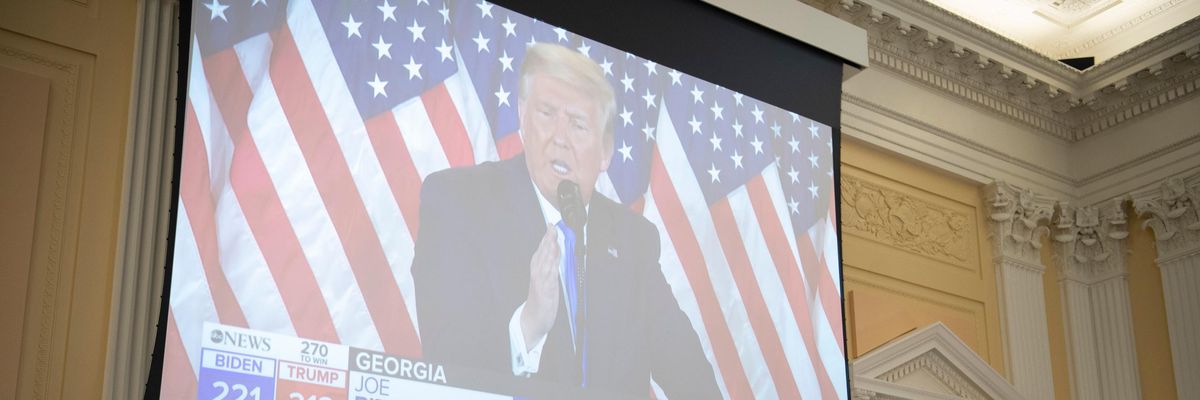
A clip of former President Donald Trump is played during a hearing of the United States House Select Committee on the January 6 Attack at the Cannon House Office Building on Monday June 13, 2022 in Washington, DC. (Photo by Matt McClain/The Washington Post via Getty Images)
The House Select Committee on Jan. 6 has detailed what at some level we already knew. Trump lost the election. He knew it. His advisers knew it. His Justice Department knew it. The courts confirmed it. There was no evidence of voter fraud. Trump lied--and continues lying to this day.
Now voters have to decide. Will they reward those who spread the lie or hold their representatives accountable?
No one likes a sore loser, but Trump would not accept that he lost. He railed about fraud so often that he convinced his followers that the election must have been stolen. He used the false claims to raise a stunning amount of money--$250 million--for an election defense fund that was a fiction. He used the money for his political and personal purposes. He not only misled those who believed in him, he ripped them off. So it goes.
That's not the real scandal. We have had a sense about Trump for a long time. Even his supporters understood he was a scoundrel, they just mistakenly thought he was their scoundrel.
Those who got misled and fooled aren't really the problem. The problem is the cynical politicians who echoed the lies--and knew better. They not only re-enforced the lies, they acted on them.
Across the country, Republicans used Trump's lies not just to demand recounts of ballots in various states, they used them to change the law in very specific ways. They made voting more difficult, particularly for working and poor people who live in urban areas. They reduced early voting days, ended voting on Sunday, limited voting places in urban areas, made vote-by-mail more difficult, demanded new forms of ID that discriminated against students and minorities, and more.
Second, they made the possibility of distorting the vote more likely. They got rid of non-partisan election officials and replaced them with partisans. They gave state legislatures greater power to overturn elections simply because they don't like the results, regardless of how the majority voted. By 2024, as many as 20 of the 50 states will run under election orders that are much more exposed to partisan manipulation.
Third, at the national level, they blocked every effort to reform the process. They blocked revival of the Voting Rights Act, which used to enjoy bipartisan support. They blocked efforts to perfect the electoral system and protect it from partisan meddling. They blocked reforms that would make it easier to register, harder to gerrymander districts, and set national standards for the country.
The cynicism of these politicians is clear. They assume that Americans won't let issues of democracy define their vote. They assume that not only will they pay no political cost for undermining democracy, they will be rewarded for it. The Trump lies fuel the anger of the Republican base--and dismay those who oppose those lies. The former are more likely to vote; the latter more likely to be turned off.
Are these Republican cynics right? Pollsters suggest they are. Voters are concerned about the price of food and gas, jobs and the economy, crime, and other concerns that impact their daily lives. They assume the existence of democracy. They assume that the debates over reforms are questions of partisanship, not patriotism.
A likely result is that Trump's Big Lie may end up discrediting him, but not the Republican politicians who joined in echoing it and cowered before Trump's wrath. To date in the Republican primaries, those who stood up to Trump have not fared well, while those who kowtowed to him have done better.
That is where we are. The Jan. 6 Committee will prove its case: Trump lied and tried to overturn an election he knew he lost. Now voters have to decide. Will they reward those who spread the lie or hold their representatives accountable?
Many commentators say that the committee has put Trump in the dock. In fact, it is our democracy that is in the dock. Will it be defended or deformed? Will it end strengthened or undermined? We need a new surge from idealists and reformers to overcome the cynics that put democracy at risk.
Dear Common Dreams reader, It’s been nearly 30 years since I co-founded Common Dreams with my late wife, Lina Newhouser. We had the radical notion that journalism should serve the public good, not corporate profits. It was clear to us from the outset what it would take to build such a project. No paid advertisements. No corporate sponsors. No millionaire publisher telling us what to think or do. Many people said we wouldn't last a year, but we proved those doubters wrong. Together with a tremendous team of journalists and dedicated staff, we built an independent media outlet free from the constraints of profits and corporate control. Our mission has always been simple: To inform. To inspire. To ignite change for the common good. Building Common Dreams was not easy. Our survival was never guaranteed. When you take on the most powerful forces—Wall Street greed, fossil fuel industry destruction, Big Tech lobbyists, and uber-rich oligarchs who have spent billions upon billions rigging the economy and democracy in their favor—the only bulwark you have is supporters who believe in your work. But here’s the urgent message from me today. It's never been this bad out there. And it's never been this hard to keep us going. At the very moment Common Dreams is most needed, the threats we face are intensifying. We need your support now more than ever. We don't accept corporate advertising and never will. We don't have a paywall because we don't think people should be blocked from critical news based on their ability to pay. Everything we do is funded by the donations of readers like you. When everyone does the little they can afford, we are strong. But if that support retreats or dries up, so do we. Will you donate now to make sure Common Dreams not only survives but thrives? —Craig Brown, Co-founder |
The House Select Committee on Jan. 6 has detailed what at some level we already knew. Trump lost the election. He knew it. His advisers knew it. His Justice Department knew it. The courts confirmed it. There was no evidence of voter fraud. Trump lied--and continues lying to this day.
Now voters have to decide. Will they reward those who spread the lie or hold their representatives accountable?
No one likes a sore loser, but Trump would not accept that he lost. He railed about fraud so often that he convinced his followers that the election must have been stolen. He used the false claims to raise a stunning amount of money--$250 million--for an election defense fund that was a fiction. He used the money for his political and personal purposes. He not only misled those who believed in him, he ripped them off. So it goes.
That's not the real scandal. We have had a sense about Trump for a long time. Even his supporters understood he was a scoundrel, they just mistakenly thought he was their scoundrel.
Those who got misled and fooled aren't really the problem. The problem is the cynical politicians who echoed the lies--and knew better. They not only re-enforced the lies, they acted on them.
Across the country, Republicans used Trump's lies not just to demand recounts of ballots in various states, they used them to change the law in very specific ways. They made voting more difficult, particularly for working and poor people who live in urban areas. They reduced early voting days, ended voting on Sunday, limited voting places in urban areas, made vote-by-mail more difficult, demanded new forms of ID that discriminated against students and minorities, and more.
Second, they made the possibility of distorting the vote more likely. They got rid of non-partisan election officials and replaced them with partisans. They gave state legislatures greater power to overturn elections simply because they don't like the results, regardless of how the majority voted. By 2024, as many as 20 of the 50 states will run under election orders that are much more exposed to partisan manipulation.
Third, at the national level, they blocked every effort to reform the process. They blocked revival of the Voting Rights Act, which used to enjoy bipartisan support. They blocked efforts to perfect the electoral system and protect it from partisan meddling. They blocked reforms that would make it easier to register, harder to gerrymander districts, and set national standards for the country.
The cynicism of these politicians is clear. They assume that Americans won't let issues of democracy define their vote. They assume that not only will they pay no political cost for undermining democracy, they will be rewarded for it. The Trump lies fuel the anger of the Republican base--and dismay those who oppose those lies. The former are more likely to vote; the latter more likely to be turned off.
Are these Republican cynics right? Pollsters suggest they are. Voters are concerned about the price of food and gas, jobs and the economy, crime, and other concerns that impact their daily lives. They assume the existence of democracy. They assume that the debates over reforms are questions of partisanship, not patriotism.
A likely result is that Trump's Big Lie may end up discrediting him, but not the Republican politicians who joined in echoing it and cowered before Trump's wrath. To date in the Republican primaries, those who stood up to Trump have not fared well, while those who kowtowed to him have done better.
That is where we are. The Jan. 6 Committee will prove its case: Trump lied and tried to overturn an election he knew he lost. Now voters have to decide. Will they reward those who spread the lie or hold their representatives accountable?
Many commentators say that the committee has put Trump in the dock. In fact, it is our democracy that is in the dock. Will it be defended or deformed? Will it end strengthened or undermined? We need a new surge from idealists and reformers to overcome the cynics that put democracy at risk.
The House Select Committee on Jan. 6 has detailed what at some level we already knew. Trump lost the election. He knew it. His advisers knew it. His Justice Department knew it. The courts confirmed it. There was no evidence of voter fraud. Trump lied--and continues lying to this day.
Now voters have to decide. Will they reward those who spread the lie or hold their representatives accountable?
No one likes a sore loser, but Trump would not accept that he lost. He railed about fraud so often that he convinced his followers that the election must have been stolen. He used the false claims to raise a stunning amount of money--$250 million--for an election defense fund that was a fiction. He used the money for his political and personal purposes. He not only misled those who believed in him, he ripped them off. So it goes.
That's not the real scandal. We have had a sense about Trump for a long time. Even his supporters understood he was a scoundrel, they just mistakenly thought he was their scoundrel.
Those who got misled and fooled aren't really the problem. The problem is the cynical politicians who echoed the lies--and knew better. They not only re-enforced the lies, they acted on them.
Across the country, Republicans used Trump's lies not just to demand recounts of ballots in various states, they used them to change the law in very specific ways. They made voting more difficult, particularly for working and poor people who live in urban areas. They reduced early voting days, ended voting on Sunday, limited voting places in urban areas, made vote-by-mail more difficult, demanded new forms of ID that discriminated against students and minorities, and more.
Second, they made the possibility of distorting the vote more likely. They got rid of non-partisan election officials and replaced them with partisans. They gave state legislatures greater power to overturn elections simply because they don't like the results, regardless of how the majority voted. By 2024, as many as 20 of the 50 states will run under election orders that are much more exposed to partisan manipulation.
Third, at the national level, they blocked every effort to reform the process. They blocked revival of the Voting Rights Act, which used to enjoy bipartisan support. They blocked efforts to perfect the electoral system and protect it from partisan meddling. They blocked reforms that would make it easier to register, harder to gerrymander districts, and set national standards for the country.
The cynicism of these politicians is clear. They assume that Americans won't let issues of democracy define their vote. They assume that not only will they pay no political cost for undermining democracy, they will be rewarded for it. The Trump lies fuel the anger of the Republican base--and dismay those who oppose those lies. The former are more likely to vote; the latter more likely to be turned off.
Are these Republican cynics right? Pollsters suggest they are. Voters are concerned about the price of food and gas, jobs and the economy, crime, and other concerns that impact their daily lives. They assume the existence of democracy. They assume that the debates over reforms are questions of partisanship, not patriotism.
A likely result is that Trump's Big Lie may end up discrediting him, but not the Republican politicians who joined in echoing it and cowered before Trump's wrath. To date in the Republican primaries, those who stood up to Trump have not fared well, while those who kowtowed to him have done better.
That is where we are. The Jan. 6 Committee will prove its case: Trump lied and tried to overturn an election he knew he lost. Now voters have to decide. Will they reward those who spread the lie or hold their representatives accountable?
Many commentators say that the committee has put Trump in the dock. In fact, it is our democracy that is in the dock. Will it be defended or deformed? Will it end strengthened or undermined? We need a new surge from idealists and reformers to overcome the cynics that put democracy at risk.