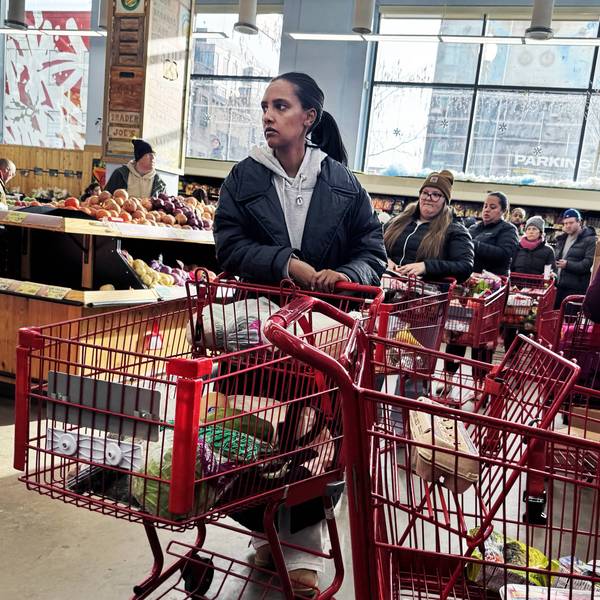

A person shops in the meat section of a grocery store on November 11, 2021 in Los Angeles, California. (Photo: Mario Tama/Getty Images)
Blame Profit-Hungry Corporations Milking Consumers for Inflation
It turns out that inflation is a boon for monopolies, for it gives them cover to flash their pricing power.
The problem with our so-called "free market" is that it's not free for you and me. It's largely controlled by monopolies, which are free to inflate prices just because they can, without worrying that consumers will be able to flee to cheaper sellers. In turn, this market punch lets the noncompetitive gougers gleefully extract unwarranted monopoly profits. It's a phenomenon that corporatists euphemistically label "pricing power."
The trick is that these giants are in noncompetitive markets operating as monopolies, so they can set higher prices, mug you and me, and scamper away with a record-busting share of America's total economic output.
This economy-wide milking of consumers by tightly consolidated industries is the unbridled force propelling today's surging price hikes. Brand-name corporations claim they are being forced to mark up price tags just to cover rising costs for raw materials, labor, transportation, etc. But in a competitive marketplace, they'd have to eat much of those increases by taking a bit less in profits. The giants have been stockpiling record profits for years, so they could easily weather a downtick. Instead, they're raising prices not simply to maintain exorbitant profits, but to squeeze even greater profits from hard-hit consumers. It's a game of corporate greed that socks America's economy: Monopolies cynically exploit the public's worry about inflation to create more inflation.
Consider diapers, a necessity for many families. As corporate watchdog Judd Legum reported, the huge consumer product seller Procter & Gamble Co. announced a year ago that COVID-19-driven production costs were forcing it to raise the price for its Pampers brand. At the time, it had just posted a quarterly profit of $3.8 billion, so P&G could easily have absorbed a temporary rise in its costs. But instead of holding the price to ease their customers' economic pain, the conglomerate used a global health crisis to justify upping diaper prices. Six months later, P&G's quarterly profit topped $5 billion. And--in that same quarter--P&G spent $3 billion to buy back shares of its own stock--a Wall Street manipulation that artificially bloats the wealth of top execs and other big shareholders. In sum, P&G used the excuse of inflation to inflate the price of diapers, then used the extra money it extracted from families to inflate the value of its stock in a ploy to further enrich its biggest shareholders. And why wouldn't savvy consumers switch from Pampers to Huggies, the brand sold by Kimberly-Clark, P&G's main "competitor"? Because co-monopolist Kimberly-Clark goosed up its prices at the same time. And--get this--the two companies control 80% of the global disposable diaper market. Welcome to the monopoly merry-go-round.
Almost all CEOs of big corporations are playing this tricky inflation blame game. Publicly, they moan that the pandemic is slamming their poor corporation with factory shutdowns, supply chain delays, labor shortages, wage hikes and other increased costs. But wait--inside their boardrooms, executives are high-fiving each other and pocketing bonuses. What's going on?
It turns out that inflation is a boon for monopolies, for it gives them cover to flash their pricing power. The trick is that these giants are in noncompetitive markets operating as monopolies, so they can set higher prices, mug you and me, and scamper away with a record-busting share of America's total economic output. In 2019 for example, before the pandemic hit, big U.S. corporations hauled in roughly a trillion dollars in profit. In 2021, during the pandemic, they grabbed more than $1.7 trillion. Antitrust analyst Matt Stoller finds that this huge profit jump accounts for 60% of the inflation now slapping U.S. families!
Take Rodney McMullen, CEO of the supermarket goliath Kroger. He gloated last summer that "a little bit of inflation is always good in our business," adding that "we've been very comfortable with our ability to pass on (price) increases" to consumers. "Comfortable" indeed. Last year, Kroger used it's "monopoly pricing" power to reap record profits, then it spent $1.5 billion of those gains not to benefit consumers or workers, but to buy back its own stock--a scam that gives more money to top executives and big shareholders. Or take fast-food purveyor McDonald's. It gushed to its shareholders that 2021 had been "a banner year." Executives bragged that despite the supply disruptions of the pandemic and higher costs for meat and labor, they used the chain's pricing power to up prices, thus increasing corporate profits by a stunning 59% over the previous year. And the party goes on: "We're going to have the best growth we've ever had this year," Wall Street banking titan Jamie Dimon exulted at the start of 2022.
Hocus pocus: This is how the rich get richer and inequality "happens."
An Urgent Message From Our Co-Founder
Dear Common Dreams reader, It’s been nearly 30 years since I co-founded Common Dreams with my late wife, Lina Newhouser. We had the radical notion that journalism should serve the public good, not corporate profits. It was clear to us from the outset what it would take to build such a project. No paid advertisements. No corporate sponsors. No millionaire publisher telling us what to think or do. Many people said we wouldn't last a year, but we proved those doubters wrong. Together with a tremendous team of journalists and dedicated staff, we built an independent media outlet free from the constraints of profits and corporate control. Our mission has always been simple: To inform. To inspire. To ignite change for the common good. Building Common Dreams was not easy. Our survival was never guaranteed. When you take on the most powerful forces—Wall Street greed, fossil fuel industry destruction, Big Tech lobbyists, and uber-rich oligarchs who have spent billions upon billions rigging the economy and democracy in their favor—the only bulwark you have is supporters who believe in your work. But here’s the urgent message from me today. It's never been this bad out there. And it's never been this hard to keep us going. At the very moment Common Dreams is most needed, the threats we face are intensifying. We need your support now more than ever. We don't accept corporate advertising and never will. We don't have a paywall because we don't think people should be blocked from critical news based on their ability to pay. Everything we do is funded by the donations of readers like you. When everyone does the little they can afford, we are strong. But if that support retreats or dries up, so do we. Will you donate now to make sure Common Dreams not only survives but thrives? —Craig Brown, Co-founder |
The problem with our so-called "free market" is that it's not free for you and me. It's largely controlled by monopolies, which are free to inflate prices just because they can, without worrying that consumers will be able to flee to cheaper sellers. In turn, this market punch lets the noncompetitive gougers gleefully extract unwarranted monopoly profits. It's a phenomenon that corporatists euphemistically label "pricing power."
The trick is that these giants are in noncompetitive markets operating as monopolies, so they can set higher prices, mug you and me, and scamper away with a record-busting share of America's total economic output.
This economy-wide milking of consumers by tightly consolidated industries is the unbridled force propelling today's surging price hikes. Brand-name corporations claim they are being forced to mark up price tags just to cover rising costs for raw materials, labor, transportation, etc. But in a competitive marketplace, they'd have to eat much of those increases by taking a bit less in profits. The giants have been stockpiling record profits for years, so they could easily weather a downtick. Instead, they're raising prices not simply to maintain exorbitant profits, but to squeeze even greater profits from hard-hit consumers. It's a game of corporate greed that socks America's economy: Monopolies cynically exploit the public's worry about inflation to create more inflation.
Consider diapers, a necessity for many families. As corporate watchdog Judd Legum reported, the huge consumer product seller Procter & Gamble Co. announced a year ago that COVID-19-driven production costs were forcing it to raise the price for its Pampers brand. At the time, it had just posted a quarterly profit of $3.8 billion, so P&G could easily have absorbed a temporary rise in its costs. But instead of holding the price to ease their customers' economic pain, the conglomerate used a global health crisis to justify upping diaper prices. Six months later, P&G's quarterly profit topped $5 billion. And--in that same quarter--P&G spent $3 billion to buy back shares of its own stock--a Wall Street manipulation that artificially bloats the wealth of top execs and other big shareholders. In sum, P&G used the excuse of inflation to inflate the price of diapers, then used the extra money it extracted from families to inflate the value of its stock in a ploy to further enrich its biggest shareholders. And why wouldn't savvy consumers switch from Pampers to Huggies, the brand sold by Kimberly-Clark, P&G's main "competitor"? Because co-monopolist Kimberly-Clark goosed up its prices at the same time. And--get this--the two companies control 80% of the global disposable diaper market. Welcome to the monopoly merry-go-round.
Almost all CEOs of big corporations are playing this tricky inflation blame game. Publicly, they moan that the pandemic is slamming their poor corporation with factory shutdowns, supply chain delays, labor shortages, wage hikes and other increased costs. But wait--inside their boardrooms, executives are high-fiving each other and pocketing bonuses. What's going on?
It turns out that inflation is a boon for monopolies, for it gives them cover to flash their pricing power. The trick is that these giants are in noncompetitive markets operating as monopolies, so they can set higher prices, mug you and me, and scamper away with a record-busting share of America's total economic output. In 2019 for example, before the pandemic hit, big U.S. corporations hauled in roughly a trillion dollars in profit. In 2021, during the pandemic, they grabbed more than $1.7 trillion. Antitrust analyst Matt Stoller finds that this huge profit jump accounts for 60% of the inflation now slapping U.S. families!
Take Rodney McMullen, CEO of the supermarket goliath Kroger. He gloated last summer that "a little bit of inflation is always good in our business," adding that "we've been very comfortable with our ability to pass on (price) increases" to consumers. "Comfortable" indeed. Last year, Kroger used it's "monopoly pricing" power to reap record profits, then it spent $1.5 billion of those gains not to benefit consumers or workers, but to buy back its own stock--a scam that gives more money to top executives and big shareholders. Or take fast-food purveyor McDonald's. It gushed to its shareholders that 2021 had been "a banner year." Executives bragged that despite the supply disruptions of the pandemic and higher costs for meat and labor, they used the chain's pricing power to up prices, thus increasing corporate profits by a stunning 59% over the previous year. And the party goes on: "We're going to have the best growth we've ever had this year," Wall Street banking titan Jamie Dimon exulted at the start of 2022.
Hocus pocus: This is how the rich get richer and inequality "happens."
The problem with our so-called "free market" is that it's not free for you and me. It's largely controlled by monopolies, which are free to inflate prices just because they can, without worrying that consumers will be able to flee to cheaper sellers. In turn, this market punch lets the noncompetitive gougers gleefully extract unwarranted monopoly profits. It's a phenomenon that corporatists euphemistically label "pricing power."
The trick is that these giants are in noncompetitive markets operating as monopolies, so they can set higher prices, mug you and me, and scamper away with a record-busting share of America's total economic output.
This economy-wide milking of consumers by tightly consolidated industries is the unbridled force propelling today's surging price hikes. Brand-name corporations claim they are being forced to mark up price tags just to cover rising costs for raw materials, labor, transportation, etc. But in a competitive marketplace, they'd have to eat much of those increases by taking a bit less in profits. The giants have been stockpiling record profits for years, so they could easily weather a downtick. Instead, they're raising prices not simply to maintain exorbitant profits, but to squeeze even greater profits from hard-hit consumers. It's a game of corporate greed that socks America's economy: Monopolies cynically exploit the public's worry about inflation to create more inflation.
Consider diapers, a necessity for many families. As corporate watchdog Judd Legum reported, the huge consumer product seller Procter & Gamble Co. announced a year ago that COVID-19-driven production costs were forcing it to raise the price for its Pampers brand. At the time, it had just posted a quarterly profit of $3.8 billion, so P&G could easily have absorbed a temporary rise in its costs. But instead of holding the price to ease their customers' economic pain, the conglomerate used a global health crisis to justify upping diaper prices. Six months later, P&G's quarterly profit topped $5 billion. And--in that same quarter--P&G spent $3 billion to buy back shares of its own stock--a Wall Street manipulation that artificially bloats the wealth of top execs and other big shareholders. In sum, P&G used the excuse of inflation to inflate the price of diapers, then used the extra money it extracted from families to inflate the value of its stock in a ploy to further enrich its biggest shareholders. And why wouldn't savvy consumers switch from Pampers to Huggies, the brand sold by Kimberly-Clark, P&G's main "competitor"? Because co-monopolist Kimberly-Clark goosed up its prices at the same time. And--get this--the two companies control 80% of the global disposable diaper market. Welcome to the monopoly merry-go-round.
Almost all CEOs of big corporations are playing this tricky inflation blame game. Publicly, they moan that the pandemic is slamming their poor corporation with factory shutdowns, supply chain delays, labor shortages, wage hikes and other increased costs. But wait--inside their boardrooms, executives are high-fiving each other and pocketing bonuses. What's going on?
It turns out that inflation is a boon for monopolies, for it gives them cover to flash their pricing power. The trick is that these giants are in noncompetitive markets operating as monopolies, so they can set higher prices, mug you and me, and scamper away with a record-busting share of America's total economic output. In 2019 for example, before the pandemic hit, big U.S. corporations hauled in roughly a trillion dollars in profit. In 2021, during the pandemic, they grabbed more than $1.7 trillion. Antitrust analyst Matt Stoller finds that this huge profit jump accounts for 60% of the inflation now slapping U.S. families!
Take Rodney McMullen, CEO of the supermarket goliath Kroger. He gloated last summer that "a little bit of inflation is always good in our business," adding that "we've been very comfortable with our ability to pass on (price) increases" to consumers. "Comfortable" indeed. Last year, Kroger used it's "monopoly pricing" power to reap record profits, then it spent $1.5 billion of those gains not to benefit consumers or workers, but to buy back its own stock--a scam that gives more money to top executives and big shareholders. Or take fast-food purveyor McDonald's. It gushed to its shareholders that 2021 had been "a banner year." Executives bragged that despite the supply disruptions of the pandemic and higher costs for meat and labor, they used the chain's pricing power to up prices, thus increasing corporate profits by a stunning 59% over the previous year. And the party goes on: "We're going to have the best growth we've ever had this year," Wall Street banking titan Jamie Dimon exulted at the start of 2022.
Hocus pocus: This is how the rich get richer and inequality "happens."