SUBSCRIBE TO OUR FREE NEWSLETTER
Daily news & progressive opinion—funded by the people, not the corporations—delivered straight to your inbox.
5
#000000
#FFFFFF
To donate by check, phone, or other method, see our More Ways to Give page.
Daily news & progressive opinion—funded by the people, not the corporations—delivered straight to your inbox.
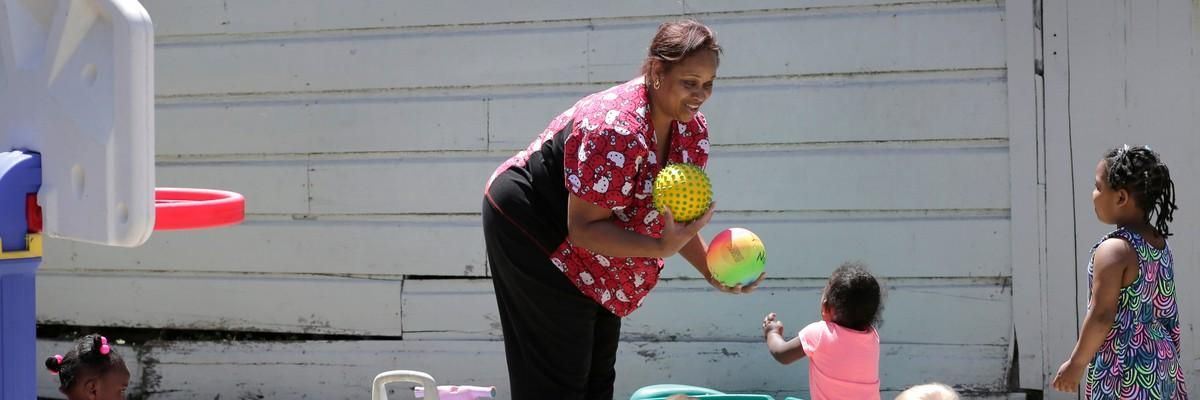
Nancy Harvey, who runs a child day care service out of her home in Oakland, Calif., plays with children on May 19, 2017. (Photo: Michael Macor/The San Francisco Chronicle via Getty Images)
Far from centering the welfare of seven future generations, as directed by the Iroquois, we have let the mindless imperative of the profit motive shape our economy and public policies. The result is that we short change our children and the future. We invest far too little in children, wasting human potential with every year that passes, and face catastrophic climate change unless we take urgent action. We can't let the immediate need to respond to Russian invasion of Ukraine be so consuming that we fail to act this year to take better care of our children and to leave them a livable planet.
Universal, free or affordable, year-round, high-quality child care is essential social and economic infrastructure for stable, healthy families, and businesses.
Early childhood education and care is not only a smart investment for our children's future, but it also reduces poverty and economic inequality as well as race and gender disparities. It is the strongest economic development tool that we have. Universal, free or affordable, year-round, high-quality child care is essential social and economic infrastructure for stable, healthy families, and businesses--as has become apparent to many during the pandemic. What's more, it's also a key driver for low-carbon post-pandemic economic recovery.
Children under 5 have the highest poverty rate of any age group in the country, and child poverty is the primary indicator of future marginalization. Yet, in 2019 in the U.S., all available parents of nearly 70 percent of children under the age of six were in the labor force, with little access to formal child care that, in many cities, costs as much as rent. Decades of evidence provide a strong economic case for investments in early childhood education and care, but for spending on children and families relative to GDP, the U.S. ranks 37th of the 38 rich and middle-income countries in the OECD, trailed only by Turkey.
The long overdue creation of a national program supporting preschool and childcare has been stalled by the undemocratically outsized voices of U.S. senators representing small, red states, as well as the largest corporations in these states. Meanwhile, Canada--a nation similar to the U.S. in many respects--has committed to spend more than $9 billion a year over the next five years, to bring down the average cost of child care to $10 a day, and create thousands of new classrooms in public and non-profit facilities. Canadians see this effort not only as an investment in the future of their children and a great equalizer, but also as a way to reshape how we think about the future economy.
As we build new child care systems, they must be integrated into planning for climate change mitigation and adaptation. We have yet to investigate what recent climate events, including extreme heat and cold, flooding, drought, smokey air and hurried evacuation from wildfires, hurricanes and tornadoes have meant for children and their families, how our emergency management systems should be integrating child care, or how child care could be greener and more resilient in a changing climate.
Again, we can look to Canada for leadership on integrating child care and climate change policy. The latest report by BC Coalition of Child Care Advocates and Early Child Care Educators show at least five ways in which child care and climate change policy can intersect, and how these forward-looking policies can improve health and wellbeing of children, families and workers, while contributing to a pro-climate/environment culture and sustainable clean economy for all.
If the U.S. government can't enact a strong program for child care and climate change this year, states and localities will have to lead the way. We can't wait any longer.
Dear Common Dreams reader, It’s been nearly 30 years since I co-founded Common Dreams with my late wife, Lina Newhouser. We had the radical notion that journalism should serve the public good, not corporate profits. It was clear to us from the outset what it would take to build such a project. No paid advertisements. No corporate sponsors. No millionaire publisher telling us what to think or do. Many people said we wouldn't last a year, but we proved those doubters wrong. Together with a tremendous team of journalists and dedicated staff, we built an independent media outlet free from the constraints of profits and corporate control. Our mission has always been simple: To inform. To inspire. To ignite change for the common good. Building Common Dreams was not easy. Our survival was never guaranteed. When you take on the most powerful forces—Wall Street greed, fossil fuel industry destruction, Big Tech lobbyists, and uber-rich oligarchs who have spent billions upon billions rigging the economy and democracy in their favor—the only bulwark you have is supporters who believe in your work. But here’s the urgent message from me today. It's never been this bad out there. And it's never been this hard to keep us going. At the very moment Common Dreams is most needed, the threats we face are intensifying. We need your support now more than ever. We don't accept corporate advertising and never will. We don't have a paywall because we don't think people should be blocked from critical news based on their ability to pay. Everything we do is funded by the donations of readers like you. When everyone does the little they can afford, we are strong. But if that support retreats or dries up, so do we. Will you donate now to make sure Common Dreams not only survives but thrives? —Craig Brown, Co-founder |
Far from centering the welfare of seven future generations, as directed by the Iroquois, we have let the mindless imperative of the profit motive shape our economy and public policies. The result is that we short change our children and the future. We invest far too little in children, wasting human potential with every year that passes, and face catastrophic climate change unless we take urgent action. We can't let the immediate need to respond to Russian invasion of Ukraine be so consuming that we fail to act this year to take better care of our children and to leave them a livable planet.
Universal, free or affordable, year-round, high-quality child care is essential social and economic infrastructure for stable, healthy families, and businesses.
Early childhood education and care is not only a smart investment for our children's future, but it also reduces poverty and economic inequality as well as race and gender disparities. It is the strongest economic development tool that we have. Universal, free or affordable, year-round, high-quality child care is essential social and economic infrastructure for stable, healthy families, and businesses--as has become apparent to many during the pandemic. What's more, it's also a key driver for low-carbon post-pandemic economic recovery.
Children under 5 have the highest poverty rate of any age group in the country, and child poverty is the primary indicator of future marginalization. Yet, in 2019 in the U.S., all available parents of nearly 70 percent of children under the age of six were in the labor force, with little access to formal child care that, in many cities, costs as much as rent. Decades of evidence provide a strong economic case for investments in early childhood education and care, but for spending on children and families relative to GDP, the U.S. ranks 37th of the 38 rich and middle-income countries in the OECD, trailed only by Turkey.
The long overdue creation of a national program supporting preschool and childcare has been stalled by the undemocratically outsized voices of U.S. senators representing small, red states, as well as the largest corporations in these states. Meanwhile, Canada--a nation similar to the U.S. in many respects--has committed to spend more than $9 billion a year over the next five years, to bring down the average cost of child care to $10 a day, and create thousands of new classrooms in public and non-profit facilities. Canadians see this effort not only as an investment in the future of their children and a great equalizer, but also as a way to reshape how we think about the future economy.
As we build new child care systems, they must be integrated into planning for climate change mitigation and adaptation. We have yet to investigate what recent climate events, including extreme heat and cold, flooding, drought, smokey air and hurried evacuation from wildfires, hurricanes and tornadoes have meant for children and their families, how our emergency management systems should be integrating child care, or how child care could be greener and more resilient in a changing climate.
Again, we can look to Canada for leadership on integrating child care and climate change policy. The latest report by BC Coalition of Child Care Advocates and Early Child Care Educators show at least five ways in which child care and climate change policy can intersect, and how these forward-looking policies can improve health and wellbeing of children, families and workers, while contributing to a pro-climate/environment culture and sustainable clean economy for all.
If the U.S. government can't enact a strong program for child care and climate change this year, states and localities will have to lead the way. We can't wait any longer.
Far from centering the welfare of seven future generations, as directed by the Iroquois, we have let the mindless imperative of the profit motive shape our economy and public policies. The result is that we short change our children and the future. We invest far too little in children, wasting human potential with every year that passes, and face catastrophic climate change unless we take urgent action. We can't let the immediate need to respond to Russian invasion of Ukraine be so consuming that we fail to act this year to take better care of our children and to leave them a livable planet.
Universal, free or affordable, year-round, high-quality child care is essential social and economic infrastructure for stable, healthy families, and businesses.
Early childhood education and care is not only a smart investment for our children's future, but it also reduces poverty and economic inequality as well as race and gender disparities. It is the strongest economic development tool that we have. Universal, free or affordable, year-round, high-quality child care is essential social and economic infrastructure for stable, healthy families, and businesses--as has become apparent to many during the pandemic. What's more, it's also a key driver for low-carbon post-pandemic economic recovery.
Children under 5 have the highest poverty rate of any age group in the country, and child poverty is the primary indicator of future marginalization. Yet, in 2019 in the U.S., all available parents of nearly 70 percent of children under the age of six were in the labor force, with little access to formal child care that, in many cities, costs as much as rent. Decades of evidence provide a strong economic case for investments in early childhood education and care, but for spending on children and families relative to GDP, the U.S. ranks 37th of the 38 rich and middle-income countries in the OECD, trailed only by Turkey.
The long overdue creation of a national program supporting preschool and childcare has been stalled by the undemocratically outsized voices of U.S. senators representing small, red states, as well as the largest corporations in these states. Meanwhile, Canada--a nation similar to the U.S. in many respects--has committed to spend more than $9 billion a year over the next five years, to bring down the average cost of child care to $10 a day, and create thousands of new classrooms in public and non-profit facilities. Canadians see this effort not only as an investment in the future of their children and a great equalizer, but also as a way to reshape how we think about the future economy.
As we build new child care systems, they must be integrated into planning for climate change mitigation and adaptation. We have yet to investigate what recent climate events, including extreme heat and cold, flooding, drought, smokey air and hurried evacuation from wildfires, hurricanes and tornadoes have meant for children and their families, how our emergency management systems should be integrating child care, or how child care could be greener and more resilient in a changing climate.
Again, we can look to Canada for leadership on integrating child care and climate change policy. The latest report by BC Coalition of Child Care Advocates and Early Child Care Educators show at least five ways in which child care and climate change policy can intersect, and how these forward-looking policies can improve health and wellbeing of children, families and workers, while contributing to a pro-climate/environment culture and sustainable clean economy for all.
If the U.S. government can't enact a strong program for child care and climate change this year, states and localities will have to lead the way. We can't wait any longer.