SUBSCRIBE TO OUR FREE NEWSLETTER
Daily news & progressive opinion—funded by the people, not the corporations—delivered straight to your inbox.
5
#000000
#FFFFFF
To donate by check, phone, or other method, see our More Ways to Give page.
Daily news & progressive opinion—funded by the people, not the corporations—delivered straight to your inbox.
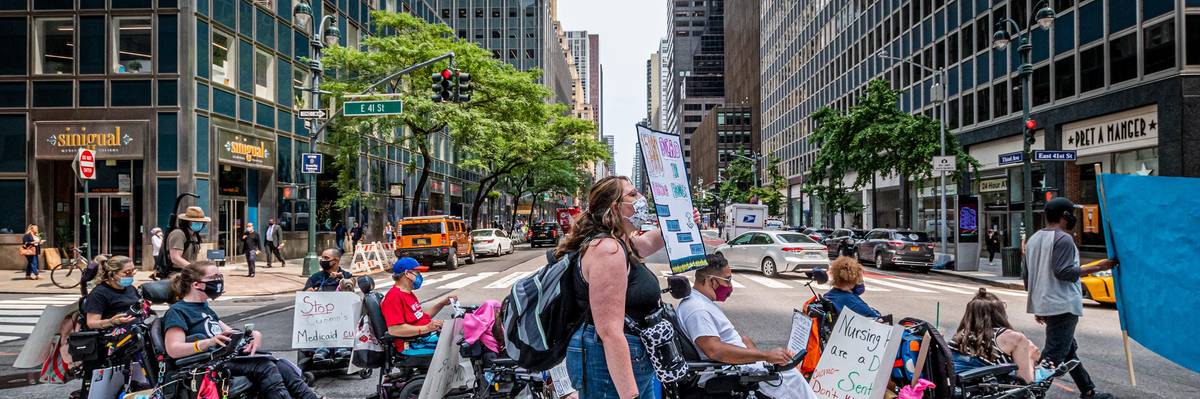
Members of Downstate New York ADAPT gathered outside of then Governor Andrew Coumo's Manhattan office at 633 3rd Avenue, as disabled activists across New York are furious with the States refusal to pass bills A.5367 and S.5028 to repeal deadly restrictions to home care access amidst the Covid-19 pandemic. (Photo: Erik McGregor/LightRocket via Getty Images)
Professor Harvey Kaye and Alan Minsky, Executive Director of Progressive Democrats of America, recently launched a proposal here on Common Dreams calling for a 21st century Economic Bill of Rights. It is a necessary proposal that creates a clear agenda for Progressive Democrats that distinguishes them from centrists. The policy implications can't be understated either, if adopted these proposals would lift millions out of poverty. I'm writing this response article to emphasize the importance of bringing the disabled into the forefront of the conversation, and shed light on the struggles we face engaging with society. Discrimination against the disabled is often hard to see, especially as it relates to our participation in the economy. We're discouraged from seeking the American dream by our laws, the economy, and physical barriers. We're discouraged from living independently, owning a home, even from marriage.
This response is not meant to tear down the proposal but to offer important considerations as these ideas shift from proposals to legislation, from the perspective of a disabled progressive. I will go through Kaye and Minsky's proposed Economic Bill of Rights point-by-point and address the concerns related specifically to the disabled.
1. The right to a useful job that pays a living wage- Many disabled Americans can't work full time, and for many of those who can, such as myself, a traditional blue-collar job isn't feasible. Those of us who can't work shouldn't be forgotten about.
2. The right to a voice in the workplace through a union and collective bargaining- All too often, disabled Americans are mistreated in the workplace, either by malicious actors or pure indifference. A union must represent all workers, regardless of need or ability status. Unfortunately, this hasn't always been the case. The wage for those with "severe" disabilities is $3.34 an hour; union negotiations have yet to fix that issue.
3. The right to comprehensive quality health care- Comprehensive healthcare looks entirely different to me and many other disabled individuals compared to the average American. Therefore, we must first explicitly define the right to comprehensive healthcare. I require 24/7 care to function. I have no practical use of my arms or legs, so I'm typing this article with my head and big toe. I am fortunately able to rely on parental support to supplement partial care from an aide. However, many are not as fortunate, and even in my situation, I cannot be economically independent from my dad. Therefore, I am unable to live as an independent individual. Public healthcare, as it is, is inadequate. We need to expand in-home care, regulate prescription drug prices, and tailor our plans to individuals' needs.
4. The right to a complete cost-free public education (child care through university) and access to broadband internet- Public education and broadband internet have tremendous benefits for the development and socialization of everyone, but especially for disabled Americans who often feel isolated. I would include special education and vocational training for disabled Americans where necessary. Oftentimes, disabled students are left behind by schools that don't quite know how to deal with them, and by a job market that's only interested in exploiting them.
5. The right to a meaningful endowment of resources at birth, free child care, and a secure retirement- Cash benefits to those with disabilities are currently severely lacking. SSI benefits cap at $841 per month; there isn't a single state where you can live on that. In Mississippi, the state with the lowest cost of living, the average rent for a two-bedroom apartment is $795 a month without including utilities or necessary expenses such as food or transportation. Even with the maximum benefit, a disabled individual would have to scrape by with $50 left for other expenses. Yes, there are programs to help, but welfare and food stamps are inadequate. "A meaningful endowment of resources" is a start, but it could justify a massive expansion in assistance to disabled Americans who cannot work.
6. The right to an equitable and economically fair justice system- Disabled Americans are discouraged from controlling their own assets. For example, my money has to go into a trust that I don't control to receive benefits.
A disabled person can be stripped of their autonomy relatively easily through conservatorships where others make even the most basic decisions. We saw earlier last year how hard it is to break a conservatorship, even for someone with perceived power and status like Brittney Spears. Imagine how hard it is for someone without status, with physical or mental limitations to break out of a conservatorship.
When the Supreme Court legalized gay marriage, that was an incredible win for equality, but we still haven't achieved full marriage equality. People in the disabled community still can't marry without their benefits being threatened. None of these issues would be the case in an equitable justice system.
7. The right to recreation and participation in civic and democratic life- Participation in public life is something most people take for granted, but for the disabled, participation in public life is anything but guaranteed. There are a multitude of obstacles, both physical and legal, that need to be overcome to achieve this end. Any proposals to allow for more participation in everyday life need to take into account the issue of physical accessibility. Cities are not easily accessible for those in wheelchairs, and this is despite legal requirements that buildings be built with accessibility in mind. People who don't spend all day in wheelchairs have a very understandable but different definition of accessibility. Accessibility isn't a ramp, it's elevators that don't break down, it's doors that wheelchairs can fit through, tables where wheelchairs can park and not disrupt traffic. We can't have robust participation in public life if we don't make it accessible.
As far as participation in Democratic life goes, if we're going to make voting accessible to all, we should take notes from blue states' responses to the pandemic. Universal mail-in ballots are the best way to make sure disabled voters are heard. But, making sure that voting lines move quickly is also a critical reform to undertake; many disabled people don't have the physical capability to stand or even sit in line for hours on end.
Moving away from the points Alan and Harvey made, I have an additional right that I believe to be a worthy addition to the Economic Bill of Rights: The right to independence. This basic right to independence is taken for granted as, for many, living alone is a part of growing up. But, for many people like me, it's a pipe dream. We've made significant progress, people in my situation used to be institutionalized, but because we understand the need for socialization, group homes have become the "independent living option." But, we can make even more significant progress towards a more inclusive society by recognizing that everyone should be allowed the opportunity for independence if they so choose.
We need an Economic Bill of Rights now more than ever; people are falling into poverty every day, people can't make ends meet despite working full time; it is a genuine crisis. But, in our haste to fix the problems the average American faces, we can't forget about the disabled community. As progressives, we strive to bring everyone to the table, let's continue doing so.
Dear Common Dreams reader, It’s been nearly 30 years since I co-founded Common Dreams with my late wife, Lina Newhouser. We had the radical notion that journalism should serve the public good, not corporate profits. It was clear to us from the outset what it would take to build such a project. No paid advertisements. No corporate sponsors. No millionaire publisher telling us what to think or do. Many people said we wouldn't last a year, but we proved those doubters wrong. Together with a tremendous team of journalists and dedicated staff, we built an independent media outlet free from the constraints of profits and corporate control. Our mission has always been simple: To inform. To inspire. To ignite change for the common good. Building Common Dreams was not easy. Our survival was never guaranteed. When you take on the most powerful forces—Wall Street greed, fossil fuel industry destruction, Big Tech lobbyists, and uber-rich oligarchs who have spent billions upon billions rigging the economy and democracy in their favor—the only bulwark you have is supporters who believe in your work. But here’s the urgent message from me today. It's never been this bad out there. And it's never been this hard to keep us going. At the very moment Common Dreams is most needed, the threats we face are intensifying. We need your support now more than ever. We don't accept corporate advertising and never will. We don't have a paywall because we don't think people should be blocked from critical news based on their ability to pay. Everything we do is funded by the donations of readers like you. When everyone does the little they can afford, we are strong. But if that support retreats or dries up, so do we. Will you donate now to make sure Common Dreams not only survives but thrives? —Craig Brown, Co-founder |
Professor Harvey Kaye and Alan Minsky, Executive Director of Progressive Democrats of America, recently launched a proposal here on Common Dreams calling for a 21st century Economic Bill of Rights. It is a necessary proposal that creates a clear agenda for Progressive Democrats that distinguishes them from centrists. The policy implications can't be understated either, if adopted these proposals would lift millions out of poverty. I'm writing this response article to emphasize the importance of bringing the disabled into the forefront of the conversation, and shed light on the struggles we face engaging with society. Discrimination against the disabled is often hard to see, especially as it relates to our participation in the economy. We're discouraged from seeking the American dream by our laws, the economy, and physical barriers. We're discouraged from living independently, owning a home, even from marriage.
This response is not meant to tear down the proposal but to offer important considerations as these ideas shift from proposals to legislation, from the perspective of a disabled progressive. I will go through Kaye and Minsky's proposed Economic Bill of Rights point-by-point and address the concerns related specifically to the disabled.
1. The right to a useful job that pays a living wage- Many disabled Americans can't work full time, and for many of those who can, such as myself, a traditional blue-collar job isn't feasible. Those of us who can't work shouldn't be forgotten about.
2. The right to a voice in the workplace through a union and collective bargaining- All too often, disabled Americans are mistreated in the workplace, either by malicious actors or pure indifference. A union must represent all workers, regardless of need or ability status. Unfortunately, this hasn't always been the case. The wage for those with "severe" disabilities is $3.34 an hour; union negotiations have yet to fix that issue.
3. The right to comprehensive quality health care- Comprehensive healthcare looks entirely different to me and many other disabled individuals compared to the average American. Therefore, we must first explicitly define the right to comprehensive healthcare. I require 24/7 care to function. I have no practical use of my arms or legs, so I'm typing this article with my head and big toe. I am fortunately able to rely on parental support to supplement partial care from an aide. However, many are not as fortunate, and even in my situation, I cannot be economically independent from my dad. Therefore, I am unable to live as an independent individual. Public healthcare, as it is, is inadequate. We need to expand in-home care, regulate prescription drug prices, and tailor our plans to individuals' needs.
4. The right to a complete cost-free public education (child care through university) and access to broadband internet- Public education and broadband internet have tremendous benefits for the development and socialization of everyone, but especially for disabled Americans who often feel isolated. I would include special education and vocational training for disabled Americans where necessary. Oftentimes, disabled students are left behind by schools that don't quite know how to deal with them, and by a job market that's only interested in exploiting them.
5. The right to a meaningful endowment of resources at birth, free child care, and a secure retirement- Cash benefits to those with disabilities are currently severely lacking. SSI benefits cap at $841 per month; there isn't a single state where you can live on that. In Mississippi, the state with the lowest cost of living, the average rent for a two-bedroom apartment is $795 a month without including utilities or necessary expenses such as food or transportation. Even with the maximum benefit, a disabled individual would have to scrape by with $50 left for other expenses. Yes, there are programs to help, but welfare and food stamps are inadequate. "A meaningful endowment of resources" is a start, but it could justify a massive expansion in assistance to disabled Americans who cannot work.
6. The right to an equitable and economically fair justice system- Disabled Americans are discouraged from controlling their own assets. For example, my money has to go into a trust that I don't control to receive benefits.
A disabled person can be stripped of their autonomy relatively easily through conservatorships where others make even the most basic decisions. We saw earlier last year how hard it is to break a conservatorship, even for someone with perceived power and status like Brittney Spears. Imagine how hard it is for someone without status, with physical or mental limitations to break out of a conservatorship.
When the Supreme Court legalized gay marriage, that was an incredible win for equality, but we still haven't achieved full marriage equality. People in the disabled community still can't marry without their benefits being threatened. None of these issues would be the case in an equitable justice system.
7. The right to recreation and participation in civic and democratic life- Participation in public life is something most people take for granted, but for the disabled, participation in public life is anything but guaranteed. There are a multitude of obstacles, both physical and legal, that need to be overcome to achieve this end. Any proposals to allow for more participation in everyday life need to take into account the issue of physical accessibility. Cities are not easily accessible for those in wheelchairs, and this is despite legal requirements that buildings be built with accessibility in mind. People who don't spend all day in wheelchairs have a very understandable but different definition of accessibility. Accessibility isn't a ramp, it's elevators that don't break down, it's doors that wheelchairs can fit through, tables where wheelchairs can park and not disrupt traffic. We can't have robust participation in public life if we don't make it accessible.
As far as participation in Democratic life goes, if we're going to make voting accessible to all, we should take notes from blue states' responses to the pandemic. Universal mail-in ballots are the best way to make sure disabled voters are heard. But, making sure that voting lines move quickly is also a critical reform to undertake; many disabled people don't have the physical capability to stand or even sit in line for hours on end.
Moving away from the points Alan and Harvey made, I have an additional right that I believe to be a worthy addition to the Economic Bill of Rights: The right to independence. This basic right to independence is taken for granted as, for many, living alone is a part of growing up. But, for many people like me, it's a pipe dream. We've made significant progress, people in my situation used to be institutionalized, but because we understand the need for socialization, group homes have become the "independent living option." But, we can make even more significant progress towards a more inclusive society by recognizing that everyone should be allowed the opportunity for independence if they so choose.
We need an Economic Bill of Rights now more than ever; people are falling into poverty every day, people can't make ends meet despite working full time; it is a genuine crisis. But, in our haste to fix the problems the average American faces, we can't forget about the disabled community. As progressives, we strive to bring everyone to the table, let's continue doing so.
Professor Harvey Kaye and Alan Minsky, Executive Director of Progressive Democrats of America, recently launched a proposal here on Common Dreams calling for a 21st century Economic Bill of Rights. It is a necessary proposal that creates a clear agenda for Progressive Democrats that distinguishes them from centrists. The policy implications can't be understated either, if adopted these proposals would lift millions out of poverty. I'm writing this response article to emphasize the importance of bringing the disabled into the forefront of the conversation, and shed light on the struggles we face engaging with society. Discrimination against the disabled is often hard to see, especially as it relates to our participation in the economy. We're discouraged from seeking the American dream by our laws, the economy, and physical barriers. We're discouraged from living independently, owning a home, even from marriage.
This response is not meant to tear down the proposal but to offer important considerations as these ideas shift from proposals to legislation, from the perspective of a disabled progressive. I will go through Kaye and Minsky's proposed Economic Bill of Rights point-by-point and address the concerns related specifically to the disabled.
1. The right to a useful job that pays a living wage- Many disabled Americans can't work full time, and for many of those who can, such as myself, a traditional blue-collar job isn't feasible. Those of us who can't work shouldn't be forgotten about.
2. The right to a voice in the workplace through a union and collective bargaining- All too often, disabled Americans are mistreated in the workplace, either by malicious actors or pure indifference. A union must represent all workers, regardless of need or ability status. Unfortunately, this hasn't always been the case. The wage for those with "severe" disabilities is $3.34 an hour; union negotiations have yet to fix that issue.
3. The right to comprehensive quality health care- Comprehensive healthcare looks entirely different to me and many other disabled individuals compared to the average American. Therefore, we must first explicitly define the right to comprehensive healthcare. I require 24/7 care to function. I have no practical use of my arms or legs, so I'm typing this article with my head and big toe. I am fortunately able to rely on parental support to supplement partial care from an aide. However, many are not as fortunate, and even in my situation, I cannot be economically independent from my dad. Therefore, I am unable to live as an independent individual. Public healthcare, as it is, is inadequate. We need to expand in-home care, regulate prescription drug prices, and tailor our plans to individuals' needs.
4. The right to a complete cost-free public education (child care through university) and access to broadband internet- Public education and broadband internet have tremendous benefits for the development and socialization of everyone, but especially for disabled Americans who often feel isolated. I would include special education and vocational training for disabled Americans where necessary. Oftentimes, disabled students are left behind by schools that don't quite know how to deal with them, and by a job market that's only interested in exploiting them.
5. The right to a meaningful endowment of resources at birth, free child care, and a secure retirement- Cash benefits to those with disabilities are currently severely lacking. SSI benefits cap at $841 per month; there isn't a single state where you can live on that. In Mississippi, the state with the lowest cost of living, the average rent for a two-bedroom apartment is $795 a month without including utilities or necessary expenses such as food or transportation. Even with the maximum benefit, a disabled individual would have to scrape by with $50 left for other expenses. Yes, there are programs to help, but welfare and food stamps are inadequate. "A meaningful endowment of resources" is a start, but it could justify a massive expansion in assistance to disabled Americans who cannot work.
6. The right to an equitable and economically fair justice system- Disabled Americans are discouraged from controlling their own assets. For example, my money has to go into a trust that I don't control to receive benefits.
A disabled person can be stripped of their autonomy relatively easily through conservatorships where others make even the most basic decisions. We saw earlier last year how hard it is to break a conservatorship, even for someone with perceived power and status like Brittney Spears. Imagine how hard it is for someone without status, with physical or mental limitations to break out of a conservatorship.
When the Supreme Court legalized gay marriage, that was an incredible win for equality, but we still haven't achieved full marriage equality. People in the disabled community still can't marry without their benefits being threatened. None of these issues would be the case in an equitable justice system.
7. The right to recreation and participation in civic and democratic life- Participation in public life is something most people take for granted, but for the disabled, participation in public life is anything but guaranteed. There are a multitude of obstacles, both physical and legal, that need to be overcome to achieve this end. Any proposals to allow for more participation in everyday life need to take into account the issue of physical accessibility. Cities are not easily accessible for those in wheelchairs, and this is despite legal requirements that buildings be built with accessibility in mind. People who don't spend all day in wheelchairs have a very understandable but different definition of accessibility. Accessibility isn't a ramp, it's elevators that don't break down, it's doors that wheelchairs can fit through, tables where wheelchairs can park and not disrupt traffic. We can't have robust participation in public life if we don't make it accessible.
As far as participation in Democratic life goes, if we're going to make voting accessible to all, we should take notes from blue states' responses to the pandemic. Universal mail-in ballots are the best way to make sure disabled voters are heard. But, making sure that voting lines move quickly is also a critical reform to undertake; many disabled people don't have the physical capability to stand or even sit in line for hours on end.
Moving away from the points Alan and Harvey made, I have an additional right that I believe to be a worthy addition to the Economic Bill of Rights: The right to independence. This basic right to independence is taken for granted as, for many, living alone is a part of growing up. But, for many people like me, it's a pipe dream. We've made significant progress, people in my situation used to be institutionalized, but because we understand the need for socialization, group homes have become the "independent living option." But, we can make even more significant progress towards a more inclusive society by recognizing that everyone should be allowed the opportunity for independence if they so choose.
We need an Economic Bill of Rights now more than ever; people are falling into poverty every day, people can't make ends meet despite working full time; it is a genuine crisis. But, in our haste to fix the problems the average American faces, we can't forget about the disabled community. As progressives, we strive to bring everyone to the table, let's continue doing so.