

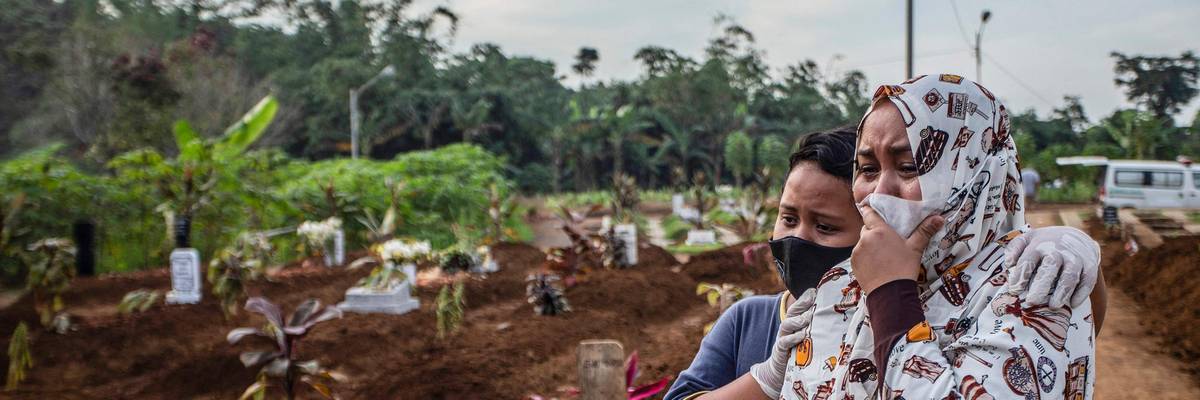
A mother mourns with her son during her mother's funeral at the Mulyaharja cemetery for Covid-19 coronavirus victims, in Bogor, West Java, on July 8, 2021. (Photo : Aditya AjiAFP via Getty Images)
Reckless Complacency by Wealthy Nations Means the Covid-19 Pandemic Is Far From Over
Like many of the world's crises, we would be in a better place in this pandemic had we listened to the countries most affected by vaccine inequity.
On March 11 2020, the director general of the World Health Organization (WHO) warned of "alarming levels of inaction" from governments as he declared that the COVID-19 outbreak had become a pandemic. Two years on, with a number of highly effective vaccines, we have the tools needed to end this pandemic. But the complacency of some governments has only become worse.
Politicians in rich countries are trying to "move on" from the pandemic; to manipulate the emotional fatigue of the public and tell them what they want to hear: that this pandemic is over. They want to pretend that COVID-19 is a problem of the past - a problem for poorer countries. That notion is as reckless as it is false.
With tens of thousands of new coronavirus deaths and infections in low and middle-income countries each day, the pandemic is far from over for the global south. The true COVID-19 death toll in lower-income countries is four times higher than in rich nations. These are not abstract statistics, these are our friends, our relatives, our loved ones. To say that we are in a "post-COVID" era is to erase their deaths.
After a brutal 22-month lockdown, schools in Uganda are finally reopening. While they have been closed, many school-age girls have married and had children. In the first 18 months of the pandemic, some 650,000 teenage girls became pregnant in Uganda. Many will never return to education. For their sake, the reopening of societies in the global south is essential.
However, removing restrictions will hasten the spread of COVID-19 among unvaccinated populations. And, as scientists have repeatedly warned, each infection poses the risk of new variants of concern that could threaten our remarkable progress in battling the virus. That, in turn, could prolong the pandemic and all of its associated suffering.
We have heard the well-rehearsed line that "no one is safe until everyone is safe" from leaders in the global north. Yet, after two years, we have seen little evidence that they are serious. At regular intervals, wealthy governments push out press releases announcing donations of millions of doses of COVID-19 vaccines. However, they fail to mention that dose donations are sporadic, sometimes close to expiry, and do not correspond to the needs of low and middle-income countries.
Like many of the world's crises, we would be in a better place in this pandemic had we listened to the countries most affected by vaccine inequity. There remains a huge untapped capacity to manufacture COVID-19 vaccines, tests, and treatments in the global south. At least 120 unused facilities are capable of making mRNA vaccines.
And why those producers are not helping us to end the pandemic? Because rich countries have let pharmaceutical companies lock the recipes behind a wall of patents and trade secrets, all to protect the rights of billionaire CEOs to bring in eye-watering profits.
There have been remarkable efforts by low and middle-income countries to break these monopolies and gain access to the tools needed to fight COVID-19. In South Africa, a WHO-led consortium of manufacturers has successfully developed a version of the mRNA COVID-19 vaccine that was first sequenced by Moderna and the US National Institute of Health with a phenomenal injection of public funding.
To the credit of the US government, they have now shared the publicly-owned aspects of this technology with the WHO. Moderna, however, has refused. The company has even filed patents in South Africa, despite a public pledge that it would not enforce patents on its COVID-19 vaccine.
The WHO plans to use mRNA technology as a base for manufacturing vaccines against other diseases, building long-term health sovereignty in Africa. But Moderna's patents could derail the project entirely.
It is little wonder that low and middle-income countries have sought to suspend patents and other intellectual property rules on COVID-19 vaccines, treatments, and associated technologies. In October 2020, South Africa and India proposed a temporary waiver of a global intellectual property agreement at the World Trade Organisation (WTO) for these tools. As the world has realised the sheer barrier these rules pose, the United States, Australia, and more than 100 nations have pledged their support for a waiver.
However, some rich governments have led a campaign to derail this solution. Despite overwhelming support for the waiver, the WTO operates via consensus, which it cannot reach without the support of all countries. Millions of people have died while wealthy nations have slow-walked the solution demanded by low and middle-income countries themselves.
Early in the pandemic, I joined more than 100 former world leaders, humanitarians, and Nobel Prize-winning scientists to call for a People's Vaccine - free from patents and profiteering, accessible to everyone, everywhere. Our call, however, remains unanswered. After two years, we are once again asking world leaders to put aside the self-destructive nationalism that has plagued the global fight against COVID-19.
That requires finally ending the impasse over intellectual property rules that are holding the world back from a fair and equitable end to the pandemic. We must salvage the WHO's target of vaccinating 70 percent of people by mid-2022 with a profound sense of urgency. And we must build the public research and development infrastructure needed to ensure a more equitable response to the next global health crisis, based on solidarity and cooperation.
In a world troubled by war, a climate crisis, and economic peril, it may seem convenient to ignore the continued spread of COVID-19 in the global south. However, the warning from scientists has been clear and consistent; ignore the health of other nations at your peril. This pandemic will not be over for any of us until it is over for all of us. After two years, it is long past time for leaders in the global north to act like it.
An Urgent Message From Our Co-Founder
Dear Common Dreams reader, It’s been nearly 30 years since I co-founded Common Dreams with my late wife, Lina Newhouser. We had the radical notion that journalism should serve the public good, not corporate profits. It was clear to us from the outset what it would take to build such a project. No paid advertisements. No corporate sponsors. No millionaire publisher telling us what to think or do. Many people said we wouldn't last a year, but we proved those doubters wrong. Together with a tremendous team of journalists and dedicated staff, we built an independent media outlet free from the constraints of profits and corporate control. Our mission has always been simple: To inform. To inspire. To ignite change for the common good. Building Common Dreams was not easy. Our survival was never guaranteed. When you take on the most powerful forces—Wall Street greed, fossil fuel industry destruction, Big Tech lobbyists, and uber-rich oligarchs who have spent billions upon billions rigging the economy and democracy in their favor—the only bulwark you have is supporters who believe in your work. But here’s the urgent message from me today. It's never been this bad out there. And it's never been this hard to keep us going. At the very moment Common Dreams is most needed, the threats we face are intensifying. We need your support now more than ever. We don't accept corporate advertising and never will. We don't have a paywall because we don't think people should be blocked from critical news based on their ability to pay. Everything we do is funded by the donations of readers like you. When everyone does the little they can afford, we are strong. But if that support retreats or dries up, so do we. Will you donate now to make sure Common Dreams not only survives but thrives? —Craig Brown, Co-founder |
On March 11 2020, the director general of the World Health Organization (WHO) warned of "alarming levels of inaction" from governments as he declared that the COVID-19 outbreak had become a pandemic. Two years on, with a number of highly effective vaccines, we have the tools needed to end this pandemic. But the complacency of some governments has only become worse.
Politicians in rich countries are trying to "move on" from the pandemic; to manipulate the emotional fatigue of the public and tell them what they want to hear: that this pandemic is over. They want to pretend that COVID-19 is a problem of the past - a problem for poorer countries. That notion is as reckless as it is false.
With tens of thousands of new coronavirus deaths and infections in low and middle-income countries each day, the pandemic is far from over for the global south. The true COVID-19 death toll in lower-income countries is four times higher than in rich nations. These are not abstract statistics, these are our friends, our relatives, our loved ones. To say that we are in a "post-COVID" era is to erase their deaths.
After a brutal 22-month lockdown, schools in Uganda are finally reopening. While they have been closed, many school-age girls have married and had children. In the first 18 months of the pandemic, some 650,000 teenage girls became pregnant in Uganda. Many will never return to education. For their sake, the reopening of societies in the global south is essential.
However, removing restrictions will hasten the spread of COVID-19 among unvaccinated populations. And, as scientists have repeatedly warned, each infection poses the risk of new variants of concern that could threaten our remarkable progress in battling the virus. That, in turn, could prolong the pandemic and all of its associated suffering.
We have heard the well-rehearsed line that "no one is safe until everyone is safe" from leaders in the global north. Yet, after two years, we have seen little evidence that they are serious. At regular intervals, wealthy governments push out press releases announcing donations of millions of doses of COVID-19 vaccines. However, they fail to mention that dose donations are sporadic, sometimes close to expiry, and do not correspond to the needs of low and middle-income countries.
Like many of the world's crises, we would be in a better place in this pandemic had we listened to the countries most affected by vaccine inequity. There remains a huge untapped capacity to manufacture COVID-19 vaccines, tests, and treatments in the global south. At least 120 unused facilities are capable of making mRNA vaccines.
And why those producers are not helping us to end the pandemic? Because rich countries have let pharmaceutical companies lock the recipes behind a wall of patents and trade secrets, all to protect the rights of billionaire CEOs to bring in eye-watering profits.
There have been remarkable efforts by low and middle-income countries to break these monopolies and gain access to the tools needed to fight COVID-19. In South Africa, a WHO-led consortium of manufacturers has successfully developed a version of the mRNA COVID-19 vaccine that was first sequenced by Moderna and the US National Institute of Health with a phenomenal injection of public funding.
To the credit of the US government, they have now shared the publicly-owned aspects of this technology with the WHO. Moderna, however, has refused. The company has even filed patents in South Africa, despite a public pledge that it would not enforce patents on its COVID-19 vaccine.
The WHO plans to use mRNA technology as a base for manufacturing vaccines against other diseases, building long-term health sovereignty in Africa. But Moderna's patents could derail the project entirely.
It is little wonder that low and middle-income countries have sought to suspend patents and other intellectual property rules on COVID-19 vaccines, treatments, and associated technologies. In October 2020, South Africa and India proposed a temporary waiver of a global intellectual property agreement at the World Trade Organisation (WTO) for these tools. As the world has realised the sheer barrier these rules pose, the United States, Australia, and more than 100 nations have pledged their support for a waiver.
However, some rich governments have led a campaign to derail this solution. Despite overwhelming support for the waiver, the WTO operates via consensus, which it cannot reach without the support of all countries. Millions of people have died while wealthy nations have slow-walked the solution demanded by low and middle-income countries themselves.
Early in the pandemic, I joined more than 100 former world leaders, humanitarians, and Nobel Prize-winning scientists to call for a People's Vaccine - free from patents and profiteering, accessible to everyone, everywhere. Our call, however, remains unanswered. After two years, we are once again asking world leaders to put aside the self-destructive nationalism that has plagued the global fight against COVID-19.
That requires finally ending the impasse over intellectual property rules that are holding the world back from a fair and equitable end to the pandemic. We must salvage the WHO's target of vaccinating 70 percent of people by mid-2022 with a profound sense of urgency. And we must build the public research and development infrastructure needed to ensure a more equitable response to the next global health crisis, based on solidarity and cooperation.
In a world troubled by war, a climate crisis, and economic peril, it may seem convenient to ignore the continued spread of COVID-19 in the global south. However, the warning from scientists has been clear and consistent; ignore the health of other nations at your peril. This pandemic will not be over for any of us until it is over for all of us. After two years, it is long past time for leaders in the global north to act like it.
On March 11 2020, the director general of the World Health Organization (WHO) warned of "alarming levels of inaction" from governments as he declared that the COVID-19 outbreak had become a pandemic. Two years on, with a number of highly effective vaccines, we have the tools needed to end this pandemic. But the complacency of some governments has only become worse.
Politicians in rich countries are trying to "move on" from the pandemic; to manipulate the emotional fatigue of the public and tell them what they want to hear: that this pandemic is over. They want to pretend that COVID-19 is a problem of the past - a problem for poorer countries. That notion is as reckless as it is false.
With tens of thousands of new coronavirus deaths and infections in low and middle-income countries each day, the pandemic is far from over for the global south. The true COVID-19 death toll in lower-income countries is four times higher than in rich nations. These are not abstract statistics, these are our friends, our relatives, our loved ones. To say that we are in a "post-COVID" era is to erase their deaths.
After a brutal 22-month lockdown, schools in Uganda are finally reopening. While they have been closed, many school-age girls have married and had children. In the first 18 months of the pandemic, some 650,000 teenage girls became pregnant in Uganda. Many will never return to education. For their sake, the reopening of societies in the global south is essential.
However, removing restrictions will hasten the spread of COVID-19 among unvaccinated populations. And, as scientists have repeatedly warned, each infection poses the risk of new variants of concern that could threaten our remarkable progress in battling the virus. That, in turn, could prolong the pandemic and all of its associated suffering.
We have heard the well-rehearsed line that "no one is safe until everyone is safe" from leaders in the global north. Yet, after two years, we have seen little evidence that they are serious. At regular intervals, wealthy governments push out press releases announcing donations of millions of doses of COVID-19 vaccines. However, they fail to mention that dose donations are sporadic, sometimes close to expiry, and do not correspond to the needs of low and middle-income countries.
Like many of the world's crises, we would be in a better place in this pandemic had we listened to the countries most affected by vaccine inequity. There remains a huge untapped capacity to manufacture COVID-19 vaccines, tests, and treatments in the global south. At least 120 unused facilities are capable of making mRNA vaccines.
And why those producers are not helping us to end the pandemic? Because rich countries have let pharmaceutical companies lock the recipes behind a wall of patents and trade secrets, all to protect the rights of billionaire CEOs to bring in eye-watering profits.
There have been remarkable efforts by low and middle-income countries to break these monopolies and gain access to the tools needed to fight COVID-19. In South Africa, a WHO-led consortium of manufacturers has successfully developed a version of the mRNA COVID-19 vaccine that was first sequenced by Moderna and the US National Institute of Health with a phenomenal injection of public funding.
To the credit of the US government, they have now shared the publicly-owned aspects of this technology with the WHO. Moderna, however, has refused. The company has even filed patents in South Africa, despite a public pledge that it would not enforce patents on its COVID-19 vaccine.
The WHO plans to use mRNA technology as a base for manufacturing vaccines against other diseases, building long-term health sovereignty in Africa. But Moderna's patents could derail the project entirely.
It is little wonder that low and middle-income countries have sought to suspend patents and other intellectual property rules on COVID-19 vaccines, treatments, and associated technologies. In October 2020, South Africa and India proposed a temporary waiver of a global intellectual property agreement at the World Trade Organisation (WTO) for these tools. As the world has realised the sheer barrier these rules pose, the United States, Australia, and more than 100 nations have pledged their support for a waiver.
However, some rich governments have led a campaign to derail this solution. Despite overwhelming support for the waiver, the WTO operates via consensus, which it cannot reach without the support of all countries. Millions of people have died while wealthy nations have slow-walked the solution demanded by low and middle-income countries themselves.
Early in the pandemic, I joined more than 100 former world leaders, humanitarians, and Nobel Prize-winning scientists to call for a People's Vaccine - free from patents and profiteering, accessible to everyone, everywhere. Our call, however, remains unanswered. After two years, we are once again asking world leaders to put aside the self-destructive nationalism that has plagued the global fight against COVID-19.
That requires finally ending the impasse over intellectual property rules that are holding the world back from a fair and equitable end to the pandemic. We must salvage the WHO's target of vaccinating 70 percent of people by mid-2022 with a profound sense of urgency. And we must build the public research and development infrastructure needed to ensure a more equitable response to the next global health crisis, based on solidarity and cooperation.
In a world troubled by war, a climate crisis, and economic peril, it may seem convenient to ignore the continued spread of COVID-19 in the global south. However, the warning from scientists has been clear and consistent; ignore the health of other nations at your peril. This pandemic will not be over for any of us until it is over for all of us. After two years, it is long past time for leaders in the global north to act like it.