SUBSCRIBE TO OUR FREE NEWSLETTER
Daily news & progressive opinion—funded by the people, not the corporations—delivered straight to your inbox.
5
#000000
#FFFFFF
To donate by check, phone, or other method, see our More Ways to Give page.
Daily news & progressive opinion—funded by the people, not the corporations—delivered straight to your inbox.
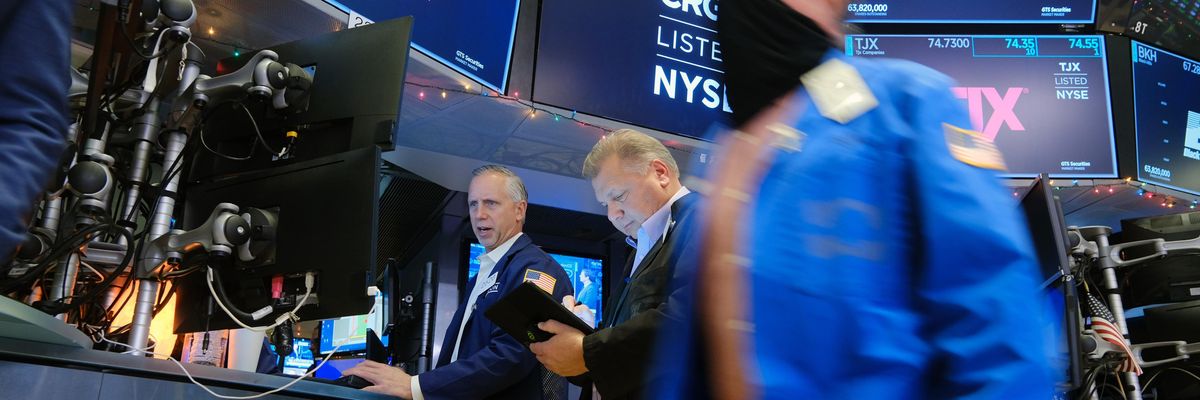
Traders work on the floor of the New York Stock Exchange (NYSE) in New York City. As investors are still concerned about rising prices due to inflation, the Dow Jones Industrial Average dropped 175 points in morning trading on December 13, 2021. (Photo: Spencer Platt/Getty Images)
Last week, the Fed's policy committee announced it would both end its bond-buying program and likely raise interest rates sooner than had been expected. "Inflation is more persistent and higher, and that the risk of it remaining higher for longer has grown," Fed chair Jerome Powell explained.
Translated: Powell and the Fed are about to slow the economy -- even though we're still at least 4 million jobs short of where we were before the pandemic. And even though, as a result, millions of American workers won't get the raises they deserve.
That's a big mistake. Powell's medicine has nothing to do with the real reason for inflation: the increasing concentration of the American economy into the hands of a relative few corporate giants with the power to raise prices.
In sum, inflation isn't driving these price increases. Corporate power is driving them.
If markets were competitive, companies would keep their prices down in order to prevent competitors from grabbing away customers. But they're raising prices even as they rake in record profits. How can this be? The answer is they have so much market power they can raise prices with impunity.
The underlying problem is not inflation. It's lack of competition. Corporations are using the excuse of inflation to raise prices and make fatter profits.
In April, Procter & Gamble announced it would start charging more for consumer staples ranging from diapers to toilet paper, citing "rising costs for raw materials, such as resin and pulp, and higher expenses to transport goods."
That was rubbish. P&G continues to rake in huge profits. In the quarter ending September 30 (after its price increases went into effect) it reported a whopping 24.7 percent profit margin. It even spent $3 billion during the quarter buying back its own stock.
The reason it could raise prices and rake in more money is P&G faces almost no competition. The lion's share of the market for diapers (to take one example) is controlled by just two companies - P&G and Kimberly-Clark - which coordinate their prices and production. It was hardly a coincidence that Kimberly-Clark announced price increases similar to P&G's at the same time P&G announced its own price increases.
Or consider another consumer product duopoly - PepsiCo (the parent company of Frito-Lay, Gatorade, Quaker, Tropicana, and other brands), and Coca-Cola. In April, PepsiCo announced it was increasing prices, blaming "higher costs for some ingredients, freight and labor." That was pure baloney. The company didn't have to raise prices. It recorded $3 billion in operating profits through September.
If PepsiCo faced tough competition it could never have gotten away with it. Consumers would have deserted it for lower-priced competitors. But PepsiCo clearly colluded with its only major competitor, Coca-Cola - which announced similar price increases at about the same time as PepsiCo, and has increased its profit margins to 28.9 percent.
Half of the recent rise in grocery prices is from meat products -- beef, pork, and poultry. Just four large conglomerates control most meat processing. They're raising their prices -- and coordinating their price increases -- even as they're scoring record profits. Here again, they're using "inflation" as an excuse.
You see the same pattern all over the American economy.
Since the 1980s, two-thirds of all American industries have become more concentrated. Monsanto now sets the prices for most of the nation's seed corn. Wall Street has consolidated into five giant banks. Airlines have merged from 12 carriers in 1980 to four today, which now control 80 percent of domestic seating capacity. The merger of Boeing and McDonnell Douglas has left the US with just one large producer of civilian aircraft -- Boeing. Three giant cable companies dominate broadband: Comcast, AT&T and Verizon. A handful of drug companies control the pharmaceutical industry: Pfizer, Eli Lilly, Johnson & Johnson, Bristol-Myers Squibb and Merck.
All this concentration gives corporations the power to raise prices, because it makes it easy for them to coordinate price increases with the handful of other companies in their same industry -- without risking the possibility of losing customers, who have no other choice.
In sum, inflation isn't driving these price increases. Corporate power is driving them.
Fed chair Powell worries about the specter of "wage-price" inflation - in which wage hikes force corporations to raise their prices, which in turn eat up the wage increases and hence cause workers to demand higher wages.
But corporations aren't being forced to raise their prices. They're enjoying record profits. They can easily absorb any wage increases without their raising prices. The sole reason they're raising prices - and eating away whatever wage increases they've provided their workers - is they face little or no competition.
So what's the appropriate government response? Not slowing down the economy. This will only hurt millions of workers, who are just beginning to get the raises they deserve. The problem at the heart of the economy is amenable to only one thing: the aggressive use of antitrust laws to bust up monopolies.
This will take time -- perhaps years. In the meantime, Biden and the Democrats could do something with a more immediate effect: Enact a windfall profits tax applicable to any large corporation that raises its prices during the same quarter its profits have risen.
Dear Common Dreams reader, It’s been nearly 30 years since I co-founded Common Dreams with my late wife, Lina Newhouser. We had the radical notion that journalism should serve the public good, not corporate profits. It was clear to us from the outset what it would take to build such a project. No paid advertisements. No corporate sponsors. No millionaire publisher telling us what to think or do. Many people said we wouldn't last a year, but we proved those doubters wrong. Together with a tremendous team of journalists and dedicated staff, we built an independent media outlet free from the constraints of profits and corporate control. Our mission has always been simple: To inform. To inspire. To ignite change for the common good. Building Common Dreams was not easy. Our survival was never guaranteed. When you take on the most powerful forces—Wall Street greed, fossil fuel industry destruction, Big Tech lobbyists, and uber-rich oligarchs who have spent billions upon billions rigging the economy and democracy in their favor—the only bulwark you have is supporters who believe in your work. But here’s the urgent message from me today. It's never been this bad out there. And it's never been this hard to keep us going. At the very moment Common Dreams is most needed, the threats we face are intensifying. We need your support now more than ever. We don't accept corporate advertising and never will. We don't have a paywall because we don't think people should be blocked from critical news based on their ability to pay. Everything we do is funded by the donations of readers like you. When everyone does the little they can afford, we are strong. But if that support retreats or dries up, so do we. Will you donate now to make sure Common Dreams not only survives but thrives? —Craig Brown, Co-founder |
Last week, the Fed's policy committee announced it would both end its bond-buying program and likely raise interest rates sooner than had been expected. "Inflation is more persistent and higher, and that the risk of it remaining higher for longer has grown," Fed chair Jerome Powell explained.
Translated: Powell and the Fed are about to slow the economy -- even though we're still at least 4 million jobs short of where we were before the pandemic. And even though, as a result, millions of American workers won't get the raises they deserve.
That's a big mistake. Powell's medicine has nothing to do with the real reason for inflation: the increasing concentration of the American economy into the hands of a relative few corporate giants with the power to raise prices.
In sum, inflation isn't driving these price increases. Corporate power is driving them.
If markets were competitive, companies would keep their prices down in order to prevent competitors from grabbing away customers. But they're raising prices even as they rake in record profits. How can this be? The answer is they have so much market power they can raise prices with impunity.
The underlying problem is not inflation. It's lack of competition. Corporations are using the excuse of inflation to raise prices and make fatter profits.
In April, Procter & Gamble announced it would start charging more for consumer staples ranging from diapers to toilet paper, citing "rising costs for raw materials, such as resin and pulp, and higher expenses to transport goods."
That was rubbish. P&G continues to rake in huge profits. In the quarter ending September 30 (after its price increases went into effect) it reported a whopping 24.7 percent profit margin. It even spent $3 billion during the quarter buying back its own stock.
The reason it could raise prices and rake in more money is P&G faces almost no competition. The lion's share of the market for diapers (to take one example) is controlled by just two companies - P&G and Kimberly-Clark - which coordinate their prices and production. It was hardly a coincidence that Kimberly-Clark announced price increases similar to P&G's at the same time P&G announced its own price increases.
Or consider another consumer product duopoly - PepsiCo (the parent company of Frito-Lay, Gatorade, Quaker, Tropicana, and other brands), and Coca-Cola. In April, PepsiCo announced it was increasing prices, blaming "higher costs for some ingredients, freight and labor." That was pure baloney. The company didn't have to raise prices. It recorded $3 billion in operating profits through September.
If PepsiCo faced tough competition it could never have gotten away with it. Consumers would have deserted it for lower-priced competitors. But PepsiCo clearly colluded with its only major competitor, Coca-Cola - which announced similar price increases at about the same time as PepsiCo, and has increased its profit margins to 28.9 percent.
Half of the recent rise in grocery prices is from meat products -- beef, pork, and poultry. Just four large conglomerates control most meat processing. They're raising their prices -- and coordinating their price increases -- even as they're scoring record profits. Here again, they're using "inflation" as an excuse.
You see the same pattern all over the American economy.
Since the 1980s, two-thirds of all American industries have become more concentrated. Monsanto now sets the prices for most of the nation's seed corn. Wall Street has consolidated into five giant banks. Airlines have merged from 12 carriers in 1980 to four today, which now control 80 percent of domestic seating capacity. The merger of Boeing and McDonnell Douglas has left the US with just one large producer of civilian aircraft -- Boeing. Three giant cable companies dominate broadband: Comcast, AT&T and Verizon. A handful of drug companies control the pharmaceutical industry: Pfizer, Eli Lilly, Johnson & Johnson, Bristol-Myers Squibb and Merck.
All this concentration gives corporations the power to raise prices, because it makes it easy for them to coordinate price increases with the handful of other companies in their same industry -- without risking the possibility of losing customers, who have no other choice.
In sum, inflation isn't driving these price increases. Corporate power is driving them.
Fed chair Powell worries about the specter of "wage-price" inflation - in which wage hikes force corporations to raise their prices, which in turn eat up the wage increases and hence cause workers to demand higher wages.
But corporations aren't being forced to raise their prices. They're enjoying record profits. They can easily absorb any wage increases without their raising prices. The sole reason they're raising prices - and eating away whatever wage increases they've provided their workers - is they face little or no competition.
So what's the appropriate government response? Not slowing down the economy. This will only hurt millions of workers, who are just beginning to get the raises they deserve. The problem at the heart of the economy is amenable to only one thing: the aggressive use of antitrust laws to bust up monopolies.
This will take time -- perhaps years. In the meantime, Biden and the Democrats could do something with a more immediate effect: Enact a windfall profits tax applicable to any large corporation that raises its prices during the same quarter its profits have risen.
Last week, the Fed's policy committee announced it would both end its bond-buying program and likely raise interest rates sooner than had been expected. "Inflation is more persistent and higher, and that the risk of it remaining higher for longer has grown," Fed chair Jerome Powell explained.
Translated: Powell and the Fed are about to slow the economy -- even though we're still at least 4 million jobs short of where we were before the pandemic. And even though, as a result, millions of American workers won't get the raises they deserve.
That's a big mistake. Powell's medicine has nothing to do with the real reason for inflation: the increasing concentration of the American economy into the hands of a relative few corporate giants with the power to raise prices.
In sum, inflation isn't driving these price increases. Corporate power is driving them.
If markets were competitive, companies would keep their prices down in order to prevent competitors from grabbing away customers. But they're raising prices even as they rake in record profits. How can this be? The answer is they have so much market power they can raise prices with impunity.
The underlying problem is not inflation. It's lack of competition. Corporations are using the excuse of inflation to raise prices and make fatter profits.
In April, Procter & Gamble announced it would start charging more for consumer staples ranging from diapers to toilet paper, citing "rising costs for raw materials, such as resin and pulp, and higher expenses to transport goods."
That was rubbish. P&G continues to rake in huge profits. In the quarter ending September 30 (after its price increases went into effect) it reported a whopping 24.7 percent profit margin. It even spent $3 billion during the quarter buying back its own stock.
The reason it could raise prices and rake in more money is P&G faces almost no competition. The lion's share of the market for diapers (to take one example) is controlled by just two companies - P&G and Kimberly-Clark - which coordinate their prices and production. It was hardly a coincidence that Kimberly-Clark announced price increases similar to P&G's at the same time P&G announced its own price increases.
Or consider another consumer product duopoly - PepsiCo (the parent company of Frito-Lay, Gatorade, Quaker, Tropicana, and other brands), and Coca-Cola. In April, PepsiCo announced it was increasing prices, blaming "higher costs for some ingredients, freight and labor." That was pure baloney. The company didn't have to raise prices. It recorded $3 billion in operating profits through September.
If PepsiCo faced tough competition it could never have gotten away with it. Consumers would have deserted it for lower-priced competitors. But PepsiCo clearly colluded with its only major competitor, Coca-Cola - which announced similar price increases at about the same time as PepsiCo, and has increased its profit margins to 28.9 percent.
Half of the recent rise in grocery prices is from meat products -- beef, pork, and poultry. Just four large conglomerates control most meat processing. They're raising their prices -- and coordinating their price increases -- even as they're scoring record profits. Here again, they're using "inflation" as an excuse.
You see the same pattern all over the American economy.
Since the 1980s, two-thirds of all American industries have become more concentrated. Monsanto now sets the prices for most of the nation's seed corn. Wall Street has consolidated into five giant banks. Airlines have merged from 12 carriers in 1980 to four today, which now control 80 percent of domestic seating capacity. The merger of Boeing and McDonnell Douglas has left the US with just one large producer of civilian aircraft -- Boeing. Three giant cable companies dominate broadband: Comcast, AT&T and Verizon. A handful of drug companies control the pharmaceutical industry: Pfizer, Eli Lilly, Johnson & Johnson, Bristol-Myers Squibb and Merck.
All this concentration gives corporations the power to raise prices, because it makes it easy for them to coordinate price increases with the handful of other companies in their same industry -- without risking the possibility of losing customers, who have no other choice.
In sum, inflation isn't driving these price increases. Corporate power is driving them.
Fed chair Powell worries about the specter of "wage-price" inflation - in which wage hikes force corporations to raise their prices, which in turn eat up the wage increases and hence cause workers to demand higher wages.
But corporations aren't being forced to raise their prices. They're enjoying record profits. They can easily absorb any wage increases without their raising prices. The sole reason they're raising prices - and eating away whatever wage increases they've provided their workers - is they face little or no competition.
So what's the appropriate government response? Not slowing down the economy. This will only hurt millions of workers, who are just beginning to get the raises they deserve. The problem at the heart of the economy is amenable to only one thing: the aggressive use of antitrust laws to bust up monopolies.
This will take time -- perhaps years. In the meantime, Biden and the Democrats could do something with a more immediate effect: Enact a windfall profits tax applicable to any large corporation that raises its prices during the same quarter its profits have risen.