
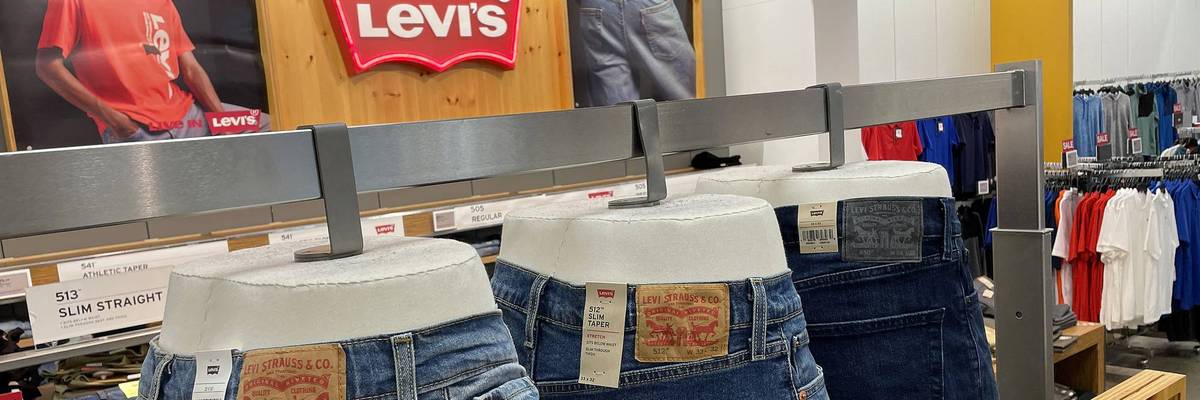
Levi's clothing is displayed at a Kohl's store on April 6, 2023 in San Rafael, California.
Why You Paid $29.99 for Those Levi's, Not $25.47: Amazon Price-Fixing Scheme Exposed
Evidence released by California's attorney general shows "blatant price-fixing" by the retail giant, said one consumer advocate.
California's top law enforcement official on Monday released a legal filing packed with evidence that Amazon is leveraging its dominance of the online retail market to artificially drive up prices for a range of goods, fueling a nationwide affordability crisis while padding its profits.
The filing was first submitted to the San Francisco Superior Court in February as part of California Attorney General Rob Bonta's broader legal effort to halt what he described as Amazon's "illegal price-fixing scheme." At the time, the filing was heavily redacted, obscuring specific examples of Amazon conspiring with vendors and competing retailers to drive up prices for apparel, pet treats, fertilizer, and other items. California's case against Amazon is set to go to trial next year.
“The evidence we've uncovered is clear as day: Amazon is working to make your life more unaffordable," Bonta said in a statement. "The company is price-fixing, colluding with vendors and other retailers to raise costs for Americans beyond what the market requires—beyond what is fair."
"Amid a crisis of affordability," Bonta added, "Amazon is illegally working to rake in profits by making sure consumers have nowhere else to turn to for lower prices. We’ll see them in court."
The filing identifies three specific tactics Amazon uses to fix prices—"breaking the price match," "increasing the competitor retail price," and "removing the product"—and offers concrete examples, backed by email evidence, of the company deploying each method.
In one instance from 2021, Amazon alerted Levi’s that Walmart.com had some of the clothing company's pants listed at a price of $25.47-$26.99—which Amazon indicated was too low for its liking. At Amazon's request, Levi's connected with Walmart, which agreed to price one of the identified products at $29.99. Amazon then matched that higher price for Levi's Easy Khaki Classic fit on its platform, locking in the cost increase for online shoppers.
"This should make your blood boil. Amazon is using its market power to coerce major retailers to hike prices," said Lee Hepner, senior counsel at the American Economic Liberties Project. "It is pouring kerosene on an affordability crisis. Forcing price hikes to preserve market share is illegal monopoly maintenance, clear as day."
Bonta's filing also details a case in which Amazon, the vendor GlobalOne, and the pet supplies company Chewy agreed to fix prices on more than 10 pet treat products.
As Bonta's office summarized:
The plan was written in an email between Amazon and its vendor, GlobalOne. For its part, Amazon would raise GlobalOne’s Canine Naturals pet treat prices to get Chewy to follow, then GlobalOne would “reach out to Chewy” to let them know that Amazon was increasing the pricing and “would ask that [Chewy] follow.” In other words, if Chewy agreed, Amazon would increase its retail pricing for the Canine Naturals pet treats and Chewy would match the price increase. The plan materialized. Amazon told GlobalOne that the pricematch override was in place, and to “let Chewy know to update [pricing] immediately.” That same day, GlobalOne confirmed the “ones that went up on Amazon immediately went up on Chewy [happy face emoji] … Overall this looks like it’s working!” The result of Amazon, Chewy and GlobalOne’s price fixing agreement was to increase the retail prices of over ten Canine Naturals pet treat products on Amazon and Chewy.
"The examples above are not outliers and are not exhaustive," Bonta's office stressed in a statement. "They are illustrative of countless interactions—spanning years and product lines—in which Amazon, vendors, and Amazon’s competitors agree to increase and fix the prices of products on other retail websites. As Amazon told one vendor explicitly: 'I am very determined to help you hunt the disrupters in the market.'"
Amazon has been coordinating with vendors and major retailers — including Target, Walmart, Chewy, and Home Depot — to raise prices across the market.
This is a widespread scheme spanning years across markets — and it’s illegal.
We’re fighting to stop it. pic.twitter.com/p77N6P0kV3
— Rob Bonta (@AGRobBonta) April 20, 2026
Stacy Mitchell, co-director of the Institute for Local Self-Reliance, said Bonta's filing shows "blatant price-fixing" by Amazon that is "almost certainly the tip of a much bigger price-fixing operation."
In a piece published at Washington Monthly on the same day that Bonta's largely unredacted filing was released, Mitchell highlighted a Biden-era federal complaint accusing Amazon of using "sophisticated AI-driven pricing systems that draw on torrents of real-time data" to raise prices. (That case, backed by 17 states, is set to go to trial next March.)
"Here’s how it allegedly worked: Amazon’s anti-discounting algorithm immediately matched competitors’ price changes to the penny, but never undercut them," Mitchell wrote. "When a rival offered a discount, Amazon’s algorithm matched it; when rivals raised prices, Amazon’s algorithm followed. This denied competing retailers a crucial tactic for luring customers from Amazon. If other retailers could never offer lower prices, Amazon’s roughly 200 million paying subscribers had little reason to shop elsewhere."
"These allegations point to a novel form of monopoly power: The ability of a dominant platform to use algorithms to lift prices across an entire market," Mitchell added.
We are at a crossroads
This country and this world are at a monumental crossroads. In a few short weeks, US voters will have an opportunity to beat back the forces of fascism and confront the billionaires who are rigging the economy, our media system, and our democracy, making it increasingly impossible for ordinary people to get by. We’re not just talking about the election. We’re talking about what must be done once these fascist elements are vanquished from power. We need a bolder set of solutions than what either major party has so far been willing to offer and a working-class movement ready to fight like hell for it. Trump didn't emerge from nowhere. The conditions that fueled MAGA authoritarianism were created by decades of radical neoliberal economic policies and a corrupt political system dominated by corporate interests. They slashed taxes on the super-rich, promising that the benefits would trickle down. They said giveaways to the corporate titans would make life more affordable for the rest of us. It was all bullshit. And when a bitter, betrayed populace searches for someone to blame, right-wing demagogues have little trouble finding scapegoats. People know when they're being lied to, but you won't hear any of this from the corporate media. Only independent journalism—powered and funded by people who believe in building a better world—can deliver truly trustworthy daily news. Our Fall Campaign is underway, and we need your help. To power our newsroom through the rest of the year, we need to raise $125,000 by midnight on October 31. So if you share our vision, please contribute whatever you can to sustain our work. |
California's top law enforcement official on Monday released a legal filing packed with evidence that Amazon is leveraging its dominance of the online retail market to artificially drive up prices for a range of goods, fueling a nationwide affordability crisis while padding its profits.
The filing was first submitted to the San Francisco Superior Court in February as part of California Attorney General Rob Bonta's broader legal effort to halt what he described as Amazon's "illegal price-fixing scheme." At the time, the filing was heavily redacted, obscuring specific examples of Amazon conspiring with vendors and competing retailers to drive up prices for apparel, pet treats, fertilizer, and other items. California's case against Amazon is set to go to trial next year.
“The evidence we've uncovered is clear as day: Amazon is working to make your life more unaffordable," Bonta said in a statement. "The company is price-fixing, colluding with vendors and other retailers to raise costs for Americans beyond what the market requires—beyond what is fair."
"Amid a crisis of affordability," Bonta added, "Amazon is illegally working to rake in profits by making sure consumers have nowhere else to turn to for lower prices. We’ll see them in court."
The filing identifies three specific tactics Amazon uses to fix prices—"breaking the price match," "increasing the competitor retail price," and "removing the product"—and offers concrete examples, backed by email evidence, of the company deploying each method.
In one instance from 2021, Amazon alerted Levi’s that Walmart.com had some of the clothing company's pants listed at a price of $25.47-$26.99—which Amazon indicated was too low for its liking. At Amazon's request, Levi's connected with Walmart, which agreed to price one of the identified products at $29.99. Amazon then matched that higher price for Levi's Easy Khaki Classic fit on its platform, locking in the cost increase for online shoppers.
"This should make your blood boil. Amazon is using its market power to coerce major retailers to hike prices," said Lee Hepner, senior counsel at the American Economic Liberties Project. "It is pouring kerosene on an affordability crisis. Forcing price hikes to preserve market share is illegal monopoly maintenance, clear as day."
Bonta's filing also details a case in which Amazon, the vendor GlobalOne, and the pet supplies company Chewy agreed to fix prices on more than 10 pet treat products.
As Bonta's office summarized:
The plan was written in an email between Amazon and its vendor, GlobalOne. For its part, Amazon would raise GlobalOne’s Canine Naturals pet treat prices to get Chewy to follow, then GlobalOne would “reach out to Chewy” to let them know that Amazon was increasing the pricing and “would ask that [Chewy] follow.” In other words, if Chewy agreed, Amazon would increase its retail pricing for the Canine Naturals pet treats and Chewy would match the price increase. The plan materialized. Amazon told GlobalOne that the pricematch override was in place, and to “let Chewy know to update [pricing] immediately.” That same day, GlobalOne confirmed the “ones that went up on Amazon immediately went up on Chewy [happy face emoji] … Overall this looks like it’s working!” The result of Amazon, Chewy and GlobalOne’s price fixing agreement was to increase the retail prices of over ten Canine Naturals pet treat products on Amazon and Chewy.
"The examples above are not outliers and are not exhaustive," Bonta's office stressed in a statement. "They are illustrative of countless interactions—spanning years and product lines—in which Amazon, vendors, and Amazon’s competitors agree to increase and fix the prices of products on other retail websites. As Amazon told one vendor explicitly: 'I am very determined to help you hunt the disrupters in the market.'"
Amazon has been coordinating with vendors and major retailers — including Target, Walmart, Chewy, and Home Depot — to raise prices across the market.
This is a widespread scheme spanning years across markets — and it’s illegal.
We’re fighting to stop it. pic.twitter.com/p77N6P0kV3
— Rob Bonta (@AGRobBonta) April 20, 2026
Stacy Mitchell, co-director of the Institute for Local Self-Reliance, said Bonta's filing shows "blatant price-fixing" by Amazon that is "almost certainly the tip of a much bigger price-fixing operation."
In a piece published at Washington Monthly on the same day that Bonta's largely unredacted filing was released, Mitchell highlighted a Biden-era federal complaint accusing Amazon of using "sophisticated AI-driven pricing systems that draw on torrents of real-time data" to raise prices. (That case, backed by 17 states, is set to go to trial next March.)
"Here’s how it allegedly worked: Amazon’s anti-discounting algorithm immediately matched competitors’ price changes to the penny, but never undercut them," Mitchell wrote. "When a rival offered a discount, Amazon’s algorithm matched it; when rivals raised prices, Amazon’s algorithm followed. This denied competing retailers a crucial tactic for luring customers from Amazon. If other retailers could never offer lower prices, Amazon’s roughly 200 million paying subscribers had little reason to shop elsewhere."
"These allegations point to a novel form of monopoly power: The ability of a dominant platform to use algorithms to lift prices across an entire market," Mitchell added.
California's top law enforcement official on Monday released a legal filing packed with evidence that Amazon is leveraging its dominance of the online retail market to artificially drive up prices for a range of goods, fueling a nationwide affordability crisis while padding its profits.
The filing was first submitted to the San Francisco Superior Court in February as part of California Attorney General Rob Bonta's broader legal effort to halt what he described as Amazon's "illegal price-fixing scheme." At the time, the filing was heavily redacted, obscuring specific examples of Amazon conspiring with vendors and competing retailers to drive up prices for apparel, pet treats, fertilizer, and other items. California's case against Amazon is set to go to trial next year.
“The evidence we've uncovered is clear as day: Amazon is working to make your life more unaffordable," Bonta said in a statement. "The company is price-fixing, colluding with vendors and other retailers to raise costs for Americans beyond what the market requires—beyond what is fair."
"Amid a crisis of affordability," Bonta added, "Amazon is illegally working to rake in profits by making sure consumers have nowhere else to turn to for lower prices. We’ll see them in court."
The filing identifies three specific tactics Amazon uses to fix prices—"breaking the price match," "increasing the competitor retail price," and "removing the product"—and offers concrete examples, backed by email evidence, of the company deploying each method.
In one instance from 2021, Amazon alerted Levi’s that Walmart.com had some of the clothing company's pants listed at a price of $25.47-$26.99—which Amazon indicated was too low for its liking. At Amazon's request, Levi's connected with Walmart, which agreed to price one of the identified products at $29.99. Amazon then matched that higher price for Levi's Easy Khaki Classic fit on its platform, locking in the cost increase for online shoppers.
"This should make your blood boil. Amazon is using its market power to coerce major retailers to hike prices," said Lee Hepner, senior counsel at the American Economic Liberties Project. "It is pouring kerosene on an affordability crisis. Forcing price hikes to preserve market share is illegal monopoly maintenance, clear as day."
Bonta's filing also details a case in which Amazon, the vendor GlobalOne, and the pet supplies company Chewy agreed to fix prices on more than 10 pet treat products.
As Bonta's office summarized:
The plan was written in an email between Amazon and its vendor, GlobalOne. For its part, Amazon would raise GlobalOne’s Canine Naturals pet treat prices to get Chewy to follow, then GlobalOne would “reach out to Chewy” to let them know that Amazon was increasing the pricing and “would ask that [Chewy] follow.” In other words, if Chewy agreed, Amazon would increase its retail pricing for the Canine Naturals pet treats and Chewy would match the price increase. The plan materialized. Amazon told GlobalOne that the pricematch override was in place, and to “let Chewy know to update [pricing] immediately.” That same day, GlobalOne confirmed the “ones that went up on Amazon immediately went up on Chewy [happy face emoji] … Overall this looks like it’s working!” The result of Amazon, Chewy and GlobalOne’s price fixing agreement was to increase the retail prices of over ten Canine Naturals pet treat products on Amazon and Chewy.
"The examples above are not outliers and are not exhaustive," Bonta's office stressed in a statement. "They are illustrative of countless interactions—spanning years and product lines—in which Amazon, vendors, and Amazon’s competitors agree to increase and fix the prices of products on other retail websites. As Amazon told one vendor explicitly: 'I am very determined to help you hunt the disrupters in the market.'"
Amazon has been coordinating with vendors and major retailers — including Target, Walmart, Chewy, and Home Depot — to raise prices across the market.
This is a widespread scheme spanning years across markets — and it’s illegal.
We’re fighting to stop it. pic.twitter.com/p77N6P0kV3
— Rob Bonta (@AGRobBonta) April 20, 2026
Stacy Mitchell, co-director of the Institute for Local Self-Reliance, said Bonta's filing shows "blatant price-fixing" by Amazon that is "almost certainly the tip of a much bigger price-fixing operation."
In a piece published at Washington Monthly on the same day that Bonta's largely unredacted filing was released, Mitchell highlighted a Biden-era federal complaint accusing Amazon of using "sophisticated AI-driven pricing systems that draw on torrents of real-time data" to raise prices. (That case, backed by 17 states, is set to go to trial next March.)
"Here’s how it allegedly worked: Amazon’s anti-discounting algorithm immediately matched competitors’ price changes to the penny, but never undercut them," Mitchell wrote. "When a rival offered a discount, Amazon’s algorithm matched it; when rivals raised prices, Amazon’s algorithm followed. This denied competing retailers a crucial tactic for luring customers from Amazon. If other retailers could never offer lower prices, Amazon’s roughly 200 million paying subscribers had little reason to shop elsewhere."
"These allegations point to a novel form of monopoly power: The ability of a dominant platform to use algorithms to lift prices across an entire market," Mitchell added.