SUBSCRIBE TO OUR FREE NEWSLETTER
Daily news & progressive opinion—funded by the people, not the corporations—delivered straight to your inbox.
5
#000000
#FFFFFF
To donate by check, phone, or other method, see our More Ways to Give page.
Daily news & progressive opinion—funded by the people, not the corporations—delivered straight to your inbox.
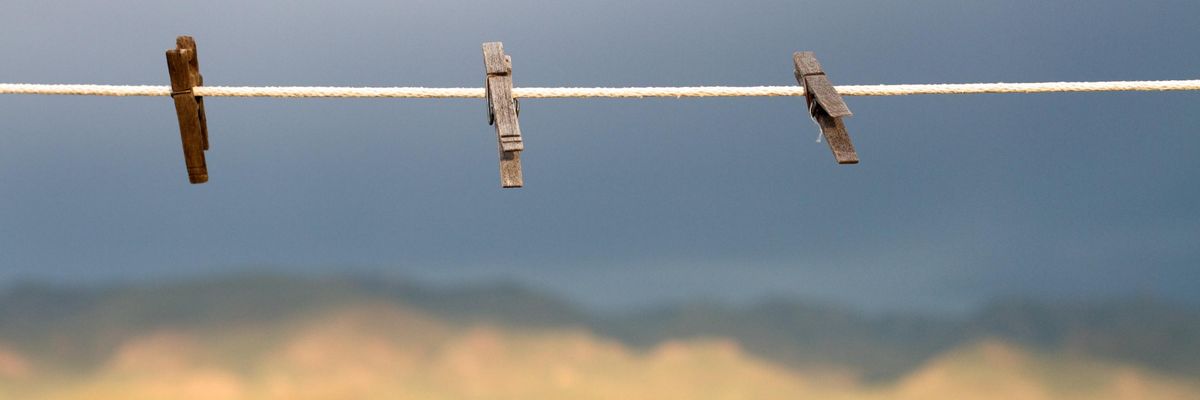
There is also the intangible value of peacefulness and harmony with nature when you spend some ten minutes to enjoy the weather. (Photo: Flickr/cc)
Solar energy comes to Earthlings in many ways. Ancient Persians used passive solar architecture. East Africans about the same time funneled cool ocean wind through tunnels to cool themselves.
Now at long last, solar energy is outpacing new fossil fuel and nuclear facilities on price, environmental safety, and speed of installation.
About 80 percent of Americans use dryers that gobble up more electricity in a household than other appliances (except for refrigerators).
One use of solar that has not received enough attention is drying clothes with clotheslines or clothes racks. Before global warming and our climate crisis became a public concern, some local governments banned backyard clotheslines as community eyesores. Fortunately, 20 states have passed "Right to Dry Laws" that allow people to use this simple low-tech and appropriate technology to reduce fuel consumption.
A big booster of hang-drying your laundry is environmentalist Joe Wachunas from Portland, Oregon. Twenty years ago, while traveling as an exchange student in Italy, he learned that only three percent of Italian households owned a dryer. Italians, he noticed, dried their clothes on clotheslines, high-rise balconies, or in open windows catching sun and cross breezes.
Wachunas has competed against dryers, taking only eight minutes longer to hang up a load of clothes than it takes to load a dryer, (not to mention a trip to and from a laundromat). Also, by line-drying, he estimates a savings of $600 a year per family, and your air-dried materials will last longer and shrink less.
As you might think, the great majority of people in the US use a clothes dryer. About 80 percent of Americans use dryers that gobble up more electricity in a household than other appliances (except for refrigerators). These folks will find moving to clean and green drying has many benefits.
Last March, Mary Marlowe Leverette wrote a piece on the Top 10 Reasons to Line Dry Laundry. You can save money, promote energy conservation, give your clothes more freshness, less wear and tear, increase your physical activity, help whiten and disinfect laundry, reduce fire risks (clothes dryer fires number around 15,000 structure fires, 15 deaths, and 400 injuries annually in the U.S. with property losses estimated at $99 million).
There is also the intangible value of peacefulness and harmony with nature when you spend some ten minutes to enjoy the weather. When the weather does not permit, indoor line drying increases humidity in a home during dry winter weather.
Finally, you feel you are making a small difference to protect the environment and set an example in your neighborhood or apartment building. Who knows what good things can spontaneously emerge while chatting with the neighbor or having backyard conversations, uninterrupted by iPhone distractions. The venerable clothesline makes common sense.
Also consider rejecting the crazy leaf blower (See: Shut off the leaf blowers and restore peace to suburbia, by Peter Bahouth) and the noisy gas powered lawn mower--two contributions to pollution and obesity in America. Maybe a gaze at a fluttering clothesline in the sun will persuade some users of these belching technologies on small lawns to pick up a rake and start using the old fuel-free push lawn mower. Such personal choices often lead people to become advocates for broader solar systems.
Rivulets, brooks, and streams make possible the mighty Mississippi River. Billions of people can do their part to usher in the use of more of the sun to help save the Earth from the man-made climate crisis/catastrophe.
Clothespins, anyone?
Dear Common Dreams reader, It’s been nearly 30 years since I co-founded Common Dreams with my late wife, Lina Newhouser. We had the radical notion that journalism should serve the public good, not corporate profits. It was clear to us from the outset what it would take to build such a project. No paid advertisements. No corporate sponsors. No millionaire publisher telling us what to think or do. Many people said we wouldn't last a year, but we proved those doubters wrong. Together with a tremendous team of journalists and dedicated staff, we built an independent media outlet free from the constraints of profits and corporate control. Our mission has always been simple: To inform. To inspire. To ignite change for the common good. Building Common Dreams was not easy. Our survival was never guaranteed. When you take on the most powerful forces—Wall Street greed, fossil fuel industry destruction, Big Tech lobbyists, and uber-rich oligarchs who have spent billions upon billions rigging the economy and democracy in their favor—the only bulwark you have is supporters who believe in your work. But here’s the urgent message from me today. It's never been this bad out there. And it's never been this hard to keep us going. At the very moment Common Dreams is most needed, the threats we face are intensifying. We need your support now more than ever. We don't accept corporate advertising and never will. We don't have a paywall because we don't think people should be blocked from critical news based on their ability to pay. Everything we do is funded by the donations of readers like you. When everyone does the little they can afford, we are strong. But if that support retreats or dries up, so do we. Will you donate now to make sure Common Dreams not only survives but thrives? —Craig Brown, Co-founder |
Solar energy comes to Earthlings in many ways. Ancient Persians used passive solar architecture. East Africans about the same time funneled cool ocean wind through tunnels to cool themselves.
Now at long last, solar energy is outpacing new fossil fuel and nuclear facilities on price, environmental safety, and speed of installation.
About 80 percent of Americans use dryers that gobble up more electricity in a household than other appliances (except for refrigerators).
One use of solar that has not received enough attention is drying clothes with clotheslines or clothes racks. Before global warming and our climate crisis became a public concern, some local governments banned backyard clotheslines as community eyesores. Fortunately, 20 states have passed "Right to Dry Laws" that allow people to use this simple low-tech and appropriate technology to reduce fuel consumption.
A big booster of hang-drying your laundry is environmentalist Joe Wachunas from Portland, Oregon. Twenty years ago, while traveling as an exchange student in Italy, he learned that only three percent of Italian households owned a dryer. Italians, he noticed, dried their clothes on clotheslines, high-rise balconies, or in open windows catching sun and cross breezes.
Wachunas has competed against dryers, taking only eight minutes longer to hang up a load of clothes than it takes to load a dryer, (not to mention a trip to and from a laundromat). Also, by line-drying, he estimates a savings of $600 a year per family, and your air-dried materials will last longer and shrink less.
As you might think, the great majority of people in the US use a clothes dryer. About 80 percent of Americans use dryers that gobble up more electricity in a household than other appliances (except for refrigerators). These folks will find moving to clean and green drying has many benefits.
Last March, Mary Marlowe Leverette wrote a piece on the Top 10 Reasons to Line Dry Laundry. You can save money, promote energy conservation, give your clothes more freshness, less wear and tear, increase your physical activity, help whiten and disinfect laundry, reduce fire risks (clothes dryer fires number around 15,000 structure fires, 15 deaths, and 400 injuries annually in the U.S. with property losses estimated at $99 million).
There is also the intangible value of peacefulness and harmony with nature when you spend some ten minutes to enjoy the weather. When the weather does not permit, indoor line drying increases humidity in a home during dry winter weather.
Finally, you feel you are making a small difference to protect the environment and set an example in your neighborhood or apartment building. Who knows what good things can spontaneously emerge while chatting with the neighbor or having backyard conversations, uninterrupted by iPhone distractions. The venerable clothesline makes common sense.
Also consider rejecting the crazy leaf blower (See: Shut off the leaf blowers and restore peace to suburbia, by Peter Bahouth) and the noisy gas powered lawn mower--two contributions to pollution and obesity in America. Maybe a gaze at a fluttering clothesline in the sun will persuade some users of these belching technologies on small lawns to pick up a rake and start using the old fuel-free push lawn mower. Such personal choices often lead people to become advocates for broader solar systems.
Rivulets, brooks, and streams make possible the mighty Mississippi River. Billions of people can do their part to usher in the use of more of the sun to help save the Earth from the man-made climate crisis/catastrophe.
Clothespins, anyone?
Solar energy comes to Earthlings in many ways. Ancient Persians used passive solar architecture. East Africans about the same time funneled cool ocean wind through tunnels to cool themselves.
Now at long last, solar energy is outpacing new fossil fuel and nuclear facilities on price, environmental safety, and speed of installation.
About 80 percent of Americans use dryers that gobble up more electricity in a household than other appliances (except for refrigerators).
One use of solar that has not received enough attention is drying clothes with clotheslines or clothes racks. Before global warming and our climate crisis became a public concern, some local governments banned backyard clotheslines as community eyesores. Fortunately, 20 states have passed "Right to Dry Laws" that allow people to use this simple low-tech and appropriate technology to reduce fuel consumption.
A big booster of hang-drying your laundry is environmentalist Joe Wachunas from Portland, Oregon. Twenty years ago, while traveling as an exchange student in Italy, he learned that only three percent of Italian households owned a dryer. Italians, he noticed, dried their clothes on clotheslines, high-rise balconies, or in open windows catching sun and cross breezes.
Wachunas has competed against dryers, taking only eight minutes longer to hang up a load of clothes than it takes to load a dryer, (not to mention a trip to and from a laundromat). Also, by line-drying, he estimates a savings of $600 a year per family, and your air-dried materials will last longer and shrink less.
As you might think, the great majority of people in the US use a clothes dryer. About 80 percent of Americans use dryers that gobble up more electricity in a household than other appliances (except for refrigerators). These folks will find moving to clean and green drying has many benefits.
Last March, Mary Marlowe Leverette wrote a piece on the Top 10 Reasons to Line Dry Laundry. You can save money, promote energy conservation, give your clothes more freshness, less wear and tear, increase your physical activity, help whiten and disinfect laundry, reduce fire risks (clothes dryer fires number around 15,000 structure fires, 15 deaths, and 400 injuries annually in the U.S. with property losses estimated at $99 million).
There is also the intangible value of peacefulness and harmony with nature when you spend some ten minutes to enjoy the weather. When the weather does not permit, indoor line drying increases humidity in a home during dry winter weather.
Finally, you feel you are making a small difference to protect the environment and set an example in your neighborhood or apartment building. Who knows what good things can spontaneously emerge while chatting with the neighbor or having backyard conversations, uninterrupted by iPhone distractions. The venerable clothesline makes common sense.
Also consider rejecting the crazy leaf blower (See: Shut off the leaf blowers and restore peace to suburbia, by Peter Bahouth) and the noisy gas powered lawn mower--two contributions to pollution and obesity in America. Maybe a gaze at a fluttering clothesline in the sun will persuade some users of these belching technologies on small lawns to pick up a rake and start using the old fuel-free push lawn mower. Such personal choices often lead people to become advocates for broader solar systems.
Rivulets, brooks, and streams make possible the mighty Mississippi River. Billions of people can do their part to usher in the use of more of the sun to help save the Earth from the man-made climate crisis/catastrophe.
Clothespins, anyone?