SUBSCRIBE TO OUR FREE NEWSLETTER
Daily news & progressive opinion—funded by the people, not the corporations—delivered straight to your inbox.
5
#000000
#FFFFFF
To donate by check, phone, or other method, see our More Ways to Give page.
Daily news & progressive opinion—funded by the people, not the corporations—delivered straight to your inbox.
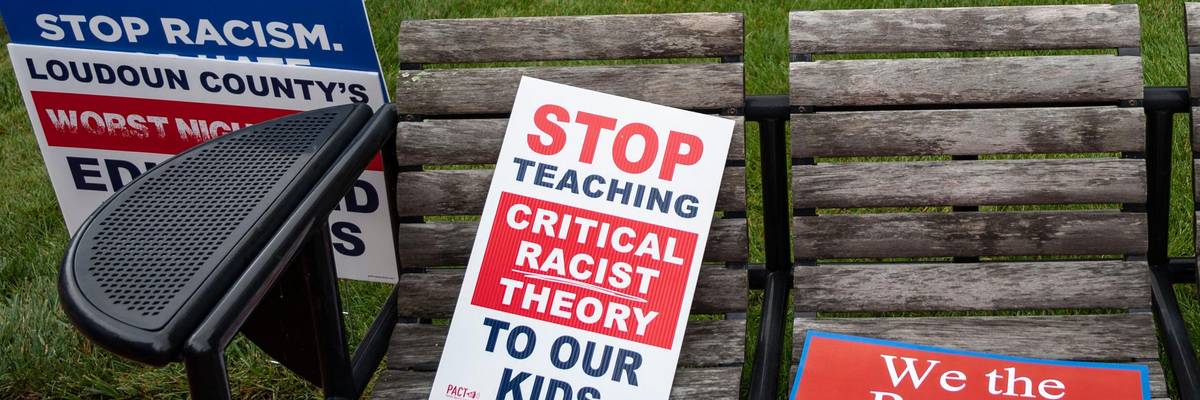
Signs are seen on a bench during a rally against "critical race theory" (CRT) being taught in schools at the Loudoun County Government center in Leesburg, Virginia on June 12, 2021. (Photo: Andrew Caballero-Reynolds/AFP via Getty Images)
For a view of the real-life fallout of the far right campaign to stamp out the teaching of the history of U.S. racism and its legacy today, meet James Whitfield.
Whitfield is the first Black principal at Colleyville Heritage High School in largely white Colleyville, Texas--a town sandwiched between Dallas and Fort Worth.
On September 20, to the outrage of students and many community members, the nearly all white Grapevine-Colleyville school board voted to not renew Whitfield's contract, an almost certain first step in his termination.
The drive to rewrite history is a key component of the Republican attack on American democracy.
While district officials tried to dress up the action with claims that Whitfield has been "unreasonable" and "disrespectful," the whole town, region, and even national media had little doubt about his real offense.
In the wake of the largest nationwide racial justice protests in decades following the May 2020 police murder of George Floyd, a deeply troubled Whitfield felt he, too, had to make a public statement.
Through a public letter to the school community, Whitfield wrote that racism is "alive and well," and "education is the key to stomping out ignorance, hate and systemic racism." It is time, he said, for everyone to work together for "liberty and justice for all" and achieve "conciliation for our nation." The response, noted the Texas Tribune, "was nothing short of spectacular, Whitfield said. He didn't hear a single negative comment."
But that was before Donald Trump weighed in. In September 2020 Trump threatened to withhold funding from schools using the New York Times Pulitzer Prize-winning 1619 project as a teaching tool. The project marked the 400th anniversary of landing of the first African slaves at an English settler colony in North America describing the ongoing impact of slavery on America today. Trump directed federal agencies to engage in a McCarthyite-style purge of any training on "critical race theory"(CRT) and "white privilege."
It was the first step in a war in what would become a feverish offensive to eradicate examination of the history and persistence of structural racism in the U.S. in hopes of reversing the growing support, especially among the nation's youth, for social, economic, cultural and political justice, challenging many of the premises of far-right ideology.
Upon leaving office, Trump urged legislators in this thrall to continue the battle. Eight Republican-dominated states this year have passed legislation to ban CRT in public schools, though few of those most loudly demanding the censorship have the vaguest idea of what CRT actually is. Nearly 20 other states have bills pending or planned to follow suit.
The drive to rewrite history is a key component of the Republican attack on American democracy. The elements of that game plan are playing out in dozens of state laws to suppress voting, including ways to replace insufficiently compliant election officials and overturn elections they lose, criminalize public protest, and incite a rightwing and white supremacist base through anti-abortion laws, attacks on LBGTQ rights, and demagogic rhetoric about immigration and crime.
Playing to boasts that "everything is bigger in Texas," Texas state, legislative, and local officials enacted some of the most draconian laws in the country. Among them, a notorious ban on abortion enforced by civilian vigilantes, severe restrictions on voting rights targeting communities of color, and directing law enforcement agencies to step up harassment of Latinx people claiming immigrants, not the governor's attacks on public health safety measures, are responsible for the pandemic surges.
Texas' CRT ban also went beyond many other states. A state Senate version included whiting out from school curriculums writings and speeches by Dr. Martin Luther King Jr., Frederick Douglass, Susan B. Anthony, and Cesar Chavez, education on the civil rights, women's suffrage, the history of Chicano, Indigenous and labor movements, and instruction that the KKK and white supremacy are "morally wrong."
Individual educators, such as Whitfield, also became targets. In late July, a former school board candidate in August stood up in a board meeting and falsely claimed Whitfield was promoting CRT by his letter as an audience member yelled "How about you fire him."
In what Washington Post columnist Karen Attiah called "a brazen display of cowardice and structural White power," no board members of school officials came to his defense and Whitfield was summarily put on administrative leave and barred from contact with any colleagues or students, the first step leading to an expected firing. They also searched for other pretexts, including what they called an inappropriate photo on his social media celebrating his anniversary with his white wife.
"I am the quintessential boogeyman for these people," Whitfield later said. "Anything that has to do with anything related to equity, or inclusion or diversity--they're going to try to attach it to CRT."
For many, Whitfield has indeed become an example of what could happen to educators who try to address issues of racism or inequality in the classroom, the Texas Tribune reported. In a sign of why the state is targeting education, students have rallied to Whitfield's support, including two school walkouts by some 100 students this month who have also packed the board meetings.
The racist underpinnings of Texas' crusade to hold back the tide of social and demographic change that threatens to upend the far right's hold on power should not be a surprise in a state that was founded by white slave owners who broke away from Mexico to secure their right to enslave people against the threat of a Mexico that was moving inexorably toward abolition.
That goal could not have been clearer, documented in the General Provisions of the Constitution establishing the Republic of Texas in 1836, as celebrated historian, law professor and Texas native Annette Gordon-Reed describes in her latest book, "On Juneteenth."
Section 6 of the Constitution limits "all privileges of citizenship" solely to "free white persons." Section 9 proclaims that "all persons of color who were slaves for life previous to their emigration to Texas, and who are now held in bondage, shall remain in the like state of servitude." It further prohibits state legislators from having the "power to emancipate slaves," bars any individual slaveowner from freeing their slaves, and declares "no free person of African descent... shall be permitted to reside permanently in the republic."
Gordon-Reed suggests an addendum to William Faulkner's famous quote that "the past is never dead. It's not even past." In fact, she posits, "the past is dead, but echoes of the past remain, leaving their traces in the people and events of the present and future."
Echoes that can be heard today in the utterings and actions of numerous Texas statewide officials, legislators, and school board members in Colleyville.
Dear Common Dreams reader, It’s been nearly 30 years since I co-founded Common Dreams with my late wife, Lina Newhouser. We had the radical notion that journalism should serve the public good, not corporate profits. It was clear to us from the outset what it would take to build such a project. No paid advertisements. No corporate sponsors. No millionaire publisher telling us what to think or do. Many people said we wouldn't last a year, but we proved those doubters wrong. Together with a tremendous team of journalists and dedicated staff, we built an independent media outlet free from the constraints of profits and corporate control. Our mission has always been simple: To inform. To inspire. To ignite change for the common good. Building Common Dreams was not easy. Our survival was never guaranteed. When you take on the most powerful forces—Wall Street greed, fossil fuel industry destruction, Big Tech lobbyists, and uber-rich oligarchs who have spent billions upon billions rigging the economy and democracy in their favor—the only bulwark you have is supporters who believe in your work. But here’s the urgent message from me today. It's never been this bad out there. And it's never been this hard to keep us going. At the very moment Common Dreams is most needed, the threats we face are intensifying. We need your support now more than ever. We don't accept corporate advertising and never will. We don't have a paywall because we don't think people should be blocked from critical news based on their ability to pay. Everything we do is funded by the donations of readers like you. When everyone does the little they can afford, we are strong. But if that support retreats or dries up, so do we. Will you donate now to make sure Common Dreams not only survives but thrives? —Craig Brown, Co-founder |
For a view of the real-life fallout of the far right campaign to stamp out the teaching of the history of U.S. racism and its legacy today, meet James Whitfield.
Whitfield is the first Black principal at Colleyville Heritage High School in largely white Colleyville, Texas--a town sandwiched between Dallas and Fort Worth.
On September 20, to the outrage of students and many community members, the nearly all white Grapevine-Colleyville school board voted to not renew Whitfield's contract, an almost certain first step in his termination.
The drive to rewrite history is a key component of the Republican attack on American democracy.
While district officials tried to dress up the action with claims that Whitfield has been "unreasonable" and "disrespectful," the whole town, region, and even national media had little doubt about his real offense.
In the wake of the largest nationwide racial justice protests in decades following the May 2020 police murder of George Floyd, a deeply troubled Whitfield felt he, too, had to make a public statement.
Through a public letter to the school community, Whitfield wrote that racism is "alive and well," and "education is the key to stomping out ignorance, hate and systemic racism." It is time, he said, for everyone to work together for "liberty and justice for all" and achieve "conciliation for our nation." The response, noted the Texas Tribune, "was nothing short of spectacular, Whitfield said. He didn't hear a single negative comment."
But that was before Donald Trump weighed in. In September 2020 Trump threatened to withhold funding from schools using the New York Times Pulitzer Prize-winning 1619 project as a teaching tool. The project marked the 400th anniversary of landing of the first African slaves at an English settler colony in North America describing the ongoing impact of slavery on America today. Trump directed federal agencies to engage in a McCarthyite-style purge of any training on "critical race theory"(CRT) and "white privilege."
It was the first step in a war in what would become a feverish offensive to eradicate examination of the history and persistence of structural racism in the U.S. in hopes of reversing the growing support, especially among the nation's youth, for social, economic, cultural and political justice, challenging many of the premises of far-right ideology.
Upon leaving office, Trump urged legislators in this thrall to continue the battle. Eight Republican-dominated states this year have passed legislation to ban CRT in public schools, though few of those most loudly demanding the censorship have the vaguest idea of what CRT actually is. Nearly 20 other states have bills pending or planned to follow suit.
The drive to rewrite history is a key component of the Republican attack on American democracy. The elements of that game plan are playing out in dozens of state laws to suppress voting, including ways to replace insufficiently compliant election officials and overturn elections they lose, criminalize public protest, and incite a rightwing and white supremacist base through anti-abortion laws, attacks on LBGTQ rights, and demagogic rhetoric about immigration and crime.
Playing to boasts that "everything is bigger in Texas," Texas state, legislative, and local officials enacted some of the most draconian laws in the country. Among them, a notorious ban on abortion enforced by civilian vigilantes, severe restrictions on voting rights targeting communities of color, and directing law enforcement agencies to step up harassment of Latinx people claiming immigrants, not the governor's attacks on public health safety measures, are responsible for the pandemic surges.
Texas' CRT ban also went beyond many other states. A state Senate version included whiting out from school curriculums writings and speeches by Dr. Martin Luther King Jr., Frederick Douglass, Susan B. Anthony, and Cesar Chavez, education on the civil rights, women's suffrage, the history of Chicano, Indigenous and labor movements, and instruction that the KKK and white supremacy are "morally wrong."
Individual educators, such as Whitfield, also became targets. In late July, a former school board candidate in August stood up in a board meeting and falsely claimed Whitfield was promoting CRT by his letter as an audience member yelled "How about you fire him."
In what Washington Post columnist Karen Attiah called "a brazen display of cowardice and structural White power," no board members of school officials came to his defense and Whitfield was summarily put on administrative leave and barred from contact with any colleagues or students, the first step leading to an expected firing. They also searched for other pretexts, including what they called an inappropriate photo on his social media celebrating his anniversary with his white wife.
"I am the quintessential boogeyman for these people," Whitfield later said. "Anything that has to do with anything related to equity, or inclusion or diversity--they're going to try to attach it to CRT."
For many, Whitfield has indeed become an example of what could happen to educators who try to address issues of racism or inequality in the classroom, the Texas Tribune reported. In a sign of why the state is targeting education, students have rallied to Whitfield's support, including two school walkouts by some 100 students this month who have also packed the board meetings.
The racist underpinnings of Texas' crusade to hold back the tide of social and demographic change that threatens to upend the far right's hold on power should not be a surprise in a state that was founded by white slave owners who broke away from Mexico to secure their right to enslave people against the threat of a Mexico that was moving inexorably toward abolition.
That goal could not have been clearer, documented in the General Provisions of the Constitution establishing the Republic of Texas in 1836, as celebrated historian, law professor and Texas native Annette Gordon-Reed describes in her latest book, "On Juneteenth."
Section 6 of the Constitution limits "all privileges of citizenship" solely to "free white persons." Section 9 proclaims that "all persons of color who were slaves for life previous to their emigration to Texas, and who are now held in bondage, shall remain in the like state of servitude." It further prohibits state legislators from having the "power to emancipate slaves," bars any individual slaveowner from freeing their slaves, and declares "no free person of African descent... shall be permitted to reside permanently in the republic."
Gordon-Reed suggests an addendum to William Faulkner's famous quote that "the past is never dead. It's not even past." In fact, she posits, "the past is dead, but echoes of the past remain, leaving their traces in the people and events of the present and future."
Echoes that can be heard today in the utterings and actions of numerous Texas statewide officials, legislators, and school board members in Colleyville.
For a view of the real-life fallout of the far right campaign to stamp out the teaching of the history of U.S. racism and its legacy today, meet James Whitfield.
Whitfield is the first Black principal at Colleyville Heritage High School in largely white Colleyville, Texas--a town sandwiched between Dallas and Fort Worth.
On September 20, to the outrage of students and many community members, the nearly all white Grapevine-Colleyville school board voted to not renew Whitfield's contract, an almost certain first step in his termination.
The drive to rewrite history is a key component of the Republican attack on American democracy.
While district officials tried to dress up the action with claims that Whitfield has been "unreasonable" and "disrespectful," the whole town, region, and even national media had little doubt about his real offense.
In the wake of the largest nationwide racial justice protests in decades following the May 2020 police murder of George Floyd, a deeply troubled Whitfield felt he, too, had to make a public statement.
Through a public letter to the school community, Whitfield wrote that racism is "alive and well," and "education is the key to stomping out ignorance, hate and systemic racism." It is time, he said, for everyone to work together for "liberty and justice for all" and achieve "conciliation for our nation." The response, noted the Texas Tribune, "was nothing short of spectacular, Whitfield said. He didn't hear a single negative comment."
But that was before Donald Trump weighed in. In September 2020 Trump threatened to withhold funding from schools using the New York Times Pulitzer Prize-winning 1619 project as a teaching tool. The project marked the 400th anniversary of landing of the first African slaves at an English settler colony in North America describing the ongoing impact of slavery on America today. Trump directed federal agencies to engage in a McCarthyite-style purge of any training on "critical race theory"(CRT) and "white privilege."
It was the first step in a war in what would become a feverish offensive to eradicate examination of the history and persistence of structural racism in the U.S. in hopes of reversing the growing support, especially among the nation's youth, for social, economic, cultural and political justice, challenging many of the premises of far-right ideology.
Upon leaving office, Trump urged legislators in this thrall to continue the battle. Eight Republican-dominated states this year have passed legislation to ban CRT in public schools, though few of those most loudly demanding the censorship have the vaguest idea of what CRT actually is. Nearly 20 other states have bills pending or planned to follow suit.
The drive to rewrite history is a key component of the Republican attack on American democracy. The elements of that game plan are playing out in dozens of state laws to suppress voting, including ways to replace insufficiently compliant election officials and overturn elections they lose, criminalize public protest, and incite a rightwing and white supremacist base through anti-abortion laws, attacks on LBGTQ rights, and demagogic rhetoric about immigration and crime.
Playing to boasts that "everything is bigger in Texas," Texas state, legislative, and local officials enacted some of the most draconian laws in the country. Among them, a notorious ban on abortion enforced by civilian vigilantes, severe restrictions on voting rights targeting communities of color, and directing law enforcement agencies to step up harassment of Latinx people claiming immigrants, not the governor's attacks on public health safety measures, are responsible for the pandemic surges.
Texas' CRT ban also went beyond many other states. A state Senate version included whiting out from school curriculums writings and speeches by Dr. Martin Luther King Jr., Frederick Douglass, Susan B. Anthony, and Cesar Chavez, education on the civil rights, women's suffrage, the history of Chicano, Indigenous and labor movements, and instruction that the KKK and white supremacy are "morally wrong."
Individual educators, such as Whitfield, also became targets. In late July, a former school board candidate in August stood up in a board meeting and falsely claimed Whitfield was promoting CRT by his letter as an audience member yelled "How about you fire him."
In what Washington Post columnist Karen Attiah called "a brazen display of cowardice and structural White power," no board members of school officials came to his defense and Whitfield was summarily put on administrative leave and barred from contact with any colleagues or students, the first step leading to an expected firing. They also searched for other pretexts, including what they called an inappropriate photo on his social media celebrating his anniversary with his white wife.
"I am the quintessential boogeyman for these people," Whitfield later said. "Anything that has to do with anything related to equity, or inclusion or diversity--they're going to try to attach it to CRT."
For many, Whitfield has indeed become an example of what could happen to educators who try to address issues of racism or inequality in the classroom, the Texas Tribune reported. In a sign of why the state is targeting education, students have rallied to Whitfield's support, including two school walkouts by some 100 students this month who have also packed the board meetings.
The racist underpinnings of Texas' crusade to hold back the tide of social and demographic change that threatens to upend the far right's hold on power should not be a surprise in a state that was founded by white slave owners who broke away from Mexico to secure their right to enslave people against the threat of a Mexico that was moving inexorably toward abolition.
That goal could not have been clearer, documented in the General Provisions of the Constitution establishing the Republic of Texas in 1836, as celebrated historian, law professor and Texas native Annette Gordon-Reed describes in her latest book, "On Juneteenth."
Section 6 of the Constitution limits "all privileges of citizenship" solely to "free white persons." Section 9 proclaims that "all persons of color who were slaves for life previous to their emigration to Texas, and who are now held in bondage, shall remain in the like state of servitude." It further prohibits state legislators from having the "power to emancipate slaves," bars any individual slaveowner from freeing their slaves, and declares "no free person of African descent... shall be permitted to reside permanently in the republic."
Gordon-Reed suggests an addendum to William Faulkner's famous quote that "the past is never dead. It's not even past." In fact, she posits, "the past is dead, but echoes of the past remain, leaving their traces in the people and events of the present and future."
Echoes that can be heard today in the utterings and actions of numerous Texas statewide officials, legislators, and school board members in Colleyville.