

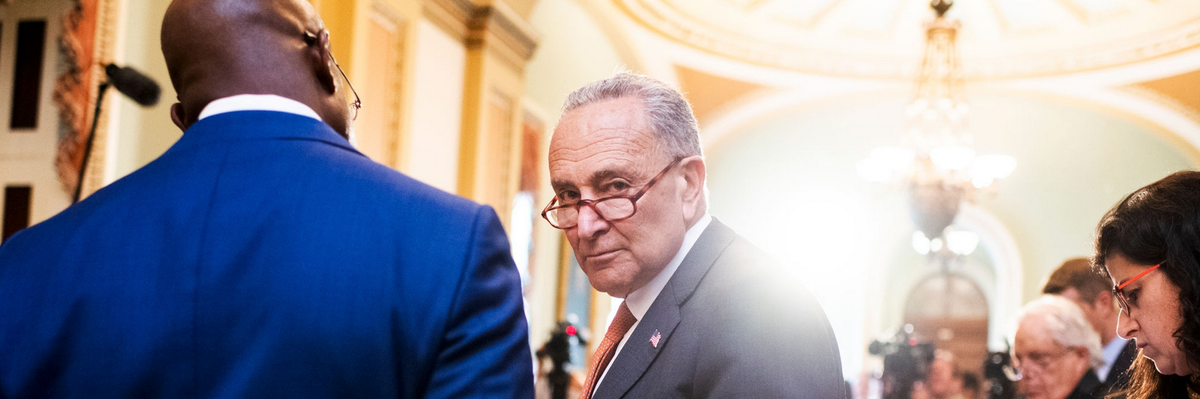
Senate Majority Leader Charles Schumer, D-N.Y., right, and Sen. Raphael Warnock, D-Ga., talks with reporters in Capitol after the senate luncheons on the day the senate will have a procedural vote on the For the People Act on Tuesday, June 22, 2021. (Photo: Tom Williams/CQ-Roll Call, Inc via Getty Images)
No Senate Recess Until Voting Rights Protected
There is an urgent need for action to protect the vote and our democracy, and it’s time that our leaders started acting like they understand this.
To paraphrase Mark Twain, reports of the death of the voting rights, anti-corruption, anti-gerrymandering legislation pending in Congress are greatly exaggerated. This urgently needed legislation is still alive, belying the claims made for months by political pundits and commentators.
That became clear last week when a breakthrough occurred on S.1, the For the People Act. A group of Senators met to prepare a revised version of the legislation based on a list of changes required by Sen. Joe Manchin (D-W.V.)--the only Democrat not co-sponsoring the bill--to unlock his support. Companion legislation, H.R.1, passed the House in March. The Manchin list includes such things as early voting, voting by mail and voter registration, as well as redistricting and campaign finance reforms.
Progress was confirmed by Sen. Amy Klobuchar (D-Minn.), who said last week that she and Senate Majority Leader Chuck Schumer (D-N.Y.), Manchin and Sen. Raphael Warnock (D-Ga.) were "very close" to reaching a deal on a revised bill. Klobuchar reportedly said they wouldn't be undertaking this effort if they thought it was destined to be blocked by a filibuster.
Like Manchin, who said in May that "inaction is not an option," Klobuchar understands the urgency of passing the For the People Act in the face of the most grave attacks on voting rights since the passage of the Voting Rights Act of 1965.
Republican-controlled state legislatures across the country enacted unprecedented voter suppression laws this year in 18 states, with more states expected to do the same. These state laws could potentially cause millions of citizens to lose their ability to vote in federal elections with new constraints on early voting, polling hours and absentee eligibility -- in particular, people of color, the elderly, young or disabled voters.
Time is running out. The Senate must pass legislation establishing voting rules for federal elections in order for the rules to be implemented in time to prevent voter suppression in the 2022 congressional elections. Similarly, redistricting standards in the legislation must be enacted quickly to be implemented in time to prevent partisan gerrymandering of congressional districts that likely will take place around the country.
That's why, with a deal in sight on revised voting rights legislation, it would be irresponsible for the Senate to go on a vacation recess before this legislation is passed.
Doing so would be an affront to the civil rights leaders and supporters who fought and died for the sacred right of every eligible American to vote.
There is an urgent need for action to protect the vote and our democracy, and it's time that our leaders started acting like they understand this. That means no time off for senators -- and the Biden administration needs to amp up the pressure.
Last week, the White House issued a statement: "The President, Vice President, Speaker, and Senate Leader agreed on the moral imperative of passing legislation to protect against voter suppression, electoral subversion, dark money, and partisan gerrymandering, and will continue working together toward that goal urgently."
These are important words, true, but without the necessary action behind them, they are just words.
Following the presidential election, then-President-elect Biden said in thanking Black voters, "You've always had my back, and I'll have yours."
There is no greater test of the president's words than whether he goes all out to protect the ability of Black Americans to vote in federal elections from the despicable voter suppression laws aimed at them, among others, and being enacted around the country.
That means passing a revised S.1. Schumer has said repeatedly about voting rights protections and political reforms that "Failure is not an option." The moment of truth has arrived for Schumer and his colleagues. It is time for the Senate to act.
We are at a crossroads
This country and this world are at a monumental crossroads. In a few short weeks, US voters will have an opportunity to beat back the forces of fascism and confront the billionaires who are rigging the economy, our media system, and our democracy, making it increasingly impossible for ordinary people to get by. We’re not just talking about the election. We’re talking about what must be done once these fascist elements are vanquished from power. We need a bolder set of solutions than what either major party has so far been willing to offer and a working-class movement ready to fight like hell for it. Trump didn't emerge from nowhere. The conditions that fueled MAGA authoritarianism were created by decades of radical neoliberal economic policies and a corrupt political system dominated by corporate interests. They slashed taxes on the super-rich, promising that the benefits would trickle down. They said giveaways to the corporate titans would make life more affordable for the rest of us. It was all bullshit. And when a bitter, betrayed populace searches for someone to blame, right-wing demagogues have little trouble finding scapegoats. People know when they're being lied to, but you won't hear any of this from the corporate media. Only independent journalism—powered and funded by people who believe in building a better world—can deliver truly trustworthy daily news. Our Fall Campaign is underway, and we need your help. To power our newsroom through the rest of the year, we need to raise $125,000 by midnight on October 31. So if you share our vision, please contribute whatever you can to sustain our work. |
To paraphrase Mark Twain, reports of the death of the voting rights, anti-corruption, anti-gerrymandering legislation pending in Congress are greatly exaggerated. This urgently needed legislation is still alive, belying the claims made for months by political pundits and commentators.
That became clear last week when a breakthrough occurred on S.1, the For the People Act. A group of Senators met to prepare a revised version of the legislation based on a list of changes required by Sen. Joe Manchin (D-W.V.)--the only Democrat not co-sponsoring the bill--to unlock his support. Companion legislation, H.R.1, passed the House in March. The Manchin list includes such things as early voting, voting by mail and voter registration, as well as redistricting and campaign finance reforms.
Progress was confirmed by Sen. Amy Klobuchar (D-Minn.), who said last week that she and Senate Majority Leader Chuck Schumer (D-N.Y.), Manchin and Sen. Raphael Warnock (D-Ga.) were "very close" to reaching a deal on a revised bill. Klobuchar reportedly said they wouldn't be undertaking this effort if they thought it was destined to be blocked by a filibuster.
Like Manchin, who said in May that "inaction is not an option," Klobuchar understands the urgency of passing the For the People Act in the face of the most grave attacks on voting rights since the passage of the Voting Rights Act of 1965.
Republican-controlled state legislatures across the country enacted unprecedented voter suppression laws this year in 18 states, with more states expected to do the same. These state laws could potentially cause millions of citizens to lose their ability to vote in federal elections with new constraints on early voting, polling hours and absentee eligibility -- in particular, people of color, the elderly, young or disabled voters.
Time is running out. The Senate must pass legislation establishing voting rules for federal elections in order for the rules to be implemented in time to prevent voter suppression in the 2022 congressional elections. Similarly, redistricting standards in the legislation must be enacted quickly to be implemented in time to prevent partisan gerrymandering of congressional districts that likely will take place around the country.
That's why, with a deal in sight on revised voting rights legislation, it would be irresponsible for the Senate to go on a vacation recess before this legislation is passed.
Doing so would be an affront to the civil rights leaders and supporters who fought and died for the sacred right of every eligible American to vote.
There is an urgent need for action to protect the vote and our democracy, and it's time that our leaders started acting like they understand this. That means no time off for senators -- and the Biden administration needs to amp up the pressure.
Last week, the White House issued a statement: "The President, Vice President, Speaker, and Senate Leader agreed on the moral imperative of passing legislation to protect against voter suppression, electoral subversion, dark money, and partisan gerrymandering, and will continue working together toward that goal urgently."
These are important words, true, but without the necessary action behind them, they are just words.
Following the presidential election, then-President-elect Biden said in thanking Black voters, "You've always had my back, and I'll have yours."
There is no greater test of the president's words than whether he goes all out to protect the ability of Black Americans to vote in federal elections from the despicable voter suppression laws aimed at them, among others, and being enacted around the country.
That means passing a revised S.1. Schumer has said repeatedly about voting rights protections and political reforms that "Failure is not an option." The moment of truth has arrived for Schumer and his colleagues. It is time for the Senate to act.
To paraphrase Mark Twain, reports of the death of the voting rights, anti-corruption, anti-gerrymandering legislation pending in Congress are greatly exaggerated. This urgently needed legislation is still alive, belying the claims made for months by political pundits and commentators.
That became clear last week when a breakthrough occurred on S.1, the For the People Act. A group of Senators met to prepare a revised version of the legislation based on a list of changes required by Sen. Joe Manchin (D-W.V.)--the only Democrat not co-sponsoring the bill--to unlock his support. Companion legislation, H.R.1, passed the House in March. The Manchin list includes such things as early voting, voting by mail and voter registration, as well as redistricting and campaign finance reforms.
Progress was confirmed by Sen. Amy Klobuchar (D-Minn.), who said last week that she and Senate Majority Leader Chuck Schumer (D-N.Y.), Manchin and Sen. Raphael Warnock (D-Ga.) were "very close" to reaching a deal on a revised bill. Klobuchar reportedly said they wouldn't be undertaking this effort if they thought it was destined to be blocked by a filibuster.
Like Manchin, who said in May that "inaction is not an option," Klobuchar understands the urgency of passing the For the People Act in the face of the most grave attacks on voting rights since the passage of the Voting Rights Act of 1965.
Republican-controlled state legislatures across the country enacted unprecedented voter suppression laws this year in 18 states, with more states expected to do the same. These state laws could potentially cause millions of citizens to lose their ability to vote in federal elections with new constraints on early voting, polling hours and absentee eligibility -- in particular, people of color, the elderly, young or disabled voters.
Time is running out. The Senate must pass legislation establishing voting rules for federal elections in order for the rules to be implemented in time to prevent voter suppression in the 2022 congressional elections. Similarly, redistricting standards in the legislation must be enacted quickly to be implemented in time to prevent partisan gerrymandering of congressional districts that likely will take place around the country.
That's why, with a deal in sight on revised voting rights legislation, it would be irresponsible for the Senate to go on a vacation recess before this legislation is passed.
Doing so would be an affront to the civil rights leaders and supporters who fought and died for the sacred right of every eligible American to vote.
There is an urgent need for action to protect the vote and our democracy, and it's time that our leaders started acting like they understand this. That means no time off for senators -- and the Biden administration needs to amp up the pressure.
Last week, the White House issued a statement: "The President, Vice President, Speaker, and Senate Leader agreed on the moral imperative of passing legislation to protect against voter suppression, electoral subversion, dark money, and partisan gerrymandering, and will continue working together toward that goal urgently."
These are important words, true, but without the necessary action behind them, they are just words.
Following the presidential election, then-President-elect Biden said in thanking Black voters, "You've always had my back, and I'll have yours."
There is no greater test of the president's words than whether he goes all out to protect the ability of Black Americans to vote in federal elections from the despicable voter suppression laws aimed at them, among others, and being enacted around the country.
That means passing a revised S.1. Schumer has said repeatedly about voting rights protections and political reforms that "Failure is not an option." The moment of truth has arrived for Schumer and his colleagues. It is time for the Senate to act.