

SUBSCRIBE TO OUR FREE NEWSLETTER
Daily news & progressive opinion—funded by the people, not the corporations—delivered straight to your inbox.
5
#000000
#FFFFFF
To donate by check, phone, or other method, see our More Ways to Give page.
Daily news & progressive opinion—funded by the people, not the corporations—delivered straight to your inbox.
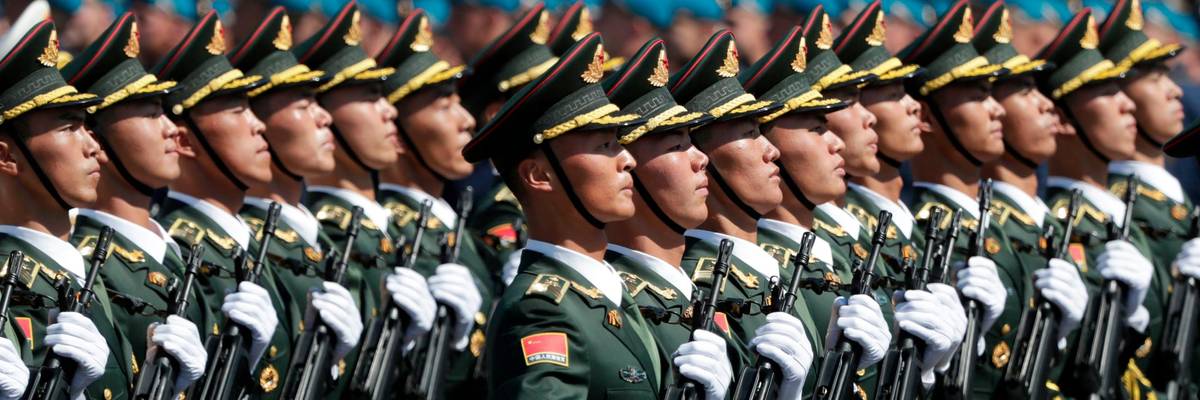
China and its growing military are not the biggest threats to the United States, argues former U.S. Labor Secretary Robert Reich. (Photo: Pavel Golovkin/Pool/AFP via Getty Images)
China's increasingly aggressive geopolitical and economic stance in the world is unleashing a fierce bipartisan backlash in America. That's fine if it leads to more public investment in basic research, education, and infrastructure--as did the Sputnik shock of the late 1950s. But it poses dangers as well.
More than 60 years ago, the sudden and palpable fear that the Soviet Union was lurching ahead of us shook America out of a postwar complacency and caused the nation to do what it should have been doing for many years. Even though we did it under the pretext of national defense--we called it the National Defense Education Act and the National Defense Highway Act and relied on the Defense Advanced Research Projects Administration for basic research leading to semiconductors, satellite technology, and the Internet--the result was to boost U.S. productivity and American wages for a generation.
"I don't mean to downplay the challenge China represents to the United States. But throughout America's postwar history it has been easier to blame others than to blame ourselves."
When the Soviet Union began to implode, America found its next foil in Japan. Japanese-made cars were taking market share away from the Big Three automakers. Meanwhile, Mitsubishi bought a substantial interest in the Rockefeller Center, Sony purchased Columbia Pictures, and Nintendo considered buying the Seattle Mariners. By the late 1980s and start of the 1990s, countless congressional hearings were held on the Japanese "challenge" to American competitiveness and the Japanese "threat" to American jobs.
A tide of books demonized Japan--Pat Choate's Agents of Influence alleged Tokyo's alleged payoffs to influential Americans were designed to achieve "effective political domination over the United States." Clyde Prestowitz's Trading Places argued that because of our failure to respond adequately to the Japanese challenge "the power of the United States and the quality of American life is diminishing rapidly in every respect." William S Dietrich's In the Shadow of the Rising Sun claimed Japan "threatens our way of life and ultimately our freedoms as much as past dangers from Nazi Germany and the Soviet Union."
Robert Zielinski and Nigel Holloway's Unequal Equities argued that Japan rigged its capital markets to undermine American corporations. Daniel Burstein's Yen! Japan's New Financial Empire and Its Threat to America asserted that Japan's growing power put the United States at risk of falling prey to a "hostile Japanese ... world order."
And on it went: The Japanese Power Game,The Coming War with Japan, Zaibatsu America: How Japanese Firms are Colonizing Vital U.S. Industries, The Silent War, Trade Wars.
But there was no vicious plot. We failed to notice that Japan had invested heavily in its own education and infrastructure--which enabled it to make high-quality products that American consumers wanted to buy. We didn't see that our own financial system resembled a casino and demanded immediate profits. We overlooked that our educational system left almost 80% of our young people unable to comprehend a news magazine and many others unprepared for work. And our infrastructure of unsafe bridges and potholed roads were draining our productivity.
In the present case of China, the geopolitical rivalry is palpable. Yet at the same time, American corporations and investors are quietly making bundles by running low-wage factories there and selling technology to their Chinese "partners." And American banks and venture capitalists are busily underwriting deals in China.
I don't mean to downplay the challenge China represents to the United States. But throughout America's postwar history it has been easier to blame others than to blame ourselves.
The greatest danger we face today is not coming from China. It is our drift toward proto-fascism. We must be careful not to demonize China so much that we encourage a new paranoia that further distorts our priorities, encourages nativism and xenophobia, and leads to larger military outlays rather than public investments in education, infrastructure, and basic research on which America's future prosperity and security critically depend.
The central question for America--an ever more diverse America, whose economy and culture are rapidly fusing with the economies and cultures of the rest of the globe--is whether it is possible to rediscover our identity and our mutual responsibility without creating another enemy.
Dear Common Dreams reader, It’s been nearly 30 years since I co-founded Common Dreams with my late wife, Lina Newhouser. We had the radical notion that journalism should serve the public good, not corporate profits. It was clear to us from the outset what it would take to build such a project. No paid advertisements. No corporate sponsors. No millionaire publisher telling us what to think or do. Many people said we wouldn't last a year, but we proved those doubters wrong. Together with a tremendous team of journalists and dedicated staff, we built an independent media outlet free from the constraints of profits and corporate control. Our mission has always been simple: To inform. To inspire. To ignite change for the common good. Building Common Dreams was not easy. Our survival was never guaranteed. When you take on the most powerful forces—Wall Street greed, fossil fuel industry destruction, Big Tech lobbyists, and uber-rich oligarchs who have spent billions upon billions rigging the economy and democracy in their favor—the only bulwark you have is supporters who believe in your work. But here’s the urgent message from me today. It's never been this bad out there. And it's never been this hard to keep us going. At the very moment Common Dreams is most needed, the threats we face are intensifying. We need your support now more than ever. We don't accept corporate advertising and never will. We don't have a paywall because we don't think people should be blocked from critical news based on their ability to pay. Everything we do is funded by the donations of readers like you. When everyone does the little they can afford, we are strong. But if that support retreats or dries up, so do we. Will you donate now to make sure Common Dreams not only survives but thrives? —Craig Brown, Co-founder |
China's increasingly aggressive geopolitical and economic stance in the world is unleashing a fierce bipartisan backlash in America. That's fine if it leads to more public investment in basic research, education, and infrastructure--as did the Sputnik shock of the late 1950s. But it poses dangers as well.
More than 60 years ago, the sudden and palpable fear that the Soviet Union was lurching ahead of us shook America out of a postwar complacency and caused the nation to do what it should have been doing for many years. Even though we did it under the pretext of national defense--we called it the National Defense Education Act and the National Defense Highway Act and relied on the Defense Advanced Research Projects Administration for basic research leading to semiconductors, satellite technology, and the Internet--the result was to boost U.S. productivity and American wages for a generation.
"I don't mean to downplay the challenge China represents to the United States. But throughout America's postwar history it has been easier to blame others than to blame ourselves."
When the Soviet Union began to implode, America found its next foil in Japan. Japanese-made cars were taking market share away from the Big Three automakers. Meanwhile, Mitsubishi bought a substantial interest in the Rockefeller Center, Sony purchased Columbia Pictures, and Nintendo considered buying the Seattle Mariners. By the late 1980s and start of the 1990s, countless congressional hearings were held on the Japanese "challenge" to American competitiveness and the Japanese "threat" to American jobs.
A tide of books demonized Japan--Pat Choate's Agents of Influence alleged Tokyo's alleged payoffs to influential Americans were designed to achieve "effective political domination over the United States." Clyde Prestowitz's Trading Places argued that because of our failure to respond adequately to the Japanese challenge "the power of the United States and the quality of American life is diminishing rapidly in every respect." William S Dietrich's In the Shadow of the Rising Sun claimed Japan "threatens our way of life and ultimately our freedoms as much as past dangers from Nazi Germany and the Soviet Union."
Robert Zielinski and Nigel Holloway's Unequal Equities argued that Japan rigged its capital markets to undermine American corporations. Daniel Burstein's Yen! Japan's New Financial Empire and Its Threat to America asserted that Japan's growing power put the United States at risk of falling prey to a "hostile Japanese ... world order."
And on it went: The Japanese Power Game,The Coming War with Japan, Zaibatsu America: How Japanese Firms are Colonizing Vital U.S. Industries, The Silent War, Trade Wars.
But there was no vicious plot. We failed to notice that Japan had invested heavily in its own education and infrastructure--which enabled it to make high-quality products that American consumers wanted to buy. We didn't see that our own financial system resembled a casino and demanded immediate profits. We overlooked that our educational system left almost 80% of our young people unable to comprehend a news magazine and many others unprepared for work. And our infrastructure of unsafe bridges and potholed roads were draining our productivity.
In the present case of China, the geopolitical rivalry is palpable. Yet at the same time, American corporations and investors are quietly making bundles by running low-wage factories there and selling technology to their Chinese "partners." And American banks and venture capitalists are busily underwriting deals in China.
I don't mean to downplay the challenge China represents to the United States. But throughout America's postwar history it has been easier to blame others than to blame ourselves.
The greatest danger we face today is not coming from China. It is our drift toward proto-fascism. We must be careful not to demonize China so much that we encourage a new paranoia that further distorts our priorities, encourages nativism and xenophobia, and leads to larger military outlays rather than public investments in education, infrastructure, and basic research on which America's future prosperity and security critically depend.
The central question for America--an ever more diverse America, whose economy and culture are rapidly fusing with the economies and cultures of the rest of the globe--is whether it is possible to rediscover our identity and our mutual responsibility without creating another enemy.
China's increasingly aggressive geopolitical and economic stance in the world is unleashing a fierce bipartisan backlash in America. That's fine if it leads to more public investment in basic research, education, and infrastructure--as did the Sputnik shock of the late 1950s. But it poses dangers as well.
More than 60 years ago, the sudden and palpable fear that the Soviet Union was lurching ahead of us shook America out of a postwar complacency and caused the nation to do what it should have been doing for many years. Even though we did it under the pretext of national defense--we called it the National Defense Education Act and the National Defense Highway Act and relied on the Defense Advanced Research Projects Administration for basic research leading to semiconductors, satellite technology, and the Internet--the result was to boost U.S. productivity and American wages for a generation.
"I don't mean to downplay the challenge China represents to the United States. But throughout America's postwar history it has been easier to blame others than to blame ourselves."
When the Soviet Union began to implode, America found its next foil in Japan. Japanese-made cars were taking market share away from the Big Three automakers. Meanwhile, Mitsubishi bought a substantial interest in the Rockefeller Center, Sony purchased Columbia Pictures, and Nintendo considered buying the Seattle Mariners. By the late 1980s and start of the 1990s, countless congressional hearings were held on the Japanese "challenge" to American competitiveness and the Japanese "threat" to American jobs.
A tide of books demonized Japan--Pat Choate's Agents of Influence alleged Tokyo's alleged payoffs to influential Americans were designed to achieve "effective political domination over the United States." Clyde Prestowitz's Trading Places argued that because of our failure to respond adequately to the Japanese challenge "the power of the United States and the quality of American life is diminishing rapidly in every respect." William S Dietrich's In the Shadow of the Rising Sun claimed Japan "threatens our way of life and ultimately our freedoms as much as past dangers from Nazi Germany and the Soviet Union."
Robert Zielinski and Nigel Holloway's Unequal Equities argued that Japan rigged its capital markets to undermine American corporations. Daniel Burstein's Yen! Japan's New Financial Empire and Its Threat to America asserted that Japan's growing power put the United States at risk of falling prey to a "hostile Japanese ... world order."
And on it went: The Japanese Power Game,The Coming War with Japan, Zaibatsu America: How Japanese Firms are Colonizing Vital U.S. Industries, The Silent War, Trade Wars.
But there was no vicious plot. We failed to notice that Japan had invested heavily in its own education and infrastructure--which enabled it to make high-quality products that American consumers wanted to buy. We didn't see that our own financial system resembled a casino and demanded immediate profits. We overlooked that our educational system left almost 80% of our young people unable to comprehend a news magazine and many others unprepared for work. And our infrastructure of unsafe bridges and potholed roads were draining our productivity.
In the present case of China, the geopolitical rivalry is palpable. Yet at the same time, American corporations and investors are quietly making bundles by running low-wage factories there and selling technology to their Chinese "partners." And American banks and venture capitalists are busily underwriting deals in China.
I don't mean to downplay the challenge China represents to the United States. But throughout America's postwar history it has been easier to blame others than to blame ourselves.
The greatest danger we face today is not coming from China. It is our drift toward proto-fascism. We must be careful not to demonize China so much that we encourage a new paranoia that further distorts our priorities, encourages nativism and xenophobia, and leads to larger military outlays rather than public investments in education, infrastructure, and basic research on which America's future prosperity and security critically depend.
The central question for America--an ever more diverse America, whose economy and culture are rapidly fusing with the economies and cultures of the rest of the globe--is whether it is possible to rediscover our identity and our mutual responsibility without creating another enemy.

