SUBSCRIBE TO OUR FREE NEWSLETTER
Daily news & progressive opinion—funded by the people, not the corporations—delivered straight to your inbox.
5
#000000
#FFFFFF
To donate by check, phone, or other method, see our More Ways to Give page.
Daily news & progressive opinion—funded by the people, not the corporations—delivered straight to your inbox.
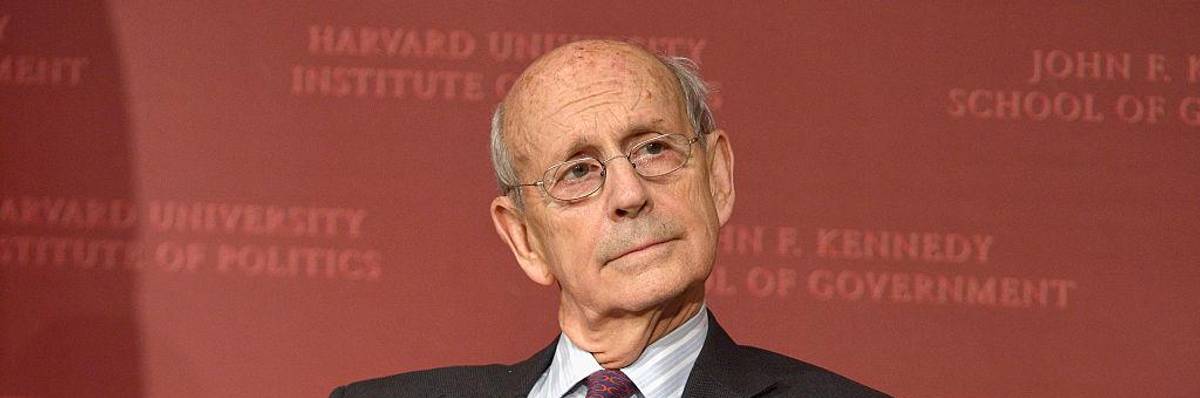
United States Supreme Court Justice Stephen Breyer. (Photo: Paul Marotta/Getty Images)
There is nothing sacred about nine.
The number was not carried down from a mountain on stone tablets, nor did it appear in a burning bush. In fact, before the Supreme Court contained nine justices, it contained six, the number fixed when the tribunal was established in 1789. Then, in an attempt to hobble his successor, President John Adams reduced it to five.
Then there were six again. Then seven. Then nine. Then 10. Then seven again.Since 1869, there have been nine.
So what to make of a speech last week at Harvard Law School in which Justice Stephen Breyer came out against the idea, now being floated on the political left, of increasing the court to 11? His fear is that the panel would come to be seen as a political tool, risking its credibility.
Nine is a lovely number, and bipartisanship is fine. But the power of the people? That's the sacred thing.
But the court has been seen as exactly that since at least the aforementioned John Adams. And the only reason there is talk of enlarging it now is to answer an act of brazen political hypocrisy by then-Senate Majority Leader Mitch McConnell. He notoriously refused to give a hearing to President Obama's nominee to the court on the flimsy claim that it would be too close--eight months out--to the 2016 election, then jammed through a nominee from Obama's successor a little over a week before 2020 balloting.
Which is not to say that Breyer's fears are irrational but, rather, that we are faced with more immediate concerns: a moment of crisis, a national unraveling and many of us wondering if the country can survive. So Breyer is like a man polishing the china in a burning house.
And Sen. Joe Manchin? He's dusting the cabinets.
The West Virginia Democrat recently came out against ending or modifying the filibuster, the parliamentary procedure that empowers the Republican minority to block legislation--in this case, a pair of bills desperately needed to fight a wave of voter-suppression measures the GOP is pushing through statehouses. Manchin, without whom the filibuster cannot be revised, told CNN that the Jan. 6 insurrection "changed" him, renewed his commitment to bipartisanship.
But there is nothing sacred about bipartisanship, either.
It is, to be sure, something to be dearly sought and highly prized. But it takes two parties to be bipartisan. And as McConnell's theft of the court seat, that January insurrection and literally dozens of other examples attest, the GOP has, in a very real sense, ceased to function as one.
So the house continues to burn, yet some of us insist on trying to reason with fire.
It is frustrating to endure these encomiums to tradition and aspirational values while watching millions of fellow Americans retreat to their own private reality where fact is a stranger and anger flows from the taps. It is hard to be sanguine as Republicans rationalize rebellion and build a bonfire of constitutional guarantees. It is challenging to remain hopeful in the face of constant appeals to all that is low, fearful and mean.
And it is particularly galling to see Manchin dusting and Breyer polishing while you wonder who will get to vote next time elections are held. Tradition and aspirational values cannot matter more than the principles they are meant to serve.
Including the one that says, in this country, every voice, every vote matters, and we each have the right to say, do and be. Nine is a lovely number, and bipartisanship is fine. But the power of the people?
That's the sacred thing.
Dear Common Dreams reader, It’s been nearly 30 years since I co-founded Common Dreams with my late wife, Lina Newhouser. We had the radical notion that journalism should serve the public good, not corporate profits. It was clear to us from the outset what it would take to build such a project. No paid advertisements. No corporate sponsors. No millionaire publisher telling us what to think or do. Many people said we wouldn't last a year, but we proved those doubters wrong. Together with a tremendous team of journalists and dedicated staff, we built an independent media outlet free from the constraints of profits and corporate control. Our mission has always been simple: To inform. To inspire. To ignite change for the common good. Building Common Dreams was not easy. Our survival was never guaranteed. When you take on the most powerful forces—Wall Street greed, fossil fuel industry destruction, Big Tech lobbyists, and uber-rich oligarchs who have spent billions upon billions rigging the economy and democracy in their favor—the only bulwark you have is supporters who believe in your work. But here’s the urgent message from me today. It's never been this bad out there. And it's never been this hard to keep us going. At the very moment Common Dreams is most needed, the threats we face are intensifying. We need your support now more than ever. We don't accept corporate advertising and never will. We don't have a paywall because we don't think people should be blocked from critical news based on their ability to pay. Everything we do is funded by the donations of readers like you. When everyone does the little they can afford, we are strong. But if that support retreats or dries up, so do we. Will you donate now to make sure Common Dreams not only survives but thrives? —Craig Brown, Co-founder |
There is nothing sacred about nine.
The number was not carried down from a mountain on stone tablets, nor did it appear in a burning bush. In fact, before the Supreme Court contained nine justices, it contained six, the number fixed when the tribunal was established in 1789. Then, in an attempt to hobble his successor, President John Adams reduced it to five.
Then there were six again. Then seven. Then nine. Then 10. Then seven again.Since 1869, there have been nine.
So what to make of a speech last week at Harvard Law School in which Justice Stephen Breyer came out against the idea, now being floated on the political left, of increasing the court to 11? His fear is that the panel would come to be seen as a political tool, risking its credibility.
Nine is a lovely number, and bipartisanship is fine. But the power of the people? That's the sacred thing.
But the court has been seen as exactly that since at least the aforementioned John Adams. And the only reason there is talk of enlarging it now is to answer an act of brazen political hypocrisy by then-Senate Majority Leader Mitch McConnell. He notoriously refused to give a hearing to President Obama's nominee to the court on the flimsy claim that it would be too close--eight months out--to the 2016 election, then jammed through a nominee from Obama's successor a little over a week before 2020 balloting.
Which is not to say that Breyer's fears are irrational but, rather, that we are faced with more immediate concerns: a moment of crisis, a national unraveling and many of us wondering if the country can survive. So Breyer is like a man polishing the china in a burning house.
And Sen. Joe Manchin? He's dusting the cabinets.
The West Virginia Democrat recently came out against ending or modifying the filibuster, the parliamentary procedure that empowers the Republican minority to block legislation--in this case, a pair of bills desperately needed to fight a wave of voter-suppression measures the GOP is pushing through statehouses. Manchin, without whom the filibuster cannot be revised, told CNN that the Jan. 6 insurrection "changed" him, renewed his commitment to bipartisanship.
But there is nothing sacred about bipartisanship, either.
It is, to be sure, something to be dearly sought and highly prized. But it takes two parties to be bipartisan. And as McConnell's theft of the court seat, that January insurrection and literally dozens of other examples attest, the GOP has, in a very real sense, ceased to function as one.
So the house continues to burn, yet some of us insist on trying to reason with fire.
It is frustrating to endure these encomiums to tradition and aspirational values while watching millions of fellow Americans retreat to their own private reality where fact is a stranger and anger flows from the taps. It is hard to be sanguine as Republicans rationalize rebellion and build a bonfire of constitutional guarantees. It is challenging to remain hopeful in the face of constant appeals to all that is low, fearful and mean.
And it is particularly galling to see Manchin dusting and Breyer polishing while you wonder who will get to vote next time elections are held. Tradition and aspirational values cannot matter more than the principles they are meant to serve.
Including the one that says, in this country, every voice, every vote matters, and we each have the right to say, do and be. Nine is a lovely number, and bipartisanship is fine. But the power of the people?
That's the sacred thing.
There is nothing sacred about nine.
The number was not carried down from a mountain on stone tablets, nor did it appear in a burning bush. In fact, before the Supreme Court contained nine justices, it contained six, the number fixed when the tribunal was established in 1789. Then, in an attempt to hobble his successor, President John Adams reduced it to five.
Then there were six again. Then seven. Then nine. Then 10. Then seven again.Since 1869, there have been nine.
So what to make of a speech last week at Harvard Law School in which Justice Stephen Breyer came out against the idea, now being floated on the political left, of increasing the court to 11? His fear is that the panel would come to be seen as a political tool, risking its credibility.
Nine is a lovely number, and bipartisanship is fine. But the power of the people? That's the sacred thing.
But the court has been seen as exactly that since at least the aforementioned John Adams. And the only reason there is talk of enlarging it now is to answer an act of brazen political hypocrisy by then-Senate Majority Leader Mitch McConnell. He notoriously refused to give a hearing to President Obama's nominee to the court on the flimsy claim that it would be too close--eight months out--to the 2016 election, then jammed through a nominee from Obama's successor a little over a week before 2020 balloting.
Which is not to say that Breyer's fears are irrational but, rather, that we are faced with more immediate concerns: a moment of crisis, a national unraveling and many of us wondering if the country can survive. So Breyer is like a man polishing the china in a burning house.
And Sen. Joe Manchin? He's dusting the cabinets.
The West Virginia Democrat recently came out against ending or modifying the filibuster, the parliamentary procedure that empowers the Republican minority to block legislation--in this case, a pair of bills desperately needed to fight a wave of voter-suppression measures the GOP is pushing through statehouses. Manchin, without whom the filibuster cannot be revised, told CNN that the Jan. 6 insurrection "changed" him, renewed his commitment to bipartisanship.
But there is nothing sacred about bipartisanship, either.
It is, to be sure, something to be dearly sought and highly prized. But it takes two parties to be bipartisan. And as McConnell's theft of the court seat, that January insurrection and literally dozens of other examples attest, the GOP has, in a very real sense, ceased to function as one.
So the house continues to burn, yet some of us insist on trying to reason with fire.
It is frustrating to endure these encomiums to tradition and aspirational values while watching millions of fellow Americans retreat to their own private reality where fact is a stranger and anger flows from the taps. It is hard to be sanguine as Republicans rationalize rebellion and build a bonfire of constitutional guarantees. It is challenging to remain hopeful in the face of constant appeals to all that is low, fearful and mean.
And it is particularly galling to see Manchin dusting and Breyer polishing while you wonder who will get to vote next time elections are held. Tradition and aspirational values cannot matter more than the principles they are meant to serve.
Including the one that says, in this country, every voice, every vote matters, and we each have the right to say, do and be. Nine is a lovely number, and bipartisanship is fine. But the power of the people?
That's the sacred thing.