

SUBSCRIBE TO OUR FREE NEWSLETTER
Daily news & progressive opinion—funded by the people, not the corporations—delivered straight to your inbox.
5
#000000
#FFFFFF
To donate by check, phone, or other method, see our More Ways to Give page.
Daily news & progressive opinion—funded by the people, not the corporations—delivered straight to your inbox.
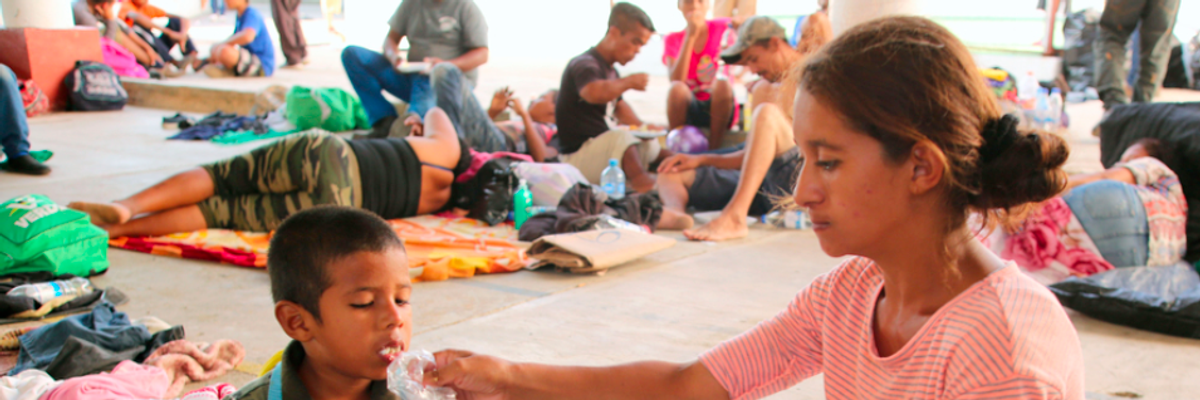
"When we buy into the sham narrative of crisis," writes Pak, "we fail to recognize migrants as human beings and we lose sight of the real issues: how our government is treating people who are escaping unimaginable violence--and how our policies are returning individuals to torture and even death." (Photo: Shutterstock)
Over the last several weeks, Customs and Border Protection (CBP) has reported a rise in the number of migrant children seeking refuge in the United States.
With the increase, the federal government's capacity to process and shelter migrant children has been stretched, leading to children being housed in overcrowded and inhumane CBP facilities for extended periods of time.
Federal officials and some media have called what's happening at the border a "crisis" or a "surge"--harmful rhetoric that has long been used to dehumanize immigrants and people approaching the southern border.
"Moving towards a better justice system isn't possible if we continue to scapegoat immigrants instead of reckoning with our broken system. People approaching our borders deserve better. At the very least, our language should recognize their humanity."
This language of crisis is a distraction--and it undermines common sense policy solutions that can secure justice and safety for everyone in our country, including immigrant survivors fleeing gender-based violence.
Not only can this language be misleading and a misrepresentation of actual migration flows, but it provokes fear and needlessly divides Americans. It turns immigration into an "us versus them" issue, falsely painting migrants as a threat.
Policy solutions then shift to emphasize criminalization and detention, rather than responding with compassion and welcoming with dignity to those seeking safety. As a result, we've seen egregious policies in the last few years, like detaining and separating families and sending people seeking asylum to wait indefinitely in Mexico for their day in court.
When we buy into the sham narrative of crisis, we fail to recognize migrants as human beings and we lose sight of the real issues: how our government is treating people who are escaping unimaginable violence--and how our policies are returning individuals to torture and even death.
Right now, children are being jailed in deplorable conditions where they are susceptible to heightened and enduring trauma. Meanwhile our border remains largely shuttered to adult survivors fleeing rape and horrific gender-based persecution because the new administration has yet to repeal an illegal policy implemented under the last one.
People escaping violence have a right to seek safety. If they can't, that's the real crisis.
Moving towards a better justice system isn't possible if we continue to scapegoat immigrants instead of reckoning with our broken system. People approaching our borders deserve better. At the very least, our language should recognize their humanity.
We should look at the context of border crossings and understand the many complex reasons people leave their homes--including to find refuge from atrocious acts of rape, domestic violence, and other forms of gender-based violence.
We should center the individual in our language--each person carries their own intricate stories and histories. Then, as a country, we must remember our moral and international obligation to uphold the legal right to seek asylum and extend refuge to those who qualify.
We have an opportunity to improve our policies and better secure access to safety for immigrant survivors. But to get there, our approach must shift to one of compassion, reflecting the humanity of people approaching the border.
Everyone deserves to live a life free from violence--and our language and policies should reflect that.
Dear Common Dreams reader, It’s been nearly 30 years since I co-founded Common Dreams with my late wife, Lina Newhouser. We had the radical notion that journalism should serve the public good, not corporate profits. It was clear to us from the outset what it would take to build such a project. No paid advertisements. No corporate sponsors. No millionaire publisher telling us what to think or do. Many people said we wouldn't last a year, but we proved those doubters wrong. Together with a tremendous team of journalists and dedicated staff, we built an independent media outlet free from the constraints of profits and corporate control. Our mission has always been simple: To inform. To inspire. To ignite change for the common good. Building Common Dreams was not easy. Our survival was never guaranteed. When you take on the most powerful forces—Wall Street greed, fossil fuel industry destruction, Big Tech lobbyists, and uber-rich oligarchs who have spent billions upon billions rigging the economy and democracy in their favor—the only bulwark you have is supporters who believe in your work. But here’s the urgent message from me today. It's never been this bad out there. And it's never been this hard to keep us going. At the very moment Common Dreams is most needed, the threats we face are intensifying. We need your support now more than ever. We don't accept corporate advertising and never will. We don't have a paywall because we don't think people should be blocked from critical news based on their ability to pay. Everything we do is funded by the donations of readers like you. When everyone does the little they can afford, we are strong. But if that support retreats or dries up, so do we. Will you donate now to make sure Common Dreams not only survives but thrives? —Craig Brown, Co-founder |
Over the last several weeks, Customs and Border Protection (CBP) has reported a rise in the number of migrant children seeking refuge in the United States.
With the increase, the federal government's capacity to process and shelter migrant children has been stretched, leading to children being housed in overcrowded and inhumane CBP facilities for extended periods of time.
Federal officials and some media have called what's happening at the border a "crisis" or a "surge"--harmful rhetoric that has long been used to dehumanize immigrants and people approaching the southern border.
"Moving towards a better justice system isn't possible if we continue to scapegoat immigrants instead of reckoning with our broken system. People approaching our borders deserve better. At the very least, our language should recognize their humanity."
This language of crisis is a distraction--and it undermines common sense policy solutions that can secure justice and safety for everyone in our country, including immigrant survivors fleeing gender-based violence.
Not only can this language be misleading and a misrepresentation of actual migration flows, but it provokes fear and needlessly divides Americans. It turns immigration into an "us versus them" issue, falsely painting migrants as a threat.
Policy solutions then shift to emphasize criminalization and detention, rather than responding with compassion and welcoming with dignity to those seeking safety. As a result, we've seen egregious policies in the last few years, like detaining and separating families and sending people seeking asylum to wait indefinitely in Mexico for their day in court.
When we buy into the sham narrative of crisis, we fail to recognize migrants as human beings and we lose sight of the real issues: how our government is treating people who are escaping unimaginable violence--and how our policies are returning individuals to torture and even death.
Right now, children are being jailed in deplorable conditions where they are susceptible to heightened and enduring trauma. Meanwhile our border remains largely shuttered to adult survivors fleeing rape and horrific gender-based persecution because the new administration has yet to repeal an illegal policy implemented under the last one.
People escaping violence have a right to seek safety. If they can't, that's the real crisis.
Moving towards a better justice system isn't possible if we continue to scapegoat immigrants instead of reckoning with our broken system. People approaching our borders deserve better. At the very least, our language should recognize their humanity.
We should look at the context of border crossings and understand the many complex reasons people leave their homes--including to find refuge from atrocious acts of rape, domestic violence, and other forms of gender-based violence.
We should center the individual in our language--each person carries their own intricate stories and histories. Then, as a country, we must remember our moral and international obligation to uphold the legal right to seek asylum and extend refuge to those who qualify.
We have an opportunity to improve our policies and better secure access to safety for immigrant survivors. But to get there, our approach must shift to one of compassion, reflecting the humanity of people approaching the border.
Everyone deserves to live a life free from violence--and our language and policies should reflect that.
Over the last several weeks, Customs and Border Protection (CBP) has reported a rise in the number of migrant children seeking refuge in the United States.
With the increase, the federal government's capacity to process and shelter migrant children has been stretched, leading to children being housed in overcrowded and inhumane CBP facilities for extended periods of time.
Federal officials and some media have called what's happening at the border a "crisis" or a "surge"--harmful rhetoric that has long been used to dehumanize immigrants and people approaching the southern border.
"Moving towards a better justice system isn't possible if we continue to scapegoat immigrants instead of reckoning with our broken system. People approaching our borders deserve better. At the very least, our language should recognize their humanity."
This language of crisis is a distraction--and it undermines common sense policy solutions that can secure justice and safety for everyone in our country, including immigrant survivors fleeing gender-based violence.
Not only can this language be misleading and a misrepresentation of actual migration flows, but it provokes fear and needlessly divides Americans. It turns immigration into an "us versus them" issue, falsely painting migrants as a threat.
Policy solutions then shift to emphasize criminalization and detention, rather than responding with compassion and welcoming with dignity to those seeking safety. As a result, we've seen egregious policies in the last few years, like detaining and separating families and sending people seeking asylum to wait indefinitely in Mexico for their day in court.
When we buy into the sham narrative of crisis, we fail to recognize migrants as human beings and we lose sight of the real issues: how our government is treating people who are escaping unimaginable violence--and how our policies are returning individuals to torture and even death.
Right now, children are being jailed in deplorable conditions where they are susceptible to heightened and enduring trauma. Meanwhile our border remains largely shuttered to adult survivors fleeing rape and horrific gender-based persecution because the new administration has yet to repeal an illegal policy implemented under the last one.
People escaping violence have a right to seek safety. If they can't, that's the real crisis.
Moving towards a better justice system isn't possible if we continue to scapegoat immigrants instead of reckoning with our broken system. People approaching our borders deserve better. At the very least, our language should recognize their humanity.
We should look at the context of border crossings and understand the many complex reasons people leave their homes--including to find refuge from atrocious acts of rape, domestic violence, and other forms of gender-based violence.
We should center the individual in our language--each person carries their own intricate stories and histories. Then, as a country, we must remember our moral and international obligation to uphold the legal right to seek asylum and extend refuge to those who qualify.
We have an opportunity to improve our policies and better secure access to safety for immigrant survivors. But to get there, our approach must shift to one of compassion, reflecting the humanity of people approaching the border.
Everyone deserves to live a life free from violence--and our language and policies should reflect that.

