SUBSCRIBE TO OUR FREE NEWSLETTER
Daily news & progressive opinion—funded by the people, not the corporations—delivered straight to your inbox.
5
#000000
#FFFFFF
To donate by check, phone, or other method, see our More Ways to Give page.
Daily news & progressive opinion—funded by the people, not the corporations—delivered straight to your inbox.
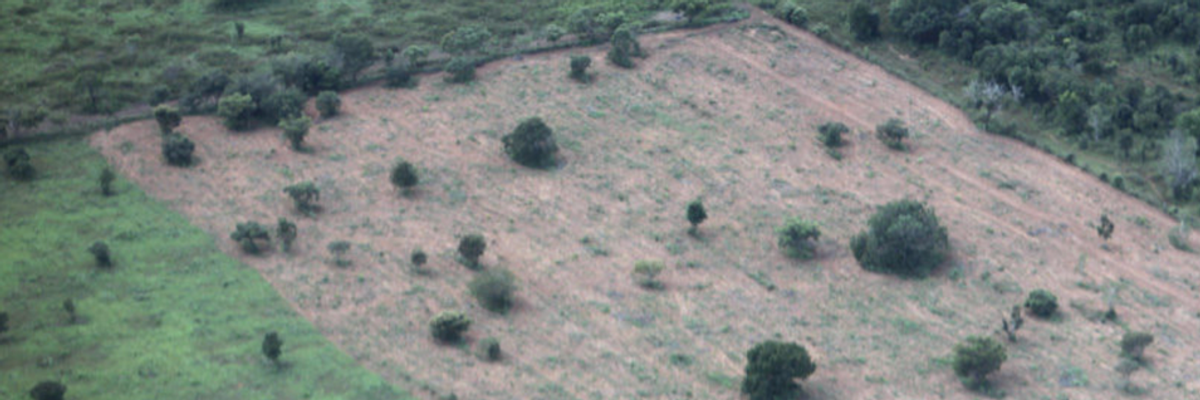
Deforestation in Brazil's Cerrado. (Photo: Mongabay)
As the planet warms, it isn't just humans who are feeling the heat--trees are too. Rising temperatures are disrupting a primary engine of life on Earth: photosynthesis.
"The disproportionate warming in the Cerrado belt is driven not just by global temperature rise, but also by local deforestation and fragmentation of wooded areas. As pastureland and cropland have eaten away into forests, their cooling effect is becoming muted."
A recent study from Brazil adds to fears that climate change is altering the face of the planet. Literally. Tropical forests could look more and more like deciduous forests or savannas in the future, according to the research based in Brazil's Cerrado biome. This ecoregion abjacent to the Amazon Rainforest is where savanna, grasslands and forests mingle.
The paper, published in Environmental Research Letters in March, focused on four trees species found in both the Amazonian tropical forests and savanna land: Qualea parviflora, known as pau-terra in Portuguese; Pseudobombax longiflorum, or the Brazilian shaving-brush tree; Hymenaea stigonocarpa (jatoba do Cerrado); and Vatairea macrocarpa, also known as angelim.
"The article extends present knowledge of heat tolerance to tropical species in particularly hot regions, testing species not tested before," said Gotthard Heinrich Krause, professor of plant physiology at Heinrich Heine University Dusseldorf, Germany.
Krause, who was not involved with the study, noted that the paper underlines how "increased number of extreme heatwaves, often combined with drought stress," compound the heat stress faced by trees.
The maximum temperatures in the Cerrado region and neighboring forests can reach 45deg Celsius (113deg Fahrenheit). The area has warmed perceptibly in recent decades, and heat waves that regularly sweep the region are becoming hotter and dryer.
How much a leaf warms depends on how much solar radiation it absorbs and what it loses through conduction and as long-wave radiation. Leaves facing the harsh tropical sun heat up faster than the ambient air around them.
"Prolonged exposure to heat can induce damage to leaf tissue, compromising photosynthetic efficiency and, consequently, trees' fitness," said Igor Araujo, first author of the new paper and an ecologist at the Mato Grosso State University, Brazil.
The disproportionate warming in the Cerrado belt is driven not just by global temperature rise, but also by local deforestation and fragmentation of wooded areas. As pastureland and cropland have eaten away into forests, their cooling effect is becoming muted.
Trees cool themselves and areas around them by transpiring water through the stomata dotting their leaf surfaces. This process, along with evaporation, is also why forested areas induce rainfall. "One single adult tree in the Amazon can transpire up to 1000 L [264 gallons] of water per day, functioning as a natural air conditioner of the environment. This process is called biotic pump, which is reduced by deforestation," Araujo said.
When faced with scorching heat and dry spells, the pores on leaves clamp shut to conserve water. "This will reduce or prevent transpirational cooling of leaves, causing substantial increases of leaf temperature above air temperature," Krause said.
The study estimated, for the first time, what temperatures leaves can tolerate. To do this, the authors calculated the temperature at which a critical component of the photosystem breaks down and the temperatures that leaves are experiencing. The difference between the two levels is called the thermal safety margin (Tsm).
Krause said he expected that the temperature at which scientists observe permanent damage to leaf tissue to be higher than what the researchers estimate. This would mean a wider safety net, but it still would not be enough to protect most species considered in the research, given the current pace of warming.
"It's not just tree health that declines; other scientists have shown that heat stress also affects carbon dioxide uptake by trees. According to Krause, there is a reduction in the CO2 absorbed by plants even at temperatures lower than those that short-circuit photosynthesis."
Such a hostile environment is dangerous for leaves and trees. The tree is not shedding leaves as part of a seasonal cycle but rather because they are not performing their function of harnessing energy.
The authors found that in some species, the maximum leaf temperatures are already exceeding this threshold. But if average temperatures rise by even 2.5degC (4.5degF), this will be true for most tree species, they estimate. With a 5degC (9degF) rise, all tree species studied will suffer from leaf burn.
It's not just tree health that declines; other scientists have shown that heat stress also affects carbon dioxide uptake by trees. According to Krause, there is a reduction in the CO2 absorbed by plants even at temperatures lower than those that short-circuit photosynthesis. "Such reduction will contribute to the reduction in carbon sink of the tropical forest," he said.
At the moment, savanna species adapted to higher temperatures are doing better than the rainforest species. "Our results thus indicate expected shifts in deciduousness in the future and thus a trend towards savanna vegetation replacing forests in the regions in Southern Amazonia characterized by large patches of deforestation," the authors write. What is happening at the Amazon-Cerrado boundary may be a precursor for feverish tropical forests across the world. Unlike humans, these forests won't have air conditioners or sunscreens to protect them.
Dear Common Dreams reader, It’s been nearly 30 years since I co-founded Common Dreams with my late wife, Lina Newhouser. We had the radical notion that journalism should serve the public good, not corporate profits. It was clear to us from the outset what it would take to build such a project. No paid advertisements. No corporate sponsors. No millionaire publisher telling us what to think or do. Many people said we wouldn't last a year, but we proved those doubters wrong. Together with a tremendous team of journalists and dedicated staff, we built an independent media outlet free from the constraints of profits and corporate control. Our mission has always been simple: To inform. To inspire. To ignite change for the common good. Building Common Dreams was not easy. Our survival was never guaranteed. When you take on the most powerful forces—Wall Street greed, fossil fuel industry destruction, Big Tech lobbyists, and uber-rich oligarchs who have spent billions upon billions rigging the economy and democracy in their favor—the only bulwark you have is supporters who believe in your work. But here’s the urgent message from me today. It's never been this bad out there. And it's never been this hard to keep us going. At the very moment Common Dreams is most needed, the threats we face are intensifying. We need your support now more than ever. We don't accept corporate advertising and never will. We don't have a paywall because we don't think people should be blocked from critical news based on their ability to pay. Everything we do is funded by the donations of readers like you. When everyone does the little they can afford, we are strong. But if that support retreats or dries up, so do we. Will you donate now to make sure Common Dreams not only survives but thrives? —Craig Brown, Co-founder |
As the planet warms, it isn't just humans who are feeling the heat--trees are too. Rising temperatures are disrupting a primary engine of life on Earth: photosynthesis.
"The disproportionate warming in the Cerrado belt is driven not just by global temperature rise, but also by local deforestation and fragmentation of wooded areas. As pastureland and cropland have eaten away into forests, their cooling effect is becoming muted."
A recent study from Brazil adds to fears that climate change is altering the face of the planet. Literally. Tropical forests could look more and more like deciduous forests or savannas in the future, according to the research based in Brazil's Cerrado biome. This ecoregion abjacent to the Amazon Rainforest is where savanna, grasslands and forests mingle.
The paper, published in Environmental Research Letters in March, focused on four trees species found in both the Amazonian tropical forests and savanna land: Qualea parviflora, known as pau-terra in Portuguese; Pseudobombax longiflorum, or the Brazilian shaving-brush tree; Hymenaea stigonocarpa (jatoba do Cerrado); and Vatairea macrocarpa, also known as angelim.
"The article extends present knowledge of heat tolerance to tropical species in particularly hot regions, testing species not tested before," said Gotthard Heinrich Krause, professor of plant physiology at Heinrich Heine University Dusseldorf, Germany.
Krause, who was not involved with the study, noted that the paper underlines how "increased number of extreme heatwaves, often combined with drought stress," compound the heat stress faced by trees.
The maximum temperatures in the Cerrado region and neighboring forests can reach 45deg Celsius (113deg Fahrenheit). The area has warmed perceptibly in recent decades, and heat waves that regularly sweep the region are becoming hotter and dryer.
How much a leaf warms depends on how much solar radiation it absorbs and what it loses through conduction and as long-wave radiation. Leaves facing the harsh tropical sun heat up faster than the ambient air around them.
"Prolonged exposure to heat can induce damage to leaf tissue, compromising photosynthetic efficiency and, consequently, trees' fitness," said Igor Araujo, first author of the new paper and an ecologist at the Mato Grosso State University, Brazil.
The disproportionate warming in the Cerrado belt is driven not just by global temperature rise, but also by local deforestation and fragmentation of wooded areas. As pastureland and cropland have eaten away into forests, their cooling effect is becoming muted.
Trees cool themselves and areas around them by transpiring water through the stomata dotting their leaf surfaces. This process, along with evaporation, is also why forested areas induce rainfall. "One single adult tree in the Amazon can transpire up to 1000 L [264 gallons] of water per day, functioning as a natural air conditioner of the environment. This process is called biotic pump, which is reduced by deforestation," Araujo said.
When faced with scorching heat and dry spells, the pores on leaves clamp shut to conserve water. "This will reduce or prevent transpirational cooling of leaves, causing substantial increases of leaf temperature above air temperature," Krause said.
The study estimated, for the first time, what temperatures leaves can tolerate. To do this, the authors calculated the temperature at which a critical component of the photosystem breaks down and the temperatures that leaves are experiencing. The difference between the two levels is called the thermal safety margin (Tsm).
Krause said he expected that the temperature at which scientists observe permanent damage to leaf tissue to be higher than what the researchers estimate. This would mean a wider safety net, but it still would not be enough to protect most species considered in the research, given the current pace of warming.
"It's not just tree health that declines; other scientists have shown that heat stress also affects carbon dioxide uptake by trees. According to Krause, there is a reduction in the CO2 absorbed by plants even at temperatures lower than those that short-circuit photosynthesis."
Such a hostile environment is dangerous for leaves and trees. The tree is not shedding leaves as part of a seasonal cycle but rather because they are not performing their function of harnessing energy.
The authors found that in some species, the maximum leaf temperatures are already exceeding this threshold. But if average temperatures rise by even 2.5degC (4.5degF), this will be true for most tree species, they estimate. With a 5degC (9degF) rise, all tree species studied will suffer from leaf burn.
It's not just tree health that declines; other scientists have shown that heat stress also affects carbon dioxide uptake by trees. According to Krause, there is a reduction in the CO2 absorbed by plants even at temperatures lower than those that short-circuit photosynthesis. "Such reduction will contribute to the reduction in carbon sink of the tropical forest," he said.
At the moment, savanna species adapted to higher temperatures are doing better than the rainforest species. "Our results thus indicate expected shifts in deciduousness in the future and thus a trend towards savanna vegetation replacing forests in the regions in Southern Amazonia characterized by large patches of deforestation," the authors write. What is happening at the Amazon-Cerrado boundary may be a precursor for feverish tropical forests across the world. Unlike humans, these forests won't have air conditioners or sunscreens to protect them.
As the planet warms, it isn't just humans who are feeling the heat--trees are too. Rising temperatures are disrupting a primary engine of life on Earth: photosynthesis.
"The disproportionate warming in the Cerrado belt is driven not just by global temperature rise, but also by local deforestation and fragmentation of wooded areas. As pastureland and cropland have eaten away into forests, their cooling effect is becoming muted."
A recent study from Brazil adds to fears that climate change is altering the face of the planet. Literally. Tropical forests could look more and more like deciduous forests or savannas in the future, according to the research based in Brazil's Cerrado biome. This ecoregion abjacent to the Amazon Rainforest is where savanna, grasslands and forests mingle.
The paper, published in Environmental Research Letters in March, focused on four trees species found in both the Amazonian tropical forests and savanna land: Qualea parviflora, known as pau-terra in Portuguese; Pseudobombax longiflorum, or the Brazilian shaving-brush tree; Hymenaea stigonocarpa (jatoba do Cerrado); and Vatairea macrocarpa, also known as angelim.
"The article extends present knowledge of heat tolerance to tropical species in particularly hot regions, testing species not tested before," said Gotthard Heinrich Krause, professor of plant physiology at Heinrich Heine University Dusseldorf, Germany.
Krause, who was not involved with the study, noted that the paper underlines how "increased number of extreme heatwaves, often combined with drought stress," compound the heat stress faced by trees.
The maximum temperatures in the Cerrado region and neighboring forests can reach 45deg Celsius (113deg Fahrenheit). The area has warmed perceptibly in recent decades, and heat waves that regularly sweep the region are becoming hotter and dryer.
How much a leaf warms depends on how much solar radiation it absorbs and what it loses through conduction and as long-wave radiation. Leaves facing the harsh tropical sun heat up faster than the ambient air around them.
"Prolonged exposure to heat can induce damage to leaf tissue, compromising photosynthetic efficiency and, consequently, trees' fitness," said Igor Araujo, first author of the new paper and an ecologist at the Mato Grosso State University, Brazil.
The disproportionate warming in the Cerrado belt is driven not just by global temperature rise, but also by local deforestation and fragmentation of wooded areas. As pastureland and cropland have eaten away into forests, their cooling effect is becoming muted.
Trees cool themselves and areas around them by transpiring water through the stomata dotting their leaf surfaces. This process, along with evaporation, is also why forested areas induce rainfall. "One single adult tree in the Amazon can transpire up to 1000 L [264 gallons] of water per day, functioning as a natural air conditioner of the environment. This process is called biotic pump, which is reduced by deforestation," Araujo said.
When faced with scorching heat and dry spells, the pores on leaves clamp shut to conserve water. "This will reduce or prevent transpirational cooling of leaves, causing substantial increases of leaf temperature above air temperature," Krause said.
The study estimated, for the first time, what temperatures leaves can tolerate. To do this, the authors calculated the temperature at which a critical component of the photosystem breaks down and the temperatures that leaves are experiencing. The difference between the two levels is called the thermal safety margin (Tsm).
Krause said he expected that the temperature at which scientists observe permanent damage to leaf tissue to be higher than what the researchers estimate. This would mean a wider safety net, but it still would not be enough to protect most species considered in the research, given the current pace of warming.
"It's not just tree health that declines; other scientists have shown that heat stress also affects carbon dioxide uptake by trees. According to Krause, there is a reduction in the CO2 absorbed by plants even at temperatures lower than those that short-circuit photosynthesis."
Such a hostile environment is dangerous for leaves and trees. The tree is not shedding leaves as part of a seasonal cycle but rather because they are not performing their function of harnessing energy.
The authors found that in some species, the maximum leaf temperatures are already exceeding this threshold. But if average temperatures rise by even 2.5degC (4.5degF), this will be true for most tree species, they estimate. With a 5degC (9degF) rise, all tree species studied will suffer from leaf burn.
It's not just tree health that declines; other scientists have shown that heat stress also affects carbon dioxide uptake by trees. According to Krause, there is a reduction in the CO2 absorbed by plants even at temperatures lower than those that short-circuit photosynthesis. "Such reduction will contribute to the reduction in carbon sink of the tropical forest," he said.
At the moment, savanna species adapted to higher temperatures are doing better than the rainforest species. "Our results thus indicate expected shifts in deciduousness in the future and thus a trend towards savanna vegetation replacing forests in the regions in Southern Amazonia characterized by large patches of deforestation," the authors write. What is happening at the Amazon-Cerrado boundary may be a precursor for feverish tropical forests across the world. Unlike humans, these forests won't have air conditioners or sunscreens to protect them.