SUBSCRIBE TO OUR FREE NEWSLETTER
Daily news & progressive opinion—funded by the people, not the corporations—delivered straight to your inbox.
5
#000000
#FFFFFF
To donate by check, phone, or other method, see our More Ways to Give page.
Daily news & progressive opinion—funded by the people, not the corporations—delivered straight to your inbox.
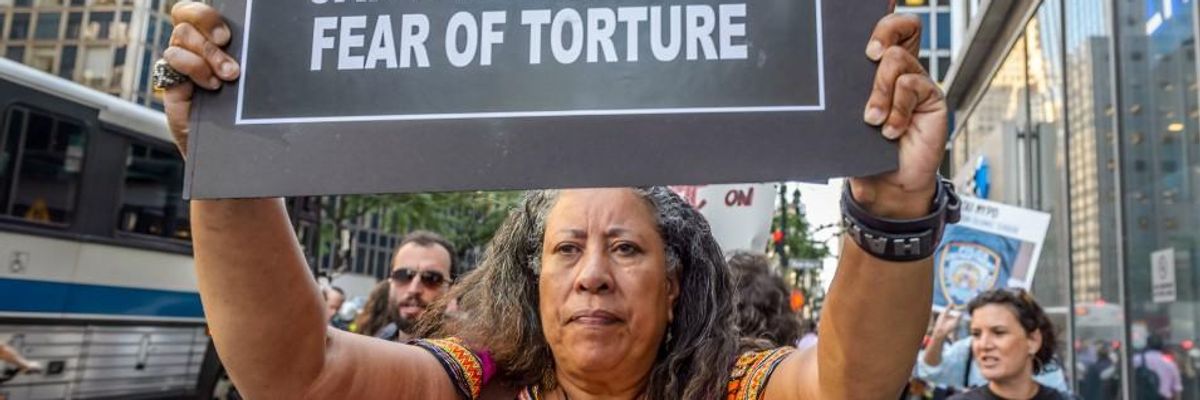
(PHOTO TAKEN PRE-PANDEMIC) Protesters march in support of the pro-Palestinian BDS movement in New York City. (Photo: Erik McGregor/Pacific Press/LightRocket via Getty Images)
Andrew DeMillo at the Associated Press reports that a 3-judge panel of the 8th U.S. Circuit Court of Appeals in St. Louis has struck down an Arkansas law requiring contractors with the state to sign a pledge not to boycott Israel.
The alternative print monthly the Arkansas Times carried advertising from the University of Arkansas - Pulaski Technical College. When the law was passed, the university demanded that owner Alan Leveritt sign the pledge not to boycott. Leveritt does not boycott Israel, but he absolutely refused to sign any such constraint on his and his reporters' freedom of speech, which had the effect of abrogating their First Amendment rights. UA-PTC thus pulled their advertising and Leveritt sued them with the help of the American Civil Liberties Union.
The 8th Circuit has upheld Leveritt's right to freedom of speech.
DeMillo writes,
"The court said the law is written so broadly that it would also apply to vendors that support or promote a boycott.
"The Act prohibits the contractor from engaging in boycott activity outside the scope of the contractual relationship 'on its own time and dime,'" the court said in its 2-1 decision. "Such a restriction violates the First Amendment."
The supporters of the anti-boycott law will not tell you that state universities consider professors who come to give talks on their campuses to be sole proprietors of a business for tax purposes, and so speakers invited to campus cannot be paid an honorarium or be reimbursed for their travel expenses unless they sign the anti-boycott pledge. These laws are thus they biggest threats to campus free speech ever seen in the history of the United States.
I don't myself boycott Israel proper, though I do boycott Israeli squatter settlements on the West Bank, but I would not sign a statement such as was demanded by the Arkansas state government and so would have been effectively prevented from speaking at the University of Arkansas.
The anti-boycott laws are the ultimate in cancel culture.
They are also un-American. The Boston Tea Party was a boycott of a British commodity because of American feelings that the British government was taxing them without representation.
Some 32 states have passed laws prohibiting the boycott of Israel. Whenever these laws have been challenged in the courts, they have been struck down, and they are clearly unconstitutional. The laws are backed by Israel's cabinet-level Ministry of Strategic Affairs and are a clear and systematic attack on the basic rights of Americans.
The proponents of boycotting Israel are making a stand against that country's policy of keeping 5 million Palestinians stateless and without basic human rights under Israeli military rule.
Boycotting the state of Israel, refusing to buy its bonds or give it money or take money from it is not the same as acting in a discriminatory way toward Jews. Some 20% of Israelis are not Jews in any case.
African-American boycotts of white discriminatory businesses were key to the victory of the Civil Rights movement in the 1920s (see below).
The right wing in America routinely gets up boycotts. Trump supporters boycotted Walmart because it carried t-shirts saying "Impeach Trump." The powerful far-right American Family Association also launched a boycott of Walmart because the company put out an ad that was gay friendly. Trump supporters boycotted Netflix over the company's deal to have Barack and Michelle Obama produce content. The Trump movement, tinged with fascism and white supremacism, has advocated large numbers of boycotts of companies- Starbucks, Nike, Nordstrom's even Oreo.
Republican Senator Rick Scott has urged a U.S. boycott of China.
Would that be a violation of the civil rights of Chinese-Americans or a form of racial discrimination? Of course not. China is a sovereign country, as is Israel, and Americans are free not to do business with a country to whose policies they object.
For the right to boycott as a first amendment right, the key case is NAACP v. Claiborne Hardware, which came out of the Civil Rights movement and the assassination of the Rev. Martin Luther King, Jr.
[I]n 1968, Martin Luther King, Jr. was assassinated, and a young black man, Roosevelt Jackson was shot and killed by two Port Gibson police officers. On April 19, 1968, the field secretary of the NAACP for Mississippi, Charles Evers, led a march to the Claiborne County courthouse and demanded that the entire Port Jefferson police force be discharged When the demand was not met, the boycott on the merchants was [imposed]. On April 21, Evers made a speech in which he said, "If we catch any of you going into these racist stores, we're going to break your damn neck." ... In at least 10 instances, blacks who violated the boycott experienced instances of violence, including shots fired into their homes, bricks thrown through their windshields, and tires on their cars slashed. Five of the incidents occurred in 1966, and were not correlated to Mr. Evers' speech, and the other 5 were undated, and so they were discarded from the court case. . .
"On October 31, 1969, 17 of the merchants sued in the Chancery Court of Hinds County, 146 individuals, the NAACP, and Mississippi Action for Progress (MAP) in state court to recover losses caused by the boycott and to enjoin future boycott activity . . . A trial began in 1973 and, in 1976, the chancellor found that the black defendants were jointly and severally liable to the plaintiffs based on three separate theories: (1) for a tort of malicious interference with the plaintiff's business; (2) for violation of a Mississippi statute banning secondary boycotts on the theory that the defendants' primary dispute was with the governing authorities of Port Gibson and Claiborne County, and not with the white merchants at whom the boycott was directed; and (3) the court found a violation of Mississippi's antitrust statute . . .
"In a decision by Justice Stevens, the Supreme Court reversed the Supreme Court of Mississippi's decision, holding that the nonviolent elements of the petitioners' activities were protected by the First Amendment to the Constitution of the United States and holding that the petitioners were not liable in damages for the consequences of their nonviolent, protected activity. This decision means that "boycotts and related activities to bring about political, social and economic change are political speech, occupying "the highest rung of the hierarchy of First Amendment values."
The Supreme Court found for the NAACP and against Claiborne Hardware in 1982: "While States have broad power to regulate economic activities, there is no comparable right to prohibit peaceful political activity such as that found in the boycott in this case."
Dear Common Dreams reader, It’s been nearly 30 years since I co-founded Common Dreams with my late wife, Lina Newhouser. We had the radical notion that journalism should serve the public good, not corporate profits. It was clear to us from the outset what it would take to build such a project. No paid advertisements. No corporate sponsors. No millionaire publisher telling us what to think or do. Many people said we wouldn't last a year, but we proved those doubters wrong. Together with a tremendous team of journalists and dedicated staff, we built an independent media outlet free from the constraints of profits and corporate control. Our mission has always been simple: To inform. To inspire. To ignite change for the common good. Building Common Dreams was not easy. Our survival was never guaranteed. When you take on the most powerful forces—Wall Street greed, fossil fuel industry destruction, Big Tech lobbyists, and uber-rich oligarchs who have spent billions upon billions rigging the economy and democracy in their favor—the only bulwark you have is supporters who believe in your work. But here’s the urgent message from me today. It's never been this bad out there. And it's never been this hard to keep us going. At the very moment Common Dreams is most needed, the threats we face are intensifying. We need your support now more than ever. We don't accept corporate advertising and never will. We don't have a paywall because we don't think people should be blocked from critical news based on their ability to pay. Everything we do is funded by the donations of readers like you. When everyone does the little they can afford, we are strong. But if that support retreats or dries up, so do we. Will you donate now to make sure Common Dreams not only survives but thrives? —Craig Brown, Co-founder |
Andrew DeMillo at the Associated Press reports that a 3-judge panel of the 8th U.S. Circuit Court of Appeals in St. Louis has struck down an Arkansas law requiring contractors with the state to sign a pledge not to boycott Israel.
The alternative print monthly the Arkansas Times carried advertising from the University of Arkansas - Pulaski Technical College. When the law was passed, the university demanded that owner Alan Leveritt sign the pledge not to boycott. Leveritt does not boycott Israel, but he absolutely refused to sign any such constraint on his and his reporters' freedom of speech, which had the effect of abrogating their First Amendment rights. UA-PTC thus pulled their advertising and Leveritt sued them with the help of the American Civil Liberties Union.
The 8th Circuit has upheld Leveritt's right to freedom of speech.
DeMillo writes,
"The court said the law is written so broadly that it would also apply to vendors that support or promote a boycott.
"The Act prohibits the contractor from engaging in boycott activity outside the scope of the contractual relationship 'on its own time and dime,'" the court said in its 2-1 decision. "Such a restriction violates the First Amendment."
The supporters of the anti-boycott law will not tell you that state universities consider professors who come to give talks on their campuses to be sole proprietors of a business for tax purposes, and so speakers invited to campus cannot be paid an honorarium or be reimbursed for their travel expenses unless they sign the anti-boycott pledge. These laws are thus they biggest threats to campus free speech ever seen in the history of the United States.
I don't myself boycott Israel proper, though I do boycott Israeli squatter settlements on the West Bank, but I would not sign a statement such as was demanded by the Arkansas state government and so would have been effectively prevented from speaking at the University of Arkansas.
The anti-boycott laws are the ultimate in cancel culture.
They are also un-American. The Boston Tea Party was a boycott of a British commodity because of American feelings that the British government was taxing them without representation.
Some 32 states have passed laws prohibiting the boycott of Israel. Whenever these laws have been challenged in the courts, they have been struck down, and they are clearly unconstitutional. The laws are backed by Israel's cabinet-level Ministry of Strategic Affairs and are a clear and systematic attack on the basic rights of Americans.
The proponents of boycotting Israel are making a stand against that country's policy of keeping 5 million Palestinians stateless and without basic human rights under Israeli military rule.
Boycotting the state of Israel, refusing to buy its bonds or give it money or take money from it is not the same as acting in a discriminatory way toward Jews. Some 20% of Israelis are not Jews in any case.
African-American boycotts of white discriminatory businesses were key to the victory of the Civil Rights movement in the 1920s (see below).
The right wing in America routinely gets up boycotts. Trump supporters boycotted Walmart because it carried t-shirts saying "Impeach Trump." The powerful far-right American Family Association also launched a boycott of Walmart because the company put out an ad that was gay friendly. Trump supporters boycotted Netflix over the company's deal to have Barack and Michelle Obama produce content. The Trump movement, tinged with fascism and white supremacism, has advocated large numbers of boycotts of companies- Starbucks, Nike, Nordstrom's even Oreo.
Republican Senator Rick Scott has urged a U.S. boycott of China.
Would that be a violation of the civil rights of Chinese-Americans or a form of racial discrimination? Of course not. China is a sovereign country, as is Israel, and Americans are free not to do business with a country to whose policies they object.
For the right to boycott as a first amendment right, the key case is NAACP v. Claiborne Hardware, which came out of the Civil Rights movement and the assassination of the Rev. Martin Luther King, Jr.
[I]n 1968, Martin Luther King, Jr. was assassinated, and a young black man, Roosevelt Jackson was shot and killed by two Port Gibson police officers. On April 19, 1968, the field secretary of the NAACP for Mississippi, Charles Evers, led a march to the Claiborne County courthouse and demanded that the entire Port Jefferson police force be discharged When the demand was not met, the boycott on the merchants was [imposed]. On April 21, Evers made a speech in which he said, "If we catch any of you going into these racist stores, we're going to break your damn neck." ... In at least 10 instances, blacks who violated the boycott experienced instances of violence, including shots fired into their homes, bricks thrown through their windshields, and tires on their cars slashed. Five of the incidents occurred in 1966, and were not correlated to Mr. Evers' speech, and the other 5 were undated, and so they were discarded from the court case. . .
"On October 31, 1969, 17 of the merchants sued in the Chancery Court of Hinds County, 146 individuals, the NAACP, and Mississippi Action for Progress (MAP) in state court to recover losses caused by the boycott and to enjoin future boycott activity . . . A trial began in 1973 and, in 1976, the chancellor found that the black defendants were jointly and severally liable to the plaintiffs based on three separate theories: (1) for a tort of malicious interference with the plaintiff's business; (2) for violation of a Mississippi statute banning secondary boycotts on the theory that the defendants' primary dispute was with the governing authorities of Port Gibson and Claiborne County, and not with the white merchants at whom the boycott was directed; and (3) the court found a violation of Mississippi's antitrust statute . . .
"In a decision by Justice Stevens, the Supreme Court reversed the Supreme Court of Mississippi's decision, holding that the nonviolent elements of the petitioners' activities were protected by the First Amendment to the Constitution of the United States and holding that the petitioners were not liable in damages for the consequences of their nonviolent, protected activity. This decision means that "boycotts and related activities to bring about political, social and economic change are political speech, occupying "the highest rung of the hierarchy of First Amendment values."
The Supreme Court found for the NAACP and against Claiborne Hardware in 1982: "While States have broad power to regulate economic activities, there is no comparable right to prohibit peaceful political activity such as that found in the boycott in this case."
Andrew DeMillo at the Associated Press reports that a 3-judge panel of the 8th U.S. Circuit Court of Appeals in St. Louis has struck down an Arkansas law requiring contractors with the state to sign a pledge not to boycott Israel.
The alternative print monthly the Arkansas Times carried advertising from the University of Arkansas - Pulaski Technical College. When the law was passed, the university demanded that owner Alan Leveritt sign the pledge not to boycott. Leveritt does not boycott Israel, but he absolutely refused to sign any such constraint on his and his reporters' freedom of speech, which had the effect of abrogating their First Amendment rights. UA-PTC thus pulled their advertising and Leveritt sued them with the help of the American Civil Liberties Union.
The 8th Circuit has upheld Leveritt's right to freedom of speech.
DeMillo writes,
"The court said the law is written so broadly that it would also apply to vendors that support or promote a boycott.
"The Act prohibits the contractor from engaging in boycott activity outside the scope of the contractual relationship 'on its own time and dime,'" the court said in its 2-1 decision. "Such a restriction violates the First Amendment."
The supporters of the anti-boycott law will not tell you that state universities consider professors who come to give talks on their campuses to be sole proprietors of a business for tax purposes, and so speakers invited to campus cannot be paid an honorarium or be reimbursed for their travel expenses unless they sign the anti-boycott pledge. These laws are thus they biggest threats to campus free speech ever seen in the history of the United States.
I don't myself boycott Israel proper, though I do boycott Israeli squatter settlements on the West Bank, but I would not sign a statement such as was demanded by the Arkansas state government and so would have been effectively prevented from speaking at the University of Arkansas.
The anti-boycott laws are the ultimate in cancel culture.
They are also un-American. The Boston Tea Party was a boycott of a British commodity because of American feelings that the British government was taxing them without representation.
Some 32 states have passed laws prohibiting the boycott of Israel. Whenever these laws have been challenged in the courts, they have been struck down, and they are clearly unconstitutional. The laws are backed by Israel's cabinet-level Ministry of Strategic Affairs and are a clear and systematic attack on the basic rights of Americans.
The proponents of boycotting Israel are making a stand against that country's policy of keeping 5 million Palestinians stateless and without basic human rights under Israeli military rule.
Boycotting the state of Israel, refusing to buy its bonds or give it money or take money from it is not the same as acting in a discriminatory way toward Jews. Some 20% of Israelis are not Jews in any case.
African-American boycotts of white discriminatory businesses were key to the victory of the Civil Rights movement in the 1920s (see below).
The right wing in America routinely gets up boycotts. Trump supporters boycotted Walmart because it carried t-shirts saying "Impeach Trump." The powerful far-right American Family Association also launched a boycott of Walmart because the company put out an ad that was gay friendly. Trump supporters boycotted Netflix over the company's deal to have Barack and Michelle Obama produce content. The Trump movement, tinged with fascism and white supremacism, has advocated large numbers of boycotts of companies- Starbucks, Nike, Nordstrom's even Oreo.
Republican Senator Rick Scott has urged a U.S. boycott of China.
Would that be a violation of the civil rights of Chinese-Americans or a form of racial discrimination? Of course not. China is a sovereign country, as is Israel, and Americans are free not to do business with a country to whose policies they object.
For the right to boycott as a first amendment right, the key case is NAACP v. Claiborne Hardware, which came out of the Civil Rights movement and the assassination of the Rev. Martin Luther King, Jr.
[I]n 1968, Martin Luther King, Jr. was assassinated, and a young black man, Roosevelt Jackson was shot and killed by two Port Gibson police officers. On April 19, 1968, the field secretary of the NAACP for Mississippi, Charles Evers, led a march to the Claiborne County courthouse and demanded that the entire Port Jefferson police force be discharged When the demand was not met, the boycott on the merchants was [imposed]. On April 21, Evers made a speech in which he said, "If we catch any of you going into these racist stores, we're going to break your damn neck." ... In at least 10 instances, blacks who violated the boycott experienced instances of violence, including shots fired into their homes, bricks thrown through their windshields, and tires on their cars slashed. Five of the incidents occurred in 1966, and were not correlated to Mr. Evers' speech, and the other 5 were undated, and so they were discarded from the court case. . .
"On October 31, 1969, 17 of the merchants sued in the Chancery Court of Hinds County, 146 individuals, the NAACP, and Mississippi Action for Progress (MAP) in state court to recover losses caused by the boycott and to enjoin future boycott activity . . . A trial began in 1973 and, in 1976, the chancellor found that the black defendants were jointly and severally liable to the plaintiffs based on three separate theories: (1) for a tort of malicious interference with the plaintiff's business; (2) for violation of a Mississippi statute banning secondary boycotts on the theory that the defendants' primary dispute was with the governing authorities of Port Gibson and Claiborne County, and not with the white merchants at whom the boycott was directed; and (3) the court found a violation of Mississippi's antitrust statute . . .
"In a decision by Justice Stevens, the Supreme Court reversed the Supreme Court of Mississippi's decision, holding that the nonviolent elements of the petitioners' activities were protected by the First Amendment to the Constitution of the United States and holding that the petitioners were not liable in damages for the consequences of their nonviolent, protected activity. This decision means that "boycotts and related activities to bring about political, social and economic change are political speech, occupying "the highest rung of the hierarchy of First Amendment values."
The Supreme Court found for the NAACP and against Claiborne Hardware in 1982: "While States have broad power to regulate economic activities, there is no comparable right to prohibit peaceful political activity such as that found in the boycott in this case."