
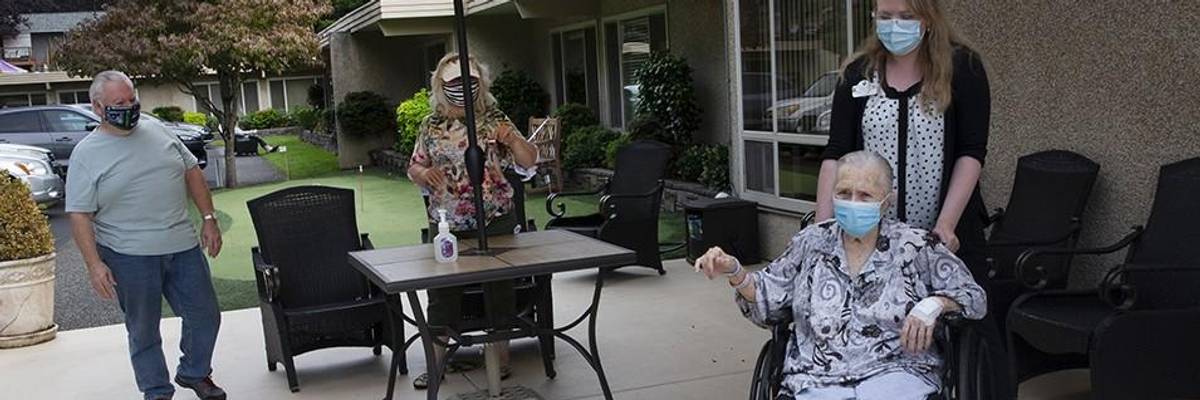
An important aspect of this momentous tragedy is that the coronavirus death rate has been significantly higher in private, profit-making homes than in not-for-profit homes. (Photo: Karen Ducey/Getty Images)
Long-Term Care Fiasco a Warning About Private Ownership
The private sector almost always does things to make a profit, and that can leave the rest of us paying a high price—in dollars and deaths.
Please put me in a long-term-care home, said nobody ever.
Still, few probably expected that these homes would become horror houses of death, taking their place at the very epicentre of a raging pandemic and accounting for some 75 per cent of coronavirus deaths in Ontario.
An important aspect of this momentous tragedy is that the coronavirus death rate has been significantly higher in private, profit-making homes than in not-for-profit homes.
If that wasn't alarming enough, then came the news earlier this week that private equity -- known for ruthlessly squeezing every ounce of profit out of its businesses -- is keenly eying the long-term care industry in Ontario.
Indeed, the private equity firm Arch Venture Holdings is lining up investors as it gears up to become a major player in the industry, the Star reported.
All this should heighten concerns about the role of profit-making in long-term care homes (also known as nursing homes).
Privatization has become a kind of economic dogma in recent years, with business commentators and politicians routinely asserting that the private sector is more efficient and always does things better -- an assertion that is rarely accompanied by any evidence.
In fact, the crucial difference separating the private and public sectors is that the private sector is focused on profit-making. Indeed, this is the only real purpose of a business enterprise.
So, regardless of what industry spokespeople say, a private company in the nursing home business is focused on maximizing profits, as its board of directors demands.
And it will typically do this by scrimping on staff costs -- hiring fewer workers and paying them rock-bottom wages with no benefits. This generally results in high turnover and worse conditions for the residents, as well as the workers.
Certainly, Ontario's three big private nursing home chains, which receive government funding under the same formula as not-for-profit homes, have been good at maximizing profits.
Over the past decade, the three chains paid out $1.5 billion in dividends to shareholders and $138 million in executive pay, according to the Star investigation.
The chains insist these payouts come out of profits they earn selling private services to residents in these and other retirement homes, which are not funded by government.
In fact, it's hard to know exactly what's going on, since the government is notoriously lax in its regulations and oversight of the industry -- as the pandemic vividly illustrates.
This laxness appears to be traceable back to Mike Harris, the former Conservative premier whose government removed minimum staffing levels for nursing homes in the late 1990s and encouraged the involvement of private businesses.
After retiring from politics in 2002, Harris has profited handsomely from the lucrative private nursing home industry he helped create, serving as chairman of Chartwell Retirement Residences, one of the three big chains. (His annual salary for this part-time position is $229,500, and he has $4.4 million in Chartwell holdings.)
Meanwhile, in the 28 nursing homes Chartwell owns or operates in Ontario, the COVID-19 infection rate has been 47 per cent higher and the fatality rate 68 per cent higher than the provincial average, according to the Star investigation.
The nursing home market isn't the only area where Mike Harris' privatization policies still reverberate.
His 1999 privatization of Highway 407 has already cost Ontario drivers billions in higher tolls and will cost them many more billions before the privatization deal expires -- in 78 years.
Contrary to business mythology, the private sector doesn't always do things better. Rather, it always does things to make a profit, and that can leave the rest of us paying a high price -- in dollars and deaths.
We are at a crossroads
This country and this world are at a monumental crossroads. In a few short weeks, US voters will have an opportunity to beat back the forces of fascism and confront the billionaires who are rigging the economy, our media system, and our democracy, making it increasingly impossible for ordinary people to get by. We’re not just talking about the election. We’re talking about what must be done once these fascist elements are vanquished from power. We need a bolder set of solutions than what either major party has so far been willing to offer and a working-class movement ready to fight like hell for it. Trump didn't emerge from nowhere. The conditions that fueled MAGA authoritarianism were created by decades of radical neoliberal economic policies and a corrupt political system dominated by corporate interests. They slashed taxes on the super-rich, promising that the benefits would trickle down. They said giveaways to the corporate titans would make life more affordable for the rest of us. It was all bullshit. And when a bitter, betrayed populace searches for someone to blame, right-wing demagogues have little trouble finding scapegoats. People know when they're being lied to, but you won't hear any of this from the corporate media. Only independent journalism—powered and funded by people who believe in building a better world—can deliver truly trustworthy daily news. Our Fall Campaign is underway, and we need your help. To power our newsroom through the rest of the year, we need to raise $125,000 by midnight on October 31. So if you share our vision, please contribute whatever you can to sustain our work. |
Please put me in a long-term-care home, said nobody ever.
Still, few probably expected that these homes would become horror houses of death, taking their place at the very epicentre of a raging pandemic and accounting for some 75 per cent of coronavirus deaths in Ontario.
An important aspect of this momentous tragedy is that the coronavirus death rate has been significantly higher in private, profit-making homes than in not-for-profit homes.
If that wasn't alarming enough, then came the news earlier this week that private equity -- known for ruthlessly squeezing every ounce of profit out of its businesses -- is keenly eying the long-term care industry in Ontario.
Indeed, the private equity firm Arch Venture Holdings is lining up investors as it gears up to become a major player in the industry, the Star reported.
All this should heighten concerns about the role of profit-making in long-term care homes (also known as nursing homes).
Privatization has become a kind of economic dogma in recent years, with business commentators and politicians routinely asserting that the private sector is more efficient and always does things better -- an assertion that is rarely accompanied by any evidence.
In fact, the crucial difference separating the private and public sectors is that the private sector is focused on profit-making. Indeed, this is the only real purpose of a business enterprise.
So, regardless of what industry spokespeople say, a private company in the nursing home business is focused on maximizing profits, as its board of directors demands.
And it will typically do this by scrimping on staff costs -- hiring fewer workers and paying them rock-bottom wages with no benefits. This generally results in high turnover and worse conditions for the residents, as well as the workers.
Certainly, Ontario's three big private nursing home chains, which receive government funding under the same formula as not-for-profit homes, have been good at maximizing profits.
Over the past decade, the three chains paid out $1.5 billion in dividends to shareholders and $138 million in executive pay, according to the Star investigation.
The chains insist these payouts come out of profits they earn selling private services to residents in these and other retirement homes, which are not funded by government.
In fact, it's hard to know exactly what's going on, since the government is notoriously lax in its regulations and oversight of the industry -- as the pandemic vividly illustrates.
This laxness appears to be traceable back to Mike Harris, the former Conservative premier whose government removed minimum staffing levels for nursing homes in the late 1990s and encouraged the involvement of private businesses.
After retiring from politics in 2002, Harris has profited handsomely from the lucrative private nursing home industry he helped create, serving as chairman of Chartwell Retirement Residences, one of the three big chains. (His annual salary for this part-time position is $229,500, and he has $4.4 million in Chartwell holdings.)
Meanwhile, in the 28 nursing homes Chartwell owns or operates in Ontario, the COVID-19 infection rate has been 47 per cent higher and the fatality rate 68 per cent higher than the provincial average, according to the Star investigation.
The nursing home market isn't the only area where Mike Harris' privatization policies still reverberate.
His 1999 privatization of Highway 407 has already cost Ontario drivers billions in higher tolls and will cost them many more billions before the privatization deal expires -- in 78 years.
Contrary to business mythology, the private sector doesn't always do things better. Rather, it always does things to make a profit, and that can leave the rest of us paying a high price -- in dollars and deaths.