SUBSCRIBE TO OUR FREE NEWSLETTER
Daily news & progressive opinion—funded by the people, not the corporations—delivered straight to your inbox.
5
#000000
#FFFFFF
To donate by check, phone, or other method, see our More Ways to Give page.
Daily news & progressive opinion—funded by the people, not the corporations—delivered straight to your inbox.
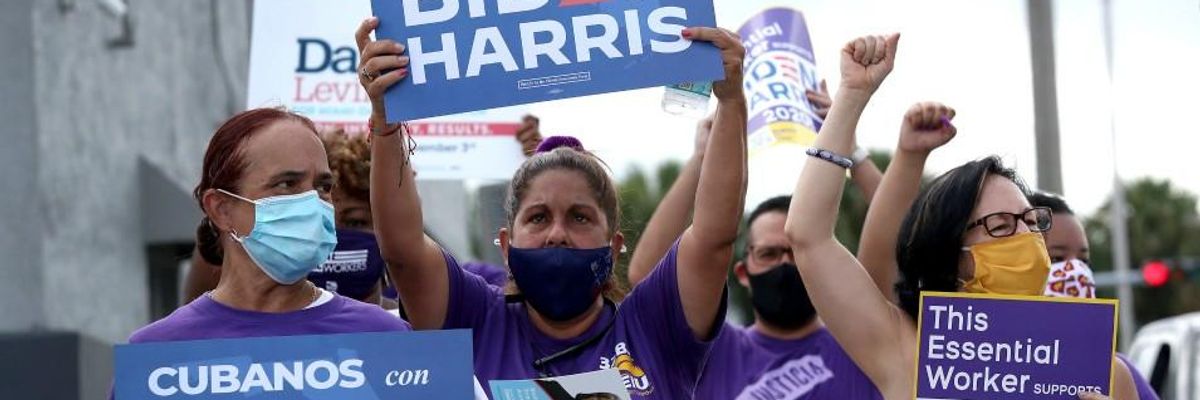
People show their support as they participate in a caravan for Democratic presidential nominee Joe Biden event on October 11, 2020 in Miami Springs, Florida. (Photo: Joe Raedle/Getty Images)
A Trump-aligned group called Citizen Voter, Inc. is spending millions of dollars to push model state constitutional reform to prevent political rights from being extended to non-citizens. The reform changes state constitutions to say only citizens can vote. The group, founded in 2018, won major victories last week in Alabama, Florida and Colorado. (North Dakota passed its model reform in 2018.)
Citizen Voter, Inc. portrays non-citizen voting as a "loophole" in the law. "How is this possible?" one of its spokesperson asks.
Non-citizen voting was once commonplace in the United States (when immigrants were whiter). Between 1776 and 1926, non-citizens were--at different periods of time--allowed to vote in 40 states and territories. In 1875, the U.S. Supreme Court held that, "citizenship has not in all cases been made a condition precedent to the enjoyment of the right of suffrage."
However, as Jim Crow laws began to be passed, so too did a wave of xenophobic laws to rollback non-citizen suffrage. (At this time incoming migration was shifting away from Western countries.)
In this era, non-citizen suffrage was banned in Alabama (1901), Colorado (1902), Wisconsin (1908), and Oregon (1914). In 1918, Kansas, Nebraska, and South Dakota all changed their constitutions to ban non-citizen voting. Indiana and Texas (1921), Mississippi (1924), and Arkansas (1926) all followed suit. Today, there is a patchwork of state laws.
Now, the contradictions are coming to a head. On the one had, the Declaration of Independence promises that democracies gain their legitimacy from the "consent of the governed." On the other, millions of people are disenfranchised from voting by immigration laws.
In the United States, the issue is entering the zeitgeist. Groups like the Poor People's Campaign: A National Call for Moral Revival have slowly begun to frame immigration policy as a voting rights issue.
In recent years, laws to recognize non-citizens' political rights have passed in a dozen Maryland municipalities, a few places in Massachusetts, Maine, and San Francisco, where non-citizen parents are now allowed to vote in School Board elections.
All of this frightens Trump-admirers like Citizen Voter, Inc.'s John Loudon. "There is controversy about the extent to which non-citizens are already voting illegally," he has said. On social media, Loudon says voter fraud was "rampant" in last week's election, he calls Trump a "gift," and asks questions like: "What is more beautiful than a rock star in his prime becoming a Christian and authoring a gorgeous love song to coax his beloved wife to salvation?"
He also says he "Live[s] in vacay places," like "SoFlo," where he now resides.
Loudon is not alone. U.S. Representative Jeff Duncan (South Carolina), for example, has railed against non-citizen voting in National Review. Non-citizen voting, he complained, "would preclude countries from providing different rights to different people based on immigration status." In 2018, Duncan introduced a bill in the U.S. House of Representatives that proposed freezing all federal funding to states and local governments that allow non-citizens to vote.
There's Money in Attacking Non-Citizen Suffrage
To get its agenda passed last week in Florida, Citizen Voters Inc. spent a whopping $8.3 million. Ballotpedia, a leading ballot and elections index, did not identify any formal opposition.
Citizen Voter, Inc spent $1.4 million through cash and in-kind contributions in Colorado. It paid off. There was almost no formal opposition to the measure; the opposition campaign, if you can call it that, received no cash contributions. Its top spender was the ACLU of Colorado, which donated $5,058.90 in in-kind contributions.
In Alabama, the group had an even easier time. There, the legislature voluntarily placed the reform on the ballot. (Not one legislator voted against putting the question on the ballot, though some Democrats did abstain from voting.)
All of this is being advanced by rubby red conservatives. In Alabama, the reform was championed by the head of the Alabama Senate, Senator Del Marsh (R), who in 2012 took it upon himself to sugar coat a xenophobic Alabama law, and said he supported a "show me your papers" provision, so long as it only applied to drivers, and not car passengers.
Why The Lack of Opposition?
Western "democracies" allege to believe that all people who are subject to the laws of a society possess inherent political rights to change those laws. However, in modern politics, this basic democratic ethic rarely gets extended to non-citizens.
When it comes to non-citizens or refugees, our "democracies" quickly put their heads down and act like they don't see political disenfranchisement. They pretend non-citizens don't get taxed without representation. They act like the consent to be governed is not necessary. It's just assumed that people who are not citizens shouldn't be allowed to vote--even though they breathe the same air, drink the same water, attend the same schools, fight the same wars, populate the same prisons, spread the same viruses, and obey the same laws.
The issue of political representation and resources for non-citizens preoccupies the rightwing. It keeps them up at night. It's why they excluded undocumented people and their families from the CARES Act, it's why they tried to add a citizenship question to the U.S. Census, it's why they want a wall.
It's why Citizen Voters Inc. exists.
A line of thinking that defends a basic human right to political participation absolutely terrifies them--as well it should.
Despite almost no resources for the opposition campaigns, 3.7 million people in Alabama, Florida, and Colorado voted not to exclude non-citizens from voting.
Dear Common Dreams reader, It’s been nearly 30 years since I co-founded Common Dreams with my late wife, Lina Newhouser. We had the radical notion that journalism should serve the public good, not corporate profits. It was clear to us from the outset what it would take to build such a project. No paid advertisements. No corporate sponsors. No millionaire publisher telling us what to think or do. Many people said we wouldn't last a year, but we proved those doubters wrong. Together with a tremendous team of journalists and dedicated staff, we built an independent media outlet free from the constraints of profits and corporate control. Our mission has always been simple: To inform. To inspire. To ignite change for the common good. Building Common Dreams was not easy. Our survival was never guaranteed. When you take on the most powerful forces—Wall Street greed, fossil fuel industry destruction, Big Tech lobbyists, and uber-rich oligarchs who have spent billions upon billions rigging the economy and democracy in their favor—the only bulwark you have is supporters who believe in your work. But here’s the urgent message from me today. It's never been this bad out there. And it's never been this hard to keep us going. At the very moment Common Dreams is most needed, the threats we face are intensifying. We need your support now more than ever. We don't accept corporate advertising and never will. We don't have a paywall because we don't think people should be blocked from critical news based on their ability to pay. Everything we do is funded by the donations of readers like you. When everyone does the little they can afford, we are strong. But if that support retreats or dries up, so do we. Will you donate now to make sure Common Dreams not only survives but thrives? —Craig Brown, Co-founder |
A Trump-aligned group called Citizen Voter, Inc. is spending millions of dollars to push model state constitutional reform to prevent political rights from being extended to non-citizens. The reform changes state constitutions to say only citizens can vote. The group, founded in 2018, won major victories last week in Alabama, Florida and Colorado. (North Dakota passed its model reform in 2018.)
Citizen Voter, Inc. portrays non-citizen voting as a "loophole" in the law. "How is this possible?" one of its spokesperson asks.
Non-citizen voting was once commonplace in the United States (when immigrants were whiter). Between 1776 and 1926, non-citizens were--at different periods of time--allowed to vote in 40 states and territories. In 1875, the U.S. Supreme Court held that, "citizenship has not in all cases been made a condition precedent to the enjoyment of the right of suffrage."
However, as Jim Crow laws began to be passed, so too did a wave of xenophobic laws to rollback non-citizen suffrage. (At this time incoming migration was shifting away from Western countries.)
In this era, non-citizen suffrage was banned in Alabama (1901), Colorado (1902), Wisconsin (1908), and Oregon (1914). In 1918, Kansas, Nebraska, and South Dakota all changed their constitutions to ban non-citizen voting. Indiana and Texas (1921), Mississippi (1924), and Arkansas (1926) all followed suit. Today, there is a patchwork of state laws.
Now, the contradictions are coming to a head. On the one had, the Declaration of Independence promises that democracies gain their legitimacy from the "consent of the governed." On the other, millions of people are disenfranchised from voting by immigration laws.
In the United States, the issue is entering the zeitgeist. Groups like the Poor People's Campaign: A National Call for Moral Revival have slowly begun to frame immigration policy as a voting rights issue.
In recent years, laws to recognize non-citizens' political rights have passed in a dozen Maryland municipalities, a few places in Massachusetts, Maine, and San Francisco, where non-citizen parents are now allowed to vote in School Board elections.
All of this frightens Trump-admirers like Citizen Voter, Inc.'s John Loudon. "There is controversy about the extent to which non-citizens are already voting illegally," he has said. On social media, Loudon says voter fraud was "rampant" in last week's election, he calls Trump a "gift," and asks questions like: "What is more beautiful than a rock star in his prime becoming a Christian and authoring a gorgeous love song to coax his beloved wife to salvation?"
He also says he "Live[s] in vacay places," like "SoFlo," where he now resides.
Loudon is not alone. U.S. Representative Jeff Duncan (South Carolina), for example, has railed against non-citizen voting in National Review. Non-citizen voting, he complained, "would preclude countries from providing different rights to different people based on immigration status." In 2018, Duncan introduced a bill in the U.S. House of Representatives that proposed freezing all federal funding to states and local governments that allow non-citizens to vote.
There's Money in Attacking Non-Citizen Suffrage
To get its agenda passed last week in Florida, Citizen Voters Inc. spent a whopping $8.3 million. Ballotpedia, a leading ballot and elections index, did not identify any formal opposition.
Citizen Voter, Inc spent $1.4 million through cash and in-kind contributions in Colorado. It paid off. There was almost no formal opposition to the measure; the opposition campaign, if you can call it that, received no cash contributions. Its top spender was the ACLU of Colorado, which donated $5,058.90 in in-kind contributions.
In Alabama, the group had an even easier time. There, the legislature voluntarily placed the reform on the ballot. (Not one legislator voted against putting the question on the ballot, though some Democrats did abstain from voting.)
All of this is being advanced by rubby red conservatives. In Alabama, the reform was championed by the head of the Alabama Senate, Senator Del Marsh (R), who in 2012 took it upon himself to sugar coat a xenophobic Alabama law, and said he supported a "show me your papers" provision, so long as it only applied to drivers, and not car passengers.
Why The Lack of Opposition?
Western "democracies" allege to believe that all people who are subject to the laws of a society possess inherent political rights to change those laws. However, in modern politics, this basic democratic ethic rarely gets extended to non-citizens.
When it comes to non-citizens or refugees, our "democracies" quickly put their heads down and act like they don't see political disenfranchisement. They pretend non-citizens don't get taxed without representation. They act like the consent to be governed is not necessary. It's just assumed that people who are not citizens shouldn't be allowed to vote--even though they breathe the same air, drink the same water, attend the same schools, fight the same wars, populate the same prisons, spread the same viruses, and obey the same laws.
The issue of political representation and resources for non-citizens preoccupies the rightwing. It keeps them up at night. It's why they excluded undocumented people and their families from the CARES Act, it's why they tried to add a citizenship question to the U.S. Census, it's why they want a wall.
It's why Citizen Voters Inc. exists.
A line of thinking that defends a basic human right to political participation absolutely terrifies them--as well it should.
Despite almost no resources for the opposition campaigns, 3.7 million people in Alabama, Florida, and Colorado voted not to exclude non-citizens from voting.
A Trump-aligned group called Citizen Voter, Inc. is spending millions of dollars to push model state constitutional reform to prevent political rights from being extended to non-citizens. The reform changes state constitutions to say only citizens can vote. The group, founded in 2018, won major victories last week in Alabama, Florida and Colorado. (North Dakota passed its model reform in 2018.)
Citizen Voter, Inc. portrays non-citizen voting as a "loophole" in the law. "How is this possible?" one of its spokesperson asks.
Non-citizen voting was once commonplace in the United States (when immigrants were whiter). Between 1776 and 1926, non-citizens were--at different periods of time--allowed to vote in 40 states and territories. In 1875, the U.S. Supreme Court held that, "citizenship has not in all cases been made a condition precedent to the enjoyment of the right of suffrage."
However, as Jim Crow laws began to be passed, so too did a wave of xenophobic laws to rollback non-citizen suffrage. (At this time incoming migration was shifting away from Western countries.)
In this era, non-citizen suffrage was banned in Alabama (1901), Colorado (1902), Wisconsin (1908), and Oregon (1914). In 1918, Kansas, Nebraska, and South Dakota all changed their constitutions to ban non-citizen voting. Indiana and Texas (1921), Mississippi (1924), and Arkansas (1926) all followed suit. Today, there is a patchwork of state laws.
Now, the contradictions are coming to a head. On the one had, the Declaration of Independence promises that democracies gain their legitimacy from the "consent of the governed." On the other, millions of people are disenfranchised from voting by immigration laws.
In the United States, the issue is entering the zeitgeist. Groups like the Poor People's Campaign: A National Call for Moral Revival have slowly begun to frame immigration policy as a voting rights issue.
In recent years, laws to recognize non-citizens' political rights have passed in a dozen Maryland municipalities, a few places in Massachusetts, Maine, and San Francisco, where non-citizen parents are now allowed to vote in School Board elections.
All of this frightens Trump-admirers like Citizen Voter, Inc.'s John Loudon. "There is controversy about the extent to which non-citizens are already voting illegally," he has said. On social media, Loudon says voter fraud was "rampant" in last week's election, he calls Trump a "gift," and asks questions like: "What is more beautiful than a rock star in his prime becoming a Christian and authoring a gorgeous love song to coax his beloved wife to salvation?"
He also says he "Live[s] in vacay places," like "SoFlo," where he now resides.
Loudon is not alone. U.S. Representative Jeff Duncan (South Carolina), for example, has railed against non-citizen voting in National Review. Non-citizen voting, he complained, "would preclude countries from providing different rights to different people based on immigration status." In 2018, Duncan introduced a bill in the U.S. House of Representatives that proposed freezing all federal funding to states and local governments that allow non-citizens to vote.
There's Money in Attacking Non-Citizen Suffrage
To get its agenda passed last week in Florida, Citizen Voters Inc. spent a whopping $8.3 million. Ballotpedia, a leading ballot and elections index, did not identify any formal opposition.
Citizen Voter, Inc spent $1.4 million through cash and in-kind contributions in Colorado. It paid off. There was almost no formal opposition to the measure; the opposition campaign, if you can call it that, received no cash contributions. Its top spender was the ACLU of Colorado, which donated $5,058.90 in in-kind contributions.
In Alabama, the group had an even easier time. There, the legislature voluntarily placed the reform on the ballot. (Not one legislator voted against putting the question on the ballot, though some Democrats did abstain from voting.)
All of this is being advanced by rubby red conservatives. In Alabama, the reform was championed by the head of the Alabama Senate, Senator Del Marsh (R), who in 2012 took it upon himself to sugar coat a xenophobic Alabama law, and said he supported a "show me your papers" provision, so long as it only applied to drivers, and not car passengers.
Why The Lack of Opposition?
Western "democracies" allege to believe that all people who are subject to the laws of a society possess inherent political rights to change those laws. However, in modern politics, this basic democratic ethic rarely gets extended to non-citizens.
When it comes to non-citizens or refugees, our "democracies" quickly put their heads down and act like they don't see political disenfranchisement. They pretend non-citizens don't get taxed without representation. They act like the consent to be governed is not necessary. It's just assumed that people who are not citizens shouldn't be allowed to vote--even though they breathe the same air, drink the same water, attend the same schools, fight the same wars, populate the same prisons, spread the same viruses, and obey the same laws.
The issue of political representation and resources for non-citizens preoccupies the rightwing. It keeps them up at night. It's why they excluded undocumented people and their families from the CARES Act, it's why they tried to add a citizenship question to the U.S. Census, it's why they want a wall.
It's why Citizen Voters Inc. exists.
A line of thinking that defends a basic human right to political participation absolutely terrifies them--as well it should.
Despite almost no resources for the opposition campaigns, 3.7 million people in Alabama, Florida, and Colorado voted not to exclude non-citizens from voting.