SUBSCRIBE TO OUR FREE NEWSLETTER
Daily news & progressive opinion—funded by the people, not the corporations—delivered straight to your inbox.
5
#000000
#FFFFFF
To donate by check, phone, or other method, see our More Ways to Give page.
Daily news & progressive opinion—funded by the people, not the corporations—delivered straight to your inbox.
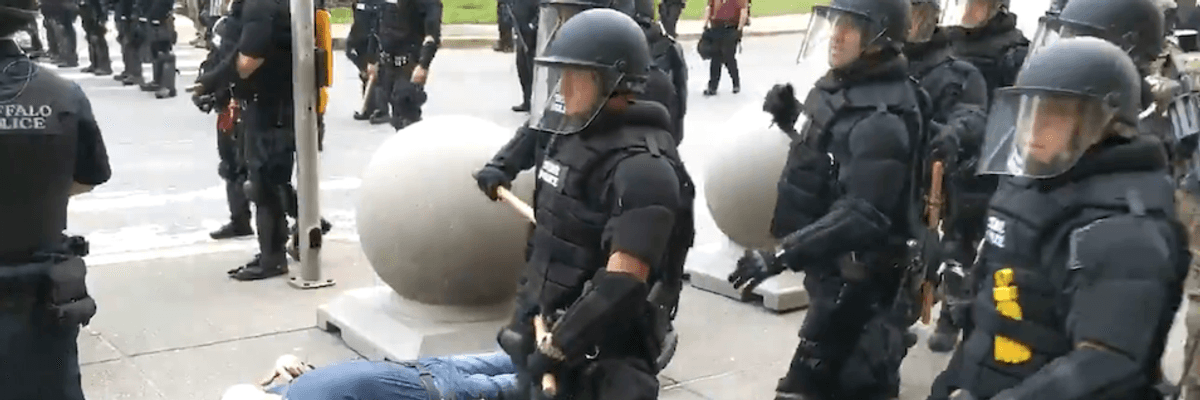
As a pediatrician, I find the entire concept of qualified immunity absurd.(Photo: Screengrab/WBFO)
In July, the Massachusetts House of Representatives passed their version of a police reform bill that has languished in a conference committee ever since, reportedly because of a deadlock over the issue of qualified immunity.
Qualified immunity is a legal doctrine that shields police officers from civil liability even when they violate someone's constitutional rights--unless the violation was already "clearly established." In other words, unless another officer has already been held liable for a nearly identical violation in the past, a victim of police misconduct who sues will likely have their case thrown out in civil court.
As a pediatrician, I find the entire concept of qualified immunity absurd. Like police officers, I have a great deal of power over the health and wellbeing of those in my charge. Like police officers, I have access to a set of tools--surgical instruments, drugs, machinery--that are supposed to save lives but that, in the wrong hands, can be deadly. And like police officers, I am bound by an oath--not "to serve and protect" but similarly to "do no harm" to my patients.
Impunity means that even at the height of nationwide scrutiny and outrage, police officers in Kenosha still felt entitled to shoot Jacob Blake, an unarmed black man, seven times in the back while his children watched, paralyzing him from the waist down.
But there is a key difference between police officers and doctors--only one of us can expect to face significant professional or legal consequences for failing to live up to our oaths. If I give penicillin to a child whom I know to be allergic, and that child later dies, I might lose my license and be sued for malpractice--or worse. All doctors accept this responsibility. It's why we carry personal liability insurance as a requirement of our jobs. Unlike police officers, we are not indemnified by our employers--we must cover the cost of our mistakes.
As a doctor, I don't need the law to tell me that tackling a mentally ill patient to the ground and tasing her in the back is wrong. But what if medical professionals could rely on the same kind of excessive legal protection? What if we had qualified immunity?
Imagine that you're a patient, and you've just woken up from surgery to find that your doctor has amputated the wrong leg. As unlikely as it might seem, it's happened before. In 1996, a Florida surgeon realized, with less than optimal timing, that he had failed to confirm the site of his procedure. He was supposed to amputate the patient's right leg below the knee, but it was too late--he was already severing the left. The patient, understandably upset, sued, and received a $900,000 settlement.
But what if a judge stopped the patient's lawsuit in its tracks? What if the judge ruled that the case was so unusual, so unprecedented, that the doctor could not have possibly known that he should confirm the site of amputation? After all, the details were a little murky--a blackboard announcing surgeries for that day also listed the wrong leg, and although the patient's consent form had the correct limb, until this incident doctors were not required to check these forms. The doctor might well have been in the wrong, but nobody had ever been punished for this exact mistake before, so it wasn't "clearly established." Case dismissed--before it even starts.
I shudder to think what would happen to my profession, to the trust between patients and caregivers, if people couldn't seek justice in our courts for clear cases of malpractice. Doctors are cautious by nature--we don't want to hurt our patients--but immunity breeds impunity, and a patient's right to sue is not only an innate part of their humanity, but also a safeguard against complacency and carelessness.
Impunity means that even at the height of nationwide scrutiny and outrage, police officers in Kenosha still felt entitled to shoot Jacob Blake, an unarmed black man, seven times in the back while his children watched, paralyzing him from the waist down. If those officers get qualified immunity, Blake will be left--like other victims who were denied justice--to pay for his own medical costs for the rest of his life.
Police unions often tout the professionalism of their members. As fellow professionals committed to community wellbeing, they must see that erecting barriers to accountability, allowing someone to escape the consequences of their actions, is unacceptable. Qualified immunity must go.
Dear Common Dreams reader, It’s been nearly 30 years since I co-founded Common Dreams with my late wife, Lina Newhouser. We had the radical notion that journalism should serve the public good, not corporate profits. It was clear to us from the outset what it would take to build such a project. No paid advertisements. No corporate sponsors. No millionaire publisher telling us what to think or do. Many people said we wouldn't last a year, but we proved those doubters wrong. Together with a tremendous team of journalists and dedicated staff, we built an independent media outlet free from the constraints of profits and corporate control. Our mission has always been simple: To inform. To inspire. To ignite change for the common good. Building Common Dreams was not easy. Our survival was never guaranteed. When you take on the most powerful forces—Wall Street greed, fossil fuel industry destruction, Big Tech lobbyists, and uber-rich oligarchs who have spent billions upon billions rigging the economy and democracy in their favor—the only bulwark you have is supporters who believe in your work. But here’s the urgent message from me today. It's never been this bad out there. And it's never been this hard to keep us going. At the very moment Common Dreams is most needed, the threats we face are intensifying. We need your support now more than ever. We don't accept corporate advertising and never will. We don't have a paywall because we don't think people should be blocked from critical news based on their ability to pay. Everything we do is funded by the donations of readers like you. When everyone does the little they can afford, we are strong. But if that support retreats or dries up, so do we. Will you donate now to make sure Common Dreams not only survives but thrives? —Craig Brown, Co-founder |
In July, the Massachusetts House of Representatives passed their version of a police reform bill that has languished in a conference committee ever since, reportedly because of a deadlock over the issue of qualified immunity.
Qualified immunity is a legal doctrine that shields police officers from civil liability even when they violate someone's constitutional rights--unless the violation was already "clearly established." In other words, unless another officer has already been held liable for a nearly identical violation in the past, a victim of police misconduct who sues will likely have their case thrown out in civil court.
As a pediatrician, I find the entire concept of qualified immunity absurd. Like police officers, I have a great deal of power over the health and wellbeing of those in my charge. Like police officers, I have access to a set of tools--surgical instruments, drugs, machinery--that are supposed to save lives but that, in the wrong hands, can be deadly. And like police officers, I am bound by an oath--not "to serve and protect" but similarly to "do no harm" to my patients.
Impunity means that even at the height of nationwide scrutiny and outrage, police officers in Kenosha still felt entitled to shoot Jacob Blake, an unarmed black man, seven times in the back while his children watched, paralyzing him from the waist down.
But there is a key difference between police officers and doctors--only one of us can expect to face significant professional or legal consequences for failing to live up to our oaths. If I give penicillin to a child whom I know to be allergic, and that child later dies, I might lose my license and be sued for malpractice--or worse. All doctors accept this responsibility. It's why we carry personal liability insurance as a requirement of our jobs. Unlike police officers, we are not indemnified by our employers--we must cover the cost of our mistakes.
As a doctor, I don't need the law to tell me that tackling a mentally ill patient to the ground and tasing her in the back is wrong. But what if medical professionals could rely on the same kind of excessive legal protection? What if we had qualified immunity?
Imagine that you're a patient, and you've just woken up from surgery to find that your doctor has amputated the wrong leg. As unlikely as it might seem, it's happened before. In 1996, a Florida surgeon realized, with less than optimal timing, that he had failed to confirm the site of his procedure. He was supposed to amputate the patient's right leg below the knee, but it was too late--he was already severing the left. The patient, understandably upset, sued, and received a $900,000 settlement.
But what if a judge stopped the patient's lawsuit in its tracks? What if the judge ruled that the case was so unusual, so unprecedented, that the doctor could not have possibly known that he should confirm the site of amputation? After all, the details were a little murky--a blackboard announcing surgeries for that day also listed the wrong leg, and although the patient's consent form had the correct limb, until this incident doctors were not required to check these forms. The doctor might well have been in the wrong, but nobody had ever been punished for this exact mistake before, so it wasn't "clearly established." Case dismissed--before it even starts.
I shudder to think what would happen to my profession, to the trust between patients and caregivers, if people couldn't seek justice in our courts for clear cases of malpractice. Doctors are cautious by nature--we don't want to hurt our patients--but immunity breeds impunity, and a patient's right to sue is not only an innate part of their humanity, but also a safeguard against complacency and carelessness.
Impunity means that even at the height of nationwide scrutiny and outrage, police officers in Kenosha still felt entitled to shoot Jacob Blake, an unarmed black man, seven times in the back while his children watched, paralyzing him from the waist down. If those officers get qualified immunity, Blake will be left--like other victims who were denied justice--to pay for his own medical costs for the rest of his life.
Police unions often tout the professionalism of their members. As fellow professionals committed to community wellbeing, they must see that erecting barriers to accountability, allowing someone to escape the consequences of their actions, is unacceptable. Qualified immunity must go.
In July, the Massachusetts House of Representatives passed their version of a police reform bill that has languished in a conference committee ever since, reportedly because of a deadlock over the issue of qualified immunity.
Qualified immunity is a legal doctrine that shields police officers from civil liability even when they violate someone's constitutional rights--unless the violation was already "clearly established." In other words, unless another officer has already been held liable for a nearly identical violation in the past, a victim of police misconduct who sues will likely have their case thrown out in civil court.
As a pediatrician, I find the entire concept of qualified immunity absurd. Like police officers, I have a great deal of power over the health and wellbeing of those in my charge. Like police officers, I have access to a set of tools--surgical instruments, drugs, machinery--that are supposed to save lives but that, in the wrong hands, can be deadly. And like police officers, I am bound by an oath--not "to serve and protect" but similarly to "do no harm" to my patients.
Impunity means that even at the height of nationwide scrutiny and outrage, police officers in Kenosha still felt entitled to shoot Jacob Blake, an unarmed black man, seven times in the back while his children watched, paralyzing him from the waist down.
But there is a key difference between police officers and doctors--only one of us can expect to face significant professional or legal consequences for failing to live up to our oaths. If I give penicillin to a child whom I know to be allergic, and that child later dies, I might lose my license and be sued for malpractice--or worse. All doctors accept this responsibility. It's why we carry personal liability insurance as a requirement of our jobs. Unlike police officers, we are not indemnified by our employers--we must cover the cost of our mistakes.
As a doctor, I don't need the law to tell me that tackling a mentally ill patient to the ground and tasing her in the back is wrong. But what if medical professionals could rely on the same kind of excessive legal protection? What if we had qualified immunity?
Imagine that you're a patient, and you've just woken up from surgery to find that your doctor has amputated the wrong leg. As unlikely as it might seem, it's happened before. In 1996, a Florida surgeon realized, with less than optimal timing, that he had failed to confirm the site of his procedure. He was supposed to amputate the patient's right leg below the knee, but it was too late--he was already severing the left. The patient, understandably upset, sued, and received a $900,000 settlement.
But what if a judge stopped the patient's lawsuit in its tracks? What if the judge ruled that the case was so unusual, so unprecedented, that the doctor could not have possibly known that he should confirm the site of amputation? After all, the details were a little murky--a blackboard announcing surgeries for that day also listed the wrong leg, and although the patient's consent form had the correct limb, until this incident doctors were not required to check these forms. The doctor might well have been in the wrong, but nobody had ever been punished for this exact mistake before, so it wasn't "clearly established." Case dismissed--before it even starts.
I shudder to think what would happen to my profession, to the trust between patients and caregivers, if people couldn't seek justice in our courts for clear cases of malpractice. Doctors are cautious by nature--we don't want to hurt our patients--but immunity breeds impunity, and a patient's right to sue is not only an innate part of their humanity, but also a safeguard against complacency and carelessness.
Impunity means that even at the height of nationwide scrutiny and outrage, police officers in Kenosha still felt entitled to shoot Jacob Blake, an unarmed black man, seven times in the back while his children watched, paralyzing him from the waist down. If those officers get qualified immunity, Blake will be left--like other victims who were denied justice--to pay for his own medical costs for the rest of his life.
Police unions often tout the professionalism of their members. As fellow professionals committed to community wellbeing, they must see that erecting barriers to accountability, allowing someone to escape the consequences of their actions, is unacceptable. Qualified immunity must go.