SUBSCRIBE TO OUR FREE NEWSLETTER
Daily news & progressive opinion—funded by the people, not the corporations—delivered straight to your inbox.
5
#000000
#FFFFFF
To donate by check, phone, or other method, see our More Ways to Give page.
Daily news & progressive opinion—funded by the people, not the corporations—delivered straight to your inbox.
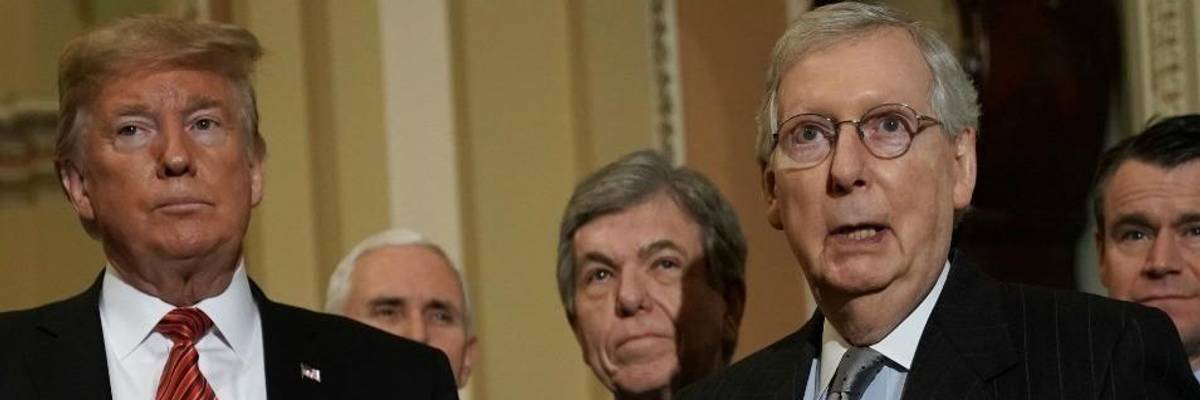
Over time, the unbridled pursuit of power wears down democratic institutions, erodes public trust, and breeds the sort of cynicism that invites despotism. (Photo: Alex Wong/Getty Images)
People in public life tend to fall into one of two broad categories - those who are motivated by principle, and those motivated by power.
Justice Ruth Bader Ginsburg, who died Friday night at the age of 87, exemplified the first.
When he nominated her in 1993, Bill Clinton called her "the Thurgood Marshall of gender-equality law," comparing her advocacy and lower-court rulings in pursuit of equal rights for women with the work of the great jurist who advanced the cause of equal rights for Black people. Ginsburg persuaded the Supreme Court that the 14th Amendment's guarantee of equal protection applied not only to racial discrimination but to sex discrimination as well.
For Ginsburg, principle was everything - not only equal rights, but also the integrity of democracy. Always concerned about the consequences of her actions for the system as a whole, she advised young people "to fight for the things you care about but do it in a way that will lead others to join you."
Mitch McConnell, the Senate majority leader, exemplifies the second category. He couldn't care less about principle. He is motivated entirely by the pursuit of power.
McConnell refused to allow the Senate to vote on President Barack Obama's nominee to the Supreme Court, Merrick Garland, in March, 2016 - almost a year before the end of Obama's term of office - on the dubious grounds that the "vacancy should not be filled until we have a new president."
McConnell's move was a pure power grab. No Senate leader had ever before asserted the right to block a vote on a president's nominee to the Supreme Court.
McConnell's "principle" of waiting for a new president disappeared Friday evening, after Ginsburg's death was announced.
Just weeks before one of the most consequential presidential elections in American history, when absentee voting has already begun in many states (and will start in McConnell's own state of Kentucky in 25 days), McConnell announced: "President Trump's nominee will receive a vote on the floor of the United States Senate."
This is, after all, the same Mitch McConnell who, soon after Trump was elected, ended the age-old requirement that Supreme Court nominees receive 60 votes to end debate and allow for a confirmation vote, and then, days later, pushed through Trump's first nominee, Neil Gorsuch.
Ginsburg and McConnell represent the opposite poles of public service today. The distinction doesn't depend on whether someone is a jurist or legislator - I've known many lawmakers who cared more about principle than power, such as the late congressman John Lewis. It depends on values.
Ginsburg refused to play power politics. As she passed her 80th birthday, near the start of Obama's second term, she dismissed calls for her to retire in order to give Obama plenty of time to name her replacement, saying she planned to stay "as long as I can do the job full steam," adding "There will be a president after this one, and I'm hopeful that that president will be a fine president."
She hoped others would also live by principle, including McConnell and Trump. Just days before her death she said, "My most fervent wish is that I will not be replaced until a new president is installed."
Her wish will not be honored.
If McConnell cannot muster the senate votes needed to confirm Trump's nominee before the election, he'll probably try to fill the vacancy in the lame-duck session after the election. He's that shameless.
Not even with Joe Biden president and control over both the House and Senate can Democrats do anything about this - except by playing power politics themselves: expanding the size of the court or restructuring it so justices on any given case are drawn from a pool of appellate judges.
The deeper question is which will prevail in public life: McConnell's power politics or Ginsburg's dedication to principle?
The problem for America, as for many other democracies at this point in history, is this is not an even match. Those who fight for power will bend or break rules to give themselves every advantage. Those who fight for principle are at an inherent disadvantage because bending or breaking rules undermines the very ideals they seek to uphold.
Over time, the unbridled pursuit of power wears down democratic institutions, erodes public trust, and breeds the sort of cynicism that invites despotism.
The only bulwark is a public that holds power accountable - demanding stronger guardrails against its abuses and voting power-mongers out of office.
Ruth Bader Ginsburg often referred to Justice Louis Brandeis's famous quote, that "the greatest menace to freedom is an inert people." Indeed.
Dear Common Dreams reader, It’s been nearly 30 years since I co-founded Common Dreams with my late wife, Lina Newhouser. We had the radical notion that journalism should serve the public good, not corporate profits. It was clear to us from the outset what it would take to build such a project. No paid advertisements. No corporate sponsors. No millionaire publisher telling us what to think or do. Many people said we wouldn't last a year, but we proved those doubters wrong. Together with a tremendous team of journalists and dedicated staff, we built an independent media outlet free from the constraints of profits and corporate control. Our mission has always been simple: To inform. To inspire. To ignite change for the common good. Building Common Dreams was not easy. Our survival was never guaranteed. When you take on the most powerful forces—Wall Street greed, fossil fuel industry destruction, Big Tech lobbyists, and uber-rich oligarchs who have spent billions upon billions rigging the economy and democracy in their favor—the only bulwark you have is supporters who believe in your work. But here’s the urgent message from me today. It's never been this bad out there. And it's never been this hard to keep us going. At the very moment Common Dreams is most needed, the threats we face are intensifying. We need your support now more than ever. We don't accept corporate advertising and never will. We don't have a paywall because we don't think people should be blocked from critical news based on their ability to pay. Everything we do is funded by the donations of readers like you. When everyone does the little they can afford, we are strong. But if that support retreats or dries up, so do we. Will you donate now to make sure Common Dreams not only survives but thrives? —Craig Brown, Co-founder |
People in public life tend to fall into one of two broad categories - those who are motivated by principle, and those motivated by power.
Justice Ruth Bader Ginsburg, who died Friday night at the age of 87, exemplified the first.
When he nominated her in 1993, Bill Clinton called her "the Thurgood Marshall of gender-equality law," comparing her advocacy and lower-court rulings in pursuit of equal rights for women with the work of the great jurist who advanced the cause of equal rights for Black people. Ginsburg persuaded the Supreme Court that the 14th Amendment's guarantee of equal protection applied not only to racial discrimination but to sex discrimination as well.
For Ginsburg, principle was everything - not only equal rights, but also the integrity of democracy. Always concerned about the consequences of her actions for the system as a whole, she advised young people "to fight for the things you care about but do it in a way that will lead others to join you."
Mitch McConnell, the Senate majority leader, exemplifies the second category. He couldn't care less about principle. He is motivated entirely by the pursuit of power.
McConnell refused to allow the Senate to vote on President Barack Obama's nominee to the Supreme Court, Merrick Garland, in March, 2016 - almost a year before the end of Obama's term of office - on the dubious grounds that the "vacancy should not be filled until we have a new president."
McConnell's move was a pure power grab. No Senate leader had ever before asserted the right to block a vote on a president's nominee to the Supreme Court.
McConnell's "principle" of waiting for a new president disappeared Friday evening, after Ginsburg's death was announced.
Just weeks before one of the most consequential presidential elections in American history, when absentee voting has already begun in many states (and will start in McConnell's own state of Kentucky in 25 days), McConnell announced: "President Trump's nominee will receive a vote on the floor of the United States Senate."
This is, after all, the same Mitch McConnell who, soon after Trump was elected, ended the age-old requirement that Supreme Court nominees receive 60 votes to end debate and allow for a confirmation vote, and then, days later, pushed through Trump's first nominee, Neil Gorsuch.
Ginsburg and McConnell represent the opposite poles of public service today. The distinction doesn't depend on whether someone is a jurist or legislator - I've known many lawmakers who cared more about principle than power, such as the late congressman John Lewis. It depends on values.
Ginsburg refused to play power politics. As she passed her 80th birthday, near the start of Obama's second term, she dismissed calls for her to retire in order to give Obama plenty of time to name her replacement, saying she planned to stay "as long as I can do the job full steam," adding "There will be a president after this one, and I'm hopeful that that president will be a fine president."
She hoped others would also live by principle, including McConnell and Trump. Just days before her death she said, "My most fervent wish is that I will not be replaced until a new president is installed."
Her wish will not be honored.
If McConnell cannot muster the senate votes needed to confirm Trump's nominee before the election, he'll probably try to fill the vacancy in the lame-duck session after the election. He's that shameless.
Not even with Joe Biden president and control over both the House and Senate can Democrats do anything about this - except by playing power politics themselves: expanding the size of the court or restructuring it so justices on any given case are drawn from a pool of appellate judges.
The deeper question is which will prevail in public life: McConnell's power politics or Ginsburg's dedication to principle?
The problem for America, as for many other democracies at this point in history, is this is not an even match. Those who fight for power will bend or break rules to give themselves every advantage. Those who fight for principle are at an inherent disadvantage because bending or breaking rules undermines the very ideals they seek to uphold.
Over time, the unbridled pursuit of power wears down democratic institutions, erodes public trust, and breeds the sort of cynicism that invites despotism.
The only bulwark is a public that holds power accountable - demanding stronger guardrails against its abuses and voting power-mongers out of office.
Ruth Bader Ginsburg often referred to Justice Louis Brandeis's famous quote, that "the greatest menace to freedom is an inert people." Indeed.
People in public life tend to fall into one of two broad categories - those who are motivated by principle, and those motivated by power.
Justice Ruth Bader Ginsburg, who died Friday night at the age of 87, exemplified the first.
When he nominated her in 1993, Bill Clinton called her "the Thurgood Marshall of gender-equality law," comparing her advocacy and lower-court rulings in pursuit of equal rights for women with the work of the great jurist who advanced the cause of equal rights for Black people. Ginsburg persuaded the Supreme Court that the 14th Amendment's guarantee of equal protection applied not only to racial discrimination but to sex discrimination as well.
For Ginsburg, principle was everything - not only equal rights, but also the integrity of democracy. Always concerned about the consequences of her actions for the system as a whole, she advised young people "to fight for the things you care about but do it in a way that will lead others to join you."
Mitch McConnell, the Senate majority leader, exemplifies the second category. He couldn't care less about principle. He is motivated entirely by the pursuit of power.
McConnell refused to allow the Senate to vote on President Barack Obama's nominee to the Supreme Court, Merrick Garland, in March, 2016 - almost a year before the end of Obama's term of office - on the dubious grounds that the "vacancy should not be filled until we have a new president."
McConnell's move was a pure power grab. No Senate leader had ever before asserted the right to block a vote on a president's nominee to the Supreme Court.
McConnell's "principle" of waiting for a new president disappeared Friday evening, after Ginsburg's death was announced.
Just weeks before one of the most consequential presidential elections in American history, when absentee voting has already begun in many states (and will start in McConnell's own state of Kentucky in 25 days), McConnell announced: "President Trump's nominee will receive a vote on the floor of the United States Senate."
This is, after all, the same Mitch McConnell who, soon after Trump was elected, ended the age-old requirement that Supreme Court nominees receive 60 votes to end debate and allow for a confirmation vote, and then, days later, pushed through Trump's first nominee, Neil Gorsuch.
Ginsburg and McConnell represent the opposite poles of public service today. The distinction doesn't depend on whether someone is a jurist or legislator - I've known many lawmakers who cared more about principle than power, such as the late congressman John Lewis. It depends on values.
Ginsburg refused to play power politics. As she passed her 80th birthday, near the start of Obama's second term, she dismissed calls for her to retire in order to give Obama plenty of time to name her replacement, saying she planned to stay "as long as I can do the job full steam," adding "There will be a president after this one, and I'm hopeful that that president will be a fine president."
She hoped others would also live by principle, including McConnell and Trump. Just days before her death she said, "My most fervent wish is that I will not be replaced until a new president is installed."
Her wish will not be honored.
If McConnell cannot muster the senate votes needed to confirm Trump's nominee before the election, he'll probably try to fill the vacancy in the lame-duck session after the election. He's that shameless.
Not even with Joe Biden president and control over both the House and Senate can Democrats do anything about this - except by playing power politics themselves: expanding the size of the court or restructuring it so justices on any given case are drawn from a pool of appellate judges.
The deeper question is which will prevail in public life: McConnell's power politics or Ginsburg's dedication to principle?
The problem for America, as for many other democracies at this point in history, is this is not an even match. Those who fight for power will bend or break rules to give themselves every advantage. Those who fight for principle are at an inherent disadvantage because bending or breaking rules undermines the very ideals they seek to uphold.
Over time, the unbridled pursuit of power wears down democratic institutions, erodes public trust, and breeds the sort of cynicism that invites despotism.
The only bulwark is a public that holds power accountable - demanding stronger guardrails against its abuses and voting power-mongers out of office.
Ruth Bader Ginsburg often referred to Justice Louis Brandeis's famous quote, that "the greatest menace to freedom is an inert people." Indeed.