SUBSCRIBE TO OUR FREE NEWSLETTER
Daily news & progressive opinion—funded by the people, not the corporations—delivered straight to your inbox.
5
#000000
#FFFFFF
To donate by check, phone, or other method, see our More Ways to Give page.
Daily news & progressive opinion—funded by the people, not the corporations—delivered straight to your inbox.
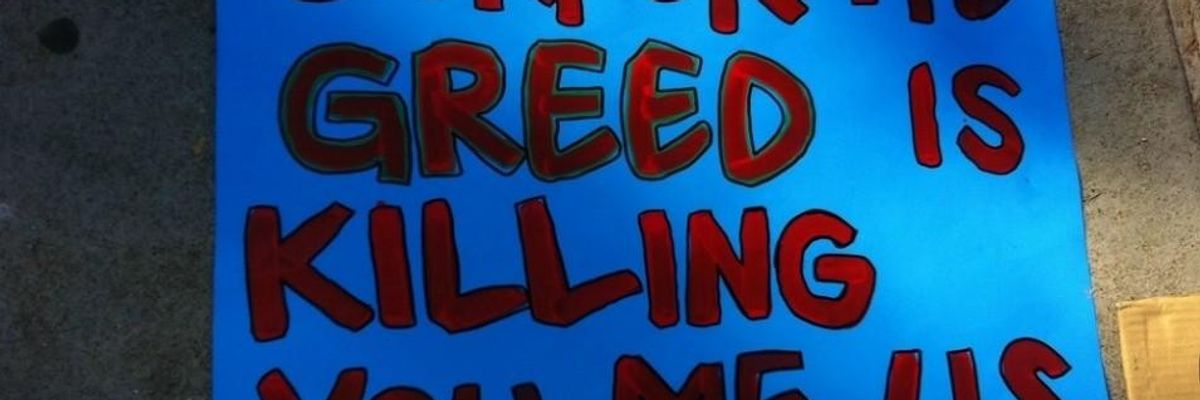
"If today's companies were truly offering a fair return to the taxpayers who built their businesses, they'd be doing a lot more to ensure that all Americans have the means to support their families, writes Buchheit. (Photo: a.mina/flickr/cc)
When Dr. Jonas Salk was asked about a patent on his polio vaccine in 1955, he said, "There is no patent. Could you patent the sun?" When Gilead Sciences recently developed an anti-Covid drug for about $12 per treatment, they set the price at $3,200.
As Republicans and business leaders decry the word 'social' as anti-American, they continue to promote the free-market "winner take all" philosophy that has caused over half of our nation to try to survive without adequate health care and life savings and job opportunities. Our richest corporations are much to blame. A review of the facts should make this clear.
They Continue to Cheat on Taxes
After building their businesses on 70 years of taxpayer-funded research and development, six dominant tech companies (Apple, Amazon, Google, Microsoft, Facebook, and Netflix), which together are worth over $7 trillion, have avoided over a hundred billion dollars in taxes over the past decade.
The profits of some of the largest U.S. corporations are surging in this pandemic year of sickness and death. And the levels of fraud and deceit keep growing along with the profits. A shocking analysis by the Tax Justice Network concludes that "Multinational firms operating around the world are shifting over $1 trillion in profits every year to corporate tax havens." A trillion dollars a year lost to the people in need of jobs and food and housing.
They've Rigged the System
Fifty years of lobbying against their own tax responsibilities have borne fruit for the big corporations. First of all, the corporate tax rate has dropped from about 35 percent to a low of 11 percent in 2019.
Secondly, the payroll tax has been used to make up the corporate shortfall. In the past fifty years, the corporate percent of tax revenue from major sources has decreased from 23 percent to 7 percent. The payroll tax percent has increased from 24 percent to 39 percent. Corporations have drastically cut their taxes while putting more of the tax burden on workers.
It gets more insidious. In the past ten years, Republicans have waged an anti-IRS campaign, slashing the budget of one of the most productive and cost-effective government agencies, and eliminating the positions of highly specialized employees who might have been expected to go after the largest corporations and the biggest cheaters.
And it gets personal. According to the IRS's own Taxpayer Advocate, the average U.S. household pays $3,000 per year to make up for the delinquents and deadbeats.
Their Greed Reached New Heights
With the 2017 corporate tax cuts came the lofty assurances that money would be freed up for new investment in jobs and R&D. So what happened? Hypocrisy happened. In the following year, S&P 500 companies set a new record for buying back their stock to artificially boost stock prices for management and investors--a practice that was illegal until the Reagan years. While about a third of S&P companies are now curtailing stock buybacks in response to the pandemic, others have depleted so much of their funds that they have turned to the pandemic-inspired CARES Act for relief to "distressed industries."
Start with the airlines. The Big Four spent $42.5 billion on buybacks between 2014 and 2019, and now they're asking for $50 billion in bailout money. Delta CEO Ed Bastian had the audacity to say "the owners of a business deserve a return, too." Boeing, which was actually borrowing money to buy back stock, is now asking for a $17 billion bailout from taxpayers.
Merck, whose 1950s slogan was "Medicine is for people, not for profits," spent $10 billion on R&D in 2018 and $14 billion on share repurchases and dividends.
At Home Depot, according to the Roosevelt Institute and the National Employment Law Project, the money spent on buybacks could have boosted the average employee's salary by $18,000 a year.
And fast food giants including KFC, Wendy's, and Papa John's, who, according to the New York Times, had spent great sums of money on buybacks, now need $145 billion of taxpayer funding to avoid mass layoffs.
They Show Disdain for the American Worker
Stock buybacks are only part of the corporate trend to diminish the state of the worker. Automation is eliminating millions of jobs. The old argument that the loss of jobs to technology has always been followed by a new and better class of work becomes meaningless when the machines start doing our thinking for us. And when the changes are occurring at such a rapid pace. A McKinsey report states: "Those earlier workforce transformations took place over many decades, allowing older workers to retire and new entrants to the workforce to transition to the growing industries. But the speed of change today is potentially faster." The speed of change is faster still because of the loss of jobs during the COVID pandemic.
Common arguments in favor of the tech companies are that (1) they're making a lot of people rich, and (2) they're providing all of us with remarkable products. Well, they're making about 20% of Americans rich. And their products are a result of 70 years of taxpayer-funded research and development, much of it by government agencies. If today's companies were truly offering a fair return to the taxpayers who built their businesses, they'd be doing a lot more to ensure that all Americans have the means to support their families.
Dear Common Dreams reader, It’s been nearly 30 years since I co-founded Common Dreams with my late wife, Lina Newhouser. We had the radical notion that journalism should serve the public good, not corporate profits. It was clear to us from the outset what it would take to build such a project. No paid advertisements. No corporate sponsors. No millionaire publisher telling us what to think or do. Many people said we wouldn't last a year, but we proved those doubters wrong. Together with a tremendous team of journalists and dedicated staff, we built an independent media outlet free from the constraints of profits and corporate control. Our mission has always been simple: To inform. To inspire. To ignite change for the common good. Building Common Dreams was not easy. Our survival was never guaranteed. When you take on the most powerful forces—Wall Street greed, fossil fuel industry destruction, Big Tech lobbyists, and uber-rich oligarchs who have spent billions upon billions rigging the economy and democracy in their favor—the only bulwark you have is supporters who believe in your work. But here’s the urgent message from me today. It's never been this bad out there. And it's never been this hard to keep us going. At the very moment Common Dreams is most needed, the threats we face are intensifying. We need your support now more than ever. We don't accept corporate advertising and never will. We don't have a paywall because we don't think people should be blocked from critical news based on their ability to pay. Everything we do is funded by the donations of readers like you. When everyone does the little they can afford, we are strong. But if that support retreats or dries up, so do we. Will you donate now to make sure Common Dreams not only survives but thrives? —Craig Brown, Co-founder |
When Dr. Jonas Salk was asked about a patent on his polio vaccine in 1955, he said, "There is no patent. Could you patent the sun?" When Gilead Sciences recently developed an anti-Covid drug for about $12 per treatment, they set the price at $3,200.
As Republicans and business leaders decry the word 'social' as anti-American, they continue to promote the free-market "winner take all" philosophy that has caused over half of our nation to try to survive without adequate health care and life savings and job opportunities. Our richest corporations are much to blame. A review of the facts should make this clear.
They Continue to Cheat on Taxes
After building their businesses on 70 years of taxpayer-funded research and development, six dominant tech companies (Apple, Amazon, Google, Microsoft, Facebook, and Netflix), which together are worth over $7 trillion, have avoided over a hundred billion dollars in taxes over the past decade.
The profits of some of the largest U.S. corporations are surging in this pandemic year of sickness and death. And the levels of fraud and deceit keep growing along with the profits. A shocking analysis by the Tax Justice Network concludes that "Multinational firms operating around the world are shifting over $1 trillion in profits every year to corporate tax havens." A trillion dollars a year lost to the people in need of jobs and food and housing.
They've Rigged the System
Fifty years of lobbying against their own tax responsibilities have borne fruit for the big corporations. First of all, the corporate tax rate has dropped from about 35 percent to a low of 11 percent in 2019.
Secondly, the payroll tax has been used to make up the corporate shortfall. In the past fifty years, the corporate percent of tax revenue from major sources has decreased from 23 percent to 7 percent. The payroll tax percent has increased from 24 percent to 39 percent. Corporations have drastically cut their taxes while putting more of the tax burden on workers.
It gets more insidious. In the past ten years, Republicans have waged an anti-IRS campaign, slashing the budget of one of the most productive and cost-effective government agencies, and eliminating the positions of highly specialized employees who might have been expected to go after the largest corporations and the biggest cheaters.
And it gets personal. According to the IRS's own Taxpayer Advocate, the average U.S. household pays $3,000 per year to make up for the delinquents and deadbeats.
Their Greed Reached New Heights
With the 2017 corporate tax cuts came the lofty assurances that money would be freed up for new investment in jobs and R&D. So what happened? Hypocrisy happened. In the following year, S&P 500 companies set a new record for buying back their stock to artificially boost stock prices for management and investors--a practice that was illegal until the Reagan years. While about a third of S&P companies are now curtailing stock buybacks in response to the pandemic, others have depleted so much of their funds that they have turned to the pandemic-inspired CARES Act for relief to "distressed industries."
Start with the airlines. The Big Four spent $42.5 billion on buybacks between 2014 and 2019, and now they're asking for $50 billion in bailout money. Delta CEO Ed Bastian had the audacity to say "the owners of a business deserve a return, too." Boeing, which was actually borrowing money to buy back stock, is now asking for a $17 billion bailout from taxpayers.
Merck, whose 1950s slogan was "Medicine is for people, not for profits," spent $10 billion on R&D in 2018 and $14 billion on share repurchases and dividends.
At Home Depot, according to the Roosevelt Institute and the National Employment Law Project, the money spent on buybacks could have boosted the average employee's salary by $18,000 a year.
And fast food giants including KFC, Wendy's, and Papa John's, who, according to the New York Times, had spent great sums of money on buybacks, now need $145 billion of taxpayer funding to avoid mass layoffs.
They Show Disdain for the American Worker
Stock buybacks are only part of the corporate trend to diminish the state of the worker. Automation is eliminating millions of jobs. The old argument that the loss of jobs to technology has always been followed by a new and better class of work becomes meaningless when the machines start doing our thinking for us. And when the changes are occurring at such a rapid pace. A McKinsey report states: "Those earlier workforce transformations took place over many decades, allowing older workers to retire and new entrants to the workforce to transition to the growing industries. But the speed of change today is potentially faster." The speed of change is faster still because of the loss of jobs during the COVID pandemic.
Common arguments in favor of the tech companies are that (1) they're making a lot of people rich, and (2) they're providing all of us with remarkable products. Well, they're making about 20% of Americans rich. And their products are a result of 70 years of taxpayer-funded research and development, much of it by government agencies. If today's companies were truly offering a fair return to the taxpayers who built their businesses, they'd be doing a lot more to ensure that all Americans have the means to support their families.
When Dr. Jonas Salk was asked about a patent on his polio vaccine in 1955, he said, "There is no patent. Could you patent the sun?" When Gilead Sciences recently developed an anti-Covid drug for about $12 per treatment, they set the price at $3,200.
As Republicans and business leaders decry the word 'social' as anti-American, they continue to promote the free-market "winner take all" philosophy that has caused over half of our nation to try to survive without adequate health care and life savings and job opportunities. Our richest corporations are much to blame. A review of the facts should make this clear.
They Continue to Cheat on Taxes
After building their businesses on 70 years of taxpayer-funded research and development, six dominant tech companies (Apple, Amazon, Google, Microsoft, Facebook, and Netflix), which together are worth over $7 trillion, have avoided over a hundred billion dollars in taxes over the past decade.
The profits of some of the largest U.S. corporations are surging in this pandemic year of sickness and death. And the levels of fraud and deceit keep growing along with the profits. A shocking analysis by the Tax Justice Network concludes that "Multinational firms operating around the world are shifting over $1 trillion in profits every year to corporate tax havens." A trillion dollars a year lost to the people in need of jobs and food and housing.
They've Rigged the System
Fifty years of lobbying against their own tax responsibilities have borne fruit for the big corporations. First of all, the corporate tax rate has dropped from about 35 percent to a low of 11 percent in 2019.
Secondly, the payroll tax has been used to make up the corporate shortfall. In the past fifty years, the corporate percent of tax revenue from major sources has decreased from 23 percent to 7 percent. The payroll tax percent has increased from 24 percent to 39 percent. Corporations have drastically cut their taxes while putting more of the tax burden on workers.
It gets more insidious. In the past ten years, Republicans have waged an anti-IRS campaign, slashing the budget of one of the most productive and cost-effective government agencies, and eliminating the positions of highly specialized employees who might have been expected to go after the largest corporations and the biggest cheaters.
And it gets personal. According to the IRS's own Taxpayer Advocate, the average U.S. household pays $3,000 per year to make up for the delinquents and deadbeats.
Their Greed Reached New Heights
With the 2017 corporate tax cuts came the lofty assurances that money would be freed up for new investment in jobs and R&D. So what happened? Hypocrisy happened. In the following year, S&P 500 companies set a new record for buying back their stock to artificially boost stock prices for management and investors--a practice that was illegal until the Reagan years. While about a third of S&P companies are now curtailing stock buybacks in response to the pandemic, others have depleted so much of their funds that they have turned to the pandemic-inspired CARES Act for relief to "distressed industries."
Start with the airlines. The Big Four spent $42.5 billion on buybacks between 2014 and 2019, and now they're asking for $50 billion in bailout money. Delta CEO Ed Bastian had the audacity to say "the owners of a business deserve a return, too." Boeing, which was actually borrowing money to buy back stock, is now asking for a $17 billion bailout from taxpayers.
Merck, whose 1950s slogan was "Medicine is for people, not for profits," spent $10 billion on R&D in 2018 and $14 billion on share repurchases and dividends.
At Home Depot, according to the Roosevelt Institute and the National Employment Law Project, the money spent on buybacks could have boosted the average employee's salary by $18,000 a year.
And fast food giants including KFC, Wendy's, and Papa John's, who, according to the New York Times, had spent great sums of money on buybacks, now need $145 billion of taxpayer funding to avoid mass layoffs.
They Show Disdain for the American Worker
Stock buybacks are only part of the corporate trend to diminish the state of the worker. Automation is eliminating millions of jobs. The old argument that the loss of jobs to technology has always been followed by a new and better class of work becomes meaningless when the machines start doing our thinking for us. And when the changes are occurring at such a rapid pace. A McKinsey report states: "Those earlier workforce transformations took place over many decades, allowing older workers to retire and new entrants to the workforce to transition to the growing industries. But the speed of change today is potentially faster." The speed of change is faster still because of the loss of jobs during the COVID pandemic.
Common arguments in favor of the tech companies are that (1) they're making a lot of people rich, and (2) they're providing all of us with remarkable products. Well, they're making about 20% of Americans rich. And their products are a result of 70 years of taxpayer-funded research and development, much of it by government agencies. If today's companies were truly offering a fair return to the taxpayers who built their businesses, they'd be doing a lot more to ensure that all Americans have the means to support their families.