SUBSCRIBE TO OUR FREE NEWSLETTER
Daily news & progressive opinion—funded by the people, not the corporations—delivered straight to your inbox.
5
#000000
#FFFFFF
To donate by check, phone, or other method, see our More Ways to Give page.
Daily news & progressive opinion—funded by the people, not the corporations—delivered straight to your inbox.
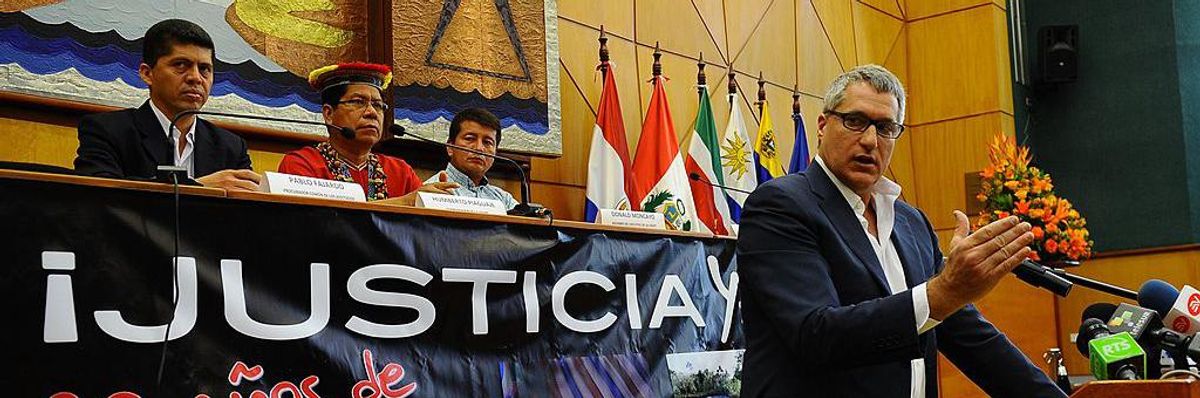
The lawyer of Ecuadorean people affected by Texaco-Chevron, Steven Donziger, gestures during a press conference on March 19, 2014 in Quito. (Photo: Rodrigo Buendia/AFP via Getty Images)
August 6 marked the one-year anniversary of the pre-trial detention of attorney Steven Donziger for a misdemeanor contempt charge in a civil case. His crime? Donziger refused to hand over his computer and phone, which contain privileged attorney-client communications, to Chevron.
It might sound absurd, but it is a deadly serious move in Chevron's years-long efforts to demonize him; to make him persona non grata both in the legal community and the human rights defender community--the worlds that he has inhabited for decades.
The long and the short of the oil giant's crusade against him is his role as lead attorney in a class action suit filed in 1993 on behalf of 30,000 Indigenous and Campesino Ecuadorians seeking damages and restitution for the massive pollution of part of the Ecuadorian Amazon that has come to be known as the "Amazon Chernobyl."
That is an apt characterization of a region laid waste through the spillage of over 17 million gallons of crude oil, the deliberate dumping of over 16 billion gallons of toxic wastewater into rivers and streams and the digging of hundreds of open pits to dispose of toxic waste throughout the Ecuadorian Amazon. When Ecuadorian courts found Chevron guilty to the tune of $9.5 billion, the company sold its Ecuadorian holdings, fled the country and refused to pay.
Since then, Chevron has been relentless in its pursuit of Donziger, bringing charges against him in New York through its ally, a corporate-friendly New York District Federal Judge, Lewis A. Kaplan, and multiple other law firms and legal friends of either Chevron or Kaplan. Their multiple manipulations of our legal system to benefit Chevron are legion and just a few examples should cause us all to wonder about the meaning of "equality before the law" in the U.S.
It all began when Chevron sought to bring charges against Donziger and looked to Judge Kaplan's court to hear it. When Donziger refused Kaplan's order to turn over his computer and phone to Chevron, Kaplan charged him with contempt and asked Federal Prosecutors to prosecute the case. They refused--twice.
Undeterred by this seeming legal obstacle, Kaplan hired a private law firm, Seward & Kissel, to do so. Public documents later revealed the firm has Chevron as a client. Kaplan then proceeded to appoint Judge Loretta Preska to preside over the contempt case, ignoring district court rules on random case assignments.
Finally, and what ultimately brings us to this first anniversary of Steven Donziger's pre-trial detention, was when Preska denied him pre-trial release accepting the flimsy argument that he was a flight risk. This, despite the fact that his passport had been seized and he had guaranteed appearing for trial with an unprecedented sum for a misdemeanor case in this country--a bail bond of $800,000. This, despite the fact that previous to this case, the longest time anyone had been held in such pre-trial detention was three months. This, despite the fact that the longest sentence in a contempt case is six months if convicted - and Donziger has not even been to trial yet on the charge. The trial might take place in September.
If none of this makes your head spin, it should. It made my head spin along with those of the 28 other Nobel Prize laureates who joined me in signing a statement in support of Steven Donziger and the Ecuadorian plaintiffs in the case against Chevron.
In our statement released on April 17, we demanded that Chevron face justice for its destruction of the Ecuadorian Amazon. We demanded it then and we demand it now. Our statement also called for the freedom of human rights defender Steven Donziger. We demanded it then and we demand it now.
In our statement we said, "Environmental activism in many countries results in murder. Chevron's strategy is death by a thousand cuts through the manipulation of a legal system it has managed to stack in its favor. Its goal is to intimidate and disempower the victims of its pollution and a lawyer who has worked for decades on their behalf." We believed what we said then and we believe it as strongly now.
One year is more than enough. It is one year of Steven Donziger's life robbed from him as his detention drags on in a small Manhattan apartment, hobbled by a monitoring device he must wear 24hours a day, seven days a week.
Twenty-nine Nobel Prize laureates invite you to join us in raising awareness of this horrendous situation for both the people of Ecuador and for their attorney Steven Donziger. It is time that Chevron faced justice and clean up its mess. It is time for the persecution of Steven Donziger to end.
Dear Common Dreams reader, It’s been nearly 30 years since I co-founded Common Dreams with my late wife, Lina Newhouser. We had the radical notion that journalism should serve the public good, not corporate profits. It was clear to us from the outset what it would take to build such a project. No paid advertisements. No corporate sponsors. No millionaire publisher telling us what to think or do. Many people said we wouldn't last a year, but we proved those doubters wrong. Together with a tremendous team of journalists and dedicated staff, we built an independent media outlet free from the constraints of profits and corporate control. Our mission has always been simple: To inform. To inspire. To ignite change for the common good. Building Common Dreams was not easy. Our survival was never guaranteed. When you take on the most powerful forces—Wall Street greed, fossil fuel industry destruction, Big Tech lobbyists, and uber-rich oligarchs who have spent billions upon billions rigging the economy and democracy in their favor—the only bulwark you have is supporters who believe in your work. But here’s the urgent message from me today. It's never been this bad out there. And it's never been this hard to keep us going. At the very moment Common Dreams is most needed, the threats we face are intensifying. We need your support now more than ever. We don't accept corporate advertising and never will. We don't have a paywall because we don't think people should be blocked from critical news based on their ability to pay. Everything we do is funded by the donations of readers like you. When everyone does the little they can afford, we are strong. But if that support retreats or dries up, so do we. Will you donate now to make sure Common Dreams not only survives but thrives? —Craig Brown, Co-founder |
August 6 marked the one-year anniversary of the pre-trial detention of attorney Steven Donziger for a misdemeanor contempt charge in a civil case. His crime? Donziger refused to hand over his computer and phone, which contain privileged attorney-client communications, to Chevron.
It might sound absurd, but it is a deadly serious move in Chevron's years-long efforts to demonize him; to make him persona non grata both in the legal community and the human rights defender community--the worlds that he has inhabited for decades.
The long and the short of the oil giant's crusade against him is his role as lead attorney in a class action suit filed in 1993 on behalf of 30,000 Indigenous and Campesino Ecuadorians seeking damages and restitution for the massive pollution of part of the Ecuadorian Amazon that has come to be known as the "Amazon Chernobyl."
That is an apt characterization of a region laid waste through the spillage of over 17 million gallons of crude oil, the deliberate dumping of over 16 billion gallons of toxic wastewater into rivers and streams and the digging of hundreds of open pits to dispose of toxic waste throughout the Ecuadorian Amazon. When Ecuadorian courts found Chevron guilty to the tune of $9.5 billion, the company sold its Ecuadorian holdings, fled the country and refused to pay.
Since then, Chevron has been relentless in its pursuit of Donziger, bringing charges against him in New York through its ally, a corporate-friendly New York District Federal Judge, Lewis A. Kaplan, and multiple other law firms and legal friends of either Chevron or Kaplan. Their multiple manipulations of our legal system to benefit Chevron are legion and just a few examples should cause us all to wonder about the meaning of "equality before the law" in the U.S.
It all began when Chevron sought to bring charges against Donziger and looked to Judge Kaplan's court to hear it. When Donziger refused Kaplan's order to turn over his computer and phone to Chevron, Kaplan charged him with contempt and asked Federal Prosecutors to prosecute the case. They refused--twice.
Undeterred by this seeming legal obstacle, Kaplan hired a private law firm, Seward & Kissel, to do so. Public documents later revealed the firm has Chevron as a client. Kaplan then proceeded to appoint Judge Loretta Preska to preside over the contempt case, ignoring district court rules on random case assignments.
Finally, and what ultimately brings us to this first anniversary of Steven Donziger's pre-trial detention, was when Preska denied him pre-trial release accepting the flimsy argument that he was a flight risk. This, despite the fact that his passport had been seized and he had guaranteed appearing for trial with an unprecedented sum for a misdemeanor case in this country--a bail bond of $800,000. This, despite the fact that previous to this case, the longest time anyone had been held in such pre-trial detention was three months. This, despite the fact that the longest sentence in a contempt case is six months if convicted - and Donziger has not even been to trial yet on the charge. The trial might take place in September.
If none of this makes your head spin, it should. It made my head spin along with those of the 28 other Nobel Prize laureates who joined me in signing a statement in support of Steven Donziger and the Ecuadorian plaintiffs in the case against Chevron.
In our statement released on April 17, we demanded that Chevron face justice for its destruction of the Ecuadorian Amazon. We demanded it then and we demand it now. Our statement also called for the freedom of human rights defender Steven Donziger. We demanded it then and we demand it now.
In our statement we said, "Environmental activism in many countries results in murder. Chevron's strategy is death by a thousand cuts through the manipulation of a legal system it has managed to stack in its favor. Its goal is to intimidate and disempower the victims of its pollution and a lawyer who has worked for decades on their behalf." We believed what we said then and we believe it as strongly now.
One year is more than enough. It is one year of Steven Donziger's life robbed from him as his detention drags on in a small Manhattan apartment, hobbled by a monitoring device he must wear 24hours a day, seven days a week.
Twenty-nine Nobel Prize laureates invite you to join us in raising awareness of this horrendous situation for both the people of Ecuador and for their attorney Steven Donziger. It is time that Chevron faced justice and clean up its mess. It is time for the persecution of Steven Donziger to end.
August 6 marked the one-year anniversary of the pre-trial detention of attorney Steven Donziger for a misdemeanor contempt charge in a civil case. His crime? Donziger refused to hand over his computer and phone, which contain privileged attorney-client communications, to Chevron.
It might sound absurd, but it is a deadly serious move in Chevron's years-long efforts to demonize him; to make him persona non grata both in the legal community and the human rights defender community--the worlds that he has inhabited for decades.
The long and the short of the oil giant's crusade against him is his role as lead attorney in a class action suit filed in 1993 on behalf of 30,000 Indigenous and Campesino Ecuadorians seeking damages and restitution for the massive pollution of part of the Ecuadorian Amazon that has come to be known as the "Amazon Chernobyl."
That is an apt characterization of a region laid waste through the spillage of over 17 million gallons of crude oil, the deliberate dumping of over 16 billion gallons of toxic wastewater into rivers and streams and the digging of hundreds of open pits to dispose of toxic waste throughout the Ecuadorian Amazon. When Ecuadorian courts found Chevron guilty to the tune of $9.5 billion, the company sold its Ecuadorian holdings, fled the country and refused to pay.
Since then, Chevron has been relentless in its pursuit of Donziger, bringing charges against him in New York through its ally, a corporate-friendly New York District Federal Judge, Lewis A. Kaplan, and multiple other law firms and legal friends of either Chevron or Kaplan. Their multiple manipulations of our legal system to benefit Chevron are legion and just a few examples should cause us all to wonder about the meaning of "equality before the law" in the U.S.
It all began when Chevron sought to bring charges against Donziger and looked to Judge Kaplan's court to hear it. When Donziger refused Kaplan's order to turn over his computer and phone to Chevron, Kaplan charged him with contempt and asked Federal Prosecutors to prosecute the case. They refused--twice.
Undeterred by this seeming legal obstacle, Kaplan hired a private law firm, Seward & Kissel, to do so. Public documents later revealed the firm has Chevron as a client. Kaplan then proceeded to appoint Judge Loretta Preska to preside over the contempt case, ignoring district court rules on random case assignments.
Finally, and what ultimately brings us to this first anniversary of Steven Donziger's pre-trial detention, was when Preska denied him pre-trial release accepting the flimsy argument that he was a flight risk. This, despite the fact that his passport had been seized and he had guaranteed appearing for trial with an unprecedented sum for a misdemeanor case in this country--a bail bond of $800,000. This, despite the fact that previous to this case, the longest time anyone had been held in such pre-trial detention was three months. This, despite the fact that the longest sentence in a contempt case is six months if convicted - and Donziger has not even been to trial yet on the charge. The trial might take place in September.
If none of this makes your head spin, it should. It made my head spin along with those of the 28 other Nobel Prize laureates who joined me in signing a statement in support of Steven Donziger and the Ecuadorian plaintiffs in the case against Chevron.
In our statement released on April 17, we demanded that Chevron face justice for its destruction of the Ecuadorian Amazon. We demanded it then and we demand it now. Our statement also called for the freedom of human rights defender Steven Donziger. We demanded it then and we demand it now.
In our statement we said, "Environmental activism in many countries results in murder. Chevron's strategy is death by a thousand cuts through the manipulation of a legal system it has managed to stack in its favor. Its goal is to intimidate and disempower the victims of its pollution and a lawyer who has worked for decades on their behalf." We believed what we said then and we believe it as strongly now.
One year is more than enough. It is one year of Steven Donziger's life robbed from him as his detention drags on in a small Manhattan apartment, hobbled by a monitoring device he must wear 24hours a day, seven days a week.
Twenty-nine Nobel Prize laureates invite you to join us in raising awareness of this horrendous situation for both the people of Ecuador and for their attorney Steven Donziger. It is time that Chevron faced justice and clean up its mess. It is time for the persecution of Steven Donziger to end.