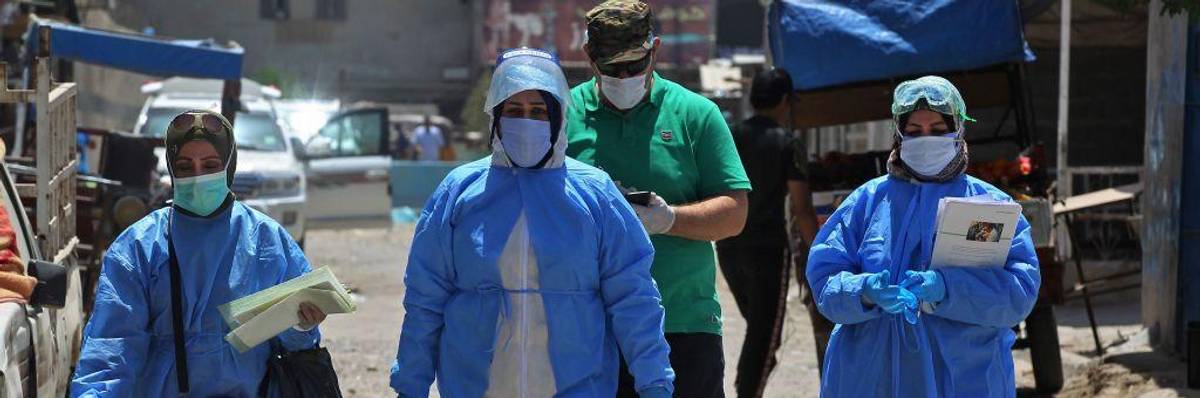
Iraqi medics arrive at the capital Baghdad's suburb of Sadr City on May 21, 2020, to test residents for COVID-19, as part of measures taken by the authorities aimed at containing the spread of the novel coronavirus. (Photo by AHMAD AL-RUBAYE/AFP via Getty Images)
Missing: 505 COVID Masks Destined for Baghdad Hospital via UPS
Our human-to-human good-will gesture—the washing, cutting, sewing, assembling and shipping costs along with the sweet anticipation of their arrival in Baghdad—has been denied, stolen from us.
Iraq experienced a dramatic upsurge in COVID cases beginning in early in June just as a group of mask-makers in Western Massachusetts was sending 500 masks--including 100 highly effective, medical-quality HEPA vac masks-- to the Pediatric Oncology Unit at Children's Welfare Teaching Hospital in Medical City Baghdad (CWTH). They were sent on June 5; I tracked them as they traveled to Kentucky, then to Dubai--taking some days at each stop. Then, they were in transit in Baghdad, scheduled for delivery on Wednesday, June 17. But they didn't move. I checked the UPS tracking site; I phoned my local store and the international UPS help line. At one point the message said the package was being help-up by a government regulatory agency hold; at another point they said it had been shipped to Kurdistan and informed the doctor who'd phoned from Baghdad they would need a request from the Ministry of Health in that province to get the package released. And then the next day--June 22nd--they told me the package was classified as "lost."
And all this while, the virus is spreading and taking a toll in Baghdad and throughout Iraq. One hundred fifty new cases of the virus were recorded on May 18; 1463 recorded on June 18 and 1870 on June 20. While aware of the emerging pandemic, masks weren't necessarily on the doctor's radar when I first asked about them. They're in an existential crisis, as they have been for more than three decades now, exhausted by their efforts to meet the needs of an increasing number of increasingly serious cancer cases without the facilities, drugs or sufficient number of properly trained personnel necessary for such a challenging specialty.
Nonetheless when I suggested my local group might make masks, they welcomed the idea even if they were not yet fully aware of what was coming, if or when it was coming, or how the masks would be of help. Infection control is a huge issue in Iraqi hospitals where--to name just a few irregularities: two or more patients and their mothers share a room; the lowest-cost, non-medical-standard cleaning service is employed; people come-and-go in street clothes rather than changing to sanitized clothing. But, everything is an issue in Iraqi hospitals for that matter. The hospitals and the entire medical system of a country that once boasted the best training, care and facilities in the Middle East--and all at no cost--fell into a state of chaos beginning with UN Economic Sanctions and the First Gulf war in 1990. The chaos and dysfunction continue to this day.
Healthcare, along with education and other vital public services, is a government function. The role of government in managing, or not-managing-- this public health crisis has been highlighted throughout these last months; we know which governments are doing a good job, and which are failing. But, Iraq hasn't had a functioning government for many months; the cabinet was only confirmed in early June. And, most recently before that, the government they did have was notoriously corrupt and preoccupied with ongoing international conflict and street protests demanding reforms.
These doctors have not stood by helplessly as all of this has unfolded in Iraq; they have been outspoken; they spoke to the press--to anyone who would listen. They publish papers, they petition global health and international cancer care organizations.
Doctors have been left on their own, managing their patients and their wards with whatever resources they can muster. Those who have chosen to stay in Iraq--the doctors on the unit at CWTH--have been witness to misery beyond their control: a soaring Under Five Mortality rate, half a million children dead , many from preventable illness such as diarrhea or from malnutrition; They have witnessed the collapse of their once stellar medical education and hospital system; had to regroup, and redouble their efforts as colleagues were kidnapped, killed or chose to leave the country for security reasons. Doctors have had endure as the world of cancer care passed them by as a result of the crippling sanctions--even books and medical journals, medicines and medical equipment were forbidden. They have had to work harder as the number of patients increased and their overall capacity decreased. They and their families, friends and neighbors have had to live with the stress of insecurity and ongoing violence in "post-war" Baghdad. And now comes COVID 19.
These doctors have not stood by helplessly as all of this has unfolded in Iraq; they have been outspoken; they spoke to the press--to anyone who would listen. They publish papers, they petition global health and international cancer care organizations. But, help has not arrived. The suggestion by WHO and the UN--that we end ongoing conflicts and concentrate our collective efforts in understanding, containing and developing drugs and treatments for COVID--seems to have fallen on deaf ears. Iraq and Iraqis struggle on--on their own.
Where governments fail to meet human needs, or make peace, or work cooperatively--people mount campaigns. Not just internationally, you see it in crisis everywhere--institutions fail and ordinary people step into the void. This was the case with the COVID masks. A group of women created a system to produce the best quality as quickly as possible; some are washing and cutting fabric and elastic or tie bands, some are assembling kits and delivering them to pick-up locations around our Valley; some are sewing, some are responding to requests and delivering masks. The materials are/have become scarce. At some points, you couldn't find elastic for instance or the HEPA vac fabric. It all became precious and costly.
The loss of the masks--505 masks that weighed in at almost 20 lbs.--and of the $800 dollars donated for shipping costs is devastating. They are desperately needed in Baghdad. And then, so disturbing on our end, is the profound disappointment experienced by the sewing collective. Our human-to-human good-will gesture--the washing, cutting, sewing, assembling and shipping costs along with the sweet anticipation of their arrival in Baghdad--has been denied, stolen from us.
I'm sure this disappearance would be world-making news If what was lost was a feral cat or beloved stray dog some army regimen had adopted off the streets of Baghdad. And, all stops would be pulled and costs disregarded to find the animal and reunite it with their humans. I'm hoping the masks will elicit the same response. Fingers crossed.
We are at a crossroads
This country and this world are at a monumental crossroads. In a few short weeks, US voters will have an opportunity to beat back the forces of fascism and confront the billionaires who are rigging the economy, our media system, and our democracy, making it increasingly impossible for ordinary people to get by. We’re not just talking about the election. We’re talking about what must be done once these fascist elements are vanquished from power. We need a bolder set of solutions than what either major party has so far been willing to offer and a working-class movement ready to fight like hell for it. Trump didn't emerge from nowhere. The conditions that fueled MAGA authoritarianism were created by decades of radical neoliberal economic policies and a corrupt political system dominated by corporate interests. They slashed taxes on the super-rich, promising that the benefits would trickle down. They said giveaways to the corporate titans would make life more affordable for the rest of us. It was all bullshit. And when a bitter, betrayed populace searches for someone to blame, right-wing demagogues have little trouble finding scapegoats. People know when they're being lied to, but you won't hear any of this from the corporate media. Only independent journalism—powered and funded by people who believe in building a better world—can deliver truly trustworthy daily news. Our Fall Campaign is underway, and we need your help. To power our newsroom through the rest of the year, we need to raise $125,000 by midnight on October 31. So if you share our vision, please contribute whatever you can to sustain our work. |
Iraq experienced a dramatic upsurge in COVID cases beginning in early in June just as a group of mask-makers in Western Massachusetts was sending 500 masks--including 100 highly effective, medical-quality HEPA vac masks-- to the Pediatric Oncology Unit at Children's Welfare Teaching Hospital in Medical City Baghdad (CWTH). They were sent on June 5; I tracked them as they traveled to Kentucky, then to Dubai--taking some days at each stop. Then, they were in transit in Baghdad, scheduled for delivery on Wednesday, June 17. But they didn't move. I checked the UPS tracking site; I phoned my local store and the international UPS help line. At one point the message said the package was being help-up by a government regulatory agency hold; at another point they said it had been shipped to Kurdistan and informed the doctor who'd phoned from Baghdad they would need a request from the Ministry of Health in that province to get the package released. And then the next day--June 22nd--they told me the package was classified as "lost."
And all this while, the virus is spreading and taking a toll in Baghdad and throughout Iraq. One hundred fifty new cases of the virus were recorded on May 18; 1463 recorded on June 18 and 1870 on June 20. While aware of the emerging pandemic, masks weren't necessarily on the doctor's radar when I first asked about them. They're in an existential crisis, as they have been for more than three decades now, exhausted by their efforts to meet the needs of an increasing number of increasingly serious cancer cases without the facilities, drugs or sufficient number of properly trained personnel necessary for such a challenging specialty.
Nonetheless when I suggested my local group might make masks, they welcomed the idea even if they were not yet fully aware of what was coming, if or when it was coming, or how the masks would be of help. Infection control is a huge issue in Iraqi hospitals where--to name just a few irregularities: two or more patients and their mothers share a room; the lowest-cost, non-medical-standard cleaning service is employed; people come-and-go in street clothes rather than changing to sanitized clothing. But, everything is an issue in Iraqi hospitals for that matter. The hospitals and the entire medical system of a country that once boasted the best training, care and facilities in the Middle East--and all at no cost--fell into a state of chaos beginning with UN Economic Sanctions and the First Gulf war in 1990. The chaos and dysfunction continue to this day.
Healthcare, along with education and other vital public services, is a government function. The role of government in managing, or not-managing-- this public health crisis has been highlighted throughout these last months; we know which governments are doing a good job, and which are failing. But, Iraq hasn't had a functioning government for many months; the cabinet was only confirmed in early June. And, most recently before that, the government they did have was notoriously corrupt and preoccupied with ongoing international conflict and street protests demanding reforms.
These doctors have not stood by helplessly as all of this has unfolded in Iraq; they have been outspoken; they spoke to the press--to anyone who would listen. They publish papers, they petition global health and international cancer care organizations.
Doctors have been left on their own, managing their patients and their wards with whatever resources they can muster. Those who have chosen to stay in Iraq--the doctors on the unit at CWTH--have been witness to misery beyond their control: a soaring Under Five Mortality rate, half a million children dead , many from preventable illness such as diarrhea or from malnutrition; They have witnessed the collapse of their once stellar medical education and hospital system; had to regroup, and redouble their efforts as colleagues were kidnapped, killed or chose to leave the country for security reasons. Doctors have had endure as the world of cancer care passed them by as a result of the crippling sanctions--even books and medical journals, medicines and medical equipment were forbidden. They have had to work harder as the number of patients increased and their overall capacity decreased. They and their families, friends and neighbors have had to live with the stress of insecurity and ongoing violence in "post-war" Baghdad. And now comes COVID 19.
These doctors have not stood by helplessly as all of this has unfolded in Iraq; they have been outspoken; they spoke to the press--to anyone who would listen. They publish papers, they petition global health and international cancer care organizations. But, help has not arrived. The suggestion by WHO and the UN--that we end ongoing conflicts and concentrate our collective efforts in understanding, containing and developing drugs and treatments for COVID--seems to have fallen on deaf ears. Iraq and Iraqis struggle on--on their own.
Where governments fail to meet human needs, or make peace, or work cooperatively--people mount campaigns. Not just internationally, you see it in crisis everywhere--institutions fail and ordinary people step into the void. This was the case with the COVID masks. A group of women created a system to produce the best quality as quickly as possible; some are washing and cutting fabric and elastic or tie bands, some are assembling kits and delivering them to pick-up locations around our Valley; some are sewing, some are responding to requests and delivering masks. The materials are/have become scarce. At some points, you couldn't find elastic for instance or the HEPA vac fabric. It all became precious and costly.
The loss of the masks--505 masks that weighed in at almost 20 lbs.--and of the $800 dollars donated for shipping costs is devastating. They are desperately needed in Baghdad. And then, so disturbing on our end, is the profound disappointment experienced by the sewing collective. Our human-to-human good-will gesture--the washing, cutting, sewing, assembling and shipping costs along with the sweet anticipation of their arrival in Baghdad--has been denied, stolen from us.
I'm sure this disappearance would be world-making news If what was lost was a feral cat or beloved stray dog some army regimen had adopted off the streets of Baghdad. And, all stops would be pulled and costs disregarded to find the animal and reunite it with their humans. I'm hoping the masks will elicit the same response. Fingers crossed.
Iraq experienced a dramatic upsurge in COVID cases beginning in early in June just as a group of mask-makers in Western Massachusetts was sending 500 masks--including 100 highly effective, medical-quality HEPA vac masks-- to the Pediatric Oncology Unit at Children's Welfare Teaching Hospital in Medical City Baghdad (CWTH). They were sent on June 5; I tracked them as they traveled to Kentucky, then to Dubai--taking some days at each stop. Then, they were in transit in Baghdad, scheduled for delivery on Wednesday, June 17. But they didn't move. I checked the UPS tracking site; I phoned my local store and the international UPS help line. At one point the message said the package was being help-up by a government regulatory agency hold; at another point they said it had been shipped to Kurdistan and informed the doctor who'd phoned from Baghdad they would need a request from the Ministry of Health in that province to get the package released. And then the next day--June 22nd--they told me the package was classified as "lost."
And all this while, the virus is spreading and taking a toll in Baghdad and throughout Iraq. One hundred fifty new cases of the virus were recorded on May 18; 1463 recorded on June 18 and 1870 on June 20. While aware of the emerging pandemic, masks weren't necessarily on the doctor's radar when I first asked about them. They're in an existential crisis, as they have been for more than three decades now, exhausted by their efforts to meet the needs of an increasing number of increasingly serious cancer cases without the facilities, drugs or sufficient number of properly trained personnel necessary for such a challenging specialty.
Nonetheless when I suggested my local group might make masks, they welcomed the idea even if they were not yet fully aware of what was coming, if or when it was coming, or how the masks would be of help. Infection control is a huge issue in Iraqi hospitals where--to name just a few irregularities: two or more patients and their mothers share a room; the lowest-cost, non-medical-standard cleaning service is employed; people come-and-go in street clothes rather than changing to sanitized clothing. But, everything is an issue in Iraqi hospitals for that matter. The hospitals and the entire medical system of a country that once boasted the best training, care and facilities in the Middle East--and all at no cost--fell into a state of chaos beginning with UN Economic Sanctions and the First Gulf war in 1990. The chaos and dysfunction continue to this day.
Healthcare, along with education and other vital public services, is a government function. The role of government in managing, or not-managing-- this public health crisis has been highlighted throughout these last months; we know which governments are doing a good job, and which are failing. But, Iraq hasn't had a functioning government for many months; the cabinet was only confirmed in early June. And, most recently before that, the government they did have was notoriously corrupt and preoccupied with ongoing international conflict and street protests demanding reforms.
These doctors have not stood by helplessly as all of this has unfolded in Iraq; they have been outspoken; they spoke to the press--to anyone who would listen. They publish papers, they petition global health and international cancer care organizations.
Doctors have been left on their own, managing their patients and their wards with whatever resources they can muster. Those who have chosen to stay in Iraq--the doctors on the unit at CWTH--have been witness to misery beyond their control: a soaring Under Five Mortality rate, half a million children dead , many from preventable illness such as diarrhea or from malnutrition; They have witnessed the collapse of their once stellar medical education and hospital system; had to regroup, and redouble their efforts as colleagues were kidnapped, killed or chose to leave the country for security reasons. Doctors have had endure as the world of cancer care passed them by as a result of the crippling sanctions--even books and medical journals, medicines and medical equipment were forbidden. They have had to work harder as the number of patients increased and their overall capacity decreased. They and their families, friends and neighbors have had to live with the stress of insecurity and ongoing violence in "post-war" Baghdad. And now comes COVID 19.
These doctors have not stood by helplessly as all of this has unfolded in Iraq; they have been outspoken; they spoke to the press--to anyone who would listen. They publish papers, they petition global health and international cancer care organizations. But, help has not arrived. The suggestion by WHO and the UN--that we end ongoing conflicts and concentrate our collective efforts in understanding, containing and developing drugs and treatments for COVID--seems to have fallen on deaf ears. Iraq and Iraqis struggle on--on their own.
Where governments fail to meet human needs, or make peace, or work cooperatively--people mount campaigns. Not just internationally, you see it in crisis everywhere--institutions fail and ordinary people step into the void. This was the case with the COVID masks. A group of women created a system to produce the best quality as quickly as possible; some are washing and cutting fabric and elastic or tie bands, some are assembling kits and delivering them to pick-up locations around our Valley; some are sewing, some are responding to requests and delivering masks. The materials are/have become scarce. At some points, you couldn't find elastic for instance or the HEPA vac fabric. It all became precious and costly.
The loss of the masks--505 masks that weighed in at almost 20 lbs.--and of the $800 dollars donated for shipping costs is devastating. They are desperately needed in Baghdad. And then, so disturbing on our end, is the profound disappointment experienced by the sewing collective. Our human-to-human good-will gesture--the washing, cutting, sewing, assembling and shipping costs along with the sweet anticipation of their arrival in Baghdad--has been denied, stolen from us.
I'm sure this disappearance would be world-making news If what was lost was a feral cat or beloved stray dog some army regimen had adopted off the streets of Baghdad. And, all stops would be pulled and costs disregarded to find the animal and reunite it with their humans. I'm hoping the masks will elicit the same response. Fingers crossed.