SUBSCRIBE TO OUR FREE NEWSLETTER
Daily news & progressive opinion—funded by the people, not the corporations—delivered straight to your inbox.
5
#000000
#FFFFFF
To donate by check, phone, or other method, see our More Ways to Give page.
Daily news & progressive opinion—funded by the people, not the corporations—delivered straight to your inbox.
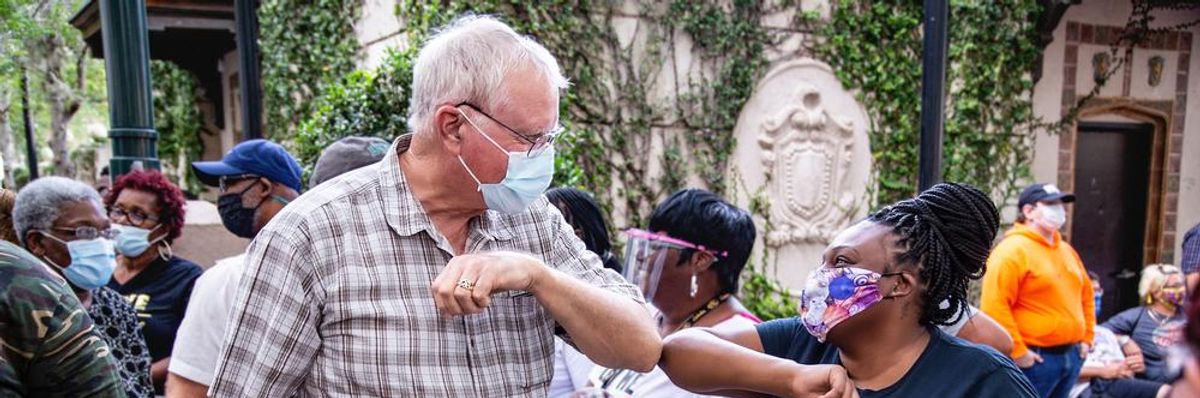
Black Lives Matter demonstrators in DeLand, Florida (Photo: Shutterstock)
I grew up biracial in a small, conservative town. Still, after living for years in Austin, moving back to one was a culture shock--it felt like going back in time.
For the last three years I've lived in Volusia County, Florida--home to Daytona Beach, many small towns and suburbs, and a population that gave about 55 percent of its vote to Donald Trump in 2016.
Racial divides are still evident in Daytona and the surrounding areas. Daytona itself is divided by U.S. Route 92, with poorer people of color primarily residing south of the road. The further north you go, the richer--and whiter--it becomes.
I've had my fair share of interactions with racists here. I often feel out of place. Even in my own neighborhood, I don't feel safe walking around without my dog or another person.
Yet even here, people are organizing demonstrations to protest racism and police violence, and to affirm that black lives matter.
At first, I was hesitant to attend. In addition to COVID-19, which is now surging in Florida, right-wing counter-protesters injured at least one person during the first weekend of demonstrations here. Still, it felt important to show up, to speak up against both local racists and systematic oppression.
The first demonstration I attended was a Black Lives Matter march through New Smyrna Beach (population: 27,000). I recognized the neighborhood we were marching through: lower income, government housing, and predominantly people of color. People there were well aware of the disfranchisement of inequality.
Along the way, we had a police escort. It was surreal following a police cruiser to our destination, considering my drive to attend came from anger about the police brutality black people face. This was a recurring theme in the other protests I attended in nearby DeLand, Ormond, and Daytona--they have all been at the convenience of police "support."
These demonstrations have been encouraging. So have supportive comments on community social media platforms. Mike Chitwood, the local sheriff, is now meeting with community members to answer questions and listen to suggestions.
Towns like mine aren't alone. New research suggests the demonstrations taking place now are the broadest in U.S. history, showing up not only in diverse, progressive cities, but also in conservative, majority-white towns.
Still, I worry that people will stop paying attention, just as many of us appear to have done with COVID-19. And I worry that while police make gestures toward reform when they're in hot water, implementing those changes could be much harder.
Really though, I am tired of asking and demanding. The black community has been asking and demanding my whole life. This is not just a black issue. Moving on from our racist past and present is a fight we all need to be a part of.
I want accountability. I want the system itself to change. I want everyone to recognize, outside of their own comfortable sphere of privilege, that this is about the betterment of all of society, starting with those who have suffered for 400 years.
I believe that marching, shouting, and sharing ideas will lead to a better tomorrow for my county--and for the country. We are starting to recognize it's not enough anymore to simply not be racist. It's time for an anti-racist movement that everyone needs to be a part of.
We aren't like New York down here, but we're ready for our voices to be heard too. I do hope this movement will result in major reform for equity, equality, and much deserved peace to the black community.
Dear Common Dreams reader, It’s been nearly 30 years since I co-founded Common Dreams with my late wife, Lina Newhouser. We had the radical notion that journalism should serve the public good, not corporate profits. It was clear to us from the outset what it would take to build such a project. No paid advertisements. No corporate sponsors. No millionaire publisher telling us what to think or do. Many people said we wouldn't last a year, but we proved those doubters wrong. Together with a tremendous team of journalists and dedicated staff, we built an independent media outlet free from the constraints of profits and corporate control. Our mission has always been simple: To inform. To inspire. To ignite change for the common good. Building Common Dreams was not easy. Our survival was never guaranteed. When you take on the most powerful forces—Wall Street greed, fossil fuel industry destruction, Big Tech lobbyists, and uber-rich oligarchs who have spent billions upon billions rigging the economy and democracy in their favor—the only bulwark you have is supporters who believe in your work. But here’s the urgent message from me today. It's never been this bad out there. And it's never been this hard to keep us going. At the very moment Common Dreams is most needed, the threats we face are intensifying. We need your support now more than ever. We don't accept corporate advertising and never will. We don't have a paywall because we don't think people should be blocked from critical news based on their ability to pay. Everything we do is funded by the donations of readers like you. When everyone does the little they can afford, we are strong. But if that support retreats or dries up, so do we. Will you donate now to make sure Common Dreams not only survives but thrives? —Craig Brown, Co-founder |
I grew up biracial in a small, conservative town. Still, after living for years in Austin, moving back to one was a culture shock--it felt like going back in time.
For the last three years I've lived in Volusia County, Florida--home to Daytona Beach, many small towns and suburbs, and a population that gave about 55 percent of its vote to Donald Trump in 2016.
Racial divides are still evident in Daytona and the surrounding areas. Daytona itself is divided by U.S. Route 92, with poorer people of color primarily residing south of the road. The further north you go, the richer--and whiter--it becomes.
I've had my fair share of interactions with racists here. I often feel out of place. Even in my own neighborhood, I don't feel safe walking around without my dog or another person.
Yet even here, people are organizing demonstrations to protest racism and police violence, and to affirm that black lives matter.
At first, I was hesitant to attend. In addition to COVID-19, which is now surging in Florida, right-wing counter-protesters injured at least one person during the first weekend of demonstrations here. Still, it felt important to show up, to speak up against both local racists and systematic oppression.
The first demonstration I attended was a Black Lives Matter march through New Smyrna Beach (population: 27,000). I recognized the neighborhood we were marching through: lower income, government housing, and predominantly people of color. People there were well aware of the disfranchisement of inequality.
Along the way, we had a police escort. It was surreal following a police cruiser to our destination, considering my drive to attend came from anger about the police brutality black people face. This was a recurring theme in the other protests I attended in nearby DeLand, Ormond, and Daytona--they have all been at the convenience of police "support."
These demonstrations have been encouraging. So have supportive comments on community social media platforms. Mike Chitwood, the local sheriff, is now meeting with community members to answer questions and listen to suggestions.
Towns like mine aren't alone. New research suggests the demonstrations taking place now are the broadest in U.S. history, showing up not only in diverse, progressive cities, but also in conservative, majority-white towns.
Still, I worry that people will stop paying attention, just as many of us appear to have done with COVID-19. And I worry that while police make gestures toward reform when they're in hot water, implementing those changes could be much harder.
Really though, I am tired of asking and demanding. The black community has been asking and demanding my whole life. This is not just a black issue. Moving on from our racist past and present is a fight we all need to be a part of.
I want accountability. I want the system itself to change. I want everyone to recognize, outside of their own comfortable sphere of privilege, that this is about the betterment of all of society, starting with those who have suffered for 400 years.
I believe that marching, shouting, and sharing ideas will lead to a better tomorrow for my county--and for the country. We are starting to recognize it's not enough anymore to simply not be racist. It's time for an anti-racist movement that everyone needs to be a part of.
We aren't like New York down here, but we're ready for our voices to be heard too. I do hope this movement will result in major reform for equity, equality, and much deserved peace to the black community.
I grew up biracial in a small, conservative town. Still, after living for years in Austin, moving back to one was a culture shock--it felt like going back in time.
For the last three years I've lived in Volusia County, Florida--home to Daytona Beach, many small towns and suburbs, and a population that gave about 55 percent of its vote to Donald Trump in 2016.
Racial divides are still evident in Daytona and the surrounding areas. Daytona itself is divided by U.S. Route 92, with poorer people of color primarily residing south of the road. The further north you go, the richer--and whiter--it becomes.
I've had my fair share of interactions with racists here. I often feel out of place. Even in my own neighborhood, I don't feel safe walking around without my dog or another person.
Yet even here, people are organizing demonstrations to protest racism and police violence, and to affirm that black lives matter.
At first, I was hesitant to attend. In addition to COVID-19, which is now surging in Florida, right-wing counter-protesters injured at least one person during the first weekend of demonstrations here. Still, it felt important to show up, to speak up against both local racists and systematic oppression.
The first demonstration I attended was a Black Lives Matter march through New Smyrna Beach (population: 27,000). I recognized the neighborhood we were marching through: lower income, government housing, and predominantly people of color. People there were well aware of the disfranchisement of inequality.
Along the way, we had a police escort. It was surreal following a police cruiser to our destination, considering my drive to attend came from anger about the police brutality black people face. This was a recurring theme in the other protests I attended in nearby DeLand, Ormond, and Daytona--they have all been at the convenience of police "support."
These demonstrations have been encouraging. So have supportive comments on community social media platforms. Mike Chitwood, the local sheriff, is now meeting with community members to answer questions and listen to suggestions.
Towns like mine aren't alone. New research suggests the demonstrations taking place now are the broadest in U.S. history, showing up not only in diverse, progressive cities, but also in conservative, majority-white towns.
Still, I worry that people will stop paying attention, just as many of us appear to have done with COVID-19. And I worry that while police make gestures toward reform when they're in hot water, implementing those changes could be much harder.
Really though, I am tired of asking and demanding. The black community has been asking and demanding my whole life. This is not just a black issue. Moving on from our racist past and present is a fight we all need to be a part of.
I want accountability. I want the system itself to change. I want everyone to recognize, outside of their own comfortable sphere of privilege, that this is about the betterment of all of society, starting with those who have suffered for 400 years.
I believe that marching, shouting, and sharing ideas will lead to a better tomorrow for my county--and for the country. We are starting to recognize it's not enough anymore to simply not be racist. It's time for an anti-racist movement that everyone needs to be a part of.
We aren't like New York down here, but we're ready for our voices to be heard too. I do hope this movement will result in major reform for equity, equality, and much deserved peace to the black community.